Developing New Medicines in the Age of AI and Personalized Medicine
Dennis Özcelik
39th Chaos Communication Congress (39C3): Power Cycles · Day 1 · Saal Zero
Overview
Dennis Özcelik's talk at 39C3, "Developing New Medicines in the Age of AI and Personalized Medicine," provides a comprehensive and critical examination of the current state and future trajectory of pharmaceutical development. The presentation meticulously dissects the traditional drug discovery pipeline, highlighting its inherent inefficiencies, exorbitant costs, and high failure rates. Against this backdrop, Özcelik explores the transformative potential of Artificial Intelligence (AI) and the emerging paradigm of personalized medicine, positioning them not merely as disruptive forces but as essential tools for the industry's survival and advancement.
Key moments
- 0:00 Introduction to AI and personalized medicine in drug development
- 1:15 Overview of the traditional drug discovery pipeline
- 4:00 Highlighting the lengthy and costly drug development process
- 4:50 Explaining the 'translational gap' or 'valley of death'
- 5:50 Discussing the replication crisis impacting academic research
Developing New Medicines in the Age of AI and Personalized Medicine
Speakers: Dennis Özcelik
Conference: 39C3
YouTube: https://www.youtube.com/watch?v=FFlMa50tfx8
Overview
Dennis Özcelik's talk at 39C3, "Developing New Medicines in the Age of AI and Personalized Medicine," provides a comprehensive and critical examination of the current state and future trajectory of pharmaceutical development. The presentation meticulously dissects the traditional drug discovery pipeline, highlighting its inherent inefficiencies, exorbitant costs, and high failure rates. Against this backdrop, Özcelik explores the transformative potential of Artificial Intelligence (AI) and the emerging paradigm of personalized medicine, positioning them not merely as disruptive forces but as essential tools for the industry's survival and advancement.
The talk is particularly relevant for anyone interested in the intersection of technology, healthcare, and economics. Özcelik addresses a diverse audience, providing a high-level overview that demystifies complex biological and pharmaceutical concepts while delving into the practical applications and strategic implications of AI. He articulates how AI can streamline processes, accelerate timelines, and optimize various stages of drug development, from target identification to compound optimization.
Crucially, Özcelic also shines a light on the significant challenges facing the pharmaceutical sector, including the "replication crisis" in academic research, experimental limitations, and the impending "patent cliff" that threatens the revenue models of major pharmaceutical companies. The discussion extends beyond technical applications to encompass the ethical and societal questions posed by personalized medicine, such as accessibility and equitable distribution of life-saving, yet immensely expensive, genetic therapies. This talk serves as a vital primer on the intricate dance between scientific innovation, economic realities, and moral considerations in the quest for new medicines.
Background
▶ Watch: Introduction to AI and personalized medicine in drug development (0:00)
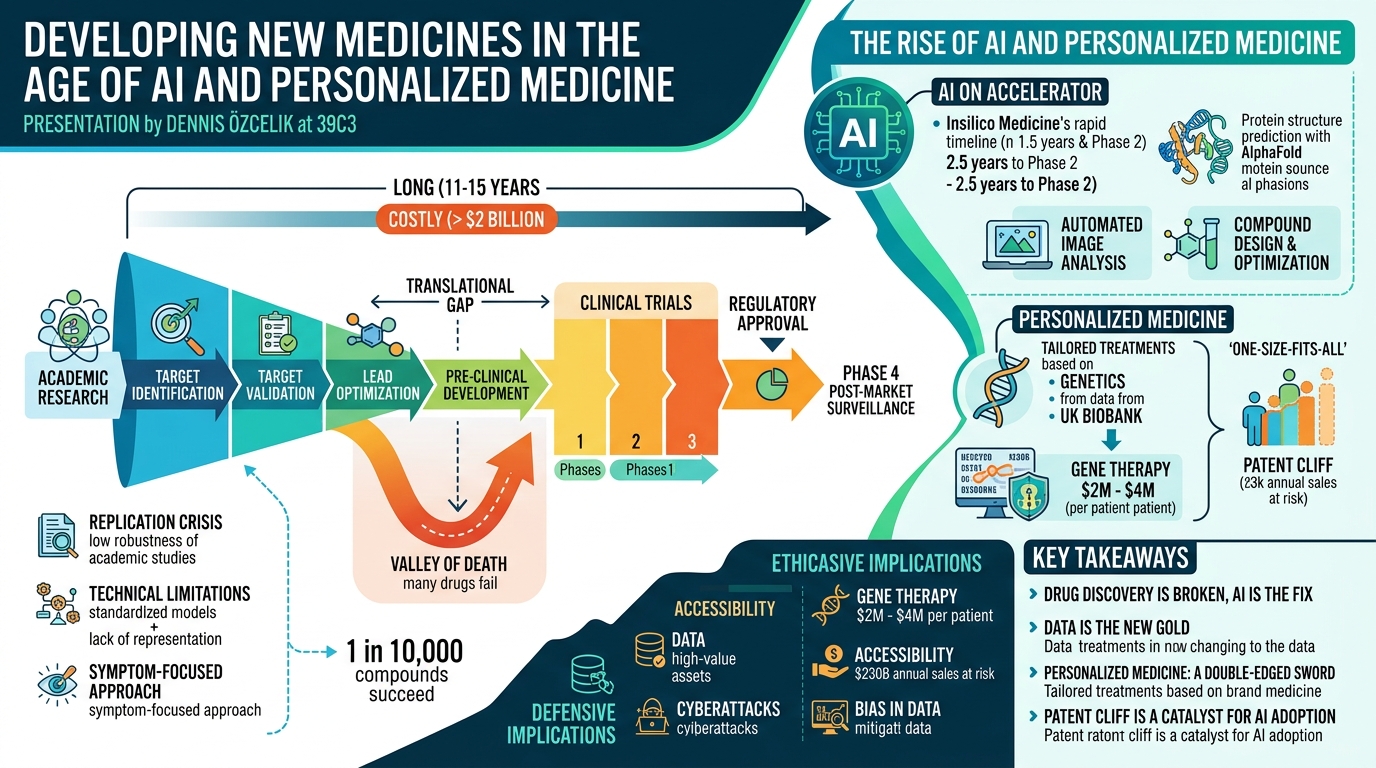
The journey of bringing a new drug to market is notoriously arduous, costly, and fraught with uncertainty. Özcelik meticulously outlines the conventional drug discovery pipeline, a multi-stage process that typically begins with foundational academic research. This initial phase identifies potential targets—specific proteins or genes associated with a disease—which then undergo target validation through in vitro experiments in test tubes and petri dishes. Promising compounds proceed to lead optimization, where chemists refine their potency and selectivity.
Following successful in vitro and lead optimization phases, compounds move into pre-clinical development, involving testing in laboratory animals to assess efficacy and identify severe side effects. The next critical stage is clinical development in humans, typically structured into three phases:
- Phase 1: Small groups of healthy volunteers assess safety and dosage.
- Phase 2: Larger groups of patients evaluate efficacy and further safety.
- Phase 3: Large-scale trials confirm efficacy, monitor side effects, and compare with existing treatments.
If successful, the drug is submitted to regulatory authorities like the FDA in the US or the EMA in Europe for approval. Even after market launch, Phase 4 involves continuous post-market surveillance.
This entire pipeline averages 11 to 15 years (13 years on average) and costs more than $2 billion per successful drug. The success rate is staggeringly low, with approximately 10,000 initial compounds yielding only one market-approved drug. A major contributing factor to this inefficiency is the "translational gap" or "valley of death," where about 90% of drugs fail between academic knowledge and human application. This gap is attributed to several critical issues:
- Replication Crisis in Academia: Özcelik highlights concerns about the robustness of academic research. Studies by the Center for Open Science on cancer research, attempting to reproduce 200 experiments from 50 papers, found that a third couldn't even be started due to insufficient information. Of those started, half couldn't be completed, and only about half of the completed ones successfully reproduced positive effects, often with weaker results than initially reported. Pharmaceutical companies, like Bayer (2011) and another unnamed company, reported similar findings, reproducing only 25% and 11% of academic literature, respectively. Disturbingly, irreproducible studies are often heavily cited, creating a "large trail of other papers referencing experiments you never can reproduce," forming a weak foundation for further scientific endeavors.
- Technical and Experimental Limitations:
- Standardized Models: Drug discovery heavily relies on standardized cancer cell lines extracted decades ago and inbred laboratory animals. These models often poorly represent the complexity of human biology and disease, leading to discrepancies in drug delivery and efficacy.
- Historical Biases in Clinical Trials: Historically, clinical trials predominantly included male Caucasians, leading to a lack of representation for women and minorities. While improving, this historical data limitation impacts the generalizability of drug effects across diverse populations.
- Symptom-Focused Approach: Clinical trials often focus on observable symptoms rather than underlying genetic or molecular mechanisms. This "flying blind" approach can lead to trial failures if a drug only works for a specific sub-type of a disease (e.g., liver disease A) but is tested on a broader patient population (liver diseases A, B, and C) with similar symptoms.
These systemic challenges underscore the urgent need for innovation and efficiency in drug discovery, setting the stage for AI's potential role.
Key Findings
▶ Watch: Overview of the traditional drug discovery pipeline (1:15)
Dennis Özcelik's presentation underscores several critical findings regarding the evolving landscape of drug discovery:
- AI as an Accelerator, Not Just a Disruptor: While many perceive AI as a disruptive force, Özcelik argues that in drug discovery, it is primarily an accelerator and an efficiency enhancer. Current AI applications are integrated into workflows to prioritize experiments, optimize timelines, and increase overall productivity. He emphasizes that AI doesn't currently replace human scientists but rather augments their capabilities, answering a subset of questions and freeing up time for other research.
- Early Successes Demonstrate AI's Potential: A compelling case study from Insilico Medicine illustrates AI's transformative power. This company, using AI from target identification to molecule design, developed a drug for a lung disease and advanced it to clinical Phase 2 trials within 2.5 years—a timeline two to three times faster than conventional methods. This example, though potentially an outlier, is a "prime example" that the industry is closely watching as a pilot for AI-driven acceleration.
- Data Quality is Paramount for AI: The foundation of any successful AI model is high-quality data. Özcelik stresses that biomedical data must be accurate, comprehensive, curated, reliable, standardized, and traceable. Obtaining such data, especially from living organisms and across diverse clinical centers, is incredibly expensive, time-consuming, and resource-intensive, often requiring large national initiatives like the UK Biobank or the internal data archives of large pharmaceutical companies.
- The Rise of Personalized/Precision Medicine: This paradigm shift aims to tailor treatments based on an individual's unique genetic makeup and other biological characteristics. The promise is optimal therapeutic effect with minimal side effects, moving away from a "one-size-fits-all" approach. However, this leads to smaller target populations and highly complex treatments, often requiring specialized infrastructure and care.
- Ethical and Economic Challenges of Gene Therapy: Özcelik highlights contemporary gene therapies for rare diseases, which offer life-saving treatments but come with staggering price tags of $2 million to $4 million per patient. With extremely small patient populations (e.g., 3-7 patients per year for treatments like Zolgensma or LipMelddy), these therapies challenge traditional revenue models and raise profound ethical questions about who decides which diseases are treated and who gains access—is it based on societal consensus or financial capability?
- The Impending "Patent Cliff" and its Impact: A major existential threat to the pharmaceutical industry is the "patent cliff." Over 20 blockbuster drugs are set to lose their exclusivity within the next four years, jeopardizing an estimated $230 billion in annual sales (roughly 20% of the global prescription market). This loss of revenue, due to the emergence of generic alternatives, necessitates a fundamental shift in how pharmaceutical companies operate and fund their extensive R&D pipelines.
- AI as a Strategic Imperative: Given the combined pressures of the patent cliff, the shift to personalized medicine (with smaller markets), and the increasing prevalence of generic drugs, AI is not merely a competitive advantage but a necessary development for large pharmaceutical companies. They are leveraging their vast internal, high-quality proprietary datasets to identify cost-reduction strategies, accelerate timelines, and discover new, high-value medicines that can command premium prices. Özcelik concludes that AI is not disrupting the industry but rather enabling it to adapt and survive these profound systemic changes.
Technical Deep Dive
▶ Watch: Highlighting the lengthy and costly drug development process (4:00)
The technical core of AI's application in drug discovery, as presented by Özcelik, revolves around enhancing efficiency and accelerating specific, often laborious, stages of the pipeline. While the talk doesn't delve into the intricate algorithms or neural network architectures, it highlights key areas where AI is already making a tangible impact:
- Protein Structure Prediction with AlphaFold: One of the most significant breakthroughs mentioned is the use of tools like AlphaFold for predicting protein structures. If a researcher aims to develop a drug against a specific protein but its 3D structure is unknown, AlphaFold can provide a highly accurate estimate. This capability drastically reduces the experimental burden, allowing researchers to prioritize a handful of likely experiments (e.g., 20 instead of 100s) and potentially achieve success much faster. Knowing the target protein's structure is fundamental for rational drug design, enabling the creation of molecules that precisely interact with the target.
- Automated Image Analysis: In pre-clinical and clinical research, the analysis of biological images (e.g., tissue samples from cancer patients, animal tissues) is a critical but often tedious task. Historically, this involved human researchers manually examining slides under a microscope, counting patterns, and checking boxes. AI-driven image analysis systems can automate this process, performing tasks like cell counting, tumor morphology assessment, and quality control. This automation not only saves immense labor but also introduces greater consistency and objectivity to the analysis, accelerating data acquisition and interpretation.
- Compound Design and Optimization: AI tools are increasingly being employed to design and optimize small molecules. These tools can predict molecular properties, synthesize novel chemical structures, and suggest modifications to existing compounds to enhance their potency, selectivity, and pharmacokinetic properties (how a drug moves through the body). The Chemical Abstract Services (part of the American Chemical Society) has noted the emergence of AI-generated compounds entering human clinical trials. While still in early stages, this application promises to significantly speed up the lead optimization phase, identifying more effective drug candidates with fewer iterations.
The success of these AI applications hinges entirely on the quality and accessibility of data. Özcelik stresses that good data is key, emphasizing attributes like accuracy, comprehensiveness, curation, reliability, and traceability. Biomedical data, however, is exceptionally challenging to obtain. It comes from living organisms, often across different countries and clinical centers, requiring detailed standardized protocols and Standard Operating Procedures (SOPs). Data curation, technical adherence, and complete traceability are expensive and time-consuming, often beyond the reach of small academic labs.
This creates a competitive advantage for large pharmaceutical companies, who possess decades of proprietary internal datasets from past R&D projects. These datasets, gathered under rigorous industry standards, are high-value assets. By applying AI to this wealth of curated data, these companies aim to gain insights into novel targets, optimize existing compounds, and streamline their entire drug discovery pathway. The speaker notes that while academic labs often have clinical data, it's not always shared, especially from failed trials, which still contain valuable lessons for AI models.
The example of Insilico Medicine further underscores the power of a data-driven, AI-first approach. Their ability to identify a target for lung disease and design a molecule, progressing to clinical Phase 2 within 2.5 years, showcases a fully integrated AI pipeline. This involves using AI for target identification, generative chemistry for novel molecule design, and potentially predictive modeling for pre-clinical and early clinical outcomes, dramatically compressing the traditional timelines.
Demo / Proof of Concept
▶ Watch: Explaining the 'translational gap' or 'valley of death' (4:50)
While Dennis Özcelik's talk did not feature a live, interactive demo of AI in action, he provided a compelling real-world proof of concept through the success story of Insilico Medicine. This company serves as a prime example of an organization that has leveraged AI across the entire spectrum of early drug discovery, from target identification to molecule design.
Özcelik highlighted that Insilico Medicine was able to identify a novel target for a lung disease and subsequently design a corresponding molecule using AI from its inception. Crucially, they progressed this candidate all the way to the first part of clinical Phase 2 trials within an astonishingly short timeframe of approximately 2.5 years. This figure stands in stark contrast to the industry average of 11 to 15 years for the entire drug development pipeline, representing a two to three-fold acceleration in the initial phases.
The achievement of Insilico Medicine is particularly significant because it demonstrates the practical feasibility of an AI-first approach in generating tangible results that can enter human trials. This case is being closely watched across the pharmaceutical industry as a benchmark for how AI can drastically reduce the time and, by extension, the cost associated with bringing new therapeutic candidates to fruition. It implicitly serves as a powerful demonstration of AI's capability to transform theoretical models into actual clinical progress, albeit with the caveat that it might be a "lucky" outlier among many AI-driven efforts.
Defensive Implications
▶ Watch: Discussing the replication crisis impacting academic research (5:50)
Dennis Özcelik's talk, while not primarily focused on cybersecurity, implicitly highlights critical defensive implications centered around the immense value and vulnerability of biomedical data in the age of AI and personalized medicine.
- High-Value Data as a Target: The core premise of AI in drug discovery is its reliance on accurate, comprehensive, curated, reliable, standardized, and traceable data. This data, ranging from academic literature and patent applications to internal R&D datasets, clinical trial results (both successful and failed), and patient genetic information, is extraordinarily valuable. Özcelik explicitly states that "good data is key" and that large pharmaceutical companies view their internal, proprietary datasets as "high value assets." This makes pharmaceutical and biotech companies prime targets for cyber incidents.
- Increased Risk of Cyberattacks: The speaker notes that "cyber incidents happen all the time" in the US, Germany, and Europe, impacting pharmaceutical companies. During the COVID-19 pandemic, front-runners in vaccine development were specifically targeted, underscoring the strategic importance of this data. The financial implications of such breaches can be "really expensive" for large pharma. Therefore, robust cybersecurity defenses are paramount to protect this intellectual property and sensitive patient information. This includes safeguarding clinical data from external cybercriminals and ensuring internal user adherence to security protocols, as "cyber security is not a new trend, it's becoming more important in the drug discovery and farmer world as well."
- Ethical and Societal Defenses for Personalized Medicine: Beyond technical cybersecurity, the shift to personalized medicine introduces profound ethical and societal "defensive" considerations. With gene therapies costing millions per patient ($2 million to $4 million), the question of accessibility becomes critical. Özcelik asks: "Who is covering the costs?" and raises the "ethical question: What disease should we treat? Who decides that and at the end who gets it? Is it a decision or an agreement that society makes or is it what is it that what money allows you to do?" These questions necessitate societal frameworks, policies, and regulations that act as a "defense" against inequitable access and ensure that the benefits of highly advanced, personalized treatments are distributed fairly, rather than being solely dictated by financial means. This is a defense of public health and equity, protecting vulnerable populations from being excluded from life-saving treatments.
- Data Bias Mitigation: A significant "defensive" challenge for AI is addressing inherent biases in historical medical datasets, particularly the overrepresentation of "male Caucasians." As AI models can "even enhance these biases," there's a need for proactive strategies. Özcelik suggests that more modern clinical trials with diverse recruitment schemes and advanced data collection technologies might gradually dilute historical biases over time. However, this is a long-term solution. In the interim, researchers and developers must be aware of and actively work to mitigate these biases in AI training data and model interpretation to prevent perpetuating health disparities. This calls for a "defense" against algorithmic unfairness and discriminatory outcomes.
In essence, the defensive implications underscore that while AI offers immense promise, its successful and ethical deployment in drug discovery requires a multi-layered defense strategy: robust technical cybersecurity for invaluable data, ethical frameworks for equitable access to personalized treatments, and conscious efforts to combat data biases.
Key Takeaways
- Drug Discovery is Broken, AI is the Fix: The traditional drug discovery pipeline is extraordinarily long (11-15 years), expensive (>$2 billion), and inefficient (1 in 10,000 success rate), plagued by a "translational gap" and a "replication crisis" in academic research. AI is emerging as a necessary tool to accelerate processes, prioritize experiments, and increase efficiency, rather than merely disrupting the industry.
- Data is the New Gold (and Highly Vulnerable): High-quality, accurate, comprehensive, curated, and traceable biomedical data is the bedrock for successful AI in drug discovery. This data is expensive to obtain and a prime target for cyberattacks, necessitating robust cybersecurity measures to protect these "high value assets."
- Personalized Medicine: A Double-Edged Sword: While offering tailored, more effective treatments, personalized medicine (especially gene therapies) creates smaller patient populations and comes with exorbitant costs ($2-4 million per patient). This challenges traditional "blockbuster drug" revenue models and raises critical ethical questions about equitable access to life-saving therapies.
- The Impending "Patent Cliff" is a Catalyst for AI Adoption: Over 20 blockbuster drugs, representing $230 billion in annual sales, are losing patent exclusivity within four years. This "patent cliff" forces pharmaceutical companies to embrace AI to reduce costs, accelerate R&D, and identify new, high-value medicines to compensate for rapidly declining revenues from their established products.
- AI Applications are Already Making an Impact: Tools like AlphaFold for protein structure prediction, AI-driven image analysis for automating tedious tasks, and AI for optimizing small molecules are already integrated into workflows, demonstrating tangible benefits in prioritizing experiments and accelerating early-stage drug development, as exemplified by Insilico Medicine's rapid progress.
- Bias in Data Demands Constant Vigilance: Historical clinical trial data suffers from significant biases (e.g., overrepresentation of male Caucasians). AI models trained on such data can perpetuate or even amplify these biases, requiring ongoing efforts to collect more diverse data and develop methods to mitigate algorithmic unfairness.
About the Speaker(s)
Dennis Özcelik is the speaker for "Developing New Medicines in the Age of AI and Personalized Medicine" at 39C3. Based on the depth and breadth of his presentation, he possesses a comprehensive understanding of the pharmaceutical industry, the intricacies of drug discovery and development, and the transformative potential of Artificial Intelligence and personalized medicine. His expertise spans the scientific, economic, and ethical dimensions of bringing new therapies to market, reflecting a strong background in life sciences and a keen awareness of emerging technological trends. While his specific title and affiliation were not provided in the transcript, his detailed analysis and articulate explanations clearly position him as a knowledgeable authority in this complex and rapidly evolving field.
All talks from 39th Chaos Communication Congress (39C3): Power Cycles