Escaping Containment: A Security Analysis of FreeBSD Jails
ilja, Michael Smith
39th Chaos Communication Congress (39C3): Power Cycles · Day 1 · Saal Fuse
Overview
This talk, "Escaping Containment: A Security Analysis of FreeBSD Jails," delves deep into the security boundaries of FreeBSD jails, a long-standing and widely used containerization technology. Presented by Ilya, a seasoned security researcher at IOActive, and Michael Smith, an independent programmer and system administrator, the session explores the attack surface of jails, investigates potential jailbreaks, and culminates in a comprehensive demonstration of how a compromised jail can lead to full host compromise. The speakers also offer critical observations, conclusions, and a call to action for future hardening efforts.
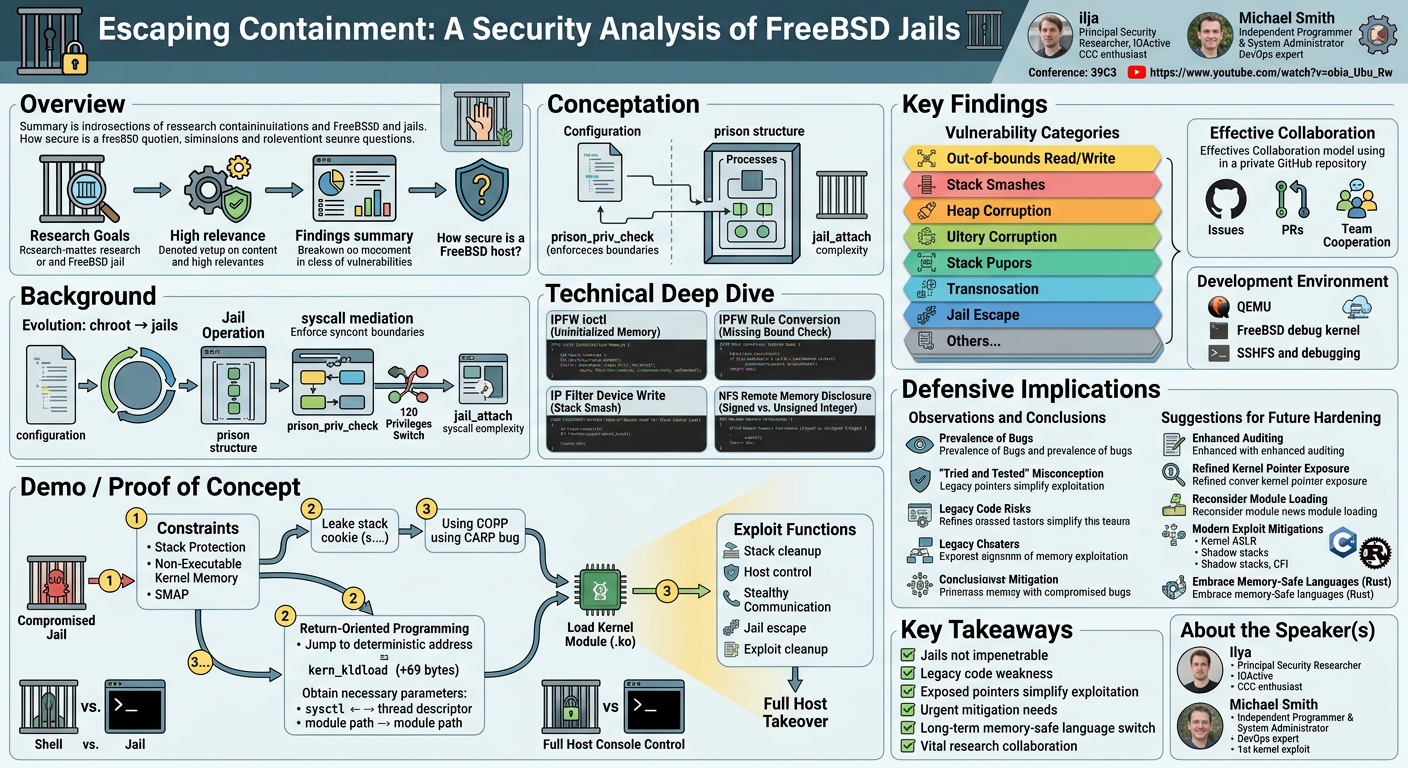
Key moments
- 0:00 Introduction: Escaping Containment, FreeBSD Jails
- 2:00 Talk agenda and target audience for analysis
- 2:55 Acknowledging collaboration with FreeBSD Security Team
- 4:00 Motivation: A 25-year quest to break jails
- 5:50 Core assumption: Analyzing already compromised jails
- 6:20 History and evolution of FreeBSD Jails
- 7:30 High-level overview: How FreeBSD Jails function
Escaping Containment: A Security Analysis of FreeBSD Jails
Speakers: ilja, Principal Security Researcher, IOActive; Michael Smith, Independent Programmer & System Administrator
Conference: 39C3
YouTube: https://www.youtube.com/watch?v=obia_Ubu_Rw
Overview
This talk, "Escaping Containment: A Security Analysis of FreeBSD Jails," delves deep into the security boundaries of FreeBSD jails, a long-standing and widely used containerization technology. Presented by Ilya, a seasoned security researcher at IOActive, and Michael Smith, an independent programmer and system administrator, the session explores the attack surface of jails, investigates potential jailbreaks, and culminates in a comprehensive demonstration of how a compromised jail can lead to full host compromise. The speakers also offer critical observations, conclusions, and a call to action for future hardening efforts.
The motivation for this research stems from Ilya's 25-year personal quest to understand the robustness of FreeBSD jails, a technology he first encountered as a teenager. Recognizing the critical role jails play in isolating services on FreeBSD systems, the speakers aimed to answer a fundamental question: how secure is a FreeBSD host if one of its jails is rooted? Their findings are highly relevant to anyone involved in defensive security, operating system development, or the deployment of containerized environments, highlighting the persistent challenges of securing complex, mature software.
The presentation is a blend of detailed code auditing, exploit development, and strategic recommendations. It not only exposes numerous vulnerabilities but also provides a unique look into a highly effective collaboration model between security researchers and an open-source project's security team. Ultimately, the talk serves as a stark reminder that even "tried and tested" systems require continuous security scrutiny and adaptation to evolving threat models and modern exploit mitigation techniques.
Background
▶ Watch: Introduction: Escaping Containment, FreeBSD Jails (0:00)
FreeBSD jails were first introduced in FreeBSD 4 during the early 2000s, spearheaded by Poul-Henning Kamp. The core idea was to provide a more robust and secure alternative to the traditional chroot mechanism, allowing multiple isolated Unix environments to run concurrently on a single physical machine. At the time, this concept of lightweight virtualization was pioneering, predating the widespread adoption of modern container technologies. Over the past two decades, jails have significantly matured, with numerous features added and initial limitations addressed, such as restricted networking and inflexible configurations.
At a high level, the operation of a jail begins with the creation of a jail configuration that defines parameters like hostname, root file system, mount points, resource limits, and exposed devices. This configuration is then translated into syscalls, primarily jail_set, which establishes the jail. Internally, the kernel creates a prison structure to encapsulate processes running within the jail. Even if a process inside the jail operates with root privileges, the prison structure ensures it remains contained, enforcing restrictions on file system access (chroot), device access, and mount points. The jail_attach syscall, used to attach processes to an existing jail, requires particular care, as file descriptors to devices or files can be inadvertently passed into a jail, potentially bypassing its configured restrictions.
The fundamental security boundary of jails relies on syscall mediation. Once a jail is created, every privileged system call made by a jailed process is intercepted and evaluated. The kernel function prison_priv_check, which is called by the main privilege checking API priv_check_cred, determines whether a jailed root is permitted to perform a specific operation. This policy enforcement mechanism is crucial for preventing a root user within a jail from gaining root privileges on the host system. The prison_priv_check function is designed to only grant privileges that are explicitly "jail-aware" or those for which specific subsystems and drivers have been adapted. This function contains a large switch statement enumerating approximately 120 potential privileges that a jail might be allowed, covering areas such as networking (IPsec, CARP, Wi-Fi, firewalls), process management, and even kmem_read (though rarely exposed due to its inherent risks). Ilya's audit methodology centered on examining these privileges, particularly focusing on handlers for "root-only" operations. His hypothesis was that code written 20-30 years ago, assuming only a trusted root user would invoke it, would likely contain more trivial security bugs due to a less mature understanding of secure C coding practices prevalent in the mid to late 1990s.
Key Findings
▶ Watch: Acknowledging collaboration with FreeBSD Security Team (2:55)
The security analysis of FreeBSD jails yielded a significant number of vulnerabilities, with the team identifying approximately 40 distinct issues. While not all have been publicly disclosed or fixed, a substantial portion has been addressed by the FreeBSD security team. The discovered vulnerabilities spanned a wide array of bug classes commonly found in C-language kernel development, including out-of-bounds reads and writes, stack smashes, heap corruption, integer overflows, race conditions, information leaks, and unbound allocations. These issues were predominantly located in critical subsystems such as IPsec, CARP (Common Address Redundancy Protocol), Wi-Fi, various interface ioctls, NFS (Network File System), and the different firewall implementations (IPFW, IP Filter).
A notable aspect of this research was the highly effective and collaborative bug reporting process established with the FreeBSD security team. Unlike traditional, often asynchronous, email-based disclosures, Ilya and Michael leveraged a private GitHub repository to track their work, including bug reports, Proof of Concepts (POCs), notes, documentation, and even virtual machine setups. Upon initial contact, the FreeBSD team was invited to join this repository, leading to an unprecedented level of real-time collaboration. This allowed for direct commenting on issues, immediate feedback on potential fixes, and a streamlined process for addressing vulnerabilities. Both speakers praised this interaction as "amazing" and "fantastic," highlighting its success as a model for external security research and open-source project engagement.
Beyond jail-specific vulnerabilities, the audit also uncovered several bugs in other, non-jail-related areas of the FreeBSD kernel, such as the ELF (Executable and Linkable Format) loader, various exec syscalls, and the netmap network driver. While interesting, these were not the primary focus of the talk. The sheer volume and diversity of the identified bugs underscore the continuous challenge of maintaining security in complex, long-lived operating system kernels, particularly in components that may not have been initially designed with modern multi-tenant or containerization threat models in mind.
Technical Deep Dive
▶ Watch: Motivation: A 25-year quest to break jails (4:00)
The audit uncovered several critical vulnerabilities that demonstrate the potential for jail escape and host compromise. A sampling of these issues provides insight into the types of flaws exploited:
- IPFW
ioctl(Uninitialized Memory): In the IPFW firewall, a specificioctlfor adding rules (add_rule) performed amallocfollowed by acopyinoperation from userland. Critically, the error return fromcopyinwas discarded, and the allocated memory frommallocwas not initialized. This could lead to the kernel operating on uninitialized kernel memory, potentially disclosing sensitive data through side channels or direct leaks.
- IPFW Rule Conversion (Missing Bound Check): Another IPFW vulnerability concerned a function designed to convert older FreeBSD 7 firewall rules to the FreeBSD 8 format. This conversion involved a
forloop processing embedded length fields (flen). A missing bound check during abcopyoperation could lead to memory corruption if the destination buffer for the new rule was smaller than the data being copied, allowing an attacker to write out-of-bounds. This bug was ultimately resolved by removing the deprecated FreeBSD 7 compatibility code entirely.
- CARP
SIOCGVRID(Out-of-Bounds Read for Stack Cookie Leak): A particularly "cute" bug was found in the CARP (Common Address Redundancy Protocol) subsystem. TheSIOCGVRIDioctlis intended to retrieve information about CARP interfaces. While thecarprstructure is designed to hold only one record, the feature allowed for a count of multiple records. Internally, thecarp_ioctl_getfunction would enumerate all records but only copy data into the first entry, effectively discarding subsequent records. However, it still returned an updated count reflecting the total number of records. When the kernel attempted to copy thecarprstructure back to userland, it would read out-of-bounds due to the mismatch between the single-record buffer and the reported multi-record count. This specific primitive proved to be highly reliable for leaking the stack cookie, a crucial piece of information for bypassing stack protection during exploitation.
- IP Filter Device Write (Classic Stack Smash): One of the older firewall implementations, IP Filter, exposed a device where writing userland data directly copied it into a 2,048-byte stack buffer without any bound checks. The accompanying code comment, "This must be sufficiently large to store any possible data type," was a stark indicator of the lack of modern security considerations in its design, making it a classic stack smash vulnerability.
- NFS Remote Memory Disclosure (Signed vs. Unsigned Integer): A fascinating and widely impactful bug was discovered in the NFS implementation. The NFS specification dictates that a server's response to a write operation should specify the number of bytes written as an
unsigned int. While the FreeBSD kernel correctly extracted this value as anunsigned int, it then stored it in asigned int. If an attacker provided a negative value (e.g., -5 bytes written), the subsequent calculation for writing before the buffer would lead to remote memory disclosure. By repeatedly sending negative write lengths, an attacker could leak kernel memory byte-by-byte over the network until a crash occurred. This vulnerability, discovered in September by the speakers, had actually been fixed in OpenBSD in 2019, but only as a "reliability fix" without realizing its full security implications as an information leak. Due to shared codebases, this bug affected not only FreeBSD but also Solaris, Illumos, and NetBSD, prompting the FreeBSD team to notify NetBSD.
To facilitate exploit development, Michael meticulously set up a robust development environment. This involved using QEMU for emulation, compiling a FreeBSD debug kernel with asserts disabled (to prevent premature panics), and leveraging SSHFS for efficient file transfer. The initial attempt at offline debugging (analyzing crash dumps) proved problematic as the debugger itself crashed. This led to a switch to online debugging via a serial link emulated over TCP between two virtual machines. A critical lesson learned during this process was the importance of cloning the debugger's disk image to the target virtual machine to ensure symbol consistency, avoiding weeks of wasted effort on mismatched symbols. The team also advised careful management of MAC addresses in multi-VM setups to prevent network collisions.
Initial proof-of-concept exploits included triggering Denial of Service (DoS) attacks through unbound malloc calls (e.g., in getsockopt and setsockopt), which would exhaust kernel memory and cause a panic. While effective for DoS, the goal was more severe: full host compromise.
Demo / Proof of Concept
▶ Watch: History and evolution of FreeBSD Jails (6:20)
The core of the presentation culminated in a demonstration of a comprehensive proof of concept exploit designed to achieve complete host takeover from a compromised jail. This exploit leveraged multiple bugs and sophisticated techniques to bypass modern kernel security mitigations.
The primary constraints faced by the exploit developers included:
- Stack Protection: The presence of a stack cookie (canary) on the kernel stack, which, if overwritten, would trigger a panic.
- Non-Executable Kernel Memory: The inability to inject and execute arbitrary shellcode directly into kernel memory.
- SMAP (Supervisor Mode Access Prevention): A hardware-enforced mitigation preventing the kernel from accessing userland memory, thus blocking direct jumps to userland shellcode.
To bypass these formidable defenses, the team devised a multi-pronged approach:
- Stack Protection Bypass: The CARP
SIOCGVRIDout-of-bounds read vulnerability (bug #50) was instrumental here. It reliably leaked the stack cookie, a global value set at boot. The exploit would read this cookie, then embed it into its userland buffer, allowing it to overwrite the stack without triggering the stack protection mechanism.
- Non-Executable Kernel Memory / SMAP Bypass: With direct shellcode injection and userland jumps blocked, the exploit employed Return-Oriented Programming (ROP) to repurpose existing kernel code. The target was the
kern_kldloadfunction, which is responsible for loading kernel modules. The address ofkern_kldloadwas found to be deterministic in the FreeBSD kernel (for a given version and architecture), making static analysis sufficient to locate it. To bypass inherent privilege checks withinkern_kldload, the exploit was engineered to jump precisely 69 bytes into the function, effectively skipping the securelevel and privilege verification logic.
- Providing
kern_kldloadParameters: Thekern_kldloadfunction requires three parameters: the current thread descriptor (td), the path to the kernel module to load, and a third, less relevant parameter.
- Thread Descriptor (
td): A crucialsysctl(documented in a Phrack 2002 article) was discovered that allows userland to retrieve the kernel address of the current thread descriptor. This address was then placed into the exploit's buffer, which the kernel would copy into its own memory, making it accessible tokern_kldload. - Module Path: Similarly, another
sysctlallowed userland to retrieve a reliable kernel pointer to theargvarguments of the currently running program. By passing the desired kernel module path as anargvparameter to the exploit, a kernel pointer to this string could be obtained and placed into the stack smash buffer. The third parameter was simply set to zero.
The kern_kldload function, once invoked via ROP, then loaded a custom kernel module (.ko). This module, written in C, gained full kernel privileges and served several purposes:
- Stack Cleanup: It performed necessary cleanup to stabilize the kernel stack after the initial smash.
- Host Control: With full privileges, it could execute arbitrary code to take total control of the host.
- Stealthy Communication: To avoid alerting the host's console, the exploit mapped a region of userland memory. The kernel module then established access to this memory, using it as an IPC (Inter-Process Communication) channel to report progress back to the userland exploit.
- Jail Escape: The module unjailed both the exploit process and its parent shell process by manipulating kernel structures. It also modified the
chrootpath for these processes, bypassing protective pointer magic to effectively remove them from the jail's file system containment. - Exploit Cleanup: To maintain system stability and avoid detection, the module unmapped the shared communication memory, unlocked the global kernel lock ("the giant") twice (a seemingly magic number found through experimentation), and finally invoked
thread_exitto gracefully "oops out" without causing a panic. An interesting post-exploit stability issue arose where an initial version caused a panic after 60 seconds due to a corrupt entry in a kernel table. This was resolved by modifying the exploit to update a non-existent entry instead of creating a new one, which the kernel would simply ignore.
Finally, the exploit accounted for varying kernel offsets across different FreeBSD versions and configurations. This was achieved by using a cyclic pattern to determine precise offsets in the overflow buffer. The team even leveraged ChatGPT to assist in calculating these offsets from register values, streamlining the process. A multi-platform struct was implemented to store these offsets, allowing the exploit to detect the running platform at runtime and select the correct values.
The pre-recorded demo visually showcased the exploit: a shell in the jail on the right, the host console on the left. The attacker built the kernel module and exploit, executed it from within the jailed environment, observed messages indicating progress, and then, for good measure, initiated a host reboot directly from the compromised jail.
Defensive Implications
▶ Watch: High-level overview: How FreeBSD Jails function (7:30)
The findings from this extensive security analysis carry significant implications for the defensive posture of FreeBSD systems and, by extension, other operating systems with similar architectures and development histories.
Observations and Conclusions:
- Prevalence of Bugs: The discovery of approximately 40 vulnerabilities, spanning a wide range of types, underscores that even mature, "tried and tested" codebases are not inherently secure.
- "Tried and Tested" Misconception: The speakers emphasized that "tried and tested" is often mistakenly equated with "more secure." While a network stack might be robust against accidental bugs, it doesn't imply resilience against deliberate, targeted exploitation.
- Legacy Code as an Attack Surface: A significant portion of the exploitable code, particularly root-only interfaces, predates the existence of jails (mid to late 1990s). This older code was not written with modern security threat models in mind, assuming only a trusted administrator would interact with it. Consequently, it often contains "trivial" bugs that are easily exploitable by today's standards.
- Jail Threat Model Disconnect: The original design and implementation of many kernel subsystems did not anticipate the specific threat model posed by a compromised, root-privileged jail attempting to escape.
- Ease of Exploitation: Despite Ilya being "rusty" and Michael developing his first kernel exploit, the process was deemed "way too easy" for a system in 2025 (as per the talk's context, nearing that year).
Suggestions for Future Hardening:
- Enhanced Auditing: The speakers recommend further comprehensive auditing, particularly for complex subsystems like the Linux compatibility layer, which they did not fully cover.
- Refined Kernel Pointer Exposure: A critical suggestion is to re-evaluate and redesign kernel interfaces that currently expose raw kernel pointers (e.g., thread descriptors,
argvpointers) via mechanisms likesysctl. While these interfaces might serve legitimate programmatic needs, they introduce significant security risks (race conditions, deterministic addresses) that were acceptable in the 1970s and 80s but are no longer suitable for modern operating systems. New interfaces should provide necessary information without leaking sensitive kernel addresses. - Reconsider Module Loading: Kernel module loading, while convenient for development and flexibility, significantly aids exploit developers by providing a powerful, reliable, and flexible alternative to complex shellcode. The speakers suggested considering models like OpenBSD's, which largely foregoes kernel modules in favor of a monolithic kernel, or at least making module loading a less default option.
- Modern Exploit Mitigations:
- Kernel ASLR (Address Space Layout Randomization): The deterministic nature of kernel function addresses (e.g.,
kern_kldload) greatly simplifies ROP attacks. Implementing kernel ASLR would introduce significant challenges for attackers. - Advanced Stack Protections: Current stack cookies are "so 2003." FreeBSD should adopt modern x86 hardware-assisted mitigations like shadow stacks and Code Flow Integrity (CFI) within the kernel to provide more robust protection against control-flow hijacking attacks.
- Embrace Memory-Safe Languages (Rust): Perhaps the most radical, yet forward-looking, suggestion is the gradual transition from C to memory-safe languages like Rust for new kernel development. C, despite its historical importance, introduces too much risk due to its inherent memory safety issues. While a multi-year effort involving "religious wars," infrastructure development, and staged adoption (new subsystems, drivers first, then backports), Rust has demonstrated a drastic reduction in memory-related vulnerabilities. It enforces memory safety by default, significantly narrowing the attack surface even when
unsafeblocks are necessary for low-level kernel operations.
Key Takeaways
- FreeBSD jails, despite their maturity, are not impenetrable. The research demonstrates that a root-privileged attacker within a jail can achieve full host compromise by exploiting a combination of vulnerabilities.
- Legacy code is a primary source of security weaknesses. Many exploitable bugs reside in older kernel components that were developed before modern security practices and multi-tenant threat models (like jails) were fully understood.
- Exposing raw kernel pointers simplifies exploitation. Current
sysctlinterfaces that provide deterministic kernel addresses for thread descriptors orargvmake it "too easy" for attackers to construct reliable ROP chains and bypass mitigations. - Modern exploit mitigations are urgently needed in the FreeBSD kernel. The absence of kernel ASLR and reliance on older stack protection mechanisms (like stack cookies) makes exploitation significantly easier than it should be in contemporary operating systems.
- Transitioning to memory-safe languages like Rust is a critical long-term strategy. While challenging, adopting languages that prevent entire classes of memory safety bugs by design is essential for building more secure kernel components in the future.
- Effective collaboration between security researchers and open-source projects is vital. The real-time, GitHub-based interaction with the FreeBSD security team proved highly successful in addressing vulnerabilities efficiently.
About the Speaker(s)
Ilya is a Principal Security Researcher at IOActive, a company specializing in computer security. A long-time enthusiast of the Chaos Communication Congress (CCC), he has attended every conference since 18C3 and has previously spoken on diverse topics including fuzzing, code review, and security issues across various operating systems like Linux, BSD, and Windows. His personal quest to analyze and potentially break FreeBSD jails dates back 25 years, stemming from his teenage years.
Michael Smith is an independent programmer and system administrator with two decades of experience. This 39C3 talk marks his second conference appearance, with his first being in 2004, both times alongside Ilya. He describes himself as passionate about computers, enjoying the process of "flipping bits" regardless of the programming language or operating system. Michael brought his expertise in FreeBSD DevOps, administration, and security from an ISP environment to this collaborative research, and notably, this project involved him writing his first kernel exploit.
All talks from 39th Chaos Communication Congress (39C3): Power Cycles