Launch
Huxley Barbee (Lead Organizer · Peace Science University)
BSides NYC 2024 · Day 1 · Opening
Overview
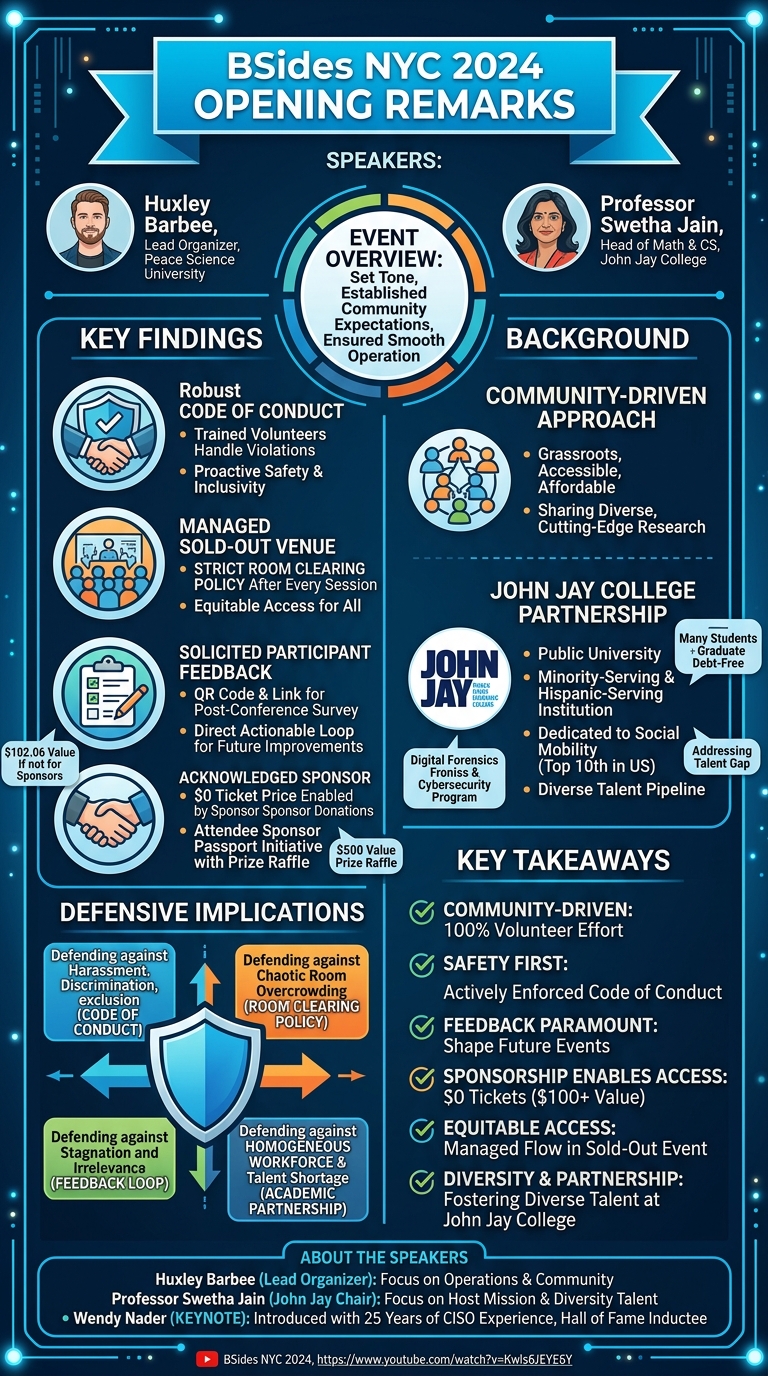
This article details the opening remarks from the BSides NYC 2024 conference, delivered by Huxley Barbee, the Lead Organizer from Peace Science University, followed by an introduction from Professor Swetha Jain, Head of the Math and Computer Science Department at John Jay College. While not a technical presentation in the traditional sense, these introductory statements are crucial for setting the tone, establishing community expectations, and ensuring the smooth operation of a large-scale cybersecurity event. The speakers outlined critical logistical elements, emphasized community values, expressed gratitude to sponsors, and highlighted the academic partnership that enables the conference.
Key moments
- 0:00 Welcome and conference agenda overview
- 0:20 Code of Conduct and room clearing policy
- 1:30 Providing feedback and appreciating sponsors
- 3:30 Introducing John Jay College host, Professor Jain
- 4:00 Professor Jain's welcome and John Jay's role
- 6:30 John Jay's social mobility and public university mission
- 7:25 Introduction of keynote speaker, Wendy Nader
BSides NYC 2024 Opening Remarks
Speakers: Huxley Barbee, Lead Organizer, Peace Science University; Professor Swetha Jain, Head of Math and Computer Science, John Jay College
Conference: BSides NYC
YouTube: https://www.youtube.com/watch?v=Kwls6JEYE6Y
Overview
This article details the opening remarks from the BSides NYC 2024 conference, delivered by Huxley Barbee, the Lead Organizer from Peace Science University, followed by an introduction from Professor Swetha Jain, Head of the Math and Computer Science Department at John Jay College. While not a technical presentation in the traditional sense, these introductory statements are crucial for setting the tone, establishing community expectations, and ensuring the smooth operation of a large-scale cybersecurity event. The speakers outlined critical logistical elements, emphasized community values, expressed gratitude to sponsors, and highlighted the academic partnership that enables the conference.
The primary focus of Barbee's remarks centered on four key areas: upholding the Code of Conduct, managing attendee flow in a sold-out venue, soliciting participant feedback for continuous improvement, and acknowledging the indispensable contributions of sponsors. Professor Jain then elaborated on John Jay College's significant role as the host institution, detailing its commitment to fostering diverse talent in cybersecurity through its academic programs. These opening remarks collectively serve to welcome attendees, establish the operational framework for the day, and reinforce the community-driven ethos that defines the BSides conference series. They underscore the importance of safety, accessibility, and engagement, which are foundational to creating an impactful and inclusive learning environment within the cybersecurity community.
Background
▶ Watch: Welcome and conference agenda overview (0:00)
BSides conferences worldwide are renowned for their grassroots, community-driven approach to cybersecurity education and networking. Unlike larger, more corporate conferences, BSides events typically prioritize accessibility, affordability, and the sharing of diverse, cutting-edge research from a wide range of practitioners. The context for BSides NYC 2024 is no exception, being a 100% volunteer-driven effort designed explicitly "for you" – the attendees. This commitment to the community is evident in the fact that tickets for the event were offered at $0, a value made possible entirely through sponsor donations. According to Barbee, without this sponsorship, each attendee would have faced a ticket cost of at least $102.06, highlighting the profound impact of financial support on event accessibility.
The conference's return to John Jay College for a second consecutive year, and its history of hosting pre-pandemic, signifies a strong partnership between the academic institution and the cybersecurity community. Professor Swetha Jain's introduction shed light on John Jay College's unique position within the CUNY system. As a public university, a minority-serving and Hispanic-serving institute, John Jay is deeply committed to social mobility, ranking among the top tenth in the country for this metric. Its Digital Forensics and Cybersecurity program, part of the Mathematics and Computer Science department, plays a vital role in addressing the cybersecurity talent gap by equipping a diverse student body with critical skills, many of whom graduate debt-free thanks to public funding and Pell grants. This partnership addresses a persistent problem in the cybersecurity industry: the challenge of major companies primarily recruiting from a limited pool of "big schools," often overlooking the high-caliber talent emerging from institutions like John Jay. The organizers' emphasis on encouraging attendees to engage with John Jay students and faculty underscores a broader effort to diversify the talent pipeline and ensure equitable opportunities within the field.
Key Findings
▶ Watch: Providing feedback and appreciating sponsors (1:30)
While this session did not present technical research or discoveries, the opening remarks offered crucial insights into the operational philosophy and community values underpinning a successful, volunteer-driven cybersecurity conference. The "key findings" in this context pertain to best practices for event organization, community engagement, and fostering an inclusive environment.
Firstly, the absolute necessity of a robust and enforced Code of Conduct was a primary finding. Barbee explicitly stated that all volunteers were trained to handle violations, underscoring a proactive approach to participant safety and inclusivity. This highlights that a written policy alone is insufficient; active training and a clear reporting mechanism are paramount for creating a genuinely welcoming space where individuals can express themselves without fear of harassment.
Secondly, the logistical challenges of a sold-out event necessitate innovative operational protocols. With BSides NYC 2024 completely sold out three weeks prior, and tickets being "scalped," the organizers implemented a strict room clearing policy after every session. This "no squatting" rule was a direct response to ensure equitable access to all attendees for subsequent talks, preventing overcrowding and maximizing the opportunity for everyone to experience the diverse program. This demonstrates a practical, attendee-centric solution to managing high demand in a fixed-capacity venue.
Thirdly, the organizers identified participant feedback as the single most important job for attendees. By providing a QR code and link for a post-conference survey, they highlighted a commitment to continuous improvement. The explicit mention that "many of the thoughts that were shared with us went into the post-mortem, which then were executed in this conference" illustrates a direct, actionable feedback loop that drives the evolution and enhancement of the event year over year. This underscores the value of iterative development in conference planning.
Finally, the critical role of sponsors and academic partners was a significant finding regarding the economic viability and community impact of the conference. The $0 ticket price, directly attributed to sponsor donations, demonstrates how corporate and institutional support can democratize access to high-quality cybersecurity education. The sponsor passport initiative, offering entry into a $500 value prize raffle for sufficient stamps, is a clever mechanism to facilitate engagement between attendees and sponsors, benefiting both parties. Furthermore, John Jay College's provision of the venue and its active role in developing a diverse talent pool represent an invaluable contribution beyond mere financial sponsorship, addressing broader industry challenges related to diversity and inclusion.
Technical Deep Dive
▶ Watch: Introducing John Jay College host, Professor Jain (3:30)
This section, typically reserved for an in-depth exploration of technical methodologies, novel protocols, specific code implementations, or architectural designs, does not apply to the provided transcript. The content of the "BSides NYC 2024 Opening Remarks" was entirely focused on administrative, logistical, and community-oriented aspects of the conference. No technical details regarding cybersecurity vulnerabilities, defensive strategies, offensive tooling, or specific research findings were discussed during this introductory segment. Therefore, a technical deep dive into specific code, network architectures, or exploit techniques is not possible based on the available information. Attendees seeking such content would find it within the individual technical talks presented throughout the conference day.
Demo / Proof of Concept
▶ Watch: John Jay's social mobility and public university mission (6:30)
Consistent with the nature of opening remarks, no demonstration or proof-of-concept was presented during this session. The speakers' objective was to welcome attendees, outline conference guidelines, and express gratitude, rather than to showcase technical capabilities or live exploits. Typically, a "Demo / Proof of Concept" section in a technical article would describe a practical application of research, a live demonstration of a tool, or a visual representation of a vulnerability being exploited or mitigated. Given the non-technical, organizational focus of Barbee's and Jain's addresses, the inclusion of any such demonstration would have been outside the scope of their designated roles as event organizers and hosts.
Defensive Implications
▶ Watch: Introduction of keynote speaker, Wendy Nader (7:25)
While the opening remarks did not delve into technical cybersecurity defenses, they carried profound defensive implications for the health, safety, and inclusivity of the cybersecurity community itself. These implications can be reframed as "defenses" against common challenges faced by large community events and the broader industry.
The emphasis on a strict Code of Conduct and trained volunteers serves as a crucial defense against harassment, discrimination, and exclusionary behavior. In a field that has historically struggled with diversity and inclusion, actively fostering a safe and respectful environment is a defensive measure against attrition of underrepresented groups and the reputational damage that can arise from unchecked misconduct. This proactive approach helps "defend" the community's integrity and ability to attract diverse talent.
The logistical "defenses" against chaos, such as the room clearing policy for sold-out sessions, protect against inequitable access and attendee frustration. By ensuring that every participant has a fair chance to attend desired talks, the organizers are defending against a common problem at popular conferences: "squatting" that limits opportunities for others. This contributes to a positive attendee experience and upholds the principle of accessibility.
The push for participant feedback acts as a defensive mechanism against stagnation and irrelevance. By actively soliciting input and demonstrating a commitment to implementing changes, the conference organizers "defend" the event's quality and ensure it remains responsive to the community's evolving needs and interests. This iterative improvement process is crucial for long-term sustainability and impact.
Finally, the highlighted partnership with John Jay College and its mission to propel students economically, particularly those from low-income and minority groups, represents a critical defensive strategy against the cybersecurity industry's talent shortage and lack of diversity. By actively encouraging recruitment from institutions like John Jay, the conference and its partners are "defending" against a homogenous workforce that may lack diverse perspectives, ultimately strengthening the industry's collective problem-solving capabilities and resilience. This also defends against the "hard fact" that most big companies hire from big schools, challenging the status quo to broaden the talent pipeline.
Key Takeaways
- Community-Driven Effort: BSides NYC 2024 is a 100% volunteer-driven event, reflecting the grassroots ethos of the BSides movement and the dedication of its community members.
- Safety and Inclusivity First: A strict Code of Conduct is actively enforced, with all volunteers trained to handle violations, ensuring a safe and welcoming environment for all participants.
- Participant Feedback is Paramount: Attendees are encouraged to provide feedback via a post-conference survey, which directly influences the improvement and evolution of future BSides NYC events.
- Sponsorship Enables Accessibility: The conference's $0 ticket price (representing over $100 value per attendee) is entirely dependent on sponsors, highlighting their crucial role in democratizing access to cybersecurity education.
- Equitable Access Management: For this sold-out event, a room clearing policy after each session was implemented to ensure fair and equitable access for all attendees to subsequent talks.
- Academic Partnership and Diversity: John Jay College serves as a vital venue host and academic partner, actively promoting social mobility and fostering diverse talent in cybersecurity through its Digital Forensics and Cybersecurity programs.
About the Speaker(s)
Huxley Barbee serves as the Lead Organizer for Peace Science University, a role that extends to his significant involvement in organizing BSides NYC 2024. His remarks primarily focused on the operational and community aspects of the conference, demonstrating his commitment to ensuring a positive, safe, and engaging experience for all attendees. He underscored the volunteer-driven nature of the event and the critical contributions of sponsors.
Professor Swetha Jain is the distinguished Chair of the Mathematics and Computer Science department and the Director of the Digital Forensics Cybersecurity program at John Jay College. Her address highlighted John Jay's integral role as the conference venue host and its broader mission as a minority-serving and Hispanic-serving institute. Professor Jain emphasized the college's dedication to social mobility, preparing a diverse student body for careers in cybersecurity, and bridging the gap between academic talent and industry recruitment. She also mentioned her three student volunteers (Kanika, Jonathan, Emmanuel) and colleague Doug Smith, an industry specialist, who are actively involved in supporting the program and connecting students with job opportunities.
The keynote speaker for the event, Wendy Nader, was introduced by Professor Jain as an extremely accomplished cyber professional. With 25 years of experience spanning both the public and private sectors, Wendy has served as a CISO for prominent organizations, including a Swiss Bank and the Texas Education Agency. Her significant contributions to the field were recognized with her induction into the Infosecurity Europe Hall of Fame in 2021. While not speaking in this specific transcript, her introduction set the stage for a high-caliber keynote address.
Reviews
Dr. Zero (Offensive Security Researcher) — WEAK
Opening remarks for a volunteer-run BSides event. There's nothing to grade technically because there's nothing technical here — it's housekeeping, sponsor acknowledgments, and a college promo. The article's attempt to reframe logistics as 'defensive implications' and 'key findings' is an absurd inflation of what this actually was.
Heather Calloway (CISO) — PASS
Opening remarks are not a session. There is no research, no argument, no risk finding, and nothing here that belongs in a security program review.