Startup Survival Tips and Uncommon Sense for First-Time Tech Founders
Eldon Sprickerhoff
BSides NYC 2024 · Day 1 · Entrepreneur
Overview
Eldon Sprickerhoff's talk, "Startup Survival Tips and Uncommon Sense for First-Time Tech Founders," delivered at BSides NYC, serves as a candid and sobering guide for aspiring and early-stage entrepreneurs in the technology sector, particularly those in cybersecurity. Drawing from his extensive experience as the founder of eSentire, a managed detection and response (MDR) company that he bootstrapped for a decade and grew to a billion-dollar valuation, Sprickerhoff cuts through the typical Silicon Valley glamour to reveal the harsh realities and essential strategies for startup longevity. The presentation is less about technical exploits and more about the fundamental business "tech" required to build a resilient company.
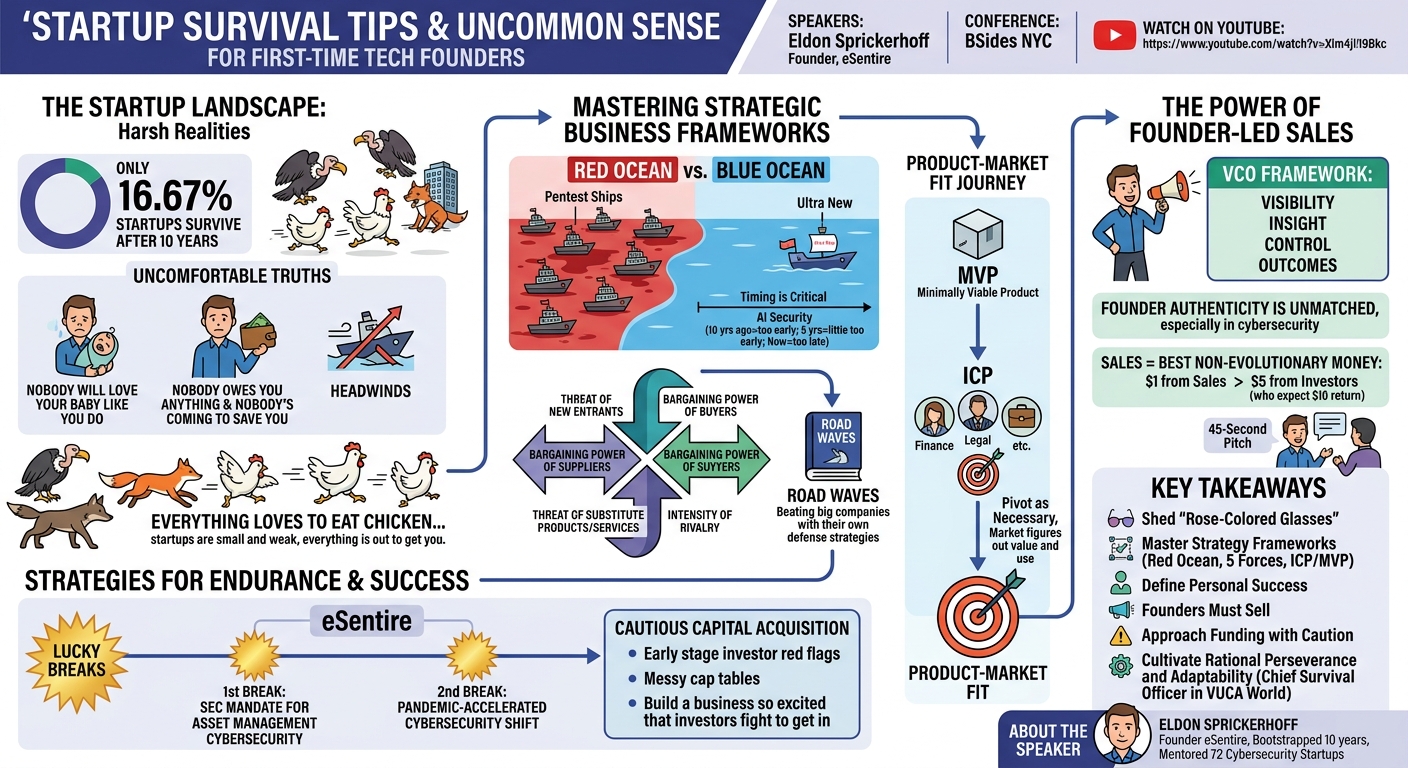
Key moments
- 0:00 Speaker introduction, bootstrapping, and startup mentoring
- 2:00 Startup simplicity contrasted with 'Do or Die' reality
- 3:30 Uncomfortable truths: nobody owes you anything, commitment tested
- 5:00 'Everything loves to eat chicken': startup survival statistics
- 6:40 Business strategy: Red Ocean vs. Blue Ocean markets
- 7:30 Michael Porter's Five Forces and beating big companies
- 8:00 Keystone projects, MVP, and feature vs. company
Startup Survival Tips and Uncommon Sense for First-Time Tech Founders
Speakers: Eldon Sprickerhoff, Founder, eSentire
Conference: BSides NYC
YouTube: https://www.youtube.com/watch?v=Xlm4jI19Bkc
Overview
Eldon Sprickerhoff's talk, "Startup Survival Tips and Uncommon Sense for First-Time Tech Founders," delivered at BSides NYC, serves as a candid and sobering guide for aspiring and early-stage entrepreneurs in the technology sector, particularly those in cybersecurity. Drawing from his extensive experience as the founder of eSentire, a managed detection and response (MDR) company that he bootstrapped for a decade and grew to a billion-dollar valuation, Sprickerhoff cuts through the typical Silicon Valley glamour to reveal the harsh realities and essential strategies for startup longevity. The presentation is less about technical exploits and more about the fundamental business "tech" required to build a resilient company.
Sprickerhoff, who also mentors dozens of cybersecurity startups, emphasizes that while the initial idea might be exciting, the path to sustained success is fraught with challenges and requires an unwavering commitment often underestimated by first-time founders. His insights are grounded in personal trials and observations of common pitfalls, culminating in a pragmatic blueprint for navigating market dynamics, securing funding, and mastering the art of sales. The talk is a critical resource for anyone considering entrepreneurship, offering an "uncommon sense" perspective that prioritizes mere survival as a significant achievement in itself.
The talk is particularly relevant in the cybersecurity landscape, where innovation is rapid but market saturation and funding pressures are intense. Sprickerhoff’s advice transcends specific technologies, focusing on universal principles of business strategy, founder resilience, and customer engagement that are crucial for any tech venture aiming to not just launch, but truly endure and thrive amidst fierce competition and unpredictable market shifts.
Background
▶ Watch: Speaker introduction, bootstrapping, and startup mentoring (0:00)
Eldon Sprickerhoff's journey into entrepreneurship began in 2001 when he founded eSentire, a company that pioneered managed detection and response (MDR) services. His path was far from conventional; he started as "employee zero" and, notably, bootstrapped the company for its first 10 years, eschewing external investment during its formative decade. This hands-on experience of building a company from the ground up, navigating its growth to a billion-dollar valuation, forms the bedrock of his advice. His academic background in Computer Science and Economics from the University of Waterloo provided a foundation, but much of his business acumen was self-taught through the "trials and tribulations" of running a startup.
The motivation for this talk stems from Sprickerhoff's subsequent role as a mentor and entrepreneur in residence at a cybersecurity accelerator in Toronto. Through this role, he has engaged with approximately 72 cybersecurity startups, observing a recurring pattern: founders, often deeply technical, are ill-prepared for the business challenges that constitute the vast majority of their operational hurdles. He notes that while they might ask one technical question, they typically have nine business-related questions. This disparity highlights a critical gap in the entrepreneurial ecosystem: a focus on technical innovation without a corresponding emphasis on fundamental business survival skills.
Sprickerhoff paints a stark picture of startup life, emphasizing the "uncomfortable truths" often glossed over in optimistic narratives. He stresses that the first 10 years are exceptionally difficult, characterized by "headwinds" that founders "have no idea about." His personal experience—starting eSentire six months after having a child—illustrates the profound personal sacrifice involved. Key among these truths are: "Nobody will love your baby like you do," "Nobody owes you anything and nobody's coming to save you," and the rapid realization of one's true market worth. He humorously recounts making more money working at a gas station during eSentire's initial five years. The prevailing issue, he argues, is a tendency for founders to "play house"—to get excited about the superficial aspects of a startup (cool name, logo, swag) without confronting the "do or die" reality. The grim statistics underscore this problem: only 16.67% of startups survive after 10 years, making it statistically "better luck playing reverse Russian Roulette." This perilous landscape necessitates a robust, realistic approach to business strategy and personal resilience, which his talk aims to provide.
Key Findings
▶ Watch: Uncomfortable truths: nobody owes you anything, commitment tested (3:30)
Sprickerhoff distills the essence of startup survival into several core findings, challenging conventional wisdom and offering a pragmatic roadmap for founders.
Firstly, he posits that startups are deceptively simple: "Pick a problem you can solve, find someone who has the problem and they can pay you, rinse and repeat." This straightforward definition belies the immense complexity and challenges involved, particularly the "uncomfortable truths" of startup life. These truths include the intense personal commitment required ("you better love what you do, and it's probably not enough"), the isolation ("nobody owes you anything and nobody's coming to save you"), the constant testing of commitment, and the universal experience that "everything takes longer than you expect." He vividly illustrates the vulnerability of new ventures with the analogy: "Everything loves to eat chicken... startups are small and weak, everything is out to get you."
A crucial finding is that mere survival is success. Given the 16.67% 10-year survival rate, reaching the five-year or even ten-year mark should be celebrated as a significant achievement. This perspective encourages founders to temper unrealistic expectations of rapid, exponential growth with a focus on sustainable endurance.
Strategically, Sprickerhoff introduces fundamental business concepts:
- Red Ocean vs. Blue Ocean: Founders must understand their competitive landscape. A Red Ocean is a crowded market (e.g., pentesting), requiring differentiation. A Blue Ocean is an uncontested market for something "ultra new," but demands educating the market and surviving long enough for adoption.
- Michael Porter's Five Forces: A framework for analyzing industry competition and developing strategies to adjust to new entrants and existing rivals.
- Road Waves: A book intended for large enterprises to watch out for smaller, disruptive companies, which Sprickerhoff ironically recommends as a strategy for startups to "beat up these big companies."
The concept of Product-Market Fit is paramount. This involves defining a Minimally Viable Product (MVP) and identifying an Ideal Client Profile (ICP). Sprickerhoff warns against the "feature vs. company" trap, where a great idea might only be a feature that can be sold, not a standalone business. He stresses the importance of listening to the market, being prepared to "pivot as necessary," and understanding that "the market will figure out if there's value in it and how to use it." The timing of market entry is critical, citing AI security as an example: 10 years ago was "way too early," even 5 years ago was "a little too early," but starting now might be "too late" unless one has a truly novel approach, as the market rapidly shifted from a Blue Ocean to a Red Ocean.
Founders must define what success looks like for them personally, rather than chasing external metrics like a "billion-dollar company in two years." This requires introspection about career goals and a realistic assessment of the time and effort involved, acknowledging that "nothing can go wrong" is an impossible scenario.
Perhaps the most impactful finding revolves around "lucky breaks." Sprickerhoff asserts that survival hinges on enduring long enough to "catch a lucky break, enjoy it, then survive long enough to catch the next lucky break." He cites eSentire's first break: the SEC's post-Target breach mandate for stronger cybersecurity in asset management funds, an area eSentire had served for 10 years, allowing them to answer 19 of 28 compliance questions immediately. The second "lucky break" was the broader shift in public perception of hacking, accelerated by the pandemic and remote work, making everyone understand the importance of cybersecurity.
Finally, Sprickerhoff unequivocally states that founders cannot delegate sales responsibility in the early stages. Founder authenticity in sales is unmatched, especially in cybersecurity where professionals are wary of salespeople. Sales also represent the "best non-evolutionary money you can buy," providing an asymmetric benefit (a dollar from sales is worth five from an investor, compared to an investor dollar expecting a ten-dollar return). Critically, sales provide invaluable market intelligence to validate the ICP and go-to-market process. Sprickerhoff, despite describing himself as "incredibly introverted," attests to his own ability to sell, using a specific 45-second pitch to engage prospects.
Technical Deep Dive
▶ Watch: 'Everything loves to eat chicken': startup survival statistics (5:00)
This talk, while delivered at a cybersecurity conference, focuses entirely on the business and strategic aspects of founding a tech startup, rather than specific technical vulnerabilities, exploits, or system architectures. As such, a traditional "Technical Deep Dive" section, exploring code, protocols, or specific technical implementations, is not applicable. Instead, this section will delve into the technical frameworks and strategic methodologies Sprickerhoff advocates for building and sustaining a successful tech business.
Sprickerhoff’s guidance serves as a "deep dive" into the strategic "architecture" of a startup. He introduces several foundational business strategy models crucial for market positioning and competitive analysis:
- Red Ocean vs. Blue Ocean Strategy: This framework helps founders understand the competitive intensity of their chosen market. A Red Ocean signifies a highly contested market with numerous competitors, requiring strong differentiation to survive (e.g., general pentesting services). A Blue Ocean represents an uncontested market space, offering opportunities for high growth but demanding market education and patience for adoption. The "technical" challenge here is accurate market assessment and strategic positioning. For instance, being too early in a Blue Ocean market (like AI security 10 years ago) means you might perish before the market matures, whereas entering a Red Ocean requires a unique value proposition.
- Michael Porter's Five Forces: This analytical tool is used to understand the competitive forces within an industry and how they affect profitability. The five forces are: threat of new entrants, bargaining power of buyers, bargaining power of suppliers, threat of substitute products or services, and intensity of rivalry. For a tech founder, "technically" applying this means systematically evaluating their business model against these external pressures to develop robust competitive strategies.
- Road Waves Strategy: While not a traditional "technical" concept, Sprickerhoff highlights a book titled Road Waves, which outlines strategies for large enterprises to defend against disruptive startups. He reinterprets this as a "technical" guide for startups on "how to beat up these big companies," effectively using the incumbents' defensive playbook as an offensive strategy.
In terms of product and market development, Sprickerhoff emphasizes:
- Minimally Viable Product (MVP): This is the core "technical" deliverable that a startup must develop. It's the simplest version of a product that can be released to the market, allowing the collection of validated learning about customers with the least amount of effort. The "technical" challenge is to define the core functionality that solves a real problem without over-engineering, distinguishing a mere "feature" from a full-fledged "company offering."
- Ideal Client Profile (ICP): Defining the ICP is a critical "technical" marketing exercise. It involves a detailed analysis of the characteristics of the customer who would most benefit from and pay for the product. This includes identifying whether the market is B2B or B2C, and specific verticals like finance, legal, healthcare, or manufacturing. The "technical" aspect is in data collection, segmentation, and precise targeting of messaging, understanding client budget cycles, and authority structures.
- Product-Market Fit: This is the convergence point between the MVP and the ICP. Achieving product-market fit means having a product that satisfies a strong market demand. Sprickerhoff uses the example of AI security to illustrate the dynamic nature of market fit: a Blue Ocean 10 years ago, a nascent opportunity 5 years ago, and potentially a crowded Red Ocean today. The "technical" challenge is continuous market feedback analysis and iterative product development to maintain this fit.
Finally, Sprickerhoff introduces a "technical" sales framework: VCO.
- VCO (Visibility, Insight, Control, Outcomes): This is a structured approach to value selling.
- Visibility: What data or information can you gather for the client?
- Insight: What knowledge or understanding can you derive from that visibility?
- Control: What actions or changes can you implement based on those insights?
- Outcomes: What tangible benefits or results will the client ultimately achieve?
This framework helps founders articulate value in a structured, problem-solving manner, moving beyond simply selling a "product" or "this" (something generic) to selling a specific, outcome-driven solution.
While not involving source code or network protocols, the "technical deep dive" into these strategic frameworks provides the essential operational "code" for a founder to engineer a sustainable business in the competitive tech landscape.
Demo / Proof of Concept
▶ Watch: Michael Porter's Five Forces and beating big companies (7:30)
This presentation was a strategic discussion about startup survival and did not feature any live demonstrations, code walkthroughs, or proof-of-concept exploits. The content was entirely focused on theoretical and experiential business advice for founders.
Defensive Implications
▶ Watch: Keystone projects, MVP, and feature vs. company (8:00)
While this talk doesn't discuss defensive implications in the context of cybersecurity vulnerabilities, it offers crucial "defensive" strategies for founders looking to protect their startup from the myriad forces that lead to failure. These are strategies for defending the very existence and viability of the business.
- Financial Fortification: A primary defensive measure is meticulous financial management. Sprickerhoff sternly advises against cutting corners on professional services, stating that "the worst things you'll do is to get a cheap lawyer or a cheap bookkeeper." He highlights the danger of personal loans, recounting putting a HELOC (Home Equity Line of Credit) on his house to start eSentire, an "insane risk" he advises against. Understanding and managing cash flow ("cash is King") and making careful financial decisions are paramount to avoid premature collapse. This also extends to understanding debt covenants, which can create personal liability for corporate debt.
- Market Intelligence and Positioning: Defending against market irrelevance requires deep understanding of the competitive landscape. Founders must conduct thorough market analysis using frameworks like Red Ocean vs. Blue Ocean and Michael Porter's Five Forces to avoid entering saturated markets without a clear differentiator. Developing a precise Ideal Client Profile (ICP) helps defend against wasted marketing efforts and ensures resources are directed towards customers who genuinely need and will pay for the solution. Understanding customer budget cycles (e.g., year-end budget spending opportunities) is also a defensive tactic against lost sales opportunities.
- Founder Resilience and Realistic Expectations: The most critical defense is the founder's own mental and emotional fortitude. Sprickerhoff's "uncomfortable truths" serve as a defensive shield against disillusionment. Understanding that "nobody owes you anything," "everything takes longer," and "everything is out to get you" prepares founders for inevitable setbacks. Defining personal "success" upfront, rather than chasing external, often unrealistic, metrics, defends against burnout and allows for rational perseverance. This also includes preparing for personal crises like illness, family deaths, or co-founder mental breakdowns.
- Strategic Sales as a Core Competency: Founder-led sales are a powerful defensive weapon. Sprickerhoff argues that "nobody loves your baby as much as you do," making the founder the most authentic and trusted salesperson. This defends against early market misinterpretation and provides invaluable "intel" on whether the go-to-market process and ICP assumptions are valid. Sales revenue is also the "best non-evolutionary money you can buy," defending against unnecessary equity dilution from early-stage investors who might take "chunks of your company."
- Cautious Capital Acquisition: While capital can fuel growth, Sprickerhoff treats it as a double-edged sword, advising caution. He identifies "early stage investor red flags" and warns that many startups are "uninvestable" due to poor storytelling or messy cap tables. Defensively, founders should "not chase investors" but rather "build a business so excited that investors will fight to get in." He also highlights that "money only solves the problems that money can solve," implying that trying to fix cultural or foundational business issues with cash will only make them worse, a crucial defensive insight against misallocating resources.
- Adaptability in a VUCA World: Sprickerhoff introduces the concept of a VUCA world (Volatility, Uncertainty, Complexity, Ambiguity). Defending a startup in such an environment requires constant vigilance and the ability to pivot. Listening to the market, understanding customer needs, and offering "unreasonable hospitality" to build relationships are proactive defensive measures. The "Chief Survival Officer" mindset, combining "rational perseverance" with an "abundance mindset," is essential for navigating these unpredictable currents.
These defensive implications, while not technical in the traditional cybersecurity sense, are foundational for ensuring a tech startup’s long-term viability and protecting it from the high probability of failure.
Key Takeaways
- Embrace the Hard Truths of Startup Life: Founders must shed "rose-colored glasses" and accept that the first 10 years are incredibly difficult. Expect relentless "headwinds," profound personal sacrifices, and the reality that "nobody owes you anything" and "everything takes longer than you expect." Survival itself, given the 16.67% 10-year success rate, is a significant achievement.
- Master Strategic Business Frameworks: Beyond technical prowess, founders need to understand and apply business strategy. This includes analyzing market competition using Red Ocean vs. Blue Ocean strategies, evaluating industry forces with Michael Porter's Five Forces, and defining a clear Minimally Viable Product (MVP) and Ideal Client Profile (ICP) to achieve crucial Product-Market Fit.
- Define Personal Success and Plan Accordingly: Do not blindly chase unicorn valuations. Founders should introspectively define what "success" looks like for them personally, considering their career stage and aspirations. This clarity helps set realistic goals and build a sustainable path, acknowledging that unforeseen challenges (e.g., market downturns, personal crises) are inevitable.
- Founder-Led Sales are Non-Negotiable: For early-stage startups, the founder must be the primary salesperson. Founder authenticity is a unique advantage, especially in cybersecurity where trust is paramount. Sales generate the "best non-evolutionary money" (a dollar from sales is worth five from an investor) and provide invaluable market intelligence, validating or refuting key business assumptions.
- Approach Funding with Extreme Caution: While tempting, chasing investor money can be a distraction and lead to unnecessary equity dilution. Prioritize building a profitable business that attracts investors, rather than desperately seeking capital. Remember that "money only solves the problems that money can solve" and cannot fix foundational business or cultural issues; in fact, it can exacerbate them.
- Cultivate Rational Perseverance and Adaptability: In a VUCA (Volatility, Uncertainty, Complexity, Ambiguity) world, continuous learning, listening to the market, and being prepared to pivot are essential. Be the "Chief Survival Officer" of your company, blending unwavering commitment with a realistic understanding of challenges, always seeking to learn from mistakes and capitalize on "lucky breaks" when they arise.
About the Speaker(s)
Eldon Sprickerhoff is a seasoned entrepreneur and a prominent figure in the cybersecurity industry, best known as the founder of eSentire. He embarked on his entrepreneurial journey in 2001, starting eSentire as "employee zero" and pioneering the concept of managed detection and response (MDR). A testament to his resilience and strategic vision, he bootstrapped the company for its first 10 years, eschewing external investment before eventually growing it to a billion-dollar valuation.
Sprickerhoff's academic background includes Computer Science and Economics from the University of Waterloo, providing a blend of technical expertise and business understanding. Beyond his direct entrepreneurial success, he has dedicated significant time to nurturing the next generation of tech founders. He serves as a mentor and entrepreneur in residence at a cybersecurity accelerator in Toronto, where he has guided approximately 72 cybersecurity startups. Through this role, he observed that many technically brilliant founders often lack essential business acumen, prompting him to compile his insights into an upcoming book on startup survival.
Despite describing himself as "incredibly introverted," Sprickerhoff emphasizes his ability to engage in effective sales, demonstrating that even those who don't naturally gravitate towards sales can master it out of necessity. His approach is characterized by a pragmatic, often "pessimistic" realism, balanced with an optimistic drive for survival and success. He speaks from a place of deep, lived experience, offering candid and actionable advice gleaned from decades in the trenches of startup life.
Reviews
Dr. Zero (Offensive Security Researcher) — SOLID
Sprickerhoff is the real deal — bootstrapped eSentire for a decade, grew it to a billion-dollar exit, mentored 72 startups — and that credibility carries the room. The talk delivers honest, earned wisdom about founder survival that most conference speakers either don't have or won't admit. But it's firmly a 'case study / war story' slot, not a research talk, and judged on that lane it's competent rather than exceptional.
Heather Calloway (CISO) — PASS
A credible founder sharing hard-won startup lessons — but this is entrepreneurship content, not security content. There is no governance angle, no defender value, and no institutional risk framing. Scope mismatch, not a quality failure.