Breaking the Mobile Log Analysis Barrier with AI
Numa Dhamani (Head of Machine Learning · iVerify)
BSides NYC 2025 (0x05) · Day 1
Overview
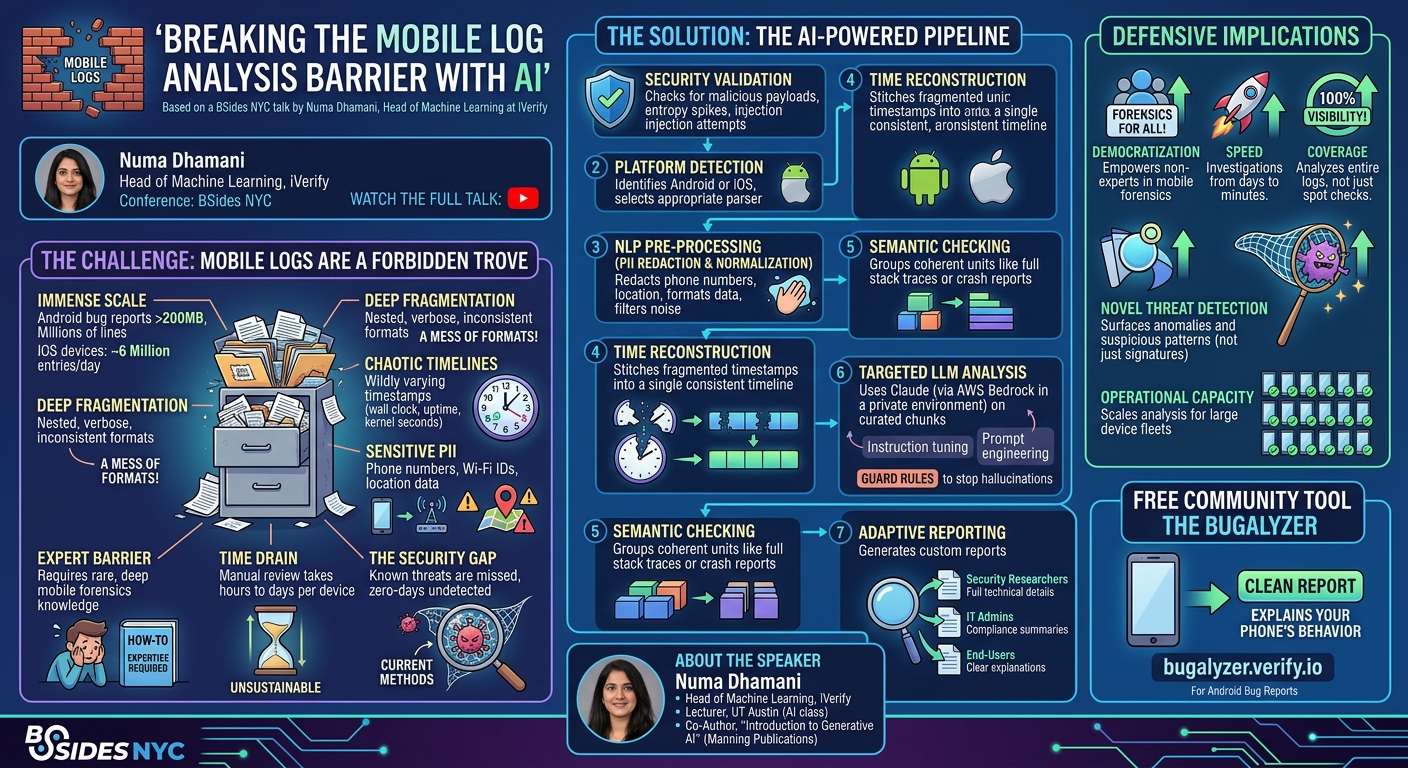
In the realm of cybersecurity, mobile device logs represent an invaluable, yet often inaccessible, trove of forensic data. Numa Dhamani, Head of Machine Learning at iVerify, delivered a compelling talk at BSides NYC, "Breaking the Mobile Log Analysis Barrier with AI," addressing this critical challenge. The presentation highlighted how the sheer scale, complexity, and fragmentation of mobile logs—such as Android bug reports and iOS unified logs—create a significant barrier to effective security investigations and incident response.
Key moments
- 0:00 Introduction to mobile log analysis challenges
- 2:00 Demonstrating the overwhelming scale and complexity of mobile logs
- 3:00 Identifying the mobile security gap from log analysis difficulties
- 4:00 Why traditional mobile log analysis methods fall short
- 5:00 Introducing the AI-powered solution for mobile log analysis
- 5:56 Detailed breakdown of the NLP and LLM processing pipeline
- 6:58 Generating adaptive reports tailored for various audiences
Breaking the Mobile Log Analysis Barrier with AI
Speakers: Numa Dhamani, Head of Machine Learning, iVerify
Conference: BSides NYC
YouTube: https://www.youtube.com/watch?v=4taQFPtehHg
Overview
In the realm of cybersecurity, mobile device logs represent an invaluable, yet often inaccessible, trove of forensic data. Numa Dhamani, Head of Machine Learning at iVerify, delivered a compelling talk at BSides NYC, "Breaking the Mobile Log Analysis Barrier with AI," addressing this critical challenge. The presentation highlighted how the sheer scale, complexity, and fragmentation of mobile logs—such as Android bug reports and iOS unified logs—create a significant barrier to effective security investigations and incident response.
Dhamani introduced an innovative AI-powered solution developed at iVerify designed to transform these chaotic logs into structured, actionable intelligence. This approach leverages a sophisticated pipeline combining traditional Natural Language Processing (NLP) techniques with targeted applications of Large Language Models (LLMs) to securely process, interpret, and present mobile log data. The talk underscored the transformative potential of AI in democratizing mobile forensics, enabling security professionals and even end-users to gain unprecedented visibility into device activity, identify novel threats, and respond more efficiently to security incidents.
The significance of this work lies in its ability to bridge a substantial gap in mobile security. By automating and intelligentizing the analysis of millions of log entries, iVerify's solution, partially released as the free community tool "Bugalyzer," empowers organizations and individuals to overcome the traditional hurdles of limited expertise, lengthy analysis times, and incomplete coverage. It redefines what's possible in mobile threat hunting, moving beyond signature-based detection to proactively surface anomalous behaviors that might indicate zero-day exploits or advanced persistent threats.
Background
▶ Watch: Introduction to mobile log analysis challenges (0:00)
Mobile logs, encompassing Android bug reports and iOS unified logs, are comprehensive diagnostic packages generated by devices. Android bug reports capture data across apps, system services, the kernel, and hardware, while iOS unified logs collect structured events continuously from all subsystems. Both record critical information including system and app logs, running processes, battery and power usage, network activity, device state, crash logs, and sometimes even user data. This makes them exceptionally valuable for forensics and security investigations.
However, their utility is severely hampered by inherent challenges:
- Scale: A single Android bug report can exceed 200 megabytes and contain millions of lines. An iOS device can generate approximately six million log entries per day, roughly 70 events per second, often resulting in multiple gigabytes of log data per device.
- Fragmentation and Messiness: Logs are deeply nested, verbose, and exhibit inconsistent formatting. Timestamps can vary wildly, mixing wall clock time, uptime since boot, and kernel seconds, making chronological correlation extremely difficult.
- Sensitive Data: These logs frequently contain personally identifiable information (PII) such as phone numbers, Wi-Fi identifiers, and location data, posing privacy and security risks during analysis.
- Expertise Barrier: Deciphering these complex logs requires specialized, deep mobile forensics knowledge, a skill set that is scarce in the industry.
- Time Consumption: Manual review of mobile logs is incredibly time-consuming, often taking hours or even days per device. This pace is unsustainable for fast-moving security investigations or large fleets of devices.
This combination of scale, limited expertise, and slow analysis creates a significant mobile security gap. Current traditional methods, such as known threat hunting (checking for indicators of compromise or signatures like "bad app.apk"), only catch previously identified threats and are ineffective against novel malware or zero-days. Spot checking, or manually reviewing portions of logs, inevitably leads to incomplete coverage, allowing compromises to be missed due to the sheer volume of data. Incident response, by definition, is reactive, meaning damage has already occurred by the time an alert is triggered, and investigations can still take days. These approaches, while having their place, fail to address the fundamental challenge of achieving comprehensive visibility in mobile logs at scale. A new, more intelligent approach is clearly required to overcome these barriers.
Key Findings
▶ Watch: Identifying the mobile security gap from log analysis difficulties (3:00)
The core problem identified by Numa Dhamani is the mobile log analysis barrier, where the immense volume, fragmentation, and technical complexity of mobile device logs render them practically unanalyzable for most organizations and security professionals. The key finding presented is that Artificial Intelligence (AI), specifically a strategic combination of Natural Language Processing (NLP) and Large Language Models (LLMs), can effectively break this barrier.
The iVerify solution demonstrates that raw, unstructured mobile logs can be transformed into secure, structured, and actionable timelines and reports. This is not achieved by simply feeding raw log data into an LLM, but through a meticulously designed multi-stage pipeline that adapts to platform differences (Android vs. iOS), reconstructs messy timelines, and then applies targeted AI analysis.
A critical contribution of this approach is the democratization of mobile forensics. Previously, deep mobile OS expertise was a prerequisite for any meaningful log analysis. The AI system significantly lowers this barrier, enabling security professionals without specialized mobile forensics knowledge to gain valuable insights. It also empowers IT administrators with compliance-focused summaries and even end-users with clear, understandable explanations of device events and actionable recommendations.
Furthermore, the system significantly enhances threat detection capabilities. Traditional methods are limited to identifying known signatures. By analyzing entire logs and surfacing anomalies and suspicious patterns, the AI can highlight behaviors that deviate from normal system activity. These signals can point to novel or unknown threats, providing a proactive defense mechanism against emerging mobile threats that would otherwise go undetected. This shift from reactive, signature-based detection to proactive, anomaly-based threat hunting represents a fundamental advancement in mobile security.
Technical Deep Dive
▶ Watch: Why traditional mobile log analysis methods fall short (4:00)
The iVerify solution is a sophisticated, multi-stage pipeline designed to process massive and complex mobile logs securely and efficiently. It strategically combines traditional Natural Language Processing (NLP) techniques with targeted applications of Large Language Models (LLMs), aiming not to indiscriminately dump data into an LLM, but to use it precisely where it adds the most value.
The pipeline initiates with security validation, a crucial first step to ensure the integrity of the analysis. This stage actively checks for malicious payloads, identifies entropy spikes that might signal hidden or encrypted content, and detects any injection attempts by attackers aiming to manipulate the analysis process. Logs deemed manipulated or unusually risky are rejected to protect both the user and the system.
Following validation, platform detection occurs. The system intelligently identifies whether the logs originate from an Android or iOS device. It then adjusts for any version differences or manufacturer customizations and selects the appropriate parser to handle the specific log format and structure unique to that platform.
The processed logs then flow into the NLP and LLM pipeline, which forms the core intelligence of the solution:
- Pre-processing with NLP: This initial phase leverages traditional NLP techniques to prepare the logs for deeper analysis.
- Personally Identifiable Information (PII) Redaction: Before any further processing, the system redacts sensitive data to ensure user privacy and compliance.
- Format Normalization: Inconsistent log formats, timestamps, and event structures are standardized.
- Noise Filtering: Irrelevant or verbose entries are filtered out to reduce data volume and improve signal-to-noise ratio.
- Time Reconstruction: A critical NLP function involves stitching together fragmented timelines. Mobile logs often use different time references (wall clock time, uptime since boot, kernel seconds). The system reconstructs these into a single, consistent chronological timeline, which is essential for understanding the sequence of events.
- Semantic Checking: Instead of arbitrarily splitting log files by size or line count (which could sever context like a stack trace or a crash log from surrounding events), the system intelligently groups coherent units of information. This involves identifying and grouping full stack traces, complete crash reports, or security events into meaningful chunks. It then prioritizes high-signal sections, ensuring that the most relevant security and diagnostic information is processed first.
- Targeted LLM Analysis: Only after this extensive pre-processing and semantic structuring are the Large Language Models engaged. The LLMs are used in a very focused manner, analyzing these curated, structured chunks of log data to extract specific findings. This targeted approach prevents the LLM from being overwhelmed by raw, chaotic data and minimizes the risk of hallucinations by providing it with well-defined contexts. The LLM currently utilized by iVerify is Claude, accessed through AWS Bedrock in a private enterprise-grade environment, ensuring that user data is never shared externally or used for model training. The LLM’s performance is refined through instruction tuning and prompt engineering, with guard rules implemented to mitigate hallucinations. For security researchers, the system explicitly provides line-level evidence for any claim made by the LLM, grounding the findings in verifiable log entries and further reducing the impact of potential probabilistic model inaccuracies.
Finally, the system generates a report that adapts to the audience. A single raw log can produce multiple perspectives:
- Security Researchers receive full technical details, including line-level information and evidence, allowing for deep dives.
- IT Admins get actionable summaries framed in compliance terms, directly supporting policy and fleet management.
- End-Users receive clear, everyday language explanations of what happened and concrete recommendations for next steps.
A significant technical achievement is the system's ability to map cross-platform security events to a common meaning. For instance, an Android SE Linux denial (e.g., media server blocked from reading a file) and an iOS sandbox violation (e.g., media server D denied file access) are expressed very differently in their respective logs. The iVerify system intelligently recognizes that both signify a "media service security violation," providing a unified understanding regardless of the device platform. This consistency reduces operational overhead and simplifies analysis for multi-platform environments.
The entire design prioritizes security from the outset. Beyond initial validation and PII redaction, all processing occurs within a private, enterprise-grade environment. Each log file is scored for potential threats, and unusually risky or manipulated logs are rejected. This layered safeguard approach ensures that the analysis is not only useful but also private and secure, building trust and reliability into the system.
Demo / Proof of Concept
▶ Watch: Detailed breakdown of the NLP and LLM processing pipeline (5:56)
Numa Dhamani presented two compelling case studies, one for Android and one for iOS, to illustrate the transformative power of the AI-driven log analysis system. These demonstrations highlighted how the system converts overwhelming, cryptic log entries into clear, actionable intelligence tailored for different audiences.
Android Case Study: Resource Exhaustion
The first case study involved a snippet from an Android bug report showing multiple events: an ANR (Application Not Responding) in WhatsApp, a low memory killer terminating apps, and CPU performance throttling. In its raw form, these scattered log lines, exacerbated by inconsistent timestamps (wall clock, uptime, kernel seconds), could easily be misinterpreted as signs of device instability, app crashes, or even a potential compromise. Manually piecing together the sequence of events from millions of such lines is a monumental, if not impossible, task.
After processing by the iVerify system, the narrative became clear and audience-tailored. For a device owner, the report explained: "Your device is under memory pressure. Apps like Microsoft Office and Google productivity are running slow. WhatsApp froze. The system started throttling CPU to cope with heat." Crucially, it concluded: "There's really no compromise. It's just resource exhaustion." This translates complex technical events into easily understandable terms.
The system's timeline reconstruction was instrumental here. It took events from various log formats and aligned them into a single, coherent flow. The timeline revealed a precise sequence: a session opens, multiple apps pile up memory requests, the device heats up, the low memory killer terminates Google Maps, and then WhatsApp locks up. This chronological ordering clarified that what appeared to be random crashes was, in fact, a resource management failure playing out step-by-step. The ability to correctly sequence events prevents misdiagnosis of problems.
Finally, the system generated evidence-based recommendations directly from the log analysis, such as: "reset app states," "clear memory," "close or remove background-heavy apps," and "clear WhatsApp Business cache after the freeze." These concrete, actionable steps empower the user to resolve the underlying issues.
iOS Case Study: Jailbreak Detection
The second demonstration focused on an iOS unified log, notoriously massive (often gigabytes), deeply nested, and fragmented across dozens of subsystems. The raw snippet contained repeated references to Cydia, an unusual app install, and a burst of location tracking events. Individually, an app install or a spike in location activity might not raise alarms, but their combined presence across disparate subsystems suggested something amiss. The challenge lies in manually correlating these scattered clues across millions of entries.
Once processed by the iVerify system, the device owner received a concise, critical report: "Your device appears to be jailbroken and that's a critical compromise." The report further explained the risks, stating that "core protections like code signing and sandboxing might be disabled," and flagged "abnormal location activity that could indicate surveillance or tracking." This translation from cryptic log entries to a clear, audience-appropriate security assessment significantly lowers the barrier to understanding.
The reconstructed timeline for the iOS case was equally revealing. By aligning events across subsystems, the chain of malicious activity became evident: "Jailbreak traces appear, core processes interact with them, network traffic follows, and then suspicious app and location activity kind of stack on top." This ordered view presented a coherent story of a compromised device.
The system then provided evidence-based recommendations: "disconnect, wipe and restore from a trusted backup, resecure accounts, and in high-risk cases, you probably want to replace your device."
The Bugalyzer: A Community Tool
To make this technology accessible, iVerify has released Bugalyzer as a free community tool for Android bug reports (available at bugalyzer.verify.io). Bugalyzer incorporates the same underlying AI pipeline, providing device owners with clear, easy-to-understand reports about what's happening on their phones. While not a replacement for professional forensics, it significantly lowers the barrier, offering everyday users unprecedented visibility and providing security professionals with a faster, more consistent way to begin investigations. Users simply upload a bug report and receive an explanation of their device's state. This initiative underscores the commitment to democratizing mobile security and making complex log analysis accessible to a broader audience.
Defensive Implications
▶ Watch: Generating adaptive reports tailored for various audiences (6:58)
The AI-powered mobile log analysis system presented by Numa Dhamani carries profound defensive implications for organizations and individual users alike. It fundamentally shifts the paradigm of mobile security from a niche, reactive, and resource-intensive endeavor to a more accessible, proactive, and scalable capability.
- Democratization of Mobile Forensics: The most significant implication is the democratization of mobile forensics. Historically, deep mobile OS expertise was a prerequisite for effective log analysis. This system empowers a broader range of security professionals, including those without specialized mobile forensics knowledge, to gain meaningful visibility into device activities. This means more teams can initiate investigations, perform internal audits, and respond to mobile incidents without relying solely on a small pool of highly specialized experts.
- Accelerated Incident Response and Investigations: Investigations that traditionally took hours, days, or even weeks can now be completed in as little as 15 to 20 minutes. By automating the parsing, timeline reconstruction, and initial analysis of millions of log entries, the system drastically reduces turnaround times. This speed is critical for fast-moving investigations, enabling organizations to contain threats more quickly and minimize potential damage.
- Comprehensive Visibility and Reduced Oversight: Unlike manual spot-checking, which inevitably leads to incomplete coverage, the AI system processes entire log files through its sophisticated pipeline. This ensures that nothing gets overlooked, providing a complete picture of device activity. This comprehensive visibility is crucial for identifying subtle indicators of compromise that might be missed in a fragmented manual review.
- Enhanced Threat Detection, Including Novel Threats: The system moves beyond the limitations of signature-based threat hunting, which only catches known threats. By analyzing entire logs and surfacing anomalies and suspicious patterns that deviate from normal system activity, it can highlight behaviors indicative of novel or unknown threats, including zero-day exploits or advanced persistent threats. This proactive anomaly detection capability provides a crucial layer of defense against emerging mobile malware and sophisticated attacks.
- Increased Operational Capacity: The automation and speed offered by the system significantly expand daily analysis capacity. What might have been limited to analyzing one or two devices per day manually can now extend to dozens of devices. This increased capacity is vital for large enterprises managing extensive mobile fleets, enabling them to regularly monitor and audit device health and security posture.
- Amplification of Human Expertise: The system does not replace human expertise but amplifies it. Security researchers can now analyze far more devices, focusing their valuable time on interpreting complex findings and responding to critical alerts, rather than sifting through raw data. IT admins gain clearer evidence to escalate specific concerns, improving communication and decision-making. Even end-users benefit by being more informed about their device's security status. This "democratization with depth" ensures that while anyone can gain initial visibility, experts still play a vital role in critical judgment and context.
- Establishment of Mobile Forensics Capability: For many organizations, this system provides the means to establish or significantly enhance their mobile forensics capability, moving from having little to no visibility into mobile endpoints to achieving actionable intelligence. This is especially impactful for organizations facing regulatory compliance requirements or those operating in high-risk environments.
In essence, the AI solution transforms mobile log analysis from an unrealistic, complex, and slow endeavor into a practical, efficient, and scalable component of a robust mobile security strategy, empowering defenders with the insights they need when they need them most.
Key Takeaways
- Mobile logs are a rich but inaccessible source of forensic data: Android bug reports and iOS unified logs contain critical security intelligence but are overwhelmingly massive, fragmented, and technically complex, creating a significant barrier to analysis for most organizations.
- AI (NLP + LLMs) can break the mobile log analysis barrier: A strategic combination of traditional Natural Language Processing and targeted Large Language Model analysis can securely transform chaotic, unstructured mobile logs into structured, actionable timelines and reports.
- A secure, multi-stage pipeline is crucial for effective analysis: The iVerify system employs security validation, platform detection, NLP pre-processing (including PII redaction and time reconstruction), semantic checking, and targeted LLM analysis to ensure accurate, private, and context-aware interpretation.
- Reports are tailored to the audience, enhancing utility: The system dynamically adapts its output to provide relevant details for security researchers (technical evidence), IT administrators (compliance summaries), and end-users (clear explanations and recommendations).
- Significant improvements in speed, coverage, and threat detection: Investigations are drastically accelerated (from days to minutes), full log processing eliminates missed threats, and anomaly detection capabilities enable the identification of novel or unknown threats beyond traditional signature matching.
- AI amplifies human expertise and democratizes mobile forensics: The technology empowers non-experts to gain critical visibility while allowing specialists to focus on interpretation and high-level strategy, making mobile security more accessible and scalable without replacing human judgment.
About the Speaker(s)
Numa Dhamani is the Head of Machine Learning at iVerify, a cybersecurity company specializing in mobile threat hunting. In addition to her role at iVerify, she is a lecturer at the University of Texas at Austin, where she teaches a class focused on Artificial Intelligence. Dhamani is also a recognized author, having co-authored "Introduction to Generative AI," published by Manning Publications. Her expertise spans the practical application of AI and machine learning in complex security challenges, particularly in the mobile domain.
Reviews
Dr. Zero (Offensive Security Researcher) — SOLID
Dhamani describes a real operational problem — mobile logs are genuinely terrible to work with at scale — and the iVerify pipeline has some thoughtful engineering in it (PII redaction before LLM ingestion, semantic chunking instead of naive splits, evidence grounding for researchers). But the talk never escapes the product demo gravity well long enough to teach the audience something they couldn't get from reading the Bugalyzer landing page.
Heather Calloway (CISO) — SOLID
Dhamani presents a technically coherent and genuinely useful capability — AI-assisted mobile log analysis is a real gap, and iVerify's pipeline approach is thoughtful. But the talk stays inside the product demo and never surfaces the institutional questions that would make it matter at scale: who owns mobile endpoint visibility in an enterprise, and what should security leaders do with this capability that they aren't doing today.