What To Expect When You’re Exploiting: 0Days Baby Monitors & Wi-Fi Cams
Mager, Forte
DEF CON 32 Creator Stage · Day 1 · Creator Stage
Overview
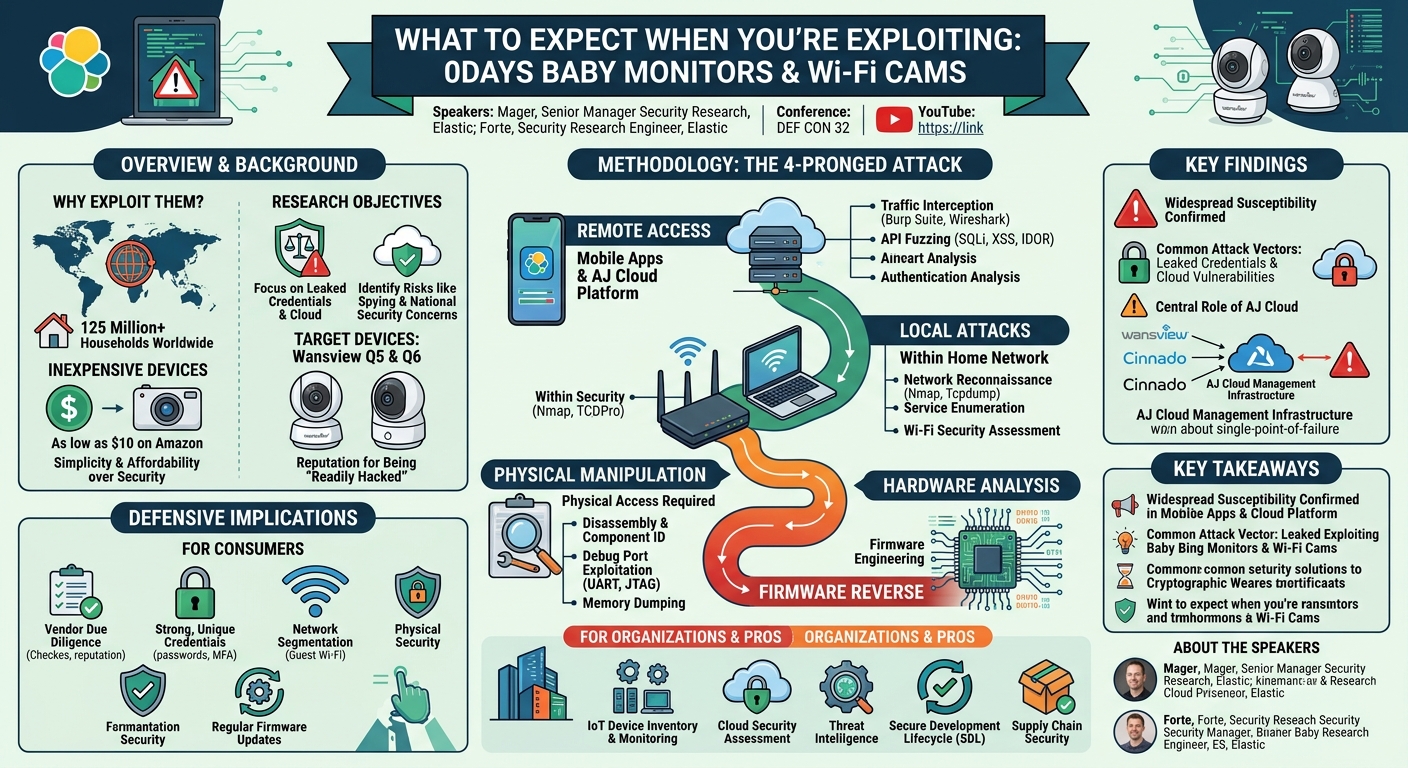
This talk, "What To Expect When You’re Exploiting: 0Days Baby Monitors & Wi-Fi Cams," delves into the pervasive security vulnerabilities inherent in consumer-grade Wi-Fi cameras and baby monitors. Presented by Mark Mager and Eric Forte from Elastic, the session highlights the significant risks posed by these ubiquitous devices, which are often marketed interchangeably and share common underlying cloud infrastructure. The speakers emphasize that these affordable, internet-connected cameras, prevalent in over 125 million households globally, represent a critical and often overlooked attack surface.
Key moments
- 0:00 Introduction to hacking baby monitors and Wi-Fi cams
- 1:00 Why Wi-Fi cameras are a critical attack surface
- 1:39 Common attack vectors: leaked credentials and cloud vulnerabilities
- 2:27 Introducing Wansview Q5/Q6 cameras and AJ Cloud platform
- 3:50 Overview of remote, local, physical, and hardware attack methods
What To Expect When You’re Exploiting: 0Days Baby Monitors & Wi-Fi Cams
Speakers: Mager, Senior Manager Security Research, Elastic; Forte, Security Research Engineer, Elastic
Conference: DEF CON 32
YouTube: https://www.youtube.com/watch?v=caY7ls4G460
Overview
This talk, "What To Expect When You’re Exploiting: 0Days Baby Monitors & Wi-Fi Cams," delves into the pervasive security vulnerabilities inherent in consumer-grade Wi-Fi cameras and baby monitors. Presented by Mark Mager and Eric Forte from Elastic, the session highlights the significant risks posed by these ubiquitous devices, which are often marketed interchangeably and share common underlying cloud infrastructure. The speakers emphasize that these affordable, internet-connected cameras, prevalent in over 125 million households globally, represent a critical and often overlooked attack surface.
The core objective of the research presented was to systematically evaluate the security posture of these devices, focusing on common attack vectors such as leaked credentials and cloud platform vulnerabilities. The choice of specific devices, notably the Wansview Q5 and Q6, was influenced by anecdotal evidence from Amazon reviews suggesting a history of readily exploitable weaknesses. By dissecting the various layers of the camera ecosystem—from the device hardware and firmware to the companion applications and overarching cloud services like AJ Cloud—Mager and Forte aimed to uncover the vulnerabilities that could lead to severe privacy breaches and even national security concerns, as evidenced by real-world incidents involving spying and reconnaissance.
The talk serves as a stark reminder of the security implications of cheap, mass-produced IoT devices. It underscores the critical need for both consumers and security professionals to understand the potential for compromise. The research methodology outlined by the speakers provides a comprehensive framework for assessing the security of such devices, encompassing remote, local, physical, and hardware-level attack surfaces. This holistic approach is crucial for identifying the multifaceted weaknesses that cyber adversaries exploit, transforming seemingly innocuous home monitoring tools into potential instruments for surveillance and disruption.
Background
▶ Watch: Introduction to hacking baby monitors and Wi-Fi cams (0:00)
The proliferation of inexpensive Wi-Fi cameras and baby monitors has created a vast and vulnerable landscape in modern homes. These devices, often costing as little as $10 on platforms like Amazon, are designed for simplicity and affordability, frequently at the expense of robust security. They typically require constant internet connectivity to a specific vendor’s cloud platform to function, enabling basic operations such as pan, tilt, zoom, and motion detection. This dependency on cloud services introduces a significant centralized point of failure and potential vulnerability.
The problem's existence is multifaceted. Firstly, the sheer volume of these devices—installed in approximately 125 million households worldwide—makes them an attractive target for attackers seeking scale. Secondly, the market is flooded with devices from various manufacturers (e.g., Wansview, Cinnado) that often rely on a shared underlying infrastructure, such as the AJ Cloud management infrastructure. This common platform provides the cloud services and companion applications that facilitate camera connectivity, meaning a vulnerability in AJ Cloud could potentially affect numerous brands and millions of devices. Prior work, or rather, prior public awareness, was evident in widespread Amazon reviews indicating that these cameras were "readily hacked enough that it took notice," signaling a known, unaddressed security deficit even before formal research.
The researchers at Elastic set out to evaluate the attack surface by categorizing potential vulnerabilities into several common vectors. These included:
- Leaked Credentials: A perennial problem across many internet-connected services, where compromised user accounts can provide direct access.
- Cloud Vulnerabilities: Weaknesses in the cloud platforms that manage camera operations, data storage, and user authentication. These were identified as among the most common and frequently exploited attack vectors.
Beyond these, the team adopted a comprehensive approach to assess the camera ecosystem:
- Remote Access: Investigating vulnerabilities accessible via the companion mobile applications that users employ to control their cameras.
- Local Attacks: Conducting active and passive network reconnaissance to identify open services, unpatched daemons, or insecure configurations on the camera's local network interface.
- Device Physical Manipulation: Recognizing that physical access to the device could enable further exploitation, such as gaining debug access or extracting sensitive information.
- Hardware Analysis: Delving into the physical components of the camera, including the system-on-chip (SoC) and memory, to extract firmware for in-depth reverse engineering.
This structured methodology was designed to uncover vulnerabilities across the entire chain of custody and operation for these devices, from their factory configuration to their daily cloud-connected use.
Key Findings
▶ Watch: Why Wi-Fi cameras are a critical attack surface (1:00)
While the talk meticulously outlines a comprehensive methodology for evaluating the security of Wi-Fi cameras and baby monitors, the provided transcript primarily focuses on the approach and context rather than detailing specific, disclosed vulnerabilities or zero-days uncovered during the research. The speakers indicate their intent to "dig into... vulnerabilities specific to the cloud platforms, the applications that control the cameras and the camera hardware itself." However, the transcript does not enumerate particular CVEs, specific exploit techniques, or percentages of vulnerable devices found.
Therefore, the key findings as presented in this portion of the talk are methodological and directional:
- Confirmation of Widespread Susceptibility: The selection of Wansview Q5 and Q6 cameras was prompted by their reputation for being "readily hacked," validating the premise that these types of devices are generally insecure.
- Identification of Key Attack Surfaces: The research confirmed that the most common attack vectors for these devices revolve around leaked credentials and cloud vulnerabilities. This highlights the critical importance of secure cloud infrastructure and strong user authentication practices.
- Central Role of AJ Cloud: The discovery that multiple camera brands, including Wansview and Cinnado, rely on the common AJ Cloud management infrastructure is a significant finding. This implies that a single vulnerability in this core platform could have far-reaching implications, affecting a broad ecosystem of devices and potentially millions of users.
- Comprehensive Assessment Strategy: The outline of their four-pronged research approach (remote access, local attacks, physical manipulation, hardware analysis) itself constitutes a key finding regarding effective IoT security research. It demonstrates that a thorough evaluation requires looking beyond just network-level attacks to encompass application logic, physical access, and firmware-level vulnerabilities.
In essence, the talk establishes the high likelihood of vulnerabilities in these devices and provides a roadmap for discovering them, rather than revealing the specific exploits themselves in this introductory segment.
Technical Deep Dive
▶ Watch: Common attack vectors: leaked credentials and cloud vulnerabilities (1:39)
The technical deep dive into exploiting baby monitors and Wi-Fi cameras, as outlined by Mager and Forte, revolves around a multi-faceted approach targeting various layers of the device ecosystem. While specific exploit code or detailed protocol breakdowns are not provided in the transcript, the methodology itself offers insight into the technical considerations.
The first vector, remote access, primarily involves interaction with the camera's companion application and its associated cloud platform, such as AJ Cloud. Technically, this would entail:
- Traffic Interception and Analysis: Using tools like Burp Suite or Wireshark to intercept and analyze encrypted and unencrypted network traffic between the mobile application, the camera, and the cloud servers. This helps in understanding proprietary protocols, API endpoints, and data formats.
- API Fuzzing and Vulnerability Scanning: Identifying and testing the cloud-based APIs for common web vulnerabilities such as SQL injection, cross-site scripting (XSS), insecure direct object references (IDORs), or authentication bypasses. Weaknesses in how user sessions are managed or how devices are registered could allow unauthorized access to camera feeds or controls belonging to other users.
- Authentication Mechanism Analysis: Scrutinizing the login and session management processes for flaws, such as weak password policies, lack of multi-factor authentication, or insecure token handling, which could lead to credential stuffing or session hijacking.
Local attacks focus on the camera's presence within a user's home network. This technical phase would involve:
- Active and Passive Network Reconnaissance: Employing tools like Nmap for port scanning to identify open services (e.g., HTTP, RTSP, telnet, SSH) on the camera's IP address. Passive listening with tools like tcpdump or Wireshark can reveal unencrypted communications, proprietary protocols, or device-specific broadcasts.
- Service Enumeration and Exploitation: Investigating identified services for known vulnerabilities (e.g., outdated web servers, default credentials for management interfaces). Many IoT devices run lightweight Linux distributions with common, sometimes unpatched, services that could be exploited for command injection or privilege escalation.
- Wi-Fi Security Assessment: Analyzing the camera's Wi-Fi configuration, including its ability to connect to insecure networks, potential for Wi-Fi deauthentication attacks, or vulnerabilities in its WPS implementation.
Device physical manipulation comes into play when remote or local software vulnerabilities are insufficient or to gain deeper access. This often requires:
- Disassembly and Component Identification: Physically opening the device to identify key components such as the main SoC, memory chips (e.g., SPI flash, NAND), and debug headers (e.g., UART, JTAG).
- Debug Port Exploitation: Connecting to exposed UART or JTAG ports to gain a serial console or direct memory access, respectively. This can allow for dumping firmware, interrupting boot processes, or injecting commands at a low level, often bypassing software-level security.
- Memory Dumping: Directly extracting firmware from flash memory chips using specialized hardware tools, either by desoldering the chip or using in-circuit programming techniques.
Finally, hardware analysis is the most profound level of technical investigation, often following firmware extraction:
- Firmware Reverse Engineering: Analyzing the extracted firmware image using tools like Ghidra or IDA Pro to understand the device's operating system, proprietary applications, cryptographic implementations, and hardcoded credentials. This can reveal backdoors, insecure configurations, or buffer overflows.
- Binary Analysis: Examining individual binaries within the firmware for vulnerabilities, particularly those handling network communication, user input, or device control functions. This includes looking for common C/C++ vulnerabilities like buffer overflows, format string bugs, or race conditions.
- Cryptographic Weakness Identification: Reviewing how the device handles encryption keys, certificates, and secure communication. Weaknesses could include the use of outdated algorithms, hardcoded keys, or improper implementation of secure protocols.
While the talk's introductory segment doesn't provide the "smoking gun" exploits, it lays out a comprehensive and technically sound framework for discovering them, highlighting the diverse skill sets required for thorough IoT security research.
Demo / Proof of Concept
▶ Watch: Introducing Wansview Q5/Q6 cameras and AJ Cloud platform (2:27)
The provided transcript focuses on the methodology and initial scope of the research into Wi-Fi cameras and baby monitors. It outlines the various attack vectors and research approaches but does not describe any specific demonstration or proof of concept that was presented during the talk. The speakers introduce their background, the problem statement, the chosen target devices (Wansview Q5/Q6), and their investigative strategy, but the narrative concludes before any specific exploit or live demo is detailed.
Defensive Implications
▶ Watch: Overview of remote, local, physical, and hardware attack methods (3:50)
The research into the vulnerabilities of Wi-Fi cameras and baby monitors, even in its methodological outline, presents several critical defensive implications for both individual consumers and the broader security community. The inherent weaknesses in these devices necessitate a proactive and multi-layered defense strategy.
For consumers, the primary defensive actions revolve around informed purchasing and careful deployment:
- Vendor Due Diligence: Be highly skeptical of extremely cheap IoT devices, especially those from lesser-known brands. Research a vendor's reputation for security updates and privacy policies. The reliance on shared cloud infrastructure like AJ Cloud means that vulnerabilities can propagate across multiple brands, making it difficult to assess individual product security.
- Strong, Unique Credentials: The prevalence of "leaked credentials" as an attack vector underscores the absolute necessity of using strong, unique passwords for camera accounts. If available, enable multi-factor authentication (MFA) immediately.
- Network Segmentation: Isolate IoT devices on a separate network segment (e.g., a guest Wi-Fi network or a dedicated VLAN). This prevents a compromised camera from being used as a pivot point to access more sensitive devices on the main home network.
- Physical Security: While Wi-Fi cameras are designed to be connected, their physical manipulation can expose deeper vulnerabilities. Place cameras in locations where physical access is restricted, especially if they are monitoring sensitive areas.
- Regular Firmware Updates: Although not explicitly discussed in the provided transcript, the mention of hardware and firmware analysis implies that outdated firmware is a common vulnerability. Users should regularly check for and apply any available firmware updates from the manufacturer, as these often contain critical security patches.
For organizations and security professionals, the implications extend to broader threat intelligence and supply chain security:
- IoT Device Inventory and Monitoring: Organizations should maintain a comprehensive inventory of all IoT devices on their networks and actively monitor their network traffic for anomalous behavior. This includes both corporate-owned and employee-owned devices that may connect to enterprise Wi-Fi.
- Cloud Security Assessment: Given the heavy reliance on cloud platforms like AJ Cloud, organizations should consider the security posture of any third-party cloud services their devices connect to. This includes evaluating data encryption, access controls, and incident response capabilities of the cloud provider.
- Threat Intelligence: Stay informed about common vulnerabilities affecting IoT devices, particularly those from popular manufacturers or those using shared cloud backends. The "readily hacked" status of devices like the Wansview Q5/Q6 should serve as a warning for similar products.
- Secure Development Lifecycle (SDL): Manufacturers must integrate security throughout the entire product development lifecycle, from hardware design to software development and cloud integration. This includes secure coding practices, rigorous testing, and a commitment to long-term security patching.
- Supply Chain Security: The use of common components and shared cloud infrastructure means that a vulnerability introduced at any point in the supply chain can affect a wide range of products. Greater scrutiny of IoT supply chains is crucial.
Ultimately, defending against these types of attacks requires a holistic approach that acknowledges the inherent vulnerabilities of cheap, mass-market IoT devices and implements controls at the device, network, application, and cloud levels.
Key Takeaways
- Ubiquitous Vulnerability: Cheap Wi-Fi cameras and baby monitors are prevalent in millions of households and are frequently insecure by design, presenting a significant and easily exploitable attack surface.
- Shared Infrastructure Risk: Many different camera brands rely on common cloud platforms like AJ Cloud, meaning a single vulnerability in this underlying infrastructure can impact a vast ecosystem of devices.
- Multi-Layered Attack Surface: Effective security assessment of these devices requires a comprehensive approach, examining remote access (companion apps, cloud APIs), local network vulnerabilities, physical manipulation, and hardware/firmware analysis.
- Real-World Impact: Compromise of these devices carries serious implications, ranging from privacy breaches and family terrorization to potentially enabling state-sponsored reconnaissance.
- Consumer Vigilance is Crucial: Users must exercise caution when purchasing and deploying IoT cameras, prioritizing vendors with strong security reputations, using unique and robust credentials, and implementing network segmentation.
- Defensive Focus on Cloud & Credentials: The most common attack vectors are leaked credentials and cloud vulnerabilities, highlighting the need for secure authentication, strong password policies, and robust cloud platform security.
About the Speaker(s)
Mark Mager is a Senior Manager of Security Research at Elastic. His professional background is deeply rooted in Windows malware research and reverse engineering. His expertise in dissecting malicious software and understanding complex system interactions makes him well-suited to uncovering hidden vulnerabilities in various technological ecosystems, including IoT devices.
Eric Forte is a Security Research Engineer at Elastic, where he is a member of the Threat Research and Detection Engineering (Trade) team. Eric's diverse background spans Linux software development, IoT systems, Unmanned Aerial Vehicles (UAVs), and the civil space sector. This wide array of experience, combined with his focus on threat research, provides him with a unique perspective on the security challenges posed by modern interconnected devices.