Breaking Secure Web Gateways for Fun and Profit
Vivek Ramachandran, Jeswin Mathai
DEF CON 32 Main Stage · Day 1 · Main Stage
Overview
In "Breaking Secure Web Gateways for Fun and Profit," Vivek Ramachandran, joined by Dashita (and Jeswin Mathai in spirit), delivered a compelling and critical analysis of Secure Web Gateways (SWGs), a foundational component of enterprise web security. The talk dissects the inherent architectural limitations of SWGs, arguing that these systems, despite their widespread adoption and vendors' ambitious Service Level Agreements (SLAs), are fundamentally incapable of preventing modern malware and sophisticated browser-based attacks. This isn't merely a matter of software bugs, the speakers contend, but a deep-seated architectural flaw stemming from how SWGs observe and interpret web traffic.
Key moments
- 0:00 Introduction to talk and speakers
- 2:00 The browser has become the computer
- 2:29 Defining Secure Web Gateway capabilities
- 3:08 SWG market size and universal architectural flaws
- 4:00 SWGs architecturally fail malware prevention
- 4:41 Vendor promises vs. reality: 100% malware prevention SLAs
Breaking Secure Web Gateways for Fun and Profit
Speakers: Vivek Ramachandran, Jeswin Mathai
Conference: DEF CON 32
YouTube: https://www.youtube.com/watch?v=mBZQnJ1MWYI
Overview
In "Breaking Secure Web Gateways for Fun and Profit," Vivek Ramachandran, joined by Dashita (and Jeswin Mathai in spirit), delivered a compelling and critical analysis of Secure Web Gateways (SWGs), a foundational component of enterprise web security. The talk dissects the inherent architectural limitations of SWGs, arguing that these systems, despite their widespread adoption and vendors' ambitious Service Level Agreements (SLAs), are fundamentally incapable of preventing modern malware and sophisticated browser-based attacks. This isn't merely a matter of software bugs, the speakers contend, but a deep-seated architectural flaw stemming from how SWGs observe and interpret web traffic.
The presentation highlights a stark disconnect between the promises made by SWG vendors – often guaranteeing 100% prevention of known malware – and the reality of their operational capabilities in today's complex web environment. As the browser increasingly functions as the primary "computer" for enterprise users, handling 90% of their daily work from cloud storage to financial transactions, the vulnerabilities of SWGs present a significant and systemic risk. This talk is crucial for security professionals, enterprise architects, and anyone relying on SWGs, as it challenges conventional wisdom and calls for a re-evaluation of web security strategies in an $80 billion market dominated by these flawed solutions.
Background
▶ Watch: Introduction to talk and speakers (0:00)
The evolution of enterprise computing has placed the web browser at its core. Today, employees conduct the vast majority – estimated at 90% – of their work within browser environments, encompassing everything from accessing cloud-based documents and storage to executing critical business transactions. This pervasive reliance on the browser necessitates robust security, leading to the widespread adoption of solutions like Secure Web Gateways (SWGs). These cloud-based components are often integrated into broader Security Service Edge (SSE) or Secure Access Service Edge (SASE) frameworks, offering functionalities such as SSL interception, malware detection, Data Loss Prevention (DLP), and sandboxing.
SWGs emerged approximately 15 to 20 years ago, at a time when the web was considerably simpler and HTTP traffic predominated over HTTPS. Their primary purpose was to provide enterprises with a means to monitor, filter, and block web traffic, acting as a proxy between users and the internet. In that era, their network-centric approach was largely effective for the threats of the day. However, the modern web has transformed into a highly dynamic, interactive, and JavaScript-heavy application platform. While endpoint security solutions exist, they often suffer from "zero visibility into the browser," leaving a critical gap that SWGs are theoretically meant to fill.
Despite this evolution, the fundamental architecture of SWGs has largely remained rooted in their original design paradigm: inspecting network traffic to infer application-layer security events. This approach is inherently challenged by the complexities of modern web applications. The speakers emphasize that the SASE/SWG market is "massive," with an estimated value of $80 billion, yet every single vendor in this space, including those prominently featured in Gartner quadrants, is susceptible to the architectural vulnerabilities discussed. This market's size underscores the critical importance of addressing these architectural flaws, as enterprises worldwide depend on these systems to uphold stringent Service Level Agreements (SLAs) that often guarantee "100% prevention of all known malware and viruses contained inside websites from leaking through our web proxy." The core problem, as the talk argues, is that these mandatory requirements for threat prevention and URL filtering are not being met due to an architectural rather than a software-specific failing.
Key Findings
▶ Watch: Defining Secure Web Gateway capabilities (2:29)
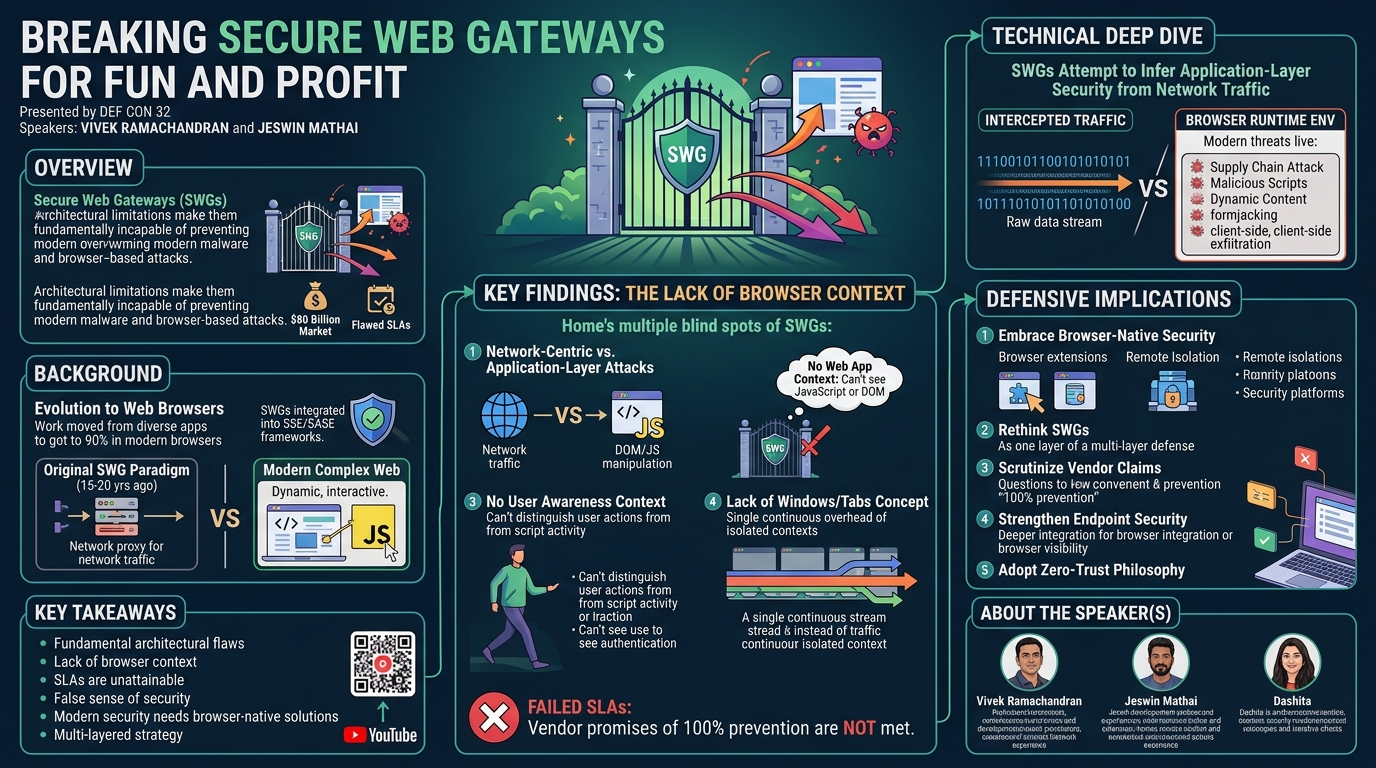
The central and most critical finding of this talk is that Secure Web Gateways (SWGs) are architecturally incapable of fulfilling their primary mandate: preventing 100% of malware and viruses from reaching end-user browsers. This is not attributed to individual software bugs that can be patched, but rather to a fundamental design flaw inherent in how SWGs operate. The speakers assert that "every single vendor in the SASE/SWG Gartner quadrant and beyond is vulnerable to the architecture attacks that we are about to discuss."
Specifically, the key findings revolve around the profound lack of browser context that plagues SWGs:
- Network-Centric vs. Application-Layer Attacks: SWGs are designed to observe and analyze network traffic. However, modern web attacks increasingly occur at the application layer within the browser itself, leveraging sophisticated JavaScript, DOM manipulation, and complex user interactions. SWGs attempt to "infer application layer attacks" from network data, a task that has become practically impossible.
- Absence of Web Application Context: SWGs lack insight into the actual state of the web application running in the user's browser. They cannot discern what JavaScript code is executing, how the Document Object Model (DOM) is being manipulated, or the specific logic of a web application. This blind spot means they cannot effectively detect client-side exploits or malicious actions initiated within the browser's runtime environment.
- No User Awareness Context: The gateways have no understanding of the user's current session, authentication state, permissions, or typical behavior within a specific application. Without this context, differentiating legitimate user actions from malicious automated or injected activity becomes incredibly difficult.
- Lack of Windows and Tabs Concept: SWGs process a continuous stream of network requests. They have no inherent concept of individual browser windows, tabs, or the isolation boundaries between them. This makes it challenging to attribute network activity to specific browser contexts or to understand the flow of user interactions across different application instances.
- Failure to Meet SLAs: Despite vendor promises of 100% malware prevention, the architectural limitations mean these SLAs are fundamentally unattainable. The talk strongly implies that enterprises are operating under a false sense of security, believing their SWGs provide comprehensive protection against web-borne threats, when in reality, significant attack vectors remain open.
In essence, the talk posits that SWGs, built for a simpler web, are ill-equipped for the complexities of modern browser-based threats. Their network-level perspective provides an incomplete and often misleading view, rendering them ineffective against the most prevalent and sophisticated web attacks today.
Technical Deep Dive
▶ Watch: SWG market size and universal architectural flaws (3:08)
The core technical argument presented is that Secure Web Gateways are fundamentally flawed because they operate primarily at the network layer, attempting to infer and prevent application-layer attacks without adequate browser context. This architectural mismatch is the root cause of their inability to effectively defend against modern web threats.
To understand this, consider the typical operation of an SWG. When an enterprise user browses the internet, their traffic is routed through the SWG. For HTTPS traffic, the SWG performs SSL interception (also known as "man-in-the-middle" SSL/TLS inspection). This involves the SWG decrypting encrypted traffic, inspecting its contents, and then re-encrypting it before forwarding it to its destination. While this allows the SWG to see the unencrypted payload, its analysis is still confined to the raw data stream at the network level.
The problem arises because the modern web is highly dynamic and client-side driven. Websites are no longer static HTML pages; they are complex web applications powered by extensive JavaScript, WebAssembly, and interactions with the Document Object Model (DOM). An SWG, observing network traffic, sees:
- HTTP/HTTPS requests and responses: URLs, headers, POST data, downloaded files.
- Network protocols: DNS lookups, TCP/IP connections.
What it cannot see or understand effectively includes:
- Web Application Context: The internal state of a web application. For example, if a legitimate JavaScript library is hijacked or a new, malicious script is injected into the DOM, the SWG might only see the initial legitimate script download or subsequent network requests. It cannot see the malicious logic execute within the browser's runtime environment or how it manipulates the page content or user interface.
- User Awareness Context: The SWG has no direct insight into the user's intent or current interaction flow within a web application. It cannot differentiate between a legitimate user click that triggers an action and a programmatically simulated click by a malicious script. It also doesn't understand the user's authentication status, roles, or access privileges within a specific application, making it difficult to detect unauthorized actions initiated from within a compromised browser session.
- Browser Internal State: The browser maintains a complex internal state, including cookies, local storage, session storage, service workers, and IndexedDB. SWGs only see what goes over the wire, not how these client-side storage mechanisms are accessed or manipulated by scripts.
- Windows and Tabs: From the SWG's perspective, all traffic from a single client machine might appear as a continuous stream. It lacks the browser's nuanced understanding of isolated contexts provided by different windows, tabs, or iframes. An attack might exploit cross-origin communication within the browser that doesn't manifest as distinct malicious network requests, or it might exfiltrate data through subtle timing attacks that are invisible at the network level.
- Dynamic Content Generation: Many modern web applications generate content dynamically on the client-side using JavaScript. An SWG might scan the initial HTML payload for malicious content, but it cannot effectively analyze or predict the malicious code that might be dynamically injected or executed after the initial page load, based on user interaction or external data fetched via AJAX/Fetch API calls.
Consider a scenario where a legitimate website is compromised with client-side JavaScript malware (e.g., a supply chain attack on a third-party script). The SWG might initially allow the legitimate website to load. However, if the malicious script then performs actions like:
- Stealing credentials from form fields before submission.
- Redirecting the user to a phishing site using
window.location. - Injecting malicious HTML/CSS to display fake login forms.
- Exfiltrating sensitive data from the DOM via
XMLHttpRequestorfetchto a C2 server, potentially disguised as legitimate API calls. - Leveraging browser APIs for persistent access or further exploits.
In these cases, the SWG, operating at the network perimeter, often lacks the necessary context to detect the malicious intent. It might see an outbound request, but without understanding the originating script, the DOM context, or the user's interaction, it cannot definitively classify it as malicious. The traffic might appear benign from a purely network perspective. This architectural gap means that while SWGs can block access to known malicious URLs or detect signatures in downloaded files, they are largely blind to the sophisticated, in-browser attacks that define the modern threat landscape.
Demo / Proof of Concept
▶ Watch: SWGs architecturally fail malware prevention (4:00)
The provided transcript does not include any details regarding a demonstration or a proof of concept. The speakers focus entirely on outlining the architectural problem and its implications rather than showcasing specific exploits or bypass techniques in action. Therefore, this section cannot provide any specific information about a demo or PoC.
Defensive Implications
▶ Watch: Vendor promises vs. reality: 100% malware prevention SLAs (4:41)
Given the profound architectural limitations of Secure Web Gateways, organizations must critically re-evaluate their web security posture and adopt a more layered and context-aware defense strategy. Relying solely on SWGs for comprehensive web threat prevention is no longer tenable.
Here are the key defensive implications:
- Embrace Browser-Native Security Solutions: The most significant implication is the need for security controls that operate within the browser's runtime environment. Since SWGs lack browser context, solutions that can observe and control JavaScript execution, DOM manipulation, API calls, and user interactions directly at the client-side are crucial. This includes Browser Security Platforms, Enterprise Browser Extensions, or Remote Browser Isolation (RBI) technologies that provide a more granular view of browser activity. These solutions can detect and mitigate threats that an SWG would miss, such as client-side supply chain attacks, formjacking, credential harvesting, and malicious redirects initiated by in-browser scripts.
- Rethink the Role of SWGs: SWGs still offer value for foundational security tasks like URL filtering (blocking access to known malicious domains), basic content scanning for obvious malware signatures in downloads, and policy enforcement for acceptable use. However, they should be viewed as one layer of defense, not the ultimate perimeter. Organizations should adjust their expectations regarding SWG capabilities, particularly concerning advanced, client-side threats.
- Strengthen Endpoint Security with Browser Visibility: While the speakers noted endpoint security's traditional "zero visibility into the browser," this highlights a critical gap that needs addressing. Modern Endpoint Detection and Response (EDR) and Extended Detection and Response (XDR) solutions should strive for deeper integration with browser telemetry to gain greater context on browser processes, network connections originating from the browser, and interactions with the operating system.
- Scrutinize Vendor SLAs and Capabilities: Enterprises should challenge SWG vendors regarding their "100% prevention" claims. It's imperative to understand the specific types of attacks their solutions can and cannot prevent, especially in the context of modern browser-based threats. Security teams need to ask pointed questions about how their SWGs handle dynamic JavaScript, DOM manipulation, and sophisticated client-side attacks.
- Implement Stronger Content Security Policies (CSPs): For web applications developed in-house, robust Content Security Policies (CSPs) can significantly reduce the attack surface by restricting which scripts can execute, where resources can be loaded from, and what inline code is permitted. While not a direct SWG countermeasure, it's a critical client-side defense.
- Focus on Data Loss Prevention (DLP) at Multiple Layers: While SWGs offer DLP capabilities, their network-centric view can be bypassed by sophisticated browser-based exfiltration techniques. Complementing SWG DLP with endpoint DLP, cloud access security broker (CASB) solutions, and potentially browser-native DLP can provide more comprehensive coverage.
- User Education and Awareness: Despite technical controls, the human element remains a critical vulnerability. Continuous training on identifying phishing, social engineering tactics, and suspicious browser behavior is essential, as some of the attacks bypassing SWGs may still require user interaction.
- Adopt a Zero-Trust Philosophy: The architectural flaws of SWGs reinforce the principles of Zero Trust. Organizations should assume that network perimeters can be breached and that browser environments might become compromised. This necessitates a focus on continuous verification, least privilege access, and micro-segmentation, even within the browser's operational context.
In summary, the talk serves as a wake-up call, urging security teams to move beyond traditional network-centric defenses and invest in solutions that provide deep, contextual visibility and control over the browser, which has become the primary battleground for enterprise cybersecurity.
Key Takeaways
- SWGs suffer from fundamental architectural flaws, not just software bugs, rendering them ineffective against modern browser-based attacks.
- The primary architectural weakness is the lack of browser context, preventing SWGs from understanding web application state, user intent, or dynamic client-side activities like JavaScript execution and DOM manipulation.
- This inherent limitation means vendor SLAs promising "100% prevention of all known malware" are largely unattainable for sophisticated web threats.
- Enterprises are operating under a false sense of security if they rely solely on SWGs for comprehensive web threat prevention.
- Effective modern web security requires browser-native solutions that provide deep visibility and control within the client's browser environment, complementing network-level defenses.
- Organizations must adopt a multi-layered security strategy, combining SWGs for foundational filtering with advanced browser security platforms, enhanced endpoint visibility, and robust client-side controls.
About the Speaker(s)
Vivek Ramachandran is a highly experienced cybersecurity professional with over 20-25 years in the field. He gave his very first DEF CON talk 17 years ago, way back in 2007, showcasing his long-standing contributions to the security community. Ramachandran is known for discovering multiple attacks, including the "cafe late attack." He is the founder of Penster Academy and currently runs Square X, a browser security company.
Jeswin Mathai serves as the Principal Engineer at Square X. His research interests primarily focus on browser extensions. While he was listed as a speaker, he was unfortunately unable to attend DEF CON 32 due to last-minute US immigration problems but sent his regards.
Dashita also conducts security research at Square X and was present at the talk, assisting Vivek Ramachandran.
Reviews
Dr. Zero (Offensive Security Researcher) — MUST SEE
This talk delivers a brutal, necessary architectural critique of Secure Web Gateways, exposing their fundamental inability to defend against modern browser-based threats. It's not about a patchable bug, but a systemic flaw rooted in their lack of browser context. This challenges an $80 billion market and forces enterprises to rethink their entire web security posture, moving beyond the false sense of security provided by misleading vendor SLAs.
Heather Calloway (CISO) — MUST SEE
This talk delivers a critical and overdue architectural assessment of Secure Web Gateways (SWGs), exposing their fundamental inability to defend against modern browser-based attacks. It's a wake-up call for every CISO operating under the false premise that these systems provide comprehensive web security, directly challenging vendor promises and demanding a strategic re-evaluation of enterprise web defense in an $80 billion market. The core message is clear: the browser is the new endpoint, and network-centric SWGs are blind to the most prevalent threats occurring within it.