Batch Normalization: Accelerating Deep Network Training by Reducing Internal Covariate Shift
Sergey Ioffe, Christian Szegedy
International Conference on Machine Learning 2025 · Test of Time Award
Overview
This article delves into the transformative impact of Batch Normalization (BN), a technique that earned Sergey Ioffe and Christian Szegedy the prestigious ICML 2025 Test of Time Award. Presented by Ioffe, this talk offers a retrospective on the paper "Batch Normalization: Accelerating Deep Network Training by Reducing Internal Covariate Shift," published at ICML 2015. The presentation not only revisits the original motivations and immediate successes of BN but also provides a refined understanding of its mechanisms, incorporating insights gained over the past decade. The committee recognized BN for its profound and widespread influence, noting that it, or its derivatives, has become an indispensable component in nearly every deep learning system, from early convolutional neural networks to contemporary architectures.
Key moments
- 0:00 Batch Normalization wins Test of Time Award
- 2:00 Speaker introduction and talk overview
- 4:00 Deep learning challenges in 2015: slow training, sigmoid saturation
- 6:00 Explaining the problem: Internal Covariate Shift
- 6:40 The simple Batch Normalization algorithm
Batch Normalization: Accelerating Deep Network Training by Reducing Internal Covariate Shift
Speakers: Sergey Ioffe, XAI; Christian Szegedy
Conference: ICML 2025
YouTube: https://slideslive.com/39044003
Overview
This article delves into the transformative impact of Batch Normalization (BN), a technique that earned Sergey Ioffe and Christian Szegedy the prestigious ICML 2025 Test of Time Award. Presented by Ioffe, this talk offers a retrospective on the paper "Batch Normalization: Accelerating Deep Network Training by Reducing Internal Covariate Shift," published at ICML 2015. The presentation not only revisits the original motivations and immediate successes of BN but also provides a refined understanding of its mechanisms, incorporating insights gained over the past decade. The committee recognized BN for its profound and widespread influence, noting that it, or its derivatives, has become an indispensable component in nearly every deep learning system, from early convolutional neural networks to contemporary architectures.
Sergey Ioffe, now at XAI, and Christian Szegedy, formerly at Google, introduced BN at a critical juncture in deep learning's evolution. In 2015, despite significant breakthroughs like the Inception model achieving state-of-the-art results on ImageNet, training deep networks remained a laborious and delicate process, often requiring weeks on large CPU clusters. BN emerged as a solution to this bottleneck, dramatically accelerating training and simplifying the optimization process. Its initial premise revolved around mitigating "Internal Covariate Shift," a concept that, while not entirely accurate in its original formulation as later research revealed, nonetheless pointed to a fundamental challenge BN effectively addressed.
The enduring relevance of Batch Normalization is underscored by its continued presence in the deep learning toolkit and its role in inspiring a rich lineage of subsequent normalization techniques, including Layer Normalization (LayerNorm), Instance Normalization (InstanceNorm), and Group Normalization (GroupNorm). This talk unpacks BN's technical underpinnings, its practical benefits, and the nuanced understanding of its true impact on the optimization landscape of deep neural networks. It also explores the limitations of BN, particularly concerning mini-batch dependencies, and introduces solutions like Batch Renormalization, alongside a forward-looking perspective on the role of mini-batch interactions in future model development.
Background
▶ Watch: Batch Normalization wins Test of Time Award (0:00)
In 2015, deep learning was experiencing rapid advancements, with models like Inception pushing the boundaries of performance on challenging tasks such as ImageNet classification. However, these successes came at a significant computational cost. Training a complex model like Inception on ImageNet could take up to a month, running on extensive clusters of CPUs. This protracted training cycle necessitated extremely conservative optimization strategies: learning rates had to be kept infinitesimally small, and model weights required precise initialization to prevent divergence. The fragility of deep network training was a major impediment to further innovation and deployment.
One particular symptom of this fragility was the difficulty in training networks with sigmoid activation functions. While sigmoids were historically prevalent in neural networks, deep architectures largely shifted towards Rectified Linear Units (ReLUs) because sigmoids proved notoriously difficult to optimize in deeper contexts. The core problem stemmed from the saturation behavior of sigmoids: if inputs to a sigmoid layer became too large (positive or negative), the activation would saturate, pushing the gradient to near zero and effectively halting learning. This "vanishing gradient" problem made it challenging for the model to learn in the useful, non-saturated region of the sigmoid.
Sergey Ioffe articulated the problem as one of Internal Covariate Shift (ICS). In a deep network, each layer's inputs are the outputs of the preceding layers. As the model trains, the weights of these preceding layers change, causing the distribution of inputs to any given layer to shift constantly and unpredictably. This constant change forces subsequent layers to continuously adapt to new input distributions, slowing down the learning process. Analogous to how a machine learning model struggles when its training data distribution differs significantly from its test data distribution, internal layers faced a similar challenge. The prevailing solution in traditional machine learning for changing input distributions was whitening or some form of input normalization. The natural question that motivated Batch Normalization was, therefore, "Why don't we apply similar normalization techniques to the inputs of internal layers within a deep network?" This idea was to stabilize the input distribution to each layer, thereby making the learning process more robust and efficient, and ideally, allowing problematic activation functions like sigmoids to be used effectively.
Key Findings
▶ Watch: Speaker introduction and talk overview (2:00)
The introduction of Batch Normalization marked a pivotal moment in deep learning, delivering a suite of immediate and profound benefits that fundamentally altered training practices. The primary initial findings were:
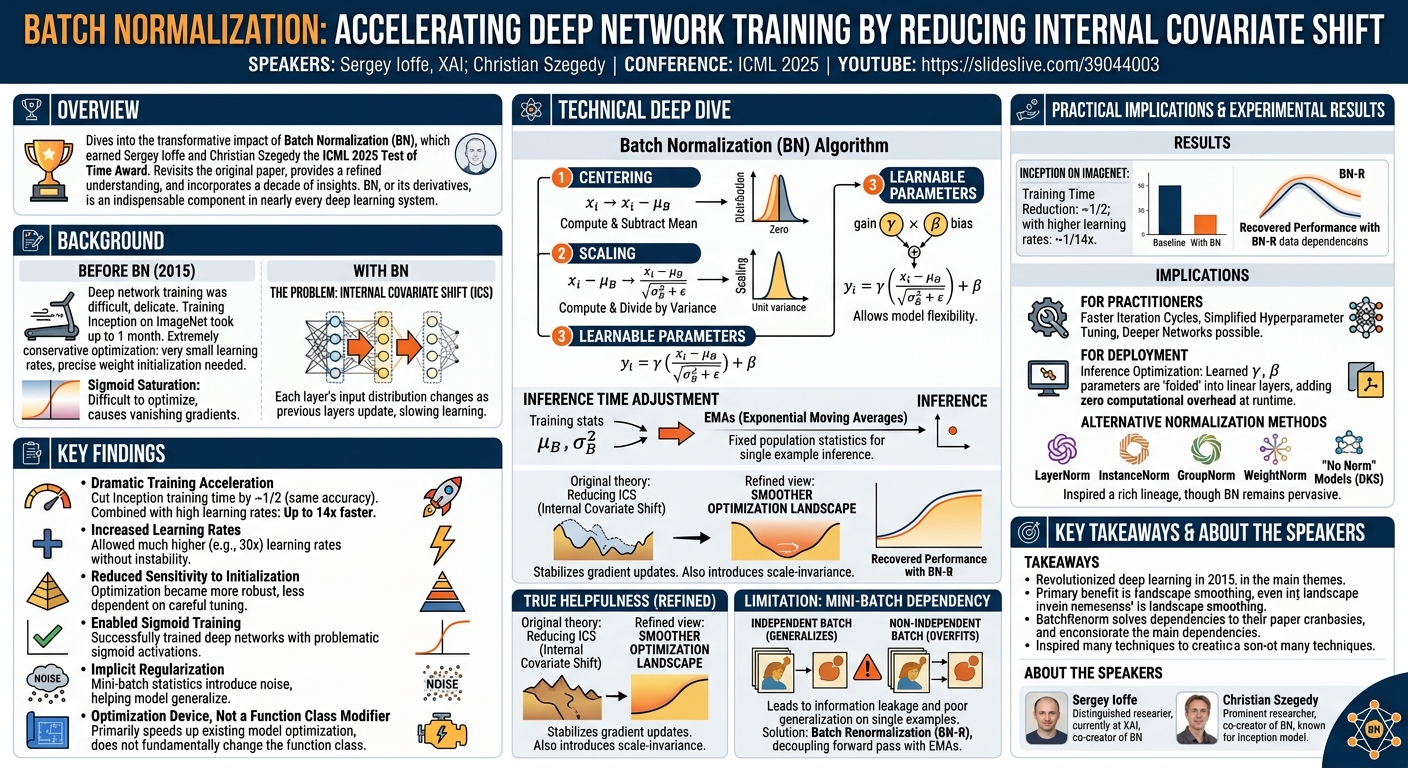
- Dramatic Training Acceleration: BN significantly reduced the time required to train deep networks. For instance, without any other modifications, it cut the training time of Inception on ImageNet by approximately half. When combined with increased learning rates, the speedup was even more substantial, reaching up to a 14x reduction in training time.
- Increased Learning Rates: BN allowed for the use of substantially higher learning rates (e.g., 30x higher), which was previously impossible due to training instability. This directly contributed to faster convergence.
- Reduced Sensitivity to Initialization and Learning Rate Schedules: Training deep models without BN required careful initialization of weights and meticulous scheduling of the learning rate. BN made the optimization process much more robust, reducing the need for such precise tuning.
- Enabling Sigmoid Training: While not ultimately outperforming ReLUs, BN successfully enabled the training of deep networks using sigmoid activation functions, which had been practically impossible before. This demonstrated BN's ability to mitigate the saturation problem.
- Implicit Regularization: The use of mini-batch statistics for normalization introduces a slight amount of noise into the training process, which implicitly regularizes the model, often leading to improved generalization performance.
- Optimization Device, Not a Function Class Modifier: Crucially, BN was characterized as an optimization device. The speaker emphasized that a model trained with BN belongs to the same function class as a model without it. At inference time, the learned scale (gamma) and shift (beta) parameters can be fused directly into preceding linear layers, meaning BN primarily makes the optimization of existing model classes more efficient rather than altering the model's fundamental representational power.
Beyond these initial observations, later research, particularly by Santurkar et al. (2018), provided a more precise understanding of BN's underlying mechanism, moving beyond the original "Internal Covariate Shift" hypothesis:
- Smoother Optimization Landscape: The most significant revelation was that BN makes the optimization landscape smoother. While not strictly "beta-smooth" in a global sense due to scale-invariance allowing gradients to become arbitrarily large near zero weights, BN substantially narrows the range of "effective beta values" observed along update directions, leading to more stable and predictable gradient updates.
- Not Solely for Gradient Explosion/Vanishing: The initial belief that BN primarily prevented gradient explosion and vanishing was found to be not entirely true. Gradients through the normalization layer can still be quite large, with the epsilon term primarily controlling the maximum gradient magnitude near zero activations.
- Scale-Invariance Properties: BN introduces scale-invariance to the model. As weights become larger, the loss does not change, but the gradient norm decreases. Furthermore, gradients in scale-normalized models are often orthogonal to the weights. This leads to an implicit increase in weight norms with every gradient update and a corresponding implicit decrease in the effective learning rate over time, an observation highlighted by Jimmy Ba and others. This interaction between normalization, weight decay, and learning rate scheduling is complex and important for effective training.
- Mini-Batch Dependencies and Limitations: A later key finding concerned BN's reliance on mini-batch statistics. When examples within a mini-batch are not independently sampled (e.g., in contrastive learning or when two examples of the same class are deliberately paired), BN can inadvertently "leak" information across examples. This dependency can lead to a significant drop in test accuracy when the model is evaluated on individual, independent examples, as it learns to exploit information that isn't available at inference time. This limitation spurred the development of solutions like Batch Renormalization.
Technical Deep Dive
▶ Watch: Deep learning challenges in 2015: slow training, sigmoid saturation (4:00)
Batch Normalization operates on a mini-batch of training examples. For each feature dimension within a layer's activations, BN performs a two-step normalization process:
- Centering: The mean of the activations for that specific feature dimension is computed across all examples in the current mini-batch. This mean is then subtracted from each activation in that dimension, effectively centering the distribution around zero.
- Scaling: The variance of the activations for that feature dimension is computed across the mini-batch. Each centered activation is then divided by the square root of this variance (plus a small epsilon for numerical stability), scaling the distribution to have unit variance.
After this raw normalization, BN introduces two learnable parameters per feature dimension: a gain parameter ($\gamma$) and a bias parameter ($\beta$). These parameters allow the model to inverse or account for the normalization if needed, giving the network the flexibility to learn the optimal scale and shift for its activations. The final normalized activation $y_i$ for an input $x_i$ in a mini-batch is given by:
$y_i = \gamma \cdot \frac{x_i - \mu_B}{\sqrt{\sigma_B^2 + \epsilon}} + \beta$
where $\mu_B$ and $\sigma_B^2$ are the mean and variance computed over the mini-batch $B$.
Inference Time Adjustments: A critical distinction arises during inference. Since individual examples are processed, mini-batch statistics are unavailable and undesirable (as they would make the output dependent on other examples). To address this, during training, BN layers typically maintain Exponential Moving Averages (EMAs) of the mini-batch means and variances across many training steps. These population-level EMAs are then used as fixed statistics for normalization during inference.
Gradient Flow and the "Why it Helps": The original paper attributed BN's success to reducing Internal Covariate Shift. However, later research, particularly by Santurkar et al. (2018), refined this understanding. It was found that a key component of BN's effectiveness comes from how gradients are propagated. Specifically, in the backward pass, the signal from the gradient that tries to move activations away from the zero-mean, unit-variance distribution is effectively removed or dampened. Even though the normalization is applied using mini-batch statistics, the model doesn't explicitly train to "undo" this normalization in the same way it might if the entire gradient flow were preserved. This partial decoupling of the gradient from the batch statistics is crucial.
The concept of scale-invariant models (models where scaling weights doesn't change the output) provides further insight. For such models, as weights become larger, the loss doesn't change, but the gradient norm decreases. Moreover, the gradient in a scale-normalized model is often orthogonal to the weights. This property means that with each SGD update, the norm of the weights tends to increase, leading to a continuously decreasing effective learning rate over time. This implicitly acts as a learning rate scheduler and regularization mechanism, interacting with explicit weight decay in complex ways.
Addressing Mini-Batch Dependencies with Batch Renormalization: A significant limitation of standard BN arises when examples within a mini-batch are not independently sampled. This is common in advanced training schemes like contrastive learning or when specific data augmentation strategies create dependencies. In such scenarios, BN can "leak" information across examples within the batch, allowing the model to learn spurious correlations that are not present during single-example inference. This leads to a degradation of generalization performance.
Batch Renormalization (BN-R), proposed in 2017, addresses this by decoupling the forward pass from the mini-batch statistics. In BN-R, the forward pass uses the population moments (the EMAs of mean and variance) for normalization, just like during inference. However, the backward pass still propagates gradients as if mini-batch normalization were being used. This means the beneficial "removal of signal" from the gradient, which prevents activations from deviating too far from a normalized distribution, is retained. BN-R recovers the performance of independently sampled examples, allows for smaller mini-batches, and can even theoretically extend to individual examples, effectively eliminating the discrepancy between training and inference normalization.
Population Normalization and Unbiased Gradients: The talk also touched upon unpublished work exploring population normalization, where all examples in the entire data distribution are normalized against each other. Batch normalization can be seen as approximating this ideal, but the gradient estimates it provides are biased because the forward pass uses mini-batch statistics, not true population statistics. The speaker introduced a method to obtain unbiased gradients for population-normalized models using mini-batches. This involves computing the gradient of the loss with respect to each normalization statistic and then reusing it from the previous optimization step as a "straight-through estimator," effectively delaying the gradients as they backpropagate. This technique aims to combine the benefits of population-level stability with mini-batch computational efficiency.
Experimental Setup & Results
▶ Watch: Explaining the problem: Internal Covariate Shift (6:00)
The original Batch Normalization paper demonstrated its efficacy through a series of compelling experiments, primarily focusing on deep convolutional neural networks for image classification.
The headline experiment involved training the Inception model on the ImageNet classification task. In 2015, training this model on large CPU clusters took approximately 30 days (or one month) to reach state-of-the-art accuracy. With the simple addition of Batch Normalization, without any other modifications, the training time was cut by half, achieving the same accuracy in roughly 15 days.
Further experiments explored the synergy between BN and other training hyperparameters:
- Increased Learning Rates: BN allowed for a substantial increase in the learning rate, up to 30 times the baseline. When combined with these higher learning rates, the overall training time was reduced by a factor of approximately 14x. This dramatic speedup was a key factor in BN's rapid adoption.
- Sigmoid Activations: One of the initial motivations for BN was to enable the training of networks with sigmoid activation functions, which were notoriously difficult to optimize in deep architectures due to saturation. BN successfully allowed models with sigmoids to train, a feat previously considered almost impossible. While these sigmoid-based models did not ultimately achieve the same performance as those using ReLUs, the experiment highlighted BN's ability to stabilize training even with challenging nonlinearities.
- Initialization and Learning Rate Schedules: The experiments showed that BN significantly reduced the sensitivity of models to precise weight initialization and intricate learning rate schedules, simplifying the overall optimization process.
Later work, discussed in the talk, highlighted a critical limitation related to mini-batch dependencies:
- Non-Independent Mini-Batches: When mini-batches were constructed with dependent examples (e.g., two examples of the same class deliberately paired, or 16 classes with two examples per class, forming a mini-batch of size 32), BN's performance suffered. While the model would train fine and initially achieve good accuracy on these dependent batches, when evaluated on individual, independent examples (using moving average statistics for inference), the test accuracy was substantially lower. This indicated that the model was learning to exploit information shared within the mini-batch that would not be available in a real-world inference scenario.
- Addressing Dependencies: A practical solution to this was to split the mini-batch into independent halves (e.g., for two examples per class, split the 32-example batch into two 16-example batches, each with one example per class) and apply BN independently to each half. This approach recovered much of the lost performance.
- Batch Renormalization (BN-R): The introduction of Batch Renormalization in 2017 provided a more principled solution. By using population moments (EMAs) in the forward pass while retaining the gradient properties of BN in the backward pass, BN-R was shown to recover the performance achieved with independently sampled examples. It also allowed for the use of smaller mini-batches, pushing the boundaries towards individual example normalization.
- Unbiased Population Gradients: The speaker briefly mentioned unpublished work on achieving unbiased gradients for population-normalized models using mini-batches. This method, involving delaying gradients from previous optimization steps, was stated to work effectively when trained on data like ImageNet with standard image classification models, suggesting a path toward more robust and efficient normalization for population-level statistics.
Practical Implications
▶ Watch: The simple Batch Normalization algorithm (6:40)
Batch Normalization has profoundly reshaped the landscape of deep learning practice, becoming an almost ubiquitous component in the design and training of neural networks. Its practical implications span various aspects of the ML workflow, from model building to deployment:
For Practitioners and Model Builders:
- Faster Iteration Cycles: The most immediate benefit is the dramatic acceleration of training. This allows researchers and developers to experiment with more complex architectures, larger datasets, and different hyperparameters in a fraction of the time, speeding up the pace of innovation.
- Simplified Hyperparameter Tuning: BN significantly reduces the sensitivity to initial weight distributions and learning rate schedules. This makes models easier to train, requiring less expert knowledge and tedious hyperparameter search, democratizing deep learning.
- Deeper Networks: By stabilizing activations and gradients, BN facilitated the training of much deeper neural networks than previously feasible. This paved the way for architectures with hundreds or thousands of layers, which are now commonplace.
- Regularization Effect: The inherent noise introduced by mini-batch statistics acts as a form of implicit regularization, often leading to better generalization performance and reducing the need for explicit regularization techniques like dropout.
For Infrastructure Teams and Deployers:
- Inference Optimization: A key advantage of BN is that its learned parameters ($\gamma$ and $\beta$) can be "folded" or fused into the preceding linear or convolutional layers at inference time. This means that after training, a model with BN layers can be converted into an equivalent model without explicit BN operations, incurring no additional computational overhead during deployment. This makes BN-enabled models efficient for real-time applications.
- Resource Utilization: Faster training times translate directly into more efficient use of computational resources (GPUs, TPUs), reducing costs associated with large-scale model development.
Tradeoffs and Limitations:
Despite its widespread success, BN is not without its limitations, which have spurred the development of alternative normalization methods:
- Mini-Batch Dependency: The reliance on mini-batch statistics is a double-edged sword. While beneficial for regularization, it can be problematic when mini-batch examples are not independently sampled (e.g., in contrastive learning, self-supervised learning, or when using specific data augmentation strategies). In these cases, BN can leak information across examples, leading to models that perform poorly on individual inference. This issue led to the development of Batch Renormalization and other techniques to mitigate such dependencies.
- Discrepancy Between Training and Inference: The difference in how normalization statistics are computed (mini-batch vs. EMAs) can sometimes lead to performance discrepancies, especially with very small batch sizes where mini-batch statistics are noisy.
- Not Always the Best Fit: For certain architectures, particularly Transformers in Natural Language Processing, Layer Normalization has proven more effective. LayerNorm normalizes across the feature dimensions within a single example, making it independent of batch size and suitable for variable-length sequences and causal models where information leakage across time steps or other examples is undesirable.
- Emergence of Alternatives: The desire to overcome BN's limitations led to a rich family of normalization techniques:
- Layer Normalization: Normalizes features within each example, independent of batch size.
- Instance Normalization: Normalizes features within each channel of a single example, often used in style transfer.
- Group Normalization: Normalizes features within groups of channels, a compromise between LayerNorm and InstanceNorm, robust to batch size variations.
- Weight Normalization: Normalizes the weights themselves rather than activations, though less widely adopted for deep convnets.
- "No Norm" Models: Interestingly, there's a growing trend to design highly performant deep models that avoid normalization layers entirely. Techniques like Deep Kernel Shaping (DKS) and careful initialization combined with skip connections demonstrate that with sufficient theoretical grounding and meticulous design, normalization can sometimes be rendered unnecessary.
Looking forward, the speaker highlighted that understanding and leveraging mini-batch interactions remains a powerful avenue for future research, particularly in areas like representation learning, contrastive learning, and learning to attend to long contexts. The development of methods like population normalization with unbiased or synthetic gradients could further enhance optimization efficiency, especially for long-sequence models where backpropagating through distant tokens is computationally expensive.
Key Takeaways
- Batch Normalization (BN) revolutionized deep learning training in 2015, dramatically accelerating convergence (up to 14x speedup) and simplifying hyperparameter tuning, especially for learning rates and weight initialization.
- BN's core mechanism involves normalizing activations within mini-batches (centering and scaling) and introducing learnable scale ($\gamma$) and shift ($\beta$) parameters, with Exponential Moving Averages (EMAs) used for inference.
- The true benefit of BN is primarily due to smoothing the optimization landscape, rather than solely reducing "Internal Covariate Shift" or preventing gradient explosion/vanishing as originally theorized. It makes the training process more stable and predictable.
- BN introduces scale-invariance, leading to implicit learning rate scheduling and regularization. However, its reliance on mini-batch statistics can cause issues with non-independently sampled examples, potentially leading to information leakage and reduced generalization.
- Batch Renormalization (BN-R) addresses mini-batch dependencies by using population moments (EMAs) in the forward pass while retaining BN's gradient properties in the backward pass, ensuring consistent performance regardless of batch structure.
- BN inspired a rich family of normalization techniques (LayerNorm, InstanceNorm, GroupNorm) tailored for different architectures and data types, and also demonstrated that careful model design can sometimes eliminate the need for normalization altogether.
About the Speaker(s)
Sergey Ioffe is a distinguished researcher in the field of deep learning, recognized for his foundational contributions, most notably the co-creation of Batch Normalization. In 2015, when the Batch Normalization paper was published, Sergey was working at Google. He is currently affiliated with XAI. His work has profoundly influenced how deep neural networks are trained and optimized, enabling the development of more complex and performant models.
Christian Szegedy is another prominent figure in deep learning, known for his work on convolutional neural networks and his collaboration with Sergey Ioffe on Batch Normalization. At the time of the paper's publication in 2015, Christian was also at Google, where he was instrumental in developing the Inception architecture, which achieved state-of-the-art results on ImageNet classification. His contributions, alongside Ioffe's, have significantly advanced the practical applicability and theoretical understanding of deep learning.
Reviews
Maya Iyer (Theoretical ML Researcher) — SOLID
This is a Test of Time retrospective on Batch Normalization — a technique whose practical significance is unambiguous and whose selection for this award is defensible on impact grounds alone. The talk is honest about what the original paper got wrong (the ICS framing), incorporates Santurkar et al.'s landscape-smoothing reinterpretation, and gestures toward Batch Renormalization and unpublished work on unbiased population gradients. Evaluated as a 2025 research contribution, however, the talk does not clear the bar for new theoretical or empirical results. It consolidates, clarifies, and contextualizes — which has real value — but the core claims are either decade-old or borrowed from…
Chen Zhao (Applied ML Researcher & Empiricist) — STRONG ACCEPT
This is a Test of Time Award retrospective on Batch Normalization — a technique whose significance is not in question. The talk earns its stars not because BN is important (obviously it is) but because Ioffe uses the retrospective format productively: he doesn't just take a victory lap, he updates the original mechanistic claim, introduces Batch Renormalization as a principled fix to a real failure mode, and gestures at unpublished work on unbiased population gradients. For a ten-year-old paper, that's a genuinely useful scientific contribution. The presentation is honest about what the original theory got wrong, which is rarer than it should be.
→ Top-rated talks at International Conference on Machine Learning 2025
All talks from International Conference on Machine Learning 2025