Identifying Incoherent Search Sessions: Search Click Fraud Remediation Under Real-World Constraints
Runze Zhang, Ranjita Pai Sridhar, Mingxuan Yao, Zheng Yang, David Oygenblik, Haichuan Xu
IEEE Symposium on Security and Privacy 2025 · Day 1 · Crime, Scams, and Fraud
Overview
In the highly competitive landscape of online advertising, search engines operate on a pay-per-click (PPC) model, where advertisers compensate the search engine each time a user clicks on their ad. This symbiotic relationship, however, is constantly threatened by click fraud, a malicious activity where automated bots or scripts simulate legitimate user clicks on advertisements. This talk, presented by Runze Zhang from Georgia Tech in collaboration with Microsoft, delves into a novel approach to combating this persistent and evolving threat by identifying "incoherent search sessions."
Key moments
- 0:00 Introduction to search click fraud and its challenges
- 2:00 Froster evasion and the core insight: incoherent queries
- 3:25 Introducing COAC: an end-to-end framework for detection
- 4:00 COAC's multi-dimensional feature extraction process
- 5:05 Real-world ground truth dataset from Bing traffic
- 6:00 COAC's high performance metrics and baseline comparison
- 6:40 Ablation study showing feature importance and dataset impact
- 7:15 Conclusion and additional details in the full paper
Identifying Incoherent Search Sessions: Search Click Fraud Remediation Under Real-World Constraints
Speakers: Runze Zhang, Georgia Institute of Technology; Ranjita Pai Sridhar, Microsoft; Mingxuan Yao, Microsoft; Zheng Yang, Microsoft; David Oygenblik, Microsoft; Haichuan Xu, Microsoft
Conference: IEEE S&P
YouTube: https://www.youtube.com/watch?v=VKeFfghfLH0
Overview
In the highly competitive landscape of online advertising, search engines operate on a pay-per-click (PPC) model, where advertisers compensate the search engine each time a user clicks on their ad. This symbiotic relationship, however, is constantly threatened by click fraud, a malicious activity where automated bots or scripts simulate legitimate user clicks on advertisements. This talk, presented by Runze Zhang from Georgia Tech in collaboration with Microsoft, delves into a novel approach to combating this persistent and evolving threat by identifying "incoherent search sessions."
The research highlights a critical vulnerability in existing fraud detection mechanisms: their inability to reliably distinguish fraudulent traffic when attackers mimic legitimate user patterns. Traditional methods, which often rely on superficial indicators like IP addresses, request headers, or user account metadata, are increasingly circumvented by sophisticated fraudsters employing proxies and fabricating user profiles. This paper introduces COSAC (COherence-based Session Anomaly Classifier), an end-to-end framework designed to automatically flag incoherent search sessions by analyzing the semantic, temporal, and behavioral patterns within a user's sequence of queries. The work is particularly significant because it leverages a fundamental insight into human search behavior – the inherent coherence in legitimate user sessions – to detect fraud that evades conventional defenses, offering a robust new line of defense for search engines and advertisers alike.
Background
▶ Watch: Introduction to search click fraud and its challenges (0:00)
Click fraud has long plagued the online advertising industry, particularly within the pay-per-click (PPC) model that underpins much of the search engine economy. Under this model, advertisers bid for placement of their ads on search results pages, paying the search engine each time a user clicks on their advertisement. The expectation is that these clicks lead to genuine user engagement and potential purchases, creating a win-win scenario for advertisers and search engines. However, this system is ripe for abuse by malicious actors, often referred to as "click fraudsters," who deploy bots or automated scripts to generate artificial clicks. These fraudulent clicks drain advertisers' budgets without delivering any genuine business value, leading to significant financial losses and wasted advertising spend. Furthermore, search engines suffer reputational damage, eroding trust among advertisers and potentially leading to long-term customer attrition.
The motivation for search engines to actively detect and block such traffic is therefore immense. Historically, fraud traffic investigators, or "Peters" as the presenter refers to them, have relied on a suite of techniques to identify suspicious activity. These include examining the reputation of source IP addresses, flagging traffic with suspicious request headers, and scrutinizing user account metadata associated with each request. While effective against unsophisticated attacks, these traditional methods are increasingly insufficient. Fraudsters have evolved their tactics, deploying sophisticated evasion techniques such as using proxy networks to mask their true IP addresses, manipulating request content to appear legitimate, and creating fictitious user profiles to imbue their fraudulent traffic with an air of authenticity. Consequently, for any individual request, investigators often have limited reliable information to definitively determine its fraudulent nature.
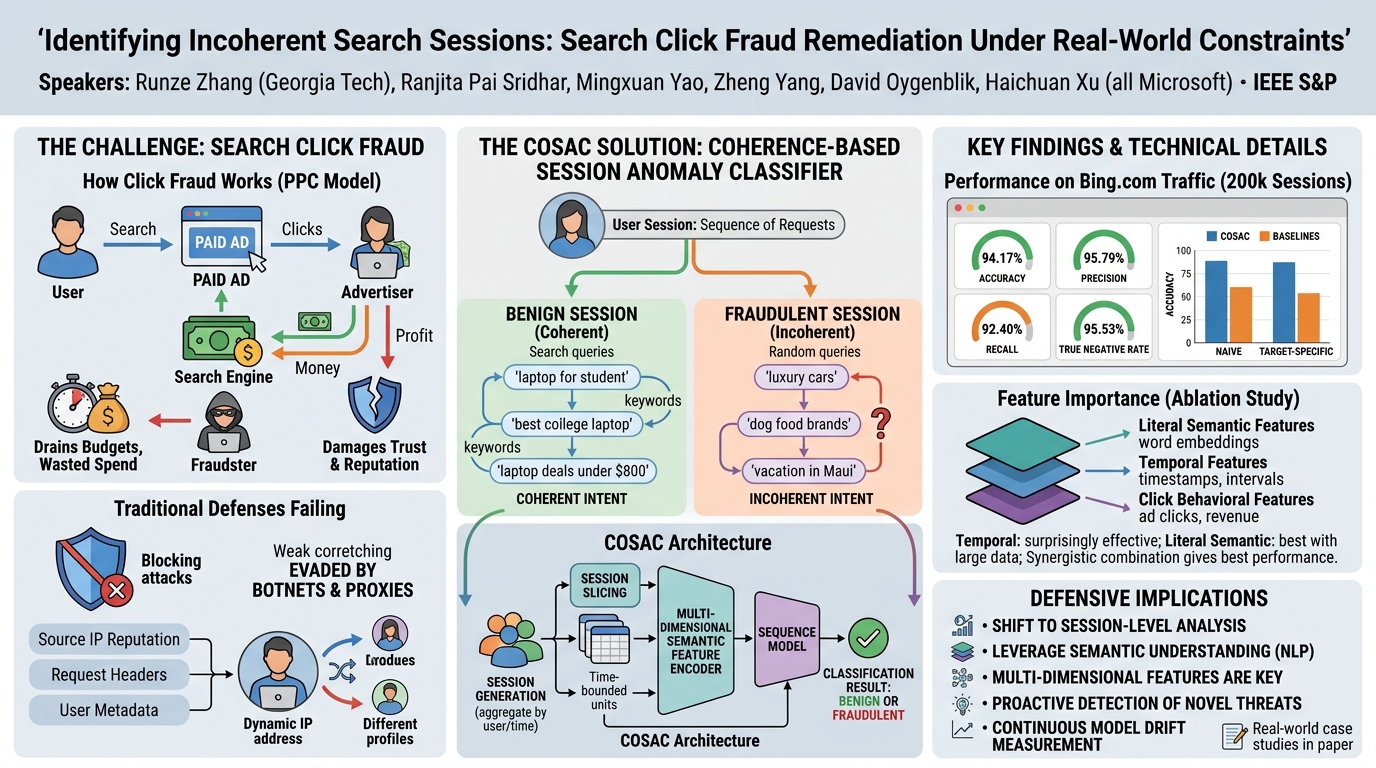
This ongoing challenge led the researchers to seek a new paradigm for fraud detection. Their core insight revolves around the search queries themselves, which fraudsters must issue to generate search results containing ad links for their bots to click. By closely examining these queries, the researchers observed a fundamental difference between fraudulent and legitimate user behavior. Fraudsters, often aiming to maximize ad impressions and clicks across a wide array of keywords, tend to generate search queries that are largely random, disconnected, and lack contextual correlation with each other. These are termed illogical searches or incoherent sessions. In stark contrast, legitimate users typically maintain a single thread of intent within a search session, refining their queries by adding or removing keywords to narrow down results. For instance, a user searching for "hotel in San Francisco" might subsequently add "with pool" or "under $200" to refine their search, resulting in a semantically coherent session. This critical distinction forms the bedrock of the COSAC framework, enabling Peter to leverage the inherent coherence (or lack thereof) in search query sequences to detect fraudulent traffic.
Key Findings
▶ Watch: Introducing COAC: an end-to-end framework for detection (3:25)
The central and most impactful finding of this research is the discovery that fraudulent search sessions exhibit a distinct lack of semantic and temporal coherence when compared to legitimate user sessions. While fraudsters generate disparate, often random queries to trigger various ads, genuine users typically engage in a logical progression of queries, refining their intent within a session. This fundamental behavioral difference provides a robust, difficult-to-evade signal for fraud detection.
To operationalize this insight, the researchers developed COSAC (COherence-based Session Anomaly Classifier), an end-to-end framework specifically designed to automatically flag these incoherent sessions. COSAC's effectiveness was rigorously validated using real-world traffic logs from Bing.com, demonstrating its capability to move beyond superficial per-request analysis to a deeper, session-level understanding of user intent.
The performance metrics achieved by COSAC are compelling:
- An average accuracy of 94.17%
- A precision of 95.79%
- A recall of 92.40%
- A true negative rate of 95.53% on benign sessions, indicating a low false positive rate.
These figures represent a significant improvement over baseline models, particularly in distinguishing between benign and fraudulent activities across both "naive" and "target-specific" fraud subsets. The framework achieved 93.49% accuracy and 91.31% recall on the fraudulent subsets, demonstrating its strong capability to identify malicious activities.
Furthermore, an ablation study performed on COSAC highlighted the critical importance of multi-dimensional features. While temporal features alone proved surprisingly effective in establishing a good decision boundary, especially with limited dataset sizes, literal semantic features emerged as the most promising performers when the model was trained with larger datasets. Crucially, COSAC achieved its best performance by integrating all feature groups – literal semantic, temporal, and click-behavioral – underscoring the synergistic benefits of a holistic feature engineering approach. This finding suggests that a combination of understanding what users search for, when they search, and how they interact with ads provides the most comprehensive signal for fraud detection.
The research also extended beyond the presentation, with the full paper documenting preliminary investigations into search coherence, additional evaluation results including COSAC's drift measurement capabilities, and comparative analyses against various baselines. Notably, the paper includes two case studies on real-world fraud campaigns, highlighting existing evasion approaches deployed by fraudsters and demonstrating COSAC's ability to identify these sophisticated tactics. These case studies underscore the practical applicability and robustness of the COSAC framework in a dynamic threat landscape.
Technical Deep Dive
▶ Watch: Real-world ground truth dataset from Bing traffic (5:05)
The COSAC framework is an intricate, end-to-end system designed to process raw traffic logs and identify fraudulent search sessions by evaluating their coherence. It comprises several key stages, each contributing to the holistic assessment of a user's search behavior.
The process begins with Session Generation. COSAC ingests raw traffic logs, which consist of individual search requests. These requests are then grouped into coherent sessions based on various criteria, primarily temporal information. This involves aggregating requests from the same user within a defined time window, acknowledging that a user's search activity typically occurs in bursts. Following session generation, Session Slicing is performed, further segmenting these longer sessions into manageable, temporally bounded units for analysis. This step is crucial for capturing short-term intent and avoiding the dilution of coherence signals across excessively long, potentially multi-topic sessions.
A critical component for model training and evaluation is the derivation of a ground truth dataset. COSAC achieves this by utilizing a statistical M-matrix from raw data. While the specifics of this matrix are not detailed in the presentation, it serves as a mechanism to identify and label sessions as either benign or fraudulent. This statistical approach helps in building a robust dataset for supervised learning, especially for identifying "target-specific fraudulent sessions" from mostly abused websites.
The core of COSAC's analytical power lies in its Multi-dimensional Semantic Feature Encoder. This module is responsible for extracting three distinct categories of features from each request within a session:
- Literal Semantic Features:
- For each search query, COSAC first tokenizes the keywords.
- These tokens are then fed into a pre-trained language model (e.g., Word2Vec, BERT, or similar embedding models). The language model transforms the textual query into high-dimensional numerical representations, known as query embeddings.
- Average pooling is then applied to these embeddings to generate a single, fixed-size literal semantic feature vector for the entire query. This vector encapsulates the meaning and context of the search query, allowing COSAC to understand the semantic relationships between consecutive queries.
- Temporal Features:
- These features capture the timing aspects of user interaction.
- They include the absolute request timestamp, providing a global context of when the search occurred.
- Crucially, they also include the intervals between requests within a session. Anomalously short or long intervals between queries could indicate automated behavior or a sudden shift in user intent, respectively. These are combined into a temporal feature vector.
- Click Behavioral Features:
- This category focuses on how users interact with the ads presented in the search results.
- Statistical features extracted include the count of ad clicks within a request or session segment.
- The revenue generated from these ad clicks is also considered, providing a direct link to the economic impact of the clicks. These metrics form the click behavioral feature vector.
Each request within a search session is thus transformed into a set of these three feature vectors. These vectors are then fed sequentially into a sequence model. While the specific architecture of the sequence model (e.g., LSTM, GRU, Transformer) is not explicitly detailed in the presentation, its role is to process the ordered sequence of feature vectors from all requests within a session. By analyzing the progression and interrelationships of these features over time, the sequence model is able to derive a final classification result, determining whether the entire session is fraudulent or benign. The ability of such models to capture long-range dependencies and contextual information within sequences is paramount for detecting subtle incoherence patterns.
The validation of COSAC relied heavily on a robust ground truth dataset harvested from daily traffic logs of Bing.com, thanks to the collaboration with Microsoft. This dataset comprised 200,000 sessions, equally split between fraudulent and benign examples. For training, 70% of this data was used, with the remaining 30% reserved for testing. Benign sessions were carefully selected from long-term trusted users, ensuring their legitimacy. Fraudulent sessions were categorized into two subsets:
- Naive fraudulent sessions: Those captured by predefined filtering rules, representing more straightforward attacks.
- Target-specific fraudulent sessions: Those identified from "mostly abused websites" derived from the statistical M-matrix, indicating more sophisticated or focused attack vectors.
This comprehensive approach to feature extraction, model architecture, and real-world data validation underscores the technical depth and practical applicability of the COSAC framework in effectively identifying incoherent search sessions and combating click fraud.
Demo / Proof of Concept
▶ Watch: COAC's high performance metrics and baseline comparison (6:00)
While the presentation by Runze Zhang provided a thorough technical explanation of the COSAC framework and its evaluation, it did not include a live demonstration or a specific step-by-step proof-of-concept (PoC) walkthrough of the system in action. The focus of the talk was primarily on detailing the architecture, the underlying insights, the feature engineering process, and the quantitative results derived from real-world data.
However, the efficacy and practical application of COSAC are implicitly demonstrated through its validation against real-world traffic logs from Bing.com. The researchers explicitly state that the full paper provides "two case studies on real world fraud campaign highlighting exiting evision approach deployed by those frosters." This indicates that COSAC has been applied to actual fraud scenarios, successfully identifying sophisticated evasion tactics. Although a visual or interactive demo was not part of the conference talk, the rigorous testing on 200,000 sessions of live Bing traffic serves as a powerful validation of COSAC's capabilities as a proof of concept. The high accuracy, precision, and recall metrics achieved on this diverse dataset attest to the framework's ability to operate effectively under real-world constraints and identify genuine instances of click fraud.
Defensive Implications
▶ Watch: Conclusion and additional details in the full paper (7:15)
The COSAC framework introduces a paradigm shift in how search engines and advertisers can defend against click fraud, moving beyond traditional, easily evaded methods to a more sophisticated, behavioral-based approach. The implications for defenders are significant and multifaceted:
- Shift to Session-Level Behavioral Analysis: The primary defensive implication is the necessity to move away from analyzing individual requests in isolation. Defenders must invest in systems capable of aggregating and analyzing sequences of user interactions within a session. This requires robust sessionization mechanisms and the infrastructure to store and process sequential data.
- Leveraging Semantic Understanding: Integrating natural language processing (NLP) and pre-trained language models into fraud detection pipelines is no longer a luxury but a necessity. Search engines should develop or adopt models that can understand the semantic content and contextual coherence of search queries. This allows for the identification of illogical or random query sequences that are indicative of bot activity, even if other superficial indicators appear legitimate.
- Multi-Dimensional Feature Engineering: COSAC demonstrates the power of combining diverse data points. Defenders should collect and analyze a rich set of features, including:
- Literal semantic features: The meaning and relationship between queries.
- Temporal features: The timing, speed, and intervals of user actions.
- Click behavioral features: How users interact with ads (e.g., click rates, ad types clicked, post-click behavior if observable).
This holistic approach provides a more robust signal than relying on any single feature type.
- Proactive Detection of Evolving Threats: By focusing on the intrinsic incoherence of fraudulent sessions, COSAC offers a method to detect novel or evolving fraud patterns that might bypass predefined rule sets or IP blacklists. As fraudsters develop new evasion techniques, their underlying lack of genuine intent will likely still manifest as incoherent search behavior, allowing COSAC-like systems to flag them.
- Continuous Monitoring and Adaptation: The mention of "drift measurement" in the paper highlights the need for continuous monitoring of model performance and data distribution. Fraud tactics are dynamic; therefore, detection systems must be adaptive, capable of being retrained or updated as fraud patterns evolve. This necessitates a feedback loop where newly identified fraud instances can inform future model improvements.
- Enhanced Ground Truth Generation: The use of a "statistical M-matrix" for deriving ground truth, particularly for "target-specific fraudulent sessions," suggests that defenders should invest in sophisticated methods for labeling data. This could involve leveraging existing abuse reports, analyzing website traffic patterns, or employing semi-supervised learning techniques to identify new sources of fraudulent activity for model training.
- Broader Applicability: The principles behind COSAC – identifying coherence in sequential user interactions – are not limited to search click fraud. Similar methodologies could be applied to detect fraud in other areas like e-commerce browsing, social media engagement, or online gaming, where legitimate user behavior typically follows a discernible, coherent pattern.
In essence, COSAC empowers defenders to fight fraud at a deeper, more intrinsic level of user intent, making it significantly harder for fraudsters to mimic genuine human behavior. This approach offers a critical advantage in the ongoing arms race against sophisticated online fraud.
Key Takeaways
- Traditional click fraud detection methods are increasingly ineffective against sophisticated fraudsters who evade IP, header, and user profile checks.
- Fraudulent search sessions are inherently incoherent, characterized by random and disconnected queries, unlike semantically logical legitimate user sessions.
- The COSAC framework provides an end-to-end solution for automatically identifying these incoherent sessions by analyzing multi-dimensional features.
- COSAC achieves high accuracy (94.17%) on real-world Bing.com traffic, demonstrating its practical effectiveness in distinguishing benign from fraudulent activity.
- A combination of literal semantic, temporal, and click-behavioral features offers the most robust signal for detecting click fraud.
- Defenders must adopt session-level, semantic-aware detection strategies to combat evolving click fraud tactics and protect advertising budgets.
About the Speaker(s)
The research presented was a collaborative effort between Georgia Tech and Microsoft, with Runze Zhang from Georgia Tech serving as the primary presenter. Zhang’s role indicates expertise in leading cutting-edge research in cybersecurity and machine learning applications, specifically in the domain of online fraud detection.
The team of collaborators from Microsoft, including Ranjita Pai Sridhar, Mingxuan Yao, Zheng Yang, David Oygenblik, and Haichuan Xu, brought invaluable industry experience and access to real-world data, such as Bing.com's daily traffic logs. Their involvement underscores Microsoft's commitment to combating online fraud and leveraging advanced analytical techniques to protect its advertising platforms. Collectively, the speakers represent a strong interdisciplinary blend of academic rigor from Georgia Tech and practical, large-scale system expertise from Microsoft, focusing on enhancing the security and integrity of online search ecosystems.