Supporting Family Discussions About Digital Privacy Through Perspective-Taking: An Empirical Investigation
Zikai Wen, Lanjing Liu, Yaxing Yao
IEEE Symposium on Security and Privacy 2025 · Day 1 · Privacy
Overview
Digital privacy has become an increasingly complex and contentious topic within families, particularly as adolescents navigate the burgeoning landscape of social media. The talk, "Supporting Family Discussions About Digital Privacy Through Perspective-Taking: An Empirical Investigation," presented by Zikai Wen alongside co-authors Lanjing Liu and Professor Yaxing Yao at IEEE S&P, delves into the critical challenges families face when discussing online privacy and proposes an innovative, empirically-backed solution. The core issue identified is a pervasive communication breakdown where parents and teenagers often "talk past each other," leading to stalled conversations, misunderstandings, and ineffective outcomes.
Key moments
- 0:00 Introduction: Common family privacy talk issues
- 1:30 Research problem: Observing family discussion dynamics
- 2:00 Targeting teens (13-15) and structured sessions
- 3:00 Framework to pinpoint disruptive conversational patterns
- 4:00 Intervention design: Three key elements of framework
- 4:40 Example of intervention improving family privacy dialogue
- 6:00 Future work: Scaling facilitation with AI assistance
Supporting Family Discussions About Digital Privacy Through Perspective-Taking: An Empirical Investigation
Speakers: Zikai Wen, Lanjing Liu, Yaxing Yao
Conference: IEEE S&P
YouTube: https://www.youtube.com/watch?v=sW7Q6aM0Jjo
Overview
Digital privacy has become an increasingly complex and contentious topic within families, particularly as adolescents navigate the burgeoning landscape of social media. The talk, "Supporting Family Discussions About Digital Privacy Through Perspective-Taking: An Empirical Investigation," presented by Zikai Wen alongside co-authors Lanjing Liu and Professor Yaxing Yao at IEEE S&P, delves into the critical challenges families face when discussing online privacy and proposes an innovative, empirically-backed solution. The core issue identified is a pervasive communication breakdown where parents and teenagers often "talk past each other," leading to stalled conversations, misunderstandings, and ineffective outcomes.
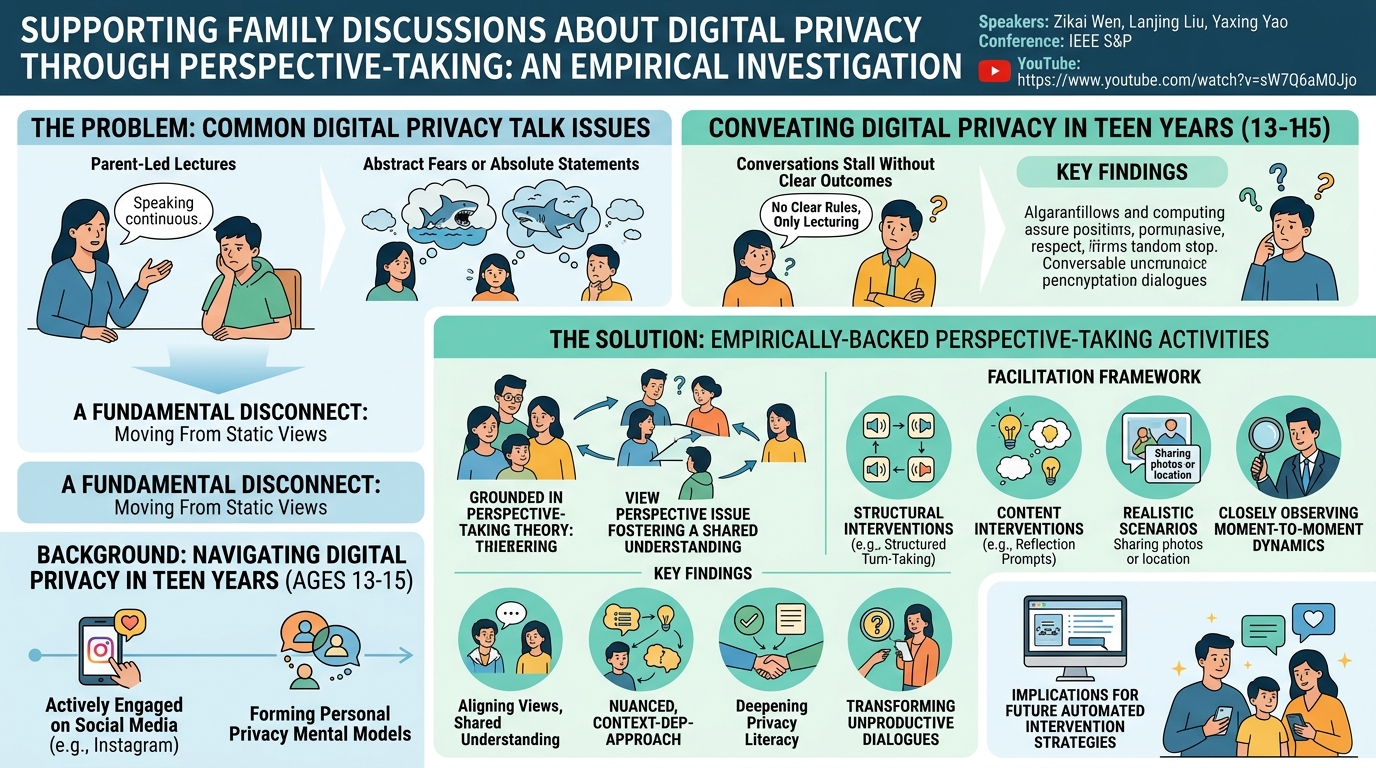
This research highlights that typical family privacy discussions frequently devolve into parent-led lectures, fail to yield clear actionable insights, and are hampered by abstract fears or absolute statements that alienate teenagers. Recognizing the critical period between ages 13 and 15, when adolescents actively engage with social media and begin forming their personal privacy mental models, the researchers developed structured activities grounded in perspective-taking theory. The objective is to foster a shared understanding of digital privacy by helping family members appreciate each other's viewpoints, moving beyond simplistic "yes/no" privacy stances to embrace a more nuanced, context-dependent approach.
The talk underscores the critical importance of effective family communication in shaping healthy digital habits and privacy literacy. By closely observing the "moment-to-moment dynamics" of these discussions, the team developed a facilitation framework designed to pinpoint and address specific conversational limitations. The findings demonstrate that by employing structured turn-taking, reflection prompts, and realistic scenarios, families can transform unproductive dialogues into constructive exchanges, aligning their perspectives and fostering a deeper, more adaptable understanding of digital privacy. This work offers a significant contribution to privacy education and family communication, with implications for future automated intervention strategies.
Background
▶ Watch: Introduction: Common family privacy talk issues (0:00)
The digital age has introduced unprecedented challenges for families attempting to navigate online privacy. As children, particularly those in their early teenage years (ages 13-15), begin to actively engage with social media platforms like Instagram, discussions about digital footprints and data sharing become inevitable. However, these conversations are frequently fraught with difficulties, often characterized by a fundamental disconnect between parents and their children. Parents, drawing from a lifetime of experience and a protective instinct, tend to emphasize the permanence and potential risks of online information, often resorting to absolute statements such as, "Once you post something online, it's almost impossible to delete later." Teenagers, on the other hand, often perceive these warnings as overly cautious or dismissive of their immediate social realities, sometimes responding with sentiments like, "Oh, come on. Relax. Nobody really cares about me anyway."
Previous research has consistently documented several common pitfalls in these family privacy talks. These include conversations that become parent-led lectures, where information is delivered unilaterally without genuine dialogue, leading to disengagement from the child. Another significant issue is that conversations often stall without clear outcomes, leaving both parties feeling unheard or misunderstood. Crucially, the researchers identified that participants frequently talk past each other, failing to grasp the underlying concerns or perspectives of the other party. This is exacerbated by the use of absolute statements (e.g., "always a risk") and abstract expressions about vague future fears, which lack the specificity needed for productive discussion and alienate teenagers who are focused on present-day social dynamics.
The choice to focus on teenagers aged 13 to 15 is deliberate. This developmental stage marks a critical period where adolescents are not only actively adopting social media but are also in the process of forming their personal privacy mental models. These models, influenced by their experiences, peer interactions, and family discussions, will shape their online behaviors for years to come. Therefore, intervening effectively at this stage to foster robust privacy literacy and communication skills is paramount. The research recognized that to design truly effective interventions, a deeper understanding of the "moment-to-moment dynamics" of these discussions was necessary – knowing precisely when and how to intervene to shift the trajectory of the conversation. Without this granular insight, interventions risk being poorly timed, irrelevant, or ineffective in addressing the root causes of communication breakdowns.
Key Findings
▶ Watch: Targeting teens (13-15) and structured sessions (2:00)
The empirical investigation revealed several significant findings regarding the efficacy of a structured, perspective-taking approach to facilitate family digital privacy discussions. The primary contribution is the demonstration that such an approach can effectively overcome common conversational limitations, transforming unproductive dialogues into more nuanced, context-based, and mutually understood exchanges.
One of the central findings was the identification of specific conversational patterns that disrupt the flow and effectiveness of privacy dialogue. The researchers pinpointed two prominent issues: first, the pervasive use of absolute statements (e.g., "there's always a risk"), which leave no room for nuance or contextual variation; and second, the reliance on abstract expressions about vague future fears, which resonate poorly with teenagers focused on immediate social contexts. The study showed that these patterns combine to make it challenging for both parents and children to genuinely understand each other's viewpoints, leading to a breakdown in communication where participants "talk past each other."
Crucially, the research confirmed that interventions grounded in perspective-taking theory and inspired by the 5Ds of privacy literacy educational framework can effectively address these identified limitations. By introducing a moderator-facilitated framework, the study observed a tangible shift in how families discussed privacy. The framework's three key elements – supporting communication adaptability through structured turn-taking and reflection prompts, enhancing digital privacy literacy by encouraging a non-binary, context-dependent view of privacy, and facilitating context-based discussions using realistic scenario prompts – collectively led to more productive outcomes.
The most compelling evidence of the framework's effectiveness was seen in the transformation of actual family exchanges. For instance, an initial conversation marked by a parent's absolute statement ("Putting anything down is always a risk") and a child's frustrated, abstract response ("How would they know I'll be the same person at 25...?") evolved significantly after intervention. The moderated approach guided the child to distinguish between "basic" and "more personal" information and prompted the parent to contextualize risks with specific examples rather than generalizations. This led to the child expressing a more nuanced understanding ("I wouldn't mind sharing basic stuff, but more personal information, not so much") and the parent reflecting a similar shift ("I think it depends on timing and the situation too"). This demonstrated that the framework successfully fostered a more focused and context-based conversation, ultimately aligning both perspectives in a productive manner.
In essence, the key findings underscore that by systematically addressing communication barriers, promoting nuanced privacy thinking, and grounding discussions in concrete scenarios, families can achieve a shared understanding of digital privacy. This empirical evidence provides a strong foundation for developing scalable interventions aimed at improving family digital literacy and communication.
Technical Deep Dive
▶ Watch: Framework to pinpoint disruptive conversational patterns (3:00)
The research's core innovation lies in its structured facilitation framework, meticulously designed to address the complex dynamics of family privacy discussions. This framework is grounded in established psychological and educational theories, specifically perspective-taking theory and the 5Ds of privacy literacy educational framework.
Perspective-taking theory posits that understanding another person's thoughts, feelings, and motivations from their viewpoint is crucial for effective communication and empathy. In the context of family privacy discussions, this means moving beyond simply hearing what the other person says to actively attempting to comprehend why they hold that view, considering their experiences, developmental stage, and concerns. The researchers adapted this theory by designing activities that explicitly prompt family members to articulate and reflect on each other's perspectives, thereby reducing instances of "talking past each other."
The 5Ds of privacy literacy educational framework, while not detailed explicitly in the talk, inspired two critical elements of the intervention. The 5Ds typically refer to a comprehensive approach to privacy education, often encompassing concepts like data collection, data usage, data sharing, data security, and data rights. From this framework, the researchers drew inspiration to:
- Enhance digital privacy literacy by encouraging families to see privacy as non-binary and context-dependent decisions. This directly counters the common tendency to view privacy as an all-or-nothing proposition (either completely private or completely public) or to apply universal, absolute rules. Instead, it promotes an understanding that privacy choices are fluid, varying based on the type of information, the audience, the platform, and the specific situation.
- Facilitate context-based discussions using realistic scenario prompts. Abstract discussions about "risk" or "privacy" are largely ineffective. By providing concrete, relatable scenarios (e.g., "sharing mental health treatment experiences on Instagram"), families are forced to ground their conversations in specific situations, making the implications and nuances of privacy decisions more tangible and easier to discuss productively.
The facilitation framework itself is built upon three interconnected elements:
- Communication Adaptability: This element focuses on structuring the interaction to ensure both parties have an opportunity to speak, be heard, and reflect. It involves:
- Carefully structured turn-taking: Moderators guide the conversation to ensure an equitable distribution of speaking time and prevent one party (often the parent) from dominating the dialogue.
- Reflection prompts: These are designed to encourage participants to pause, consider what has been said, and articulate their understanding or feelings. Examples might include "What do you hear your child saying about why they want to share this?" or "How do you think your parent feels when you say that?" This directly fosters perspective-taking.
- Digital Privacy Literacy Enhancement: As inspired by the 5Ds framework, this aims to shift participants' mental models of privacy. Moderators guide families to:
- Deconstruct absolute statements: Challenging generalizations like "always a risk" and prompting for specific conditions under which risk might vary.
- Embrace nuance: Encouraging the recognition that different types of information (e.g., basic contact details vs. sensitive personal experiences) warrant different levels of privacy consideration.
- Contextualize decisions: Highlighting that the "right" privacy choice depends heavily on the specific situation, platform, audience, and intent.
- Context-Based Discussions: To move away from vague fears and abstract warnings, the framework utilizes:
- Realistic scenario prompts: These are carefully crafted situations that mirror actual dilemmas teenagers face online. By discussing these concrete examples, families can explore potential consequences and develop strategies in a practical, applicable manner. For instance, instead of "don't share too much online," the discussion becomes "what are the implications of sharing X specific detail with Y group on Z platform?"
The moderator's role is central to this framework. They act as a neutral facilitator, not a lecturer, to identify conversational limitations in real-time. For example, upon hearing an absolute statement or an abstract fear, the moderator would intervene with specific prompts designed to break down these barriers. This might involve asking a teenager to clearly distinguish between basic versus more personal information or prompting a parent to stop using absolute tones and instead discuss specific examples to contextualize the risks. This precise, targeted intervention, informed by the framework, allows for the transformation of stalled or adversarial conversations into productive, collaborative problem-solving sessions.
The effectiveness of this "technical" approach lies in its systematic application of theoretical constructs to real-world communication challenges, providing a structured, repeatable method for improving complex interpersonal dialogues about digital privacy.
Demo / Proof of Concept
▶ Watch: Example of intervention improving family privacy dialogue (4:40)
The talk provided a compelling real-world example from their study that served as a clear proof of concept for their structured facilitation framework. This demonstration highlighted both the typical pitfalls of unguided family privacy discussions and the transformative power of their intervention.
The scenario involved a parent and child discussing the sensitive topic of whether to share the child's mental health treatment experiences on Instagram. This is a highly relevant and emotionally charged situation for many families, encapsulating the tension between a teenager's desire for self-expression and a parent's concerns about long-term consequences.
Initially, the conversation exemplified the very issues the research aimed to address. The parent, operating from a place of caution, made an absolute statement: "Putting anything down is always a risk." This broad generalization, while perhaps well-intentioned, offered little practical guidance and failed to acknowledge the child's perspective. The child, in turn, responded with frustration and an abstract expression of future uncertainty: "How would they know I'll be the same person at 25, say, as I was like, you know, 10 or 11?" This response, while understandable from a teenager's evolving identity perspective, also contributed to the conversation stalling, as both parties were talking past each other without addressing specific concerns. The speaker noted that even without deep analysis, one could "sense something's wrong there."
This is where the moderator, armed with the perspective-taking facilitation framework, intervened. The intervention was precise and targeted, directly addressing the identified conversational limitations:
- Addressing Abstractness and Generalization (Child): The moderator first engaged the teenager, asking them "to step back and clearly distinguish basic versus more personal information." This prompt immediately moved the conversation away from vague notions of "risk" or "what people care about" towards a more concrete categorization of data.
- Addressing Absolute Statements (Parent): Simultaneously, the moderator encouraged the parent "to stop using absolute tones and instead discuss specific examples to contextualize the risks." This guided the parent away from blanket warnings and towards a more nuanced discussion of how and why certain types of information might carry specific risks in particular contexts.
The immediate results of this intervention were striking and validated the framework's efficacy. The child, prompted to differentiate information types, clarified her thoughts: "I wouldn't mind sharing basic stuff, but more personal informations, not so much." This response clearly demonstrated an enhanced digital privacy literacy, recognizing that privacy is not a binary concept but depends on the type of information. The parent, having been encouraged to contextualize, reflected a similar shift: "Same here, but I think it depends on timing and the situation too." This showed a move towards appreciating the context-dependent nature of privacy decisions.
As a direct consequence, the conversation transformed. It became "more focused and context-based," with both perspectives aligning in a "productive way." This single, vivid example powerfully illustrated how the structured application of perspective-taking, communication adaptability, and context-based prompts can effectively break down communication barriers and foster a shared, nuanced understanding of digital privacy within families.
Defensive Implications
▶ Watch: Future work: Scaling facilitation with AI assistance (6:00)
While this talk isn't about traditional cybersecurity vulnerabilities or exploits, its implications for "defenders" are profound, particularly for those involved in privacy education, digital literacy, and family well-being. In this context, "defenders" include parents, educators, platform designers, and policymakers who aim to protect individuals, especially young people, from negative privacy outcomes and foster healthy digital citizenship.
For parents, the primary "defenders" in family privacy discussions, the research offers a clear roadmap. Instead of defaulting to lectures or absolute warnings, parents should:
- Adopt Perspective-Taking: Actively seek to understand their child's viewpoint, motivations, and social context. Ask open-ended questions about why their child wants to share something, rather than immediately stating disapproval.
- Avoid Absolute Statements: Recognize that phrases like "always a risk" are unhelpful. Instead, contextualize risks with specific examples and discuss probabilities rather than certainties.
- Promote Nuance and Context: Guide discussions towards differentiating information types (e.g., public vs. private, basic vs. personal) and recognizing that privacy decisions are highly dependent on the "who, what, when, where, and why" of sharing.
- Use Realistic Scenarios: Ground conversations in concrete, relatable situations that teenagers actually encounter online, making the abstract concept of privacy more tangible and actionable.
For educators and organizations involved in digital literacy programs, the findings provide a validated pedagogical approach. Integrating structured activities based on perspective-taking and context-based scenarios into curricula can significantly improve students' and parents' ability to engage in productive privacy dialogues. Teaching the principles inspired by the 5Ds of privacy literacy educational framework—emphasizing privacy as non-binary and context-dependent—is crucial for developing robust privacy mental models. Furthermore, training for educators and counselors on how to facilitate these nuanced conversations, identifying and addressing "conversational limitations" in real-time, can empower them to be more effective privacy advocates.
Technology platform designers also have a role to play. The research's future vision of embedding structured turn-taking and contextual prompts into automated tools, potentially leveraging AI assistance balanced by expert oversight, suggests an avenue for proactive intervention. Platforms could design features that:
- Prompt Reflection: Before sharing sensitive information, users could be prompted with questions that encourage them to consider the audience, permanence, and potential future implications, mirroring the reflection prompts used by human moderators.
- Contextualize Privacy Settings: Instead of generic "public/private" toggles, privacy settings could guide users through scenarios or ask about the type of content being shared to suggest appropriate settings.
- Facilitate Family Accounts: For family accounts, tools could be developed to encourage structured discussions between parents and children about privacy settings, perhaps with built-in prompts that encourage perspective-taking.
Ultimately, the defensive implication is a shift from reactive warnings to proactive, facilitative education. By equipping families with the communication tools and conceptual frameworks to engage in nuanced privacy discussions, we can collectively defend against misunderstandings, foster digital resilience, and empower individuals to make more informed and adaptable privacy decisions in an ever-evolving online world.
Key Takeaways
- Family discussions about digital privacy often fail due to communication breakdowns, characterized by parent-led lectures, absolute statements, abstract fears, and a lack of mutual understanding.
- Perspective-taking theory offers a powerful framework for improving these conversations, helping parents and teenagers understand each other's viewpoints and underlying concerns.
- Effective interventions involve structured turn-taking, reflection prompts, and the use of realistic scenario prompts to ground discussions in concrete contexts.
- Privacy should be understood as non-binary and context-dependent, not an all-or-nothing concept. Different information types and situations warrant different privacy considerations.
- The research demonstrated that structured moderation can successfully shift conversations from abstract warnings to nuanced, context-based dialogues, leading to greater alignment and shared understanding within families.
- Future efforts include scaling these interventions through automated tools potentially using AI assistance, though challenges remain in maintaining emotional nuance and long-term effectiveness.
About the Speaker(s)
The research presented was a collaborative effort by Zikai Wen, Lanjing Liu, and Professor Yaxing Yao. Zikai Wen was the primary presenter of this work at IEEE S&P, sharing insights from their empirical investigation. Professor Yaxing Yao is acknowledged as a co-author, indicating their role as a senior researcher or faculty member guiding the project. Lanjing Liu is also credited as a co-author. The acknowledgment of support from NSF, Google, and Meta suggests that the authors are affiliated with academic or research institutions, conducting rigorous, externally funded research in the fields of human-computer interaction, privacy, and education. Their collective work focuses on understanding and improving digital literacy and communication dynamics within families.