Sparta: Practical Anonymity with Long-Term Resistance to Traffic Analysis
Kyle Fredrickson, Ioannis Demertzis, James Hughes, Darrell Long
IEEE Symposium on Security and Privacy 2025 · Day 2 · Censorship and Traffic Analysis
Overview
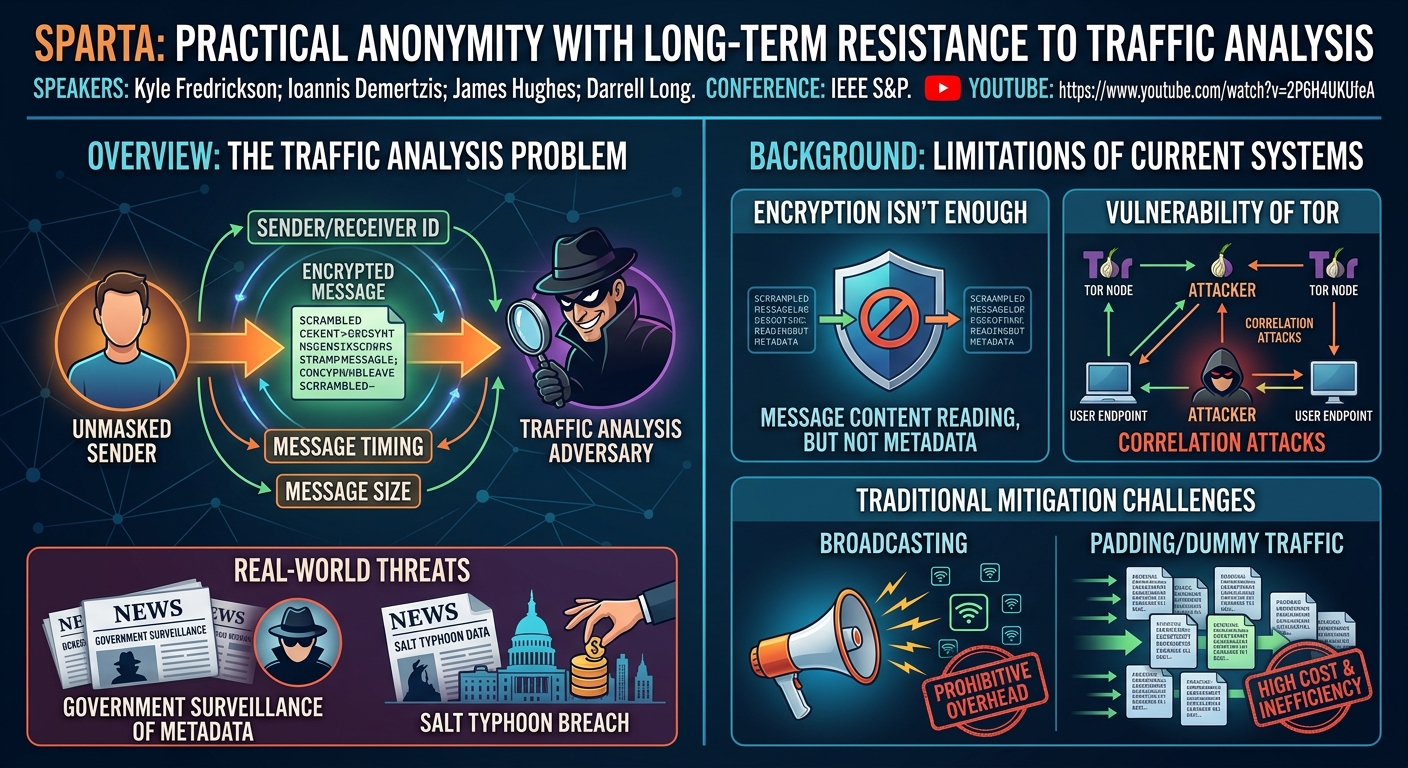
In an era where digital communication is ubiquitous, the talk "Sparta: Practical Anonymity with Long-Term Resistance to Traffic Analysis" by Kyle Fredrickson and co-authors introduces a groundbreaking approach to securing private messaging against sophisticated adversaries. The core problem addressed is the pervasive threat of traffic analysis, which exploits communication metadata—such as who is talking to whom, when, and how much—even when message contents are fully encrypted. While end-to-end encryption is a foundational security measure, it has proven insufficient against adversaries capable of observing network traffic patterns. This presentation argues that by rethinking how we define and achieve traffic analysis resistance, it is indeed possible to build practical systems that offer robust anonymity.
Key moments
- 0:00 Sparta: A new approach to traffic analysis resistance
- 2:00 Understanding realistic traffic analysis attacks and their vulnerability
- 3:00 Limitations of current traffic analysis resistance solutions
- 4:00 Defining traffic analysis resistance through communication states
- 4:40 Leakage functions: identifying vulnerable systems by timing information
- 5:40 Discovering the unexplored point for flexible, secure traffic
- 6:10 Deferred Retrieval: Sparta's practical approach to achieving security
Sparta: Practical Anonymity with Long-Term Resistance to Traffic Analysis
Speakers: Kyle Fredrickson; Ioannis Demertzis; James Hughes; Darrell Long
Conference: IEEE S&P
YouTube: https://www.youtube.com/watch?v=2P6H4UKUfeA
Overview
In an era where digital communication is ubiquitous, the talk "Sparta: Practical Anonymity with Long-Term Resistance to Traffic Analysis" by Kyle Fredrickson and co-authors introduces a groundbreaking approach to securing private messaging against sophisticated adversaries. The core problem addressed is the pervasive threat of traffic analysis, which exploits communication metadata—such as who is talking to whom, when, and how much—even when message contents are fully encrypted. While end-to-end encryption is a foundational security measure, it has proven insufficient against adversaries capable of observing network traffic patterns. This presentation argues that by rethinking how we define and achieve traffic analysis resistance, it is indeed possible to build practical systems that offer robust anonymity.
The work presented in Sparta is highly significant because it moves beyond theoretical vulnerabilities to address realistic attack scenarios that plague existing anonymity networks like Tor. The speakers highlight that government agencies and other powerful actors routinely leverage metadata for intelligence gathering, with high-ranking officials publicly acknowledging its immense value. Recent events, such as the Salt Typhoon breach explicitly targeting device metadata in the DC area, underscore the practical and pressing need for solutions that protect not just message content but also the sensitive patterns of communication. Sparta proposes a novel framework and an implementation strategy using Trusted Execution Environments (TEEs) and oblivious algorithms to achieve this elusive goal with unprecedented practicality and efficiency.
Background
▶ Watch: Sparta: A new approach to traffic analysis resistance (0:00)
The foundational challenge in private messaging over untrusted infrastructure lies in the adversary's ability to observe network activity. While encryption effectively hides the content of messages, it does not obscure the metadata associated with these communications. This metadata—including the identities of communicating parties, the precise timing of messages, and their sizes—can reveal highly sensitive information. For instance, observing an undercover agent communicating with a law enforcement agency, a patient contacting an oncologist, or a whistleblower reaching out to a journalist can expose critical details, compromising safety, privacy, or ongoing investigations.
Current anonymity systems, most notably Tor, are often discussed in the academic literature in the context of their vulnerability to global adversaries who can observe the entire network and trace messages end-to-end. However, the talk emphasizes that the more realistic and prevalent threats come from traffic analysis attacks that focus on the features of traffic at the users' endpoints, bypassing the anonymity system itself. These attacks exploit correlations in traffic patterns over time, leveraging timing information, message volume, and repeated connections between users. Crucially, such attacks are independent of whether the underlying system is secure against global adversaries or even if it functions as a fully trusted black box, making them a potential vulnerability for all anonymity systems.
Traditional approaches to mitigate traffic analysis have significant limitations. Broadcasting, where every user receives every message, offers strong anonymity but incurs prohibitive network overhead in large networks. Another common academic assumption involves requiring every honest user to send one message every round for the system's lifetime, often padded with dummy traffic. This approach, while theoretically sound, is impractical in the real world. Honest users can lose connectivity (e.g., phone dying, boarding a plane), failing to send their required messages. Furthermore, the choice of "round" duration presents a dilemma: short rounds lead to immense dummy traffic and network inundation, while long rounds introduce unbounded latency for users who need to send messages more frequently than the average. These practical constraints highlight the critical gap in existing solutions, underscoring the need for a new paradigm that can offer traffic analysis resistance without sacrificing practicality or imposing unrealistic demands on users and infrastructure.
Key Findings
▶ Watch: Limitations of current traffic analysis resistance solutions (3:00)
The central and most surprising finding of the Sparta research is the affirmative answer to the question: is traffic analysis resistance even possible in practice? The speakers demonstrate that, contrary to prevailing assumptions about the inherent difficulties, it is indeed achievable. To reach this conclusion, the team first identified a critical missing piece in the academic landscape: a formal security definition that accurately captures traffic analysis resistance. Existing formal definitions for anonymity often fail to account for the nuanced ways metadata correlations can compromise privacy.
To address this, Sparta introduces a novel framework based on communication states. A communication state is defined as a set of tuples, each containing a sender, a receiver, and the time a message was sent. These can be visualized as directed graphs where nodes are users and edges are messages with associated timing information. The security properties of an anonymity system are then expressed as leakage functions applied to these communication states, which restrict the information an adversary can learn. By applying this framework, the researchers were able to formally specify and compare the security of all existing anonymity systems for the first time in 40 years of research.
A crucial insight emerged from this analysis: systems vulnerable to traffic analysis consistently allowed timing information to leak for both senders and receivers, enabling correlations between input and output traffic over time – precisely the feature that attacks leverage. Conversely, systems that did not leak such timing correlations were resistant. These secure systems, categorized as having "tier 4 leakages," enforced independence between input and output traffic but came with significant drawbacks: fixed bandwidth rates across all users, leading to high overhead and latency.
The key innovation of Sparta lies in identifying an "unexplored point" in the design space of leakage functions. This ideal leakage enforces independence between input and output traffic, thereby preventing traffic analysis, but critically, it also allows the traffic at both senders and receivers to vary. This flexibility is what makes practical implementation feasible. To achieve this ideal leakage, Sparta introduces an abstract functionality called Deferred Retrieval. This functionality can be implemented using various cryptographic primitives or secure computing paradigms, such as multi-party computation (MPC), fully homomorphic encryption (FHE), or Trusted Execution Environments (TEEs).
Finally, Sparta itself is presented as a concrete implementation of Deferred Retrieval, leveraging the practical advantages of TEEs and the growing maturity of oblivious algorithms. This specific implementation demonstrates that traffic analysis resistance can be achieved with multiple orders of magnitude lower network costs and much more flexible assumptions compared to prior approaches, even if users don't perfectly estimate their preferred traffic rates. The findings represent a significant leap forward, transforming traffic analysis resistance from a theoretical ideal into a practical reality.
Technical Deep Dive
▶ Watch: Defining traffic analysis resistance through communication states (4:00)
The technical foundation of Sparta rests on a rigorous formal model for understanding and defining traffic analysis resistance. The researchers propose modeling the input to anonymity systems as communication states. A communication state is formally represented as a set of (sender, receiver, time) tuples, effectively capturing the complete communication graph with precise timing information. This model allows for expressing security properties as leakage functions, which are mathematical functions that restrict the information an adversary can learn about the communication state. For example, a leakage function might only reveal who sent a message and when, but not the receiver, or only the volume of messages a receiver gets, without timing or sender information.
Through this formalization, Sparta identifies that the fundamental difference between systems vulnerable to traffic analysis and those resistant to it lies in whether their leakage functions allow for correlations between input and output traffic over time. Insecure systems inherently leak timing information for both senders and receivers, creating patterns that traffic analysis attacks can exploit. Conversely, systems that prevent these correlations, often categorized as having "tier 4 leakages," achieve traffic analysis resistance. However, these tier 4 systems traditionally suffer from practical limitations such as fixed bandwidth rates across all users, leading to high network overhead and undesirable latency.
The innovation of Sparta is the conceptualization and practical realization of Deferred Retrieval. This abstract functionality is designed to achieve the ideal leakage property: enforcing independence between input and output traffic to prevent traffic analysis, while simultaneously allowing the traffic rates at senders and receivers to vary. The core mechanism of Deferred Retrieval is as follows:
- Message Queuing: Users send messages into the system, which are then queued in a hidden, secure state.
- User-Defined Fetch Rates: Users independently set their message fetch rates based on their estimation of their overall traffic needs, not on the real-time volume of messages they are actually receiving.
- Padding and Deferral: The system then retrieves messages for users at their chosen rate, padding the traffic and deferring actual message delivery to match this rate. This ensures that the observed outgoing traffic pattern from the system is independent of the incoming message volume or timing, thus breaking the correlations vital for traffic analysis.
Deferred Retrieval is an abstract concept, meaning it can be implemented using various underlying technologies. The talk specifically highlights Trusted Execution Environments (TEEs) and oblivious algorithms as the chosen path for Sparta due to their increasing practicality and deployment. TEEs, such as Intel SGX or AMD SEV, provide a hardware-isolated environment where code and data can execute securely, even if the host operating system or hypervisor is compromised. This isolation is crucial for maintaining the hidden state and performing the padding/deferral operations without revealing sensitive metadata. The use of TEEs aligns with real-world deployments, with companies like Signal already utilizing them for certain security features.
Oblivious algorithms are a class of algorithms designed to ensure that the memory access patterns of a computation are independent of the sensitive input data. This is critical in TEEs, as even the sequence of memory accesses can leak information to an untrusted host. Sparta leverages these algorithms to process messages within the TEE without revealing patterns that could be exploited by traffic analysis.
Sparta itself is presented in three variants, tailored for different application needs: one for low-latency applications and two for high-throughput scenarios. The most detailed variant discussed is sort-based Sparta, which is optimized for high throughput. This variant implements Deferred Retrieval using a sequence of oblivious operations: a sort, a linear scan, and two compactions. These operations are performed within the TEE, ensuring that the processing of messages, their queuing, and their eventual release at the user-defined rate do not leak any correlatable timing or volume information. The combination of TEEs for secure execution and oblivious algorithms for data-independent access patterns forms the robust technical backbone of Sparta, enabling practical and efficient traffic analysis resistance.
Demo / Proof of Concept
▶ Watch: Discovering the unexplored point for flexible, secure traffic (5:40)
While the talk did not feature a live, interactive demonstration of Sparta in action, the speakers presented compelling performance metrics derived from their implementation of the system. This practical evaluation serves as a robust proof of concept for the feasibility and efficiency of their proposed architecture.
The core performance claims center on the sort-based Sparta variant, which is specifically optimized for high-throughput applications. This implementation demonstrated the ability to process 700,100 byte messages per second. This figure is particularly impressive when compared to prior state-of-the-art anonymity systems. The speakers highlighted that Sparta, running on a single machine, achieved a throughput that was 15 times higher than a leading prior system which required 150 machines to achieve its performance. This dramatic improvement underscores the efficiency gains brought by Sparta's design, particularly its use of TEEs and optimized oblivious algorithms.
Furthermore, the research team is optimistic about future improvements. They noted that since the submission of their paper, new oblivious primitives have been developed. Integrating these newer primitives into Sparta's architecture could immediately yield even greater throughput improvements, estimated to be between 10 and 100 times higher than the already impressive current figures. These performance results provide strong evidence that Sparta offers a practical and scalable solution for achieving traffic analysis resistance without incurring the prohibitive overheads that have plagued previous academic proposals. The focus on high throughput makes Sparta a viable candidate for real-world deployment in demanding private messaging and communication systems.
Defensive Implications
▶ Watch: Deferred Retrieval: Sparta's practical approach to achieving security (6:10)
The Sparta research carries significant implications for defenders, emphasizing the critical need to shift focus beyond mere content encryption to comprehensive metadata protection. For individuals and organizations operating in sensitive environments, understanding and mitigating traffic analysis is paramount.
- Re-evaluate Current Anonymity Solutions: Defenders should recognize that widely used anonymity systems like Tor, while effective against certain threats, remain vulnerable to realistic traffic analysis attacks that exploit correlations at the user level. Relying solely on these systems for ultimate metadata privacy may be insufficient for high-risk users such as whistleblowers, journalists, or intelligence operatives.
- Prioritize Metadata Protection: The talk underscores that metadata is not "secondary" information; it can be as revealing, if not more so, than message content. Defensive strategies must explicitly incorporate mechanisms to obscure communication patterns, timing, and volume, alongside traditional encryption.
- Explore Deferred Retrieval Principles: Developers of secure communication platforms should investigate integrating the principles of Deferred Retrieval. This abstract functionality offers a blueprint for building systems that decouple observed traffic patterns from actual communication events, thereby breaking the correlations that enable traffic analysis.
- Leverage Trusted Execution Environments (TEEs) and Oblivious Algorithms: Sparta demonstrates the practical utility of TEEs and oblivious algorithms as fundamental building blocks for next-generation privacy-preserving systems. Defenders involved in system design should consider these technologies for processing sensitive metadata in a way that resists leakage, even from compromised host environments. As TEEs become more mature and ubiquitous, and oblivious algorithms continue to improve in efficiency, their integration into secure architectures will be crucial.
- Design for Flexible Traffic Rates: The insight that traffic analysis resistance can be achieved even with varying sender and receiver traffic rates (unlike rigid fixed-rate systems) is vital. Defenders should advocate for and develop systems that offer this flexibility, improving usability and reducing the likelihood of users bypassing security measures due to inconvenience.
- Invest in Research and Development: The significant performance gains achieved by Sparta, particularly its orders-of-magnitude lower network costs, highlight the potential for continued innovation in this space. Organizations concerned with high-stakes privacy should support further research and development into practical, high-performance traffic analysis resistant systems.
- Educate Users: For end-users, understanding that even encrypted communications can expose them through metadata is a crucial awareness point. While Sparta aims to automate this protection, general security awareness campaigns should touch upon the risks of traffic analysis and the limitations of content encryption alone.
By adopting these defensive postures, organizations and individuals can move towards a more robust and holistic approach to digital privacy, one that acknowledges and actively combats the sophisticated threat of traffic analysis.
Key Takeaways
- Metadata is a Critical Vulnerability: Even with strong end-to-end encryption, communication metadata (who, when, how often) can reveal extremely sensitive information and is actively exploited by sophisticated adversaries, as evidenced by incidents like the Salt Typhoon breach.
- Existing Anonymity Systems Fall Short: Traditional anonymity networks like Tor are vulnerable to realistic traffic analysis attacks that exploit correlations in user-level traffic patterns over time, independent of global network observation capabilities.
- Traffic Analysis Resistance is Possible in Practice: Sparta demonstrates that robust traffic analysis resistance is achievable, challenging prior assumptions about its inherent impracticality.
- Novel Formal Framework: The research introduces a new formal model using "communication states" and "leakage functions" to precisely define and compare the security of anonymity systems, identifying how insecure leakages enable timing correlations.
- Deferred Retrieval is the Core Innovation: Sparta proposes Deferred Retrieval as an abstract functionality that breaks input-output traffic correlations while allowing flexible traffic rates, offering a practical path to traffic analysis resistance.
- Practical Implementation with TEEs and Oblivious Algorithms: Sparta implements Deferred Retrieval using Trusted Execution Environments (TEEs) and oblivious algorithms, showcasing impressive performance gains, including 15x higher throughput on a single machine compared to prior state-of-the-art solutions running on 150 machines.
About the Speaker(s)
The work on Sparta was presented by Kyle Fredrickson. He is credited as the lead author alongside Ioannis Demertzis, James Hughes, and Darrell Long. The presentation was delivered at the IEEE S&P conference, a premier venue for research in security and privacy.