EveGuard: Defeating Vibration-based Side-Channel Eavesdropping with Audio Adversarial Perturbations
Jung-Woo Chang, Ke Sun, David Xia, Xinyu Zhang, Farinaz Koushanfar
IEEE Symposium on Security and Privacy 2025 · Day 3 · Audio and Video Security
Overview
In an increasingly voice-interface driven world, the omnipresence of speakers in devices like smartphones, smart home assistants, vehicles, and public infrastructure presents a significant yet often overlooked security vulnerability: vibration-based side-channel eavesdropping. The talk "EveGuard: Defeating Vibration-based Side-Channel Eavesdropping with Audio Adversarial Perturbations," presented by Jung-Woo Chang from UC San Diego and collaborators, introduces a novel software-only defense mechanism designed to protect human speech from unauthorized capture by exploiting the inherent differences between human auditory perception and how IoT sensors interpret sound. This research addresses a critical privacy and security concern, as malicious actors can leverage built-in device sensors to reconstruct spoken content, often without requiring direct access to microphones.
Key moments
- 0:00 Introduction: The growing threat of IoT-based speech eavesdropping.
- 3:00 Limitations of current defenses against IoT eavesdropping.
- 4:05 Introducing EveGuard: A software-only, unobtrusive defense solution.
- 4:45 EveGuard's core: Low-frequency perturbations imperceptible to human ears.
- 5:30 Visualizing EveGuard's impact: Distorting sensor capture, preserving human audio.
- 7:30 IFGAN: A generative model to simulate IoT sensor perception.
- 9:00 Evaluation results: Significant privacy protection, preserved audio quality.
EveGuard: Defeating Vibration-based Side-Channel Eavesdropping with Audio Adversarial Perturbations
Speakers: Jung-Woo Chang; Ke Sun; David Xia; Xinyu Zhang; Farinaz Koushanfar
Conference: IEEE S&P
YouTube: https://www.youtube.com/watch?v=WZt-Art99oM
Overview
In an increasingly voice-interface driven world, the omnipresence of speakers in devices like smartphones, smart home assistants, vehicles, and public infrastructure presents a significant yet often overlooked security vulnerability: vibration-based side-channel eavesdropping. The talk "EveGuard: Defeating Vibration-based Side-Channel Eavesdropping with Audio Adversarial Perturbations," presented by Jung-Woo Chang from UC San Diego and collaborators, introduces a novel software-only defense mechanism designed to protect human speech from unauthorized capture by exploiting the inherent differences between human auditory perception and how IoT sensors interpret sound. This research addresses a critical privacy and security concern, as malicious actors can leverage built-in device sensors to reconstruct spoken content, often without requiring direct access to microphones.
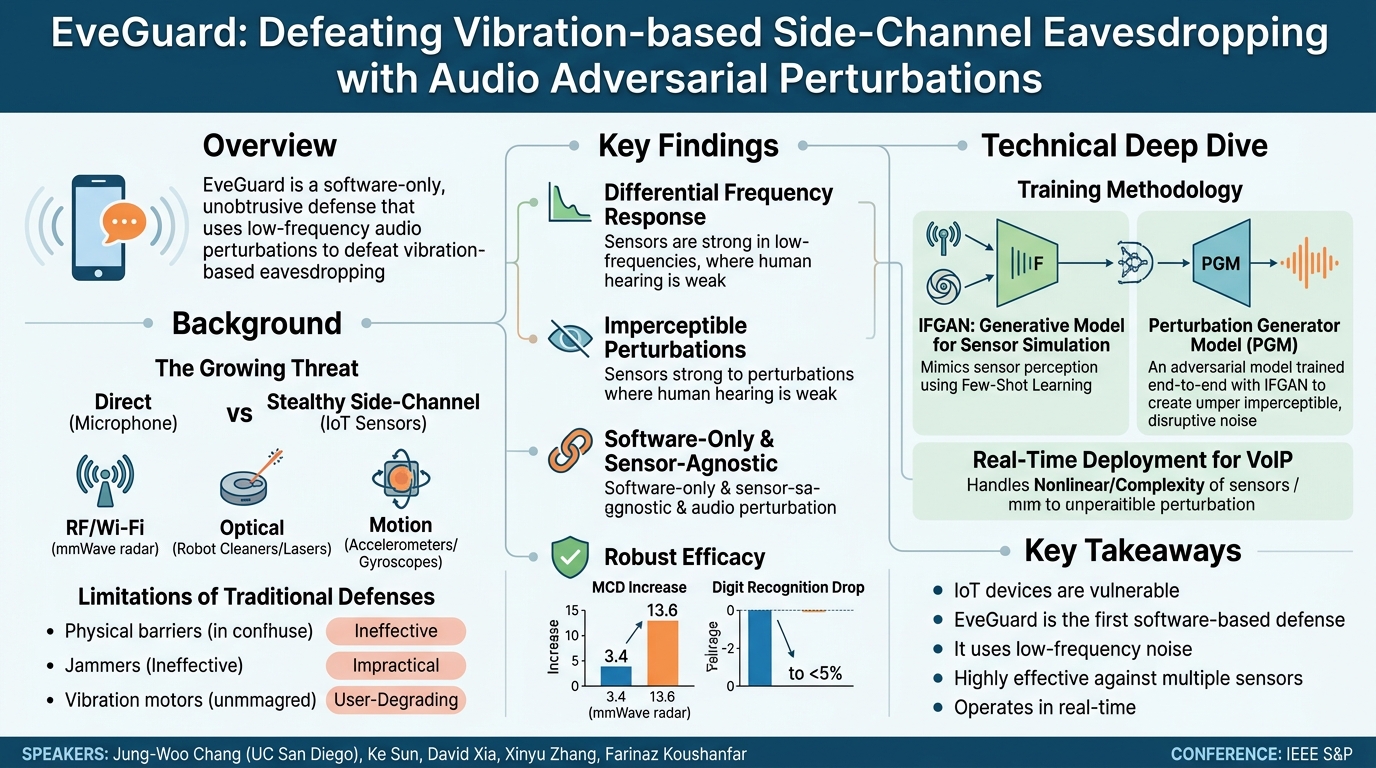
The core innovation of EveGuard lies in its ability to introduce subtle, low-frequency audio perturbations that are imperceptible to human ears but effectively distort the signals captured by IoT sensors. This approach bypasses the limitations of traditional defenses—such as physical obstructions, RF jammers, or internal vibration motors—which are often intrusive, power-intensive, or easily circumvented. By developing a sophisticated generative model, IFGAN, to accurately simulate sensor responses and integrate few-shot learning, EveGuard achieves a robust, scalable, and deployable solution. This work not only highlights the pervasive threat of sensor-based eavesdropping but also provides a practical, software-driven countermeasure that maintains user experience while significantly enhancing speech privacy across diverse cyber-physical systems.
Background
▶ Watch: Introduction: The growing threat of IoT-based speech eavesdropping. (0:00)
The modern technological landscape is saturated with devices featuring integrated speakers, from personal smartphones to public information systems. These devices facilitate seamless human-device interaction through voice commands, notifications, and multimedia playback. While convenient, this ubiquity simultaneously amplifies the risk of speech eavesdropping, transforming what might seem like a mere privacy concern into a serious security threat. As voice interfaces become the primary mode of interaction for sensitive information, protecting spoken content from unauthorized capture is paramount.
Researchers have explored various methodologies for recovering speech, each with distinct capabilities and limitations. The most straightforward method involves direct use of microphones; however, these are often easy to detect, block, or are outright restricted in secure environments. Electromagnetic (EM) emission-based attacks offer stealthier options, capable of operating over distance and through barriers, but typically necessitate expensive, bulky equipment, making them difficult to deploy and susceptible to environmental noise and interference.
A particularly practical and stealthy approach, and the focus of this research, involves exploiting built-in sensors in smartphones or IoT devices. These sensors are pervasive, constantly collecting data, and frequently accessible by applications, rendering them ideal targets for side-channel attacks to reconstruct spoken content. IoT-based eavesdropping attacks can be broadly categorized by the type of sensor utilized:
- Regular sensors such as millimeter wave (mmWave) radar and Wi-Fi can capture vibrations through reflected signals.
- Optical sensors, commonly found in devices like robot cleaners or specialized laser microphones, can detect subtle surface vibrations induced by sound waves.
- Motion sensors, including accelerometers and gyroscopes embedded in smartphones, can be exploited by malicious apps to reconstruct spoken content by detecting device vibrations.
Existing defensive measures against these IoT-based eavesdropping attempts have proven to be largely insufficient or impractical. For RF-based eavesdropping, solutions like reflecting surfaces or jammers aim to distort radio paths, but their effectiveness is limited by the need for precise placement and their inability to adapt to dynamic environments. Optical eavesdropping has seen proposals for physical obstructions like cotton or walls; however, these are not universally effective, as laser-based sensors can bypass minor barriers, and deploying barriers in every potential line of sight is neither practical nor scalable. Some research has suggested using a smartphone's vibration motor to interfere with motion sensors. While conceptually sound, this method has shown limited impact as attackers can often filter out the noise or leverage more resilient sensor modalities. Furthermore, it consumes significant power and degrades user experience, making it unsuitable for real-world deployment.
The cumulative limitations of these existing defenses underscored the urgent need for a more robust, non-intrusive, and scalable solution. This motivated the development of EveGuard, which shifts the defensive paradigm from blocking or hiding audio to intelligently interfering with how sensors perceive the signal, all while ensuring the audio remains perfectly natural and intelligible to human listeners. The design objectives were clear: a software-only solution that is unobtrusive, easy to deploy across various platforms, and capable of addressing the complex, nonlinear responses of diverse IoT sensors.
Key Findings
▶ Watch: Introducing EveGuard: A software-only, unobtrusive defense solution. (4:05)
The research behind EveGuard yielded several pivotal findings that underpin its innovative defense strategy against vibration-based side-channel eavesdropping:
- Differential Frequency Response: A preliminary study comparing human hearing with IoT sensor capabilities revealed a critical distinction: IoT sensors exhibit a significantly strong frequency response in the low-frequency band of speech. This divergence forms the foundational insight for EveGuard, as it allows for targeted interference that exploits this sensory gap.
- Imperceptible Perturbations: Based on the above finding, EveGuard was designed to introduce specific low-frequency perturbations into the audio signal. These perturbations are engineered to be easily detectable and disruptive to IoT sensors, yet remain entirely imperceptible to the human ear. This ensures that speech privacy is enhanced without degrading the user's audio experience.
- Software-Only, Sensor-Agnostic Defense: EveGuard demonstrates that a purely software-based approach can effectively protect against a wide array of vibration-driven speech eavesdropping attacks, including those utilizing mmWave radar, optical sensors, and motion sensors. This eliminates the need for bulky hardware, physical modifications, or high power consumption associated with previous defense attempts.
- Generative Model for Sensor Simulation (IFGAN): A significant contribution is the development of IFGAN, a novel generative model designed to simulate how various IoT sensors perceive audio. Given the complex, nonlinear, and environmentally sensitive nature of sensor responses, IFGAN provides a learnable and differentiable mechanism to mimic these perceptions. This model is crucial as it overcomes the lack of physical simulators, enabling efficient and scalable training of the defense system.
- Data-Efficient Training with Few-Shot Learning: To address the substantial data collection burden associated with training across diverse sensor types and environmental conditions, EveGuard incorporates few-shot learning into IFGAN. This allows the model to generalize effectively to unseen scenarios with minimal sensor data, making EveGuard practical for deployment across a broad spectrum of cyber-physical systems.
- End-to-End Trainable Perturbation Generator: The system integrates a Perturbation Generator Model (PGM), trained in an end-to-end differentiable manner with IFGAN. The PGM learns to precisely add the imperceptible noise that distorts the signal for the eavesdropping sensor model, ensuring effective protection.
- Robust Efficacy Against State-of-the-Art Attacks: Comprehensive evaluation demonstrated EveGuard's strong protective capabilities:
- In mmWave radar-based scenarios, EveGuard significantly increased the Mel-cepstral distortion (MCD), a standard metric for speech distortion, from 3.4 to 13.6. This dramatic increase indicates strong obstruction of the original speech signal.
- Furthermore, digit recognition accuracy for reconstructed speech dropped to below 5%, effectively rendering the captured content unintelligible.
- Similar strong protection against speech leakage was observed in evaluations against optical and motion sensor-based attack settings.
- Preservation of Perceptual Audio Quality: A user study confirmed that speech processed by EveGuard maintains its original perceptual quality, ensuring that the defense mechanism does not degrade the user experience. This finding is critical for real-world applicability and user acceptance.
These key findings collectively establish EveGuard as a groundbreaking and practical solution for enhancing speech privacy in an IoT-saturated environment, addressing long-standing challenges in side-channel attack mitigation.
Technical Deep Dive
▶ Watch: EveGuard's core: Low-frequency perturbations imperceptible to human ears. (4:45)
The technical ingenuity of EveGuard primarily lies in its novel training methodology, which overcomes significant challenges inherent in simulating and counteracting complex sensor behaviors. The core problem for developing such a defense is the inability to accurately predict an attacker's sensor output from a given audio input, due to the highly nonlinear, context-dependent, and environment-sensitive nature of sensor responses. This lack of a reliable physical simulator, coupled with the immense data collection burden across diverse sensor types (RF, optical, motion), environments, speakers, distances, and directions, necessitated a fundamentally new approach.
EveGuard addresses these challenges through a two-pronged, end-to-end trainable architecture centered around IFGAN and a Perturbation Generator Model (PGM).
IFGAN: Mimicking Sensor Perception
The first critical component is IFGAN, a generative model designed to simulate how various IoT sensors perceive audio. Instead of attempting to model the physics of vibration propagation directly, IFGAN learns to translate an original audio signal into a version that mimics what an attacker's sensor would capture. This "mimicked" output serves as a differentiable proxy for the actual sensor response, allowing the entire defense system to be trained efficiently.
The design of IFGAN is crucial because it:
- Handles Complexity and Nonlinearity: Sensor responses are not simple linear transformations of sound waves. They involve complex interactions with surfaces, materials, ambient noise, and sensor specific characteristics. IFGAN's generative architecture is capable of learning these intricate, nonlinear mappings.
- Enables Differentiable Training: By providing a differentiable approximation of the sensor's perception, IFGAN allows for the use of gradient-based optimization techniques, which are standard in deep learning. This is fundamental for training the PGM to generate effective perturbations.
- Reduces Data Collection Burden with Few-Shot Learning: To make IFGAN practical across a wide range of real-world scenarios without exhaustive data collection for every possible sensor and environment, the researchers incorporated few-shot learning. This technique allows IFGAN to generalize its learned sensor perception capabilities to unseen scenarios with minimal new sensor data. For instance, if IFGAN has been trained on a few examples from a new sensor type or environment, it can quickly adapt to accurately simulate that sensor's response without requiring a massive dataset specific to that context. This is critical for the generalizability and scalability of EveGuard across diverse cyber-physical system deployments.
Perturbation Generator Model (PGM): Crafting Imperceptible Noise
Once IFGAN is in place and capable of simulating sensor perception, the next step is to train the Perturbation Generator Model (PGM). The PGM's role is to take the original clean audio signal and add carefully crafted, imperceptible noise—specifically, low-frequency perturbations. The PGM is trained in an adversarial manner, where its objective is to generate perturbations that maximize the distortion of the sensor-perceived audio (as simulated by IFGAN) while minimizing the perceptual impact on human listeners.
The training process is end-to-end:
- Original audio is fed into the PGM.
- The PGM adds low-frequency perturbations to create the "perturbed audio."
- This perturbed audio is then fed into IFGAN, which simulates what an attacker's sensor would capture from this perturbed signal.
- A loss function guides the training, optimizing the PGM to:
- Maximize the difference between IFGAN's output for the clean audio and IFGAN's output for the perturbed audio (i.e., maximize distortion for the sensor).
- Minimize the difference between the original clean audio and the perturbed audio as perceived by human listeners (i.e., ensure imperceptibility).
The key insight here is the exploitation of the difference in frequency response between human hearing and IoT sensors. Humans are less sensitive to low-frequency noise when overlaid on speech, whereas many IoT sensors, particularly those relying on physical vibrations, are highly sensitive to these same low frequencies. By targeting this specific band, EveGuard ensures that the defense is effective for machines but unnoticeable to humans.
Real-time Deployment Considerations
EveGuard was explicitly designed to function within the strict latency constraints of real-time applications, such as Voice over IP (VoIP). This means the perturbation generation process must be computationally efficient enough not to introduce noticeable delays. After training, the PGM is conceptually "inserted" before the audio source, processing the audio stream in real-time to add the necessary perturbations before it is emitted by the device's speaker. This software-only, real-time approach makes EveGuard highly deployable in existing systems without requiring hardware modifications or significant architectural changes.
In summary, the technical deep dive reveals a sophisticated interplay between a generative sensor simulator (IFGAN) and an adversarial perturbation generator (PGM), all optimized through few-shot learning and end-to-end training. This architecture allows EveGuard to intelligently manipulate audio signals in a way that disrupts machine perception while preserving human experience, effectively turning a side-channel vulnerability into a robust defensive mechanism.
Demo / Proof of Concept
▶ Watch: IFGAN: A generative model to simulate IoT sensor perception. (7:30)
While the talk did not feature a live, interactive demonstration of EveGuard, the speakers presented a clear conceptual demonstration, supported by rigorous evaluation results, to serve as a strong proof of concept for the system's effectiveness.
The conceptual demonstration was articulated through a two-scenario comparison:
- Without EveGuard: An attacker's sensor receives a clean, unperturbed audio signal. The talk visualized this as a clean waveform. Consequently, the attacker can successfully reconstruct intelligible speech from the sensor readings, leading to inevitable privacy leakage. This scenario highlights the baseline vulnerability that EveGuard aims to address.
- With EveGuard Enabled: The system introduces its carefully crafted low-frequency perturbations into the audio signal. The visualization showed a subtly altered waveform. Crucially, while this perturbed speech sounds perfectly normal and intelligible to human listeners, the attacker's sensor captures a significantly distorted version of the signal. As a direct result, any attempt to recover speech from these distorted sensor readings yields unintelligible content, demonstrating EveGuard's practical ability to enhance speech privacy.
Beyond this conceptual illustration, the strength of EveGuard's proof of concept comes from its comprehensive quantitative evaluation across various attack vectors. The results robustly validate its efficacy and robustness against state-of-the-art eavesdropping techniques:
- mmWave Radar-Based Attacks: In scenarios involving millimeter wave radar, a sensor type known for its ability to capture subtle vibrations, EveGuard demonstrated profound obstruction capabilities. The Mel-cepstral distortion (MCD), a widely accepted metric for measuring the distortion between two speech signals (where higher MCD indicates greater dissimilarity and thus distortion), was significantly increased. Without EveGuard, the MCD value was 3.4, indicating relatively clear speech reconstruction. With EveGuard active, the MCD surged to 13.6. This more than threefold increase signifies a drastic degradation in the quality and intelligibility of the reconstructed speech. Further, the digit recognition accuracy—a direct measure of how well automated systems could understand the compromised speech—plummeted to below 5%. This low accuracy confirms that the speech captured by the sensor became effectively unintelligible to machine processing.
- Optical and Motion Sensor-Based Attacks: The evaluation extended to other prevalent side-channel attack modalities, including those leveraging optical sensors and motion sensors. In both these settings, EveGuard consistently showed strong protection against speech leakage, indicating its sensor-agnostic robustness. The specific quantitative metrics for these evaluations were not detailed in the transcript but the general effectiveness was highlighted.
- User Study on Perceptual Quality: A crucial aspect of any practical defense is ensuring it doesn't negatively impact the user experience. A user study was conducted to assess the perceptual quality of speech processed by EveGuard. The research indicated that EveGuard successfully preserved the original speech quality, maintaining user experience while simultaneously offering robust privacy protection. This result is vital for the real-world adoption of the technology, as an effective defense that degrades usability is unlikely to be deployed.
In essence, the combination of a clear conceptual explanation and compelling quantitative results across multiple sensor types provides a strong proof of concept that EveGuard is not only theoretically sound but also practically effective in mitigating vibration-based speech eavesdropping attacks without compromising audio quality for human listeners.
Defensive Implications
▶ Watch: Evaluation results: Significant privacy protection, preserved audio quality. (9:00)
EveGuard presents several profound defensive implications for individuals, organizations, and device manufacturers seeking to bolster speech privacy in an increasingly interconnected world. Its novel approach offers a significant departure from traditional, often inadequate, countermeasures.
First and foremost, EveGuard provides a software-only, sensor-agnostic defense framework. This is a critical advantage. Unlike hardware-based solutions (e.g., physical obstructions, RF jammers) or power-intensive internal vibration motors, EveGuard can be deployed as a software update or integrated into existing audio processing pipelines without requiring costly hardware modifications or significant design changes. This makes it highly scalable and adaptable to a wide range of devices, from smartphones and smart speakers to public display systems and vehicles.
The core defensive strategy—interfering with how sensors perceive signals while preserving human audio quality—is a paradigm shift. Instead of trying to block or hide the audio, which is often difficult and detectable, EveGuard subtly manipulates the audio stream itself. This makes the defense inherently stealthy and difficult for attackers to circumvent, as the "clean" audio they would expect is never actually propagated in a sensor-readable form. Defenders should recognize this as a potent strategy for protecting sensitive spoken data.
Specifically, for organizations concerned about mmWave radar, optical, and motion sensor-based eavesdropping, EveGuard offers a concrete and validated defense. The significant increase in Mel-cepstral distortion (MCD) (from 3.4 to 13.6) and the drastic drop in digit recognition accuracy (below 5%) against mmWave radar attacks highlight its strong practical impact. This suggests that device manufacturers can integrate similar adversarial audio perturbation techniques into their products to protect against these specific side-channel threats.
Furthermore, EveGuard's design to operate within real-time latency constraints (e.g., for VoIP applications) means it can be seamlessly integrated into everyday communication and interaction systems without introducing noticeable overhead or degrading user experience. This makes it a viable solution for protecting live conversations and voice commands, which are often the most sensitive data streams.
However, defenders must also be aware of EveGuard's stated limitations to plan for a comprehensive security strategy:
- Electromagnetic-based attacks: The current design was not evaluated against and cannot prevent attacks that exploit electromagnetic emissions. This implies that a multi-modal defense strategy might still be necessary in highly secure environments where EM eavesdropping is a concern.
- Human throat vibration: EveGuard cannot prevent attacks that exploit vibrations directly from the human throat. Such attacks would bypass the audio output of a device entirely. This points to the need for physical security measures or alternative biometric defenses in extremely high-security contexts.
In conclusion, EveGuard empowers defenders with a practical, software-driven, and unobtrusive tool to combat a pervasive and growing threat. Its insights into the differential perception of audio by humans and machines open new avenues for privacy-preserving technologies. Device manufacturers should consider adopting such adversarial audio processing techniques, especially focusing on low-frequency bands, to build more resilient and privacy-aware products. For consumers and enterprises, this research underscores the importance of software-based security updates and the potential for advanced privacy features to be integrated directly into the devices they use daily.
Key Takeaways
- IoT devices, including smartphones and smart home assistants, are highly vulnerable to vibration-based side-channel eavesdropping via built-in sensors like mmWave radar, optical sensors, accelerometers, and gyroscopes.
- EveGuard is the first software-based defense framework that effectively prevents these vibration-driven speech eavesdropping attacks by exploiting the differential frequency responses between human hearing and IoT sensors.
- The system introduces imperceptible low-frequency audio perturbations that distort signals for sensors while preserving the original speech quality for human listeners, as validated by user studies.
- EveGuard employs IFGAN, a novel generative model, to simulate complex, nonlinear sensor perceptions, enabling end-to-end differentiable training of a Perturbation Generator Model (PGM) with minimal data through few-shot learning.
- Evaluation results demonstrate strong protective capabilities: EveGuard increased Mel-cepstral distortion (MCD) from 3.4 to 13.6 and reduced digit recognition accuracy to below 5% in mmWave radar scenarios, with similar effectiveness against optical and motion sensors.
- Designed for real-time applications like VoIP, EveGuard is a software-only, unobtrusive, and deployable solution that offers robust privacy enhancement without noticeable overhead or degradation of user experience.
About the Speaker(s)
The talk "EveGuard: Defeating Vibration-based Side-Channel Eavesdropping with Audio Adversarial Perturbations" was presented by Jung-Woo Chang. He is affiliated with Mrs. San Diego, which is commonly understood to refer to the University of California San Diego (UCSD), a prominent institution in computer science and engineering research. Jung-Woo Chang’s research focuses on security and privacy, particularly in the realm of side-channel attacks and developing novel defenses using techniques like adversarial perturbations.
He collaborated with a team of researchers: Ke Sun, David Xia, Xinyu Zhang, and Farinaz Koushanfar. Farinaz Koushanfar is a well-known professor at UCSD, leading research in areas such as cyber-physical systems security, hardware security, and machine learning for security. The collective expertise of the team spans various aspects of security, sensor technology, and advanced machine learning, which was critical in developing a sophisticated solution like EveGuard to address complex cyber-physical security challenges. Their work highlights a commitment to advancing practical and effective privacy-preserving technologies against emerging threats.