Open Source Malware or a Vulnerability?... Brian Fox, Madelein van der Hout & Santiago Torres-Arias
Brian Fox, Madelein van der Hout, Santiago Torres-Arias
KubeCon + CloudNativeCon Europe 2025 · Session
Overview
This insightful panel discussion at KubeCon EU, featuring industry veterans Brian Fox, Madelein van der Hout, and Santiago Torres-Arias, meticulously dissects the evolving landscape of software supply chain threats. The talk challenges conventional perceptions by drawing a critical distinction between unintentional software supply chain vulnerabilities—such as the infamous Log4j—and deliberate software supply chain attacks, exemplified by incidents like SolarWinds or the attempted XZ Utils compromise. This nuanced differentiation is presented as fundamental to developing effective mitigation strategies, moving beyond a simplistic view of all supply chain incidents as uniform.
Key moments
- 0:00 Speakers introduce themselves and the talk's agenda
- 2:40 Early supply chain vulnerabilities: Struts and Heartbleed
- 4:00 Major incidents raising public awareness: Equifax, Log4j
- 5:00 Santiago's critical distinction: supply chain attacks vs. vulnerabilities
- 6:20 Massive impact and challenges in rapid incident mitigation
Open Source Malware or a Vulnerability?... Brian Fox, Madelein van der Hout & Santiago Torres-Arias
Speakers: Brian Fox, Co-founder & CTO, Sonatype; Madelein van der Hout, Senior Industry Analyst, Cybersecurity and Risk, Forrester Research; Santiago Torres-Arias, Professor, Purdue University
Conference: KubeCon EU
YouTube: https://www.youtube.com/watch?v=kyLdmGY26BQ
Overview
This insightful panel discussion at KubeCon EU, featuring industry veterans Brian Fox, Madelein van der Hout, and Santiago Torres-Arias, meticulously dissects the evolving landscape of software supply chain threats. The talk challenges conventional perceptions by drawing a critical distinction between unintentional software supply chain vulnerabilities—such as the infamous Log4j—and deliberate software supply chain attacks, exemplified by incidents like SolarWinds or the attempted XZ Utils compromise. This nuanced differentiation is presented as fundamental to developing effective mitigation strategies, moving beyond a simplistic view of all supply chain incidents as uniform.
The speakers highlight a alarming surge in intentionally malicious open-source components, often masquerading as legitimate software, and expose the stark inadequacy of traditional security tools in detecting these sophisticated threats. They argue that the current defensive posture, largely reliant on signature-based malware detection or basic Software Composition Analysis (SCA), is ill-equipped to handle the behavioral anomalies and custom code deployed by attackers. The discussion underscores the critical need for a paradigm shift in security, advocating for advanced behavioral analysis, increased developer awareness, and robust collaboration across the open-source ecosystem to safeguard the software supply chain.
Why this talk matters is evident in the sheer scale and impact of modern supply chain incidents. As open-source software underpins nearly all modern applications, any compromise within this foundational layer can have catastrophic and widespread consequences across industries and national infrastructure. The panel’s collective expertise, spanning from deep technical research and open-source project stewardship to industry analysis and policy implications, provides a comprehensive and urgent call to action for developers, security professionals, and policymakers alike to confront these escalating threats with innovative and integrated defense mechanisms.
Background
▶ Watch: Speakers introduce themselves and the talk's agenda (0:00)
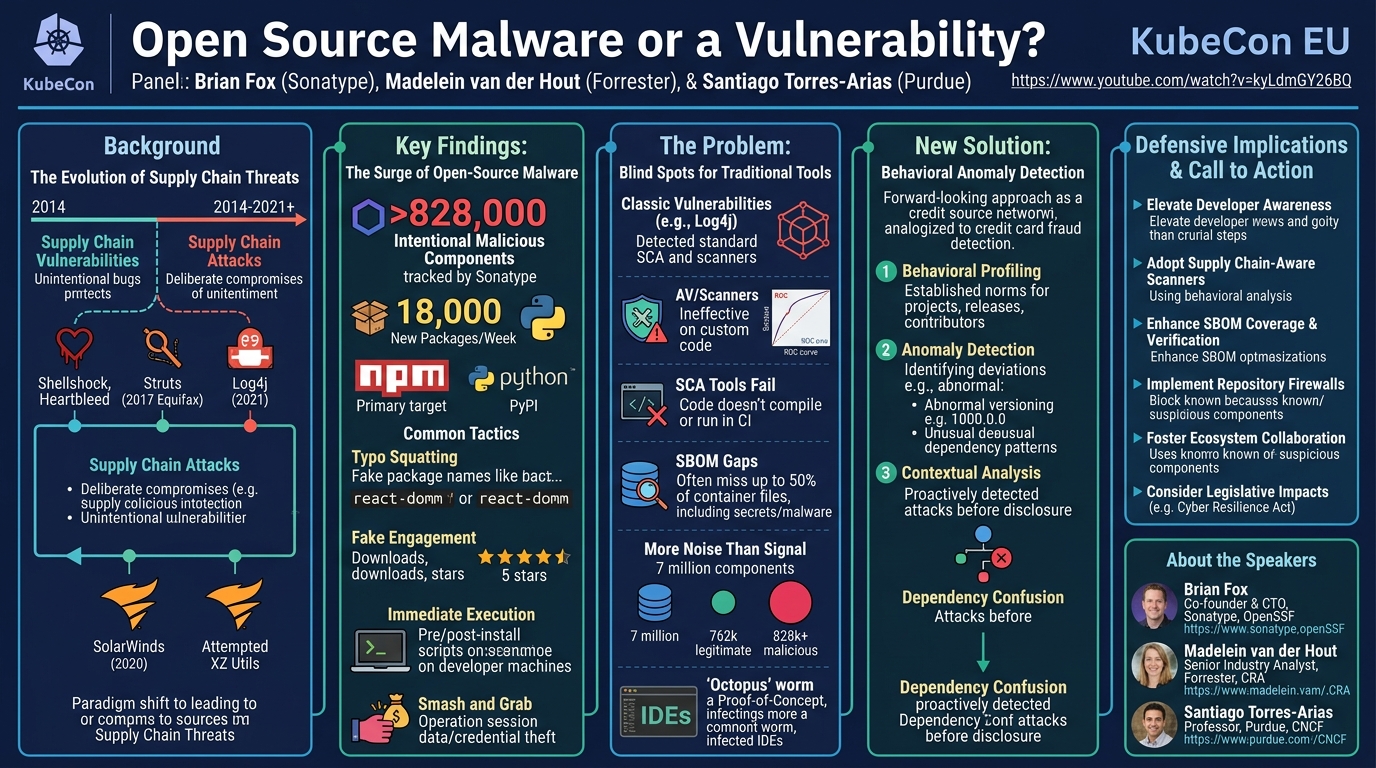
The concept of a software supply chain attack has evolved dramatically over the past decade, moving from the exploitation of unintentional bugs to highly sophisticated, deliberate compromises. Early incidents like Struts (prior to the Equifax breach), Heartbleed, and Shellshock in 2014 marked a turning point. These were largely software supply chain vulnerabilities—unintentional bugs that, once disclosed, were rapidly exploited by attackers. At this stage, the race was primarily about rapid patching and updates to outpace fast-following exploits. The Equifax breach in 2017, also stemming from a Struts vulnerability, brought these issues into mainstream consciousness, demonstrating their potential for massive data loss and reputational damage.
The COVID-19 pandemic era saw further high-profile incidents, including the ubiquitous Log4j vulnerability in 2021. While Log4j had a monumental impact due to its widespread use, Santiago Torres-Arias characterized it as an "old school boring kind of bug"—a vulnerability rooted in the intersection of deserialization and a Java runtime issue. This type of incident, where a flaw spreads through the supply chain, contrasts sharply with incidents like SolarWinds in 2020. SolarWinds was unequivocally a supply chain attack, where malicious code was intentionally injected into legitimate software during its development or distribution. Similarly, the attempted compromise of XZ Utils, a popular compression library, saw an attacker gain commit access and submit malicious code, narrowly averted before it reached stable releases. This distinction between vulnerability and attack is crucial, as the panel argues that without it, effective mitigation strategies for both types of threats cannot be developed.
Madelein van der Hout further highlighted the societal pressure to quickly determine root causes, often rushing the investigation process. This urgency can obscure the nuanced nature of incidents, hindering comprehensive learning and the development of appropriate long-term mitigations. Historically, many early exploits and hacks originated from academic curiosity, a point that is often forgotten when focusing solely on technical mitigations, neglecting the behavioral aspects of both attackers and defenders. The panel asserts that traditional security solutions, designed for known vulnerabilities or conventional malware, are struggling to keep pace with these evolving, often intentionally crafted, threats within the open-source supply chain.
Key Findings
▶ Watch: Early supply chain vulnerabilities: Struts and Heartbleed (2:40)
The panel unveiled several critical findings that underscore the severity and evolving nature of open-source software supply chain threats:
- Explosive Growth of Intentional Malware: Since 2017, there has been a massive and sustained rise in intentional malicious components, which Brian Fox refers to as "open-source malware." Sonatype has tracked over 828,000 such components, with approximately 18,000 new packages appearing weekly. This volume indicates a systematic and industrial-scale effort by attackers.
- Dominance in Key Ecosystems: The majority of these malicious packages are found in npm (Node Package Manager), followed closely by Python (PyPI). The prevalence in Python is particularly concerning given its central role in artificial intelligence and machine learning development, as highlighted by the attempted TensorFlow backdoor mentioned by Santiago.
- Primary Attack Vector: Typo Squatting: A significant portion of these attacks leverage typo squatting, where attackers publish packages with names subtly similar to popular, legitimate ones. They then fake download counts, stars, and comments to deceive developers into downloading the malicious versions.
- Immediate Execution on Developer Machines: Unlike traditional vulnerabilities that might require specific runtime conditions, many of these malicious npm and Python packages contain pre- and post-install scripts. This allows the malicious code to execute immediately upon installation on a developer's machine, often before it even enters a CI/CD pipeline or is compiled.
- "Smash and Grab" Tactics: A common objective of these attacks is "smash and grab"—stealing sensitive data like environment variables and developer credentials. While some attacks are more sophisticated, dropping backdoors, many aim for quick, high-volume data exfiltration, banking on a numbers game.
- Blind Spots for Traditional Security Tools:
- Traditional SCA tools and vulnerability scanners are largely blind to these attacks because the malicious components often don't compile or are not recognized as traditional vulnerabilities. The compromise occurs at the developer's workstation, outside the typical CI/CD scanning flow.
- Off-the-shelf anti-malware (AV) software is highly ineffective against open-source malware. Santiago presented an ROC curve study demonstrating that AV tools perform little better than a coin flip in detecting these threats, as they lack specific fingerprints for custom-designed, mal-intended open-source code.
- Software Bill of Materials (SBOMs), while valuable, have significant limitations. A study revealed that for some containers, up to 50% of files are not reported in SBOMs. This includes secrets and malicious code that is not part of a recognized package or not covered by a full filesystem hash, creating critical blind spots.
- More Noise Than Signal: Brian Fox revealed a stark reality: the number of fake, malicious components in the open-source ecosystem is now comparable to, or even exceeds, the number of commonly used legitimate components. Of approximately 7 million open-source components, only about 762,000 are commonly used, while the number of tracked malicious components has surpassed 828,000. This "noise" significantly complicates discovery and trust.
- Proof-of-Concept for Worm-like Behavior: The panel referenced the "Octopus" worm from around 2021, a Java-based proof-of-concept that leveraged IDEs like Eclipse and IntelliJ. This worm replicated itself across JAR files on a developer's machine, demonstrating the potential for self-propagating open-source malware. While it didn't perform overt malicious actions beyond replication, its existence highlights a powerful, underutilized attack vector.
Technical Deep Dive
▶ Watch: Major incidents raising public awareness: Equifax, Log4j (4:00)
The technical core of the discussion revolves around the fundamental differences between traditional software vulnerabilities and modern open-source malware, and the innovative detection techniques required to counter the latter.
Brian Fox meticulously explained that classic vulnerabilities like Log4j or Struts were unintentional bugs. While their exploitation could have massive impact, the underlying flaw was not designed with malicious intent. These issues often arise from complex interactions between components, such as the deserialization flaw in Log4j intersecting with Java runtime issues. Traditional Software Composition Analysis (SCA) tools are generally effective at identifying these known vulnerabilities by scanning for specific versions of components with published CVEs.
In contrast, open-source malware is characterized by intentional malicious components. These are not bugs, but deliberately crafted pieces of code designed to compromise systems. The primary vector for these attacks is typo squatting, where attackers create packages with names remarkably similar to popular libraries (e.g., react-dom vs. react-domm). These malicious packages are then padded with fake download statistics, star counts, and positive comments to appear legitimate, tricking developers during their search for dependencies.
A critical technical detail for npm and Python ecosystems is the use of pre- and post-install scripts. These scripts execute automatically when a package is installed, even if the package itself doesn't compile or isn't integrated into the final application. This mechanism allows attackers to immediately execute arbitrary code on a developer's machine, facilitating "smash and grab" operations—stealing environment variables, API keys, or other sensitive data accessible to the developer. This direct execution on the development workstation bypasses many traditional security controls that typically monitor compiled artifacts or runtime environments further down the CI/CD pipeline.
The panel underscored why traditional anti-malware (AV) software is ineffective against this new breed of threat. Unlike traditional viruses or rootkits, which often have identifiable signatures or binary patterns, open-source malware is typically custom code. It might perform seemingly innocuous actions, like making network requests or reading file system paths, but with malicious intent. As Santiago Torres-Arias elaborated with his ROC curve study, generic malware scanners perform little better than random chance when faced with open-source malware. This is because they lack the contextual understanding of normal open-source project behavior to differentiate between legitimate and malicious custom code.
Further compounding the issue are the limitations of current Software Bill of Materials (SBOMs). While SBOMs aim to provide transparency into software components, they often fall short in comprehensive coverage. Santiago's research indicated that up to 50% of files within containers might not be reported by SBOMs, especially if these files are not part of a recognized package or if the SBOM generation process doesn't hash the entire filesystem. This creates blind spots where embedded secrets or malicious code, not tied to a specific package, can reside undetected.
To address these challenges, Sonatype has developed an innovative approach, which Brian Fox likened to credit card fraud detection. Their system, known as Sonatype Repository Firewall or Sonatype Malware Defense, does not rely on signatures but on stereotypical models of open-source projects. This involves:
- Behavioral Profiling: Understanding normal project behavior, such as typical release locations, common contributors, time-of-day for commits, and standard dependency patterns.
- Anomaly Detection: Identifying deviations from these established norms. For instance, a project publishing its "first" version as
1000.0.0is highly abnormal, as is a popular project suddenly introducing a dependency that no other project uses. - Contextual Analysis: Recognizing that certain behaviors, while not inherently malicious in isolation, are highly suspicious when observed in the context of open-source package distribution. This system successfully detected dependency confusion attacks before they were publicly disclosed, precisely because it flagged the abnormal versioning and naming conventions.
This behavioral analysis shifts the defense from reactive signature matching to proactive anomaly detection, offering a more robust defense against the constantly evolving tactics of open-source malware authors.
Demo / Proof of Concept
▶ Watch: Santiago's critical distinction: supply chain attacks vs. vulnerabilities (5:00)
While the panel discussion itself did not feature a live, interactive demonstration of an attack or a defensive tool, the speakers extensively described several critical proof-of-concept incidents and the operational mechanics of Sonatype's detection system.
A significant proof-of-concept mentioned was the "Octopus" worm, which emerged around 2021 during the pandemic. This was a Java-based worm specifically designed to leverage popular Integrated Development Environments (IDEs) such as Eclipse and IntelliJ. The mechanism involved a malicious component that, once pulled down by a developer, would worm-style infect every Java Archive (JAR) file accessible on that developer's machine. Crucially, the Octopus worm, at least in its observed form, did not perform any overtly destructive or data-exfiltrating actions beyond replicating itself. This led Brian Fox to speculate that it was likely a proof-of-concept, demonstrating the feasibility of self-propagating open-source malware within development environments. Its lack of mass deployment since then remains an open question, suggesting attackers might be "saving their good antibiotics" for when current, simpler methods become less effective.
Furthermore, Brian Fox detailed how Sonatype's prototype detection system, the precursor to Sonatype Repository Firewall, effectively identified the dependency confusion research before its public disclosure. This research involved white-hat hackers publishing components to public repositories with the same names as internal, private components used by various companies, but with very high version numbers. Build tools, prioritizing the latest version, would then inadvertently pull the public (malicious) package instead of the intended internal one. Sonatype's system flagged this as abnormal behavior because legitimate projects typically start with low version numbers (e.g., 0.1 or 1.0), not 1000. This demonstrated the efficacy of their behavioral modeling approach in detecting novel attack vectors without relying on prior knowledge of specific malicious signatures.
These examples, though descriptive rather than live, powerfully illustrate the sophisticated nature of open-source supply chain attacks and the potential for advanced, behavioral-based detection mechanisms to identify them.
Defensive Implications
▶ Watch: Massive impact and challenges in rapid incident mitigation (6:20)
The panel's insights offer crucial guidance for defenders grappling with the escalating threat of open-source malware and supply chain attacks. The overarching message is that traditional security paradigms are insufficient, necessitating a fundamental shift in strategy.
- Elevate Developer Awareness: A primary defensive implication is the critical need to increase developer awareness. Brian Fox emphasized that many developers are simply unaware that open-source components can be a vector for intentional malware. When they download a typo-squatted package, they might simply realize they picked the "wrong" one, correct their mistake, and move on, completely oblivious that their machine might have been compromised and data exfiltrated. Education campaigns and training programs are essential to help developers recognize suspicious activities, understand the risks of package installation (especially for npm and Python with their pre/post-install scripts), and know when to report unusual events.
- Adopt Behavioral Anomaly Detection: Traditional anti-malware (AV) software and signature-based scanning are demonstrably ineffective against custom open-source malware. Defenders must invest in supply chain-aware scanners and tools that utilize behavioral analysis and anomaly detection, similar to Sonatype's approach. These tools should monitor for unusual project behaviors—such as abnormal versioning, unexpected dependencies, or releases from uncharacteristic locations—rather than just looking for known malicious fingerprints. This proactive, context-aware monitoring is vital for identifying novel or polymorphic threats.
- Enhance SBOM Coverage and Verification: While Software Bill of Materials (SBOMs) are a step in the right direction for transparency, their current implementation often leaves significant gaps. Organizations need to push for more comprehensive SBOM generation that accounts for all files within containers, not just those tied to recognized packages. This includes mechanisms to detect embedded secrets or malicious code that might bypass package-level tracking. Furthermore, SBOMs should be part of a broader "gating trust" strategy, where the integrity and provenance of all distributed artifacts are continuously verified.
- Implement Robust Repository Firewalls: Given the sheer volume of malicious packages (18,000 new ones weekly), organizations must deploy repository firewalls like Sonatype Repository Firewall to block known and suspicious components before they even reach a developer's machine or internal repositories. This acts as a crucial first line of defense, preventing the initial compromise.
- Foster Collaboration and Information Sharing: Madelein van der Hout and Santiago Torres-Arias stressed the importance of information sharing and collaboration across the security ecosystem. Adversaries constantly innovate and share tactics; defenders must do the same. This includes collaboration between researchers, vendors, open-source communities (like the OpenSSF and CNCF), and individual organizations to share threat intelligence, best practices, and contribute to the collective defense of the software supply chain.
- Consider Legislative Impacts: The discussion touched upon the potential impact of legislation like the Cyber Resilience Act (CRA), which aims to mandate stricter security requirements for software. While such regulations could force greater scrutiny of components and libraries, they also pose challenges, potentially leading to the banning of certain components or forcing costly functionality replacements, impacting innovation. Defenders should actively engage with these legislative efforts to ensure they promote effective security without stifling the agility and open nature of software development.
In essence, defending against modern open-source supply chain threats requires moving beyond a reactive, technical-only approach to embrace a proactive, behavioral, and collaborative strategy that integrates security throughout the entire software development lifecycle, from developer workstation to deployment.
Key Takeaways
- Evolving Threat Landscape: Software supply chain threats have fundamentally evolved from exploitable bugs (vulnerabilities like Log4j) to sophisticated, intentional malware (attacks like SolarWinds or typo-squatted packages).
- Traditional Tools Are Inadequate: Conventional anti-malware (AV) software and basic Software Composition Analysis (SCA) tools are largely ineffective against open-source malware, which uses custom code and behavioral anomalies rather than known signatures.
- Behavioral Detection is Key: Effective defense requires new tools that employ behavioral analysis and anomaly detection, similar to credit card fraud detection, to identify suspicious patterns in open-source project releases and dependencies.
- Developer Awareness is Critical: A significant gap in current defenses is the lack of developer awareness regarding open-source malware; many developers are unknowingly exposed and may not recognize a compromise when it occurs.
- SBOMs Have Limitations: While valuable, Software Bill of Materials (SBOMs) often miss a substantial portion of files within containers (up to 50%), including secrets and malicious code not tied to traditional packages, creating critical blind spots.
- Collaboration and Proactive Measures: A robust defense strategy demands increased collaboration across the open-source ecosystem, proactive measures like repository firewalls, and a fundamental shift towards integrating supply chain integrity throughout the entire software development lifecycle.
About the Speaker(s)
Brian Fox is the Co-founder and CTO at Sonatype, where he has dedicated over 17 years to helping enterprises manage their software dependencies. His company operates the Maven Central repository, a foundational resource for Java open-source components. Brian is also a prominent figure in the open-source security community, serving on the board of the Open Source Security Foundation (OpenSSF) and the Finnos Financial Open Source Foundation at the Linux Foundation. He is also a long-time member of the Apache Software Foundation.
Madelein van der Hout is a Senior Industry Analyst specializing in Cybersecurity and Risk at Forrester Research. Her research encompasses a wide array of cybersecurity domains, including API security, cyber consulting services, emerging threats, and the impact of legislation such as the Cyber Resilience Act (CRA) and SBOMs (Software Bill of Materials) on the industry.
Santiago Torres-Arias is a Professor at Purdue University, where his research focuses on how to securely develop software and verify its secure development. With nearly two decades of experience in this field, Santiago is actively involved with the CNCF (Cloud Native Computing Foundation), contributing to several projects. He works closely with the open-source community to assess risks, identify upcoming threats, and develop mitigation strategies to minimize the impact of malicious actors across the software supply chain.
Reviews
Dr. Zero (Offensive Security Researcher) — MUST SEE
This panel cuts through the noise to deliver a brutally honest assessment of the software supply chain. It meticulously dissects the critical distinction between accidental vulnerabilities and intentional, industrial-scale open-source malware. With hard data on the explosion of malicious packages, concrete examples of novel attack vectors, and a deep dive into effective behavioral detection, this session provides actionable intelligence that every developer, CISO, and security professional needs to internalize. It's a much-needed, no-bullshit look at a threat that traditional security tools are utterly failing to address, offering a clear path forward.
Heather Calloway (CISO) — MUST SEE
This panel delivers a critical and urgent assessment of the evolving software supply chain threat, drawing a crucial distinction between unintentional vulnerabilities and deliberate, malicious attacks. The speakers meticulously detail the alarming surge in open-source malware, the systemic inadequacy of traditional security tools, and the immediate operational risks posed by typo-squatted packages executing on developer workstations. Far from a generic problem statement, the discussion offers clear, actionable strategies centered on behavioral anomaly detection, enhanced developer awareness, and robust institutional controls, making a compelling case for fundamental shifts in security…