FlashInfer: Efficient and Customizable Attention Engine for LLM Inference Serving
Zihao Ye (Graduate Student · University of Washington), Lequn Chen, Ruihang Lai, Tianqi Chen, Arvind Krishnamurthy, Luis Ceze
Conference on Machine Learning and Systems 2025 · Day 2 · Session 1: LLM and Diffusion Model Serving
Overview
The proliferation of Large Language Models (LLMs) has introduced significant challenges in deploying and serving these models efficiently, particularly concerning the core attention mechanism. This talk introduces FlashInfer, an innovative and open-source attention engine designed to tackle these complexities head-on. FlashInfer aims to provide a high-performance, customizable, and unified solution for LLM inference serving by addressing critical issues such as the heterogeneity of KV cache management, the explosion of attention variants, and the dynamic nature of inference workloads.
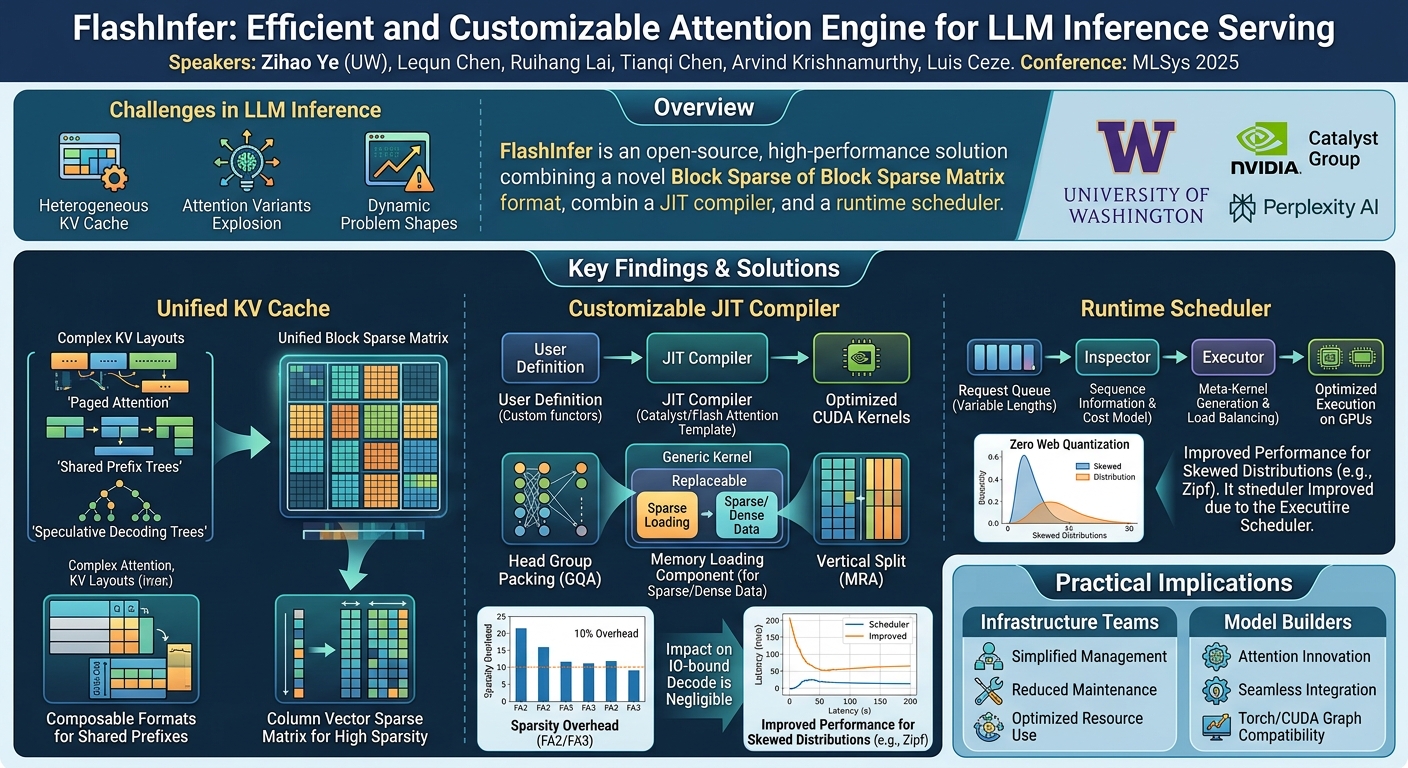
Key moments
- 0:00 Introduction to FlashInfer and talk overview
- 0:27 Overview of three main attention inference challenges
- 0:39 First challenge: KV cache heterogeneity and management
- 1:14 Second challenge: Explosion of attention variants
- 1:46 Third challenge: Dynamic problem shapes in inference
- 4:09 FlashInfer's solution: Block sparse matrix for KV cache
- 6:08 Column vector sparse matrix for highly sparse tree attention
- 8:08 JIT compiler and runtime for attention variants and dynamic shapes
FlashInfer: Efficient and Customizable Attention Engine for LLM Inference Serving
Speakers: Zihao Ye, Graduate Student, University of Washington; Lequn Chen; Ruihang Lai; Tianqi Chen; Arvind Krishnamurthy; Luis Ceze
Conference: MLSys 2025
YouTube: https://www.youtube.com/watch?v=None
Overview
The proliferation of Large Language Models (LLMs) has introduced significant challenges in deploying and serving these models efficiently, particularly concerning the core attention mechanism. This talk introduces FlashInfer, an innovative and open-source attention engine designed to tackle these complexities head-on. FlashInfer aims to provide a high-performance, customizable, and unified solution for LLM inference serving by addressing critical issues such as the heterogeneity of KV cache management, the explosion of attention variants, and the dynamic nature of inference workloads.
Developed through a collaboration spanning the University of Washington, Catalyst Group in CMU, Nvidia, and Perplexity AI, FlashInfer stands out by proposing a novel block sparse matrix format for KV cache storage, coupled with a sophisticated JIT compiler and a dynamic runtime scheduler. This integrated approach allows FlashInfer to deliver state-of-the-art performance while maintaining flexibility across diverse LLM architectures and deployment scenarios. The project positions itself as a vital component for the evolving landscape of generative AI, offering a robust foundation for next-generation LLM serving infrastructure.
The significance of FlashInfer lies in its ability to abstract away much of the underlying complexity of high-performance attention computation. By offering a unified interface and an adaptive execution strategy, it empowers researchers and practitioners to focus on model innovation rather than low-level kernel optimization. Its commitment to open-source development further fosters community-driven progress, ensuring that the engine remains at the forefront of LLM inference efficiency.
Background
▶ Watch: Introduction to FlashInfer and talk overview (0:00)
The rapid advancements in Large Language Models (LLMs) have been paralleled by an increasing demand for efficient inference serving. At the heart of LLM inference lies the attention mechanism, which enables models to weigh the importance of different parts of the input sequence. While the original Transformer architecture introduced vanilla attention in 2017, subsequent innovations have dramatically altered its implementation and optimization requirements.
The core problem FlashInfer addresses stems from three primary challenges in modern LLM inference serving:
- KV Cache Heterogeneity: The Key-Value (KV) cache stores previously computed keys and values to avoid redundant computation during token generation. However, various techniques have emerged to optimize KV cache usage, leading to diverse storage and access patterns. For instance, Paged Attention (as seen in systems like vLLM) uses page tables to manage variable sequence lengths and reduce memory fragmentation. Sliding Window Memory (SWM) (e.g., in SLaM) groups shared prefixes into tree-like structures for reuse. Furthermore, active research in KV cache compression, pruning, and speculative decoding (e.g., SpecInfer) introduces scenarios where only parts of the KV cache are accessed, or where the cache itself forms a complex tree structure (like an expanding token tree). These diverse strategies mean that KV cache data is often non-contiguous and dynamic, posing a significant challenge for designing generic, high-performance attention operators. Traditional dense attention kernels cannot directly handle these sparse, fragmented access patterns, often requiring expensive data movement to dense memory first.
- Attention Variant Explosion: The vanilla attention mechanism is rarely used in its original form today. Model developers continually introduce new variants to improve efficiency, performance, or specific model properties. Examples include Multi-Query Attention (MQA), Grouped-Query Attention (GQA), and Multi-Round Attention (MRA), which optimize for different trade-offs in terms of memory bandwidth and computational intensity. Beyond these structural changes, variations in head dimensions, data types, and specific logit transformations (such as the logarithmic scaling seen in models like Grok and Gamma) further multiply the number of distinct attention computations. Each of these variants ideally requires a specialized, highly optimized CUDA kernel to achieve peak performance. This leads to a combinatorial explosion in the number of kernels that need to be developed and maintained, resulting in excessively large binary sizes for inference libraries and hindering rapid iteration on new model architectures.
- Dynamic Problem Shapes: Unlike model training, where inputs are often padded to uniform lengths for batch processing, LLM inference serving must handle highly dynamic and variable sequence lengths from user requests. Furthermore, inference typically involves distinct stages: prefill (processing the initial prompt), decode (generating subsequent tokens one by one), and append (adding new tokens to the KV cache). Each stage, and indeed different user requests, presents a unique distribution of input shapes and sizes. This dynamism makes static kernel compilation inefficient and necessitates sophisticated runtime scheduling and load balancing strategies to fully utilize GPU resources and minimize latency. Without such mechanisms, performance can degrade significantly due to underutilization or inefficient memory access patterns.
Prior work like FlashAttention significantly improved attention efficiency by optimizing for GPU memory hierarchies, reducing redundant memory accesses, and enabling higher throughput. However, FlashAttention primarily targets dense, contiguous attention scenarios. FlashInfer builds upon these foundational optimizations while extending them to accommodate the complexities introduced by KV cache heterogeneity, attention variants, and dynamic workloads, aiming to provide a comprehensive solution for the intricate demands of modern LLM inference.
Key Findings
▶ Watch: First challenge: KV cache heterogeneity and management (0:39)
FlashInfer presents several key findings and contributions that collectively address the core challenges of efficient LLM inference serving:
- Unified KV Cache Storage via Block Sparse Matrix: A fundamental insight is the proposal of a block sparse matrix as a unified format for storing the KV cache. This format effectively models diverse KV cache management techniques, including paged attention, shared prefix trees, and speculative decoding trees. This unification eliminates the need for distinct data structures and specialized kernels for each cache strategy, significantly streamlining the attention engine design. Importantly, for highly sparse structures like tree attention, FlashInfer introduces the column vector sparse matrix variant, ensuring efficient memory utilization even with large block sizes.
- Composable Formats for Shared Prefixes: Recognizing the prevalence of shared prefixes in multi-request scenarios (e.g., batching requests with common starting tokens), FlashInfer demonstrates that a block sparse matrix can be decomposed into a combination of several block sparse matrices, each potentially with a different block size. This "composable format" strategy allows for optimized memory access patterns and increased operational intensity, particularly leveraging GPU tensor cores more effectively for larger, denser blocks while still accommodating sparse components.
- Customizable JIT Compiler for Attention Variants: To combat the explosion of attention variants, FlashInfer develops a JIT (Just-In-Time) compiler that generates highly optimized CUDA kernels on demand. This compiler is built around a customizable Flash Attention template that supports both contiguous and sparse KV cache formats. Users can define their own key, query, and logic transform functions, which the JIT compiler then specializes and compiles into efficient operators. This approach ensures that FlashInfer can adapt to new attention mechanisms without requiring manual kernel development or bloating the library with pre-compiled binaries for every possible variant.
- Runtime Scheduler for Dynamic Problem Shapes: FlashInfer incorporates a sophisticated runtime scheduler designed to handle the dynamic and variable sequence lengths characteristic of inference workloads. Similar to the inspector-executor pattern in HPC, this scheduler inspects sequence information ahead of time and uses a cost model to deterministically balance the load across GPU resources. It aims for "zero web quantization," ensuring optimal utilization and minimizing latency even with skewed request distributions (e.g., Zipf distribution).
- Demonstrated Efficiency and Low Overhead: Experimental results show that the sparsity introduced by the block sparse matrix format incurs only around 10% overhead when compared to dense Flash Attention (FA2 and FA3) templates. For IO-bound decode scenarios, this impact becomes negligible. Furthermore, the load-balancing scheduler is proven to achieve better performance for workloads with skewed sequence length distributions, confirming the effectiveness of its dynamic optimization strategy.
- Open-Source and Evolving Ecosystem: FlashInfer is an open-source project actively gathering contributions from industry and academia, with a mission to build a versatile kernel generator for generative AI models. It emphasizes compatibility with existing frameworks like Torch Compile and CUDA Graph, and is already planning support for future hardware generations (e.g., Blackwell), showcasing its commitment to evolving with the community and hardware landscape.
Technical Deep Dive
▶ Watch: Third challenge: Dynamic problem shapes in inference (1:46)
FlashInfer's technical prowess stems from its multi-pronged approach, integrating novel data structures, a flexible JIT compilation system, and an intelligent runtime scheduler.
Unified KV Cache Format: The Block Sparse Matrix
The core innovation for handling KV cache heterogeneity is the adoption of a block sparse matrix as a unified storage format. This is not merely a theoretical concept but a practical design choice tailored for modern GPU architectures.
- Block Sparse Matrix Definition: A block sparse matrix is a type of sparse matrix where the minimal non-zero element is a block of data, rather than a single scalar. Each block has a shape of
BR(block row) byBC(block column). TheBCdimension is particularly crucial as it is designed to align with the optimal data access patterns and computational units of modern GPU tensor cores (e.g., on Nvidia Ampere, Hopper, and Blackwell architectures) and TPU matrix cores. These cores achieve peak efficiency when operating on larger, contiguous blocks of data, and this trend towards larger optimal block sizes is continually growing. By storing KV cache data directly in a block format, FlashInfer can utilize these specialized hardware units without the overhead of reshaping or reorganizing sparse elements into dense blocks at runtime.
- Modeling Existing KV Cache Strategies:
- Paged Attention (vLLM): FlashInfer demonstrates that paged attention can be elegantly represented as a special form of block sparse matrix. If all user requests and their queries are packed together (forming the rows), and the entire page pool constitutes the columns, then the non-zero elements (or non-zero columns per row) correspond to the activated pages for each query and request. This mapping allows FlashInfer to treat paged attention as a block sparse operation.
- Radix Tree / Token Tree (Speculative Decoding, SLaM): Structures like the expanding token tree used in speculative decoding, or the shared prefix trees in SLaM, are inherently sparse. They represent a tree-like access pattern over the KV cache. While naturally sparse, direct mapping to a general block sparse matrix can be problematic.
- Addressing High Sparsity with Column Vector Sparse Matrix: A challenge arises with highly sparse structures, such as the tree attention patterns seen in models like Medusa. In these cases, each row might have only one or two active elements. Using a large
BR x BCblock size for such sparse patterns would lead to significant memory waste, as most of the block would be zeros. FlashInfer's solution is to employ a column vector sparse matrix, which is a specialized form where the number of columns per block is one (BC=1). This minimizes waste for very sparse structures. Crucially, even with these "column vector" blocks, FlashInfer can still leverage dense tensor cores. This is achieved by intelligently loading the non-contiguous rows and columns from global memory into dense shared memory on the GPU, where they can then be processed by the tensor cores at high efficiency.
- Composable Formats for Shared Prefixes: Many real-world inference scenarios involve multiple requests that share common prefixes (e.g., "The quick brown fox" followed by different endings). Optimizing for these shared prefix scenarios is vital for throughput. FlashInfer proposes that the original block sparse matrix representing the KV cache can be decomposed into a combination of several block sparse matrices, each potentially with a different, optimized block size. For example, a dense shared prefix could be processed with a larger
BR x BCblock size to maximize tensor core utilization and operational intensity, while the unique, sparser continuations could be handled with smaller or column-vector blocks. This dynamic decomposition allows FlashInfer to adapt its memory access patterns and computation strategies to the specific sparsity characteristics of different parts of the KV cache, leading to better overall performance.
JIT Compiler and Customizable Flash Attention Template
To address the "attention variant explosion," FlashInfer employs a sophisticated JIT compilation strategy based on a highly customizable Flash Attention template.
- Customizable Template Design: The core of this system is a Flash Attention template implemented using Catalyst. This template assumes that queries and outputs are stored in dense tensors (which can represent variable-length arrays), while the KV cache can be stored in either a dense tensor format or FlashInfer's sparse tensor format. A key architectural design is a modular memory loading component. This component is responsible for loading data from global memory into shared memory. The genius here is that the rest of the kernel (the actual attention computation logic) remains identical, regardless of whether the KV cache is dense or sparse. Only the memory loading module changes, simplifying kernel development and maintenance significantly.
- Hardware Specificity: While the template is flexible, achieving peak performance necessitates hardware-specific optimizations. FlashInfer acknowledges that a distinct template design is required for each GPU architecture (e.g., Nvidia Ampere, Hopper, Blackwell) to fully exploit their unique features and maximize performance.
- Optimizations for Grouping Patterns:
- Head Group Packing (GQA): For Grouped-Query Attention (GQA), FlashInfer implements head group packing. This technique increases the operational intensity by grouping multiple query heads that share the same key/value heads, allowing for more efficient use of computational units and memory bandwidth.
- Vertical Split (MRA): For Multi-Round Attention (MRA), a vertical split strategy is employed to reduce register pressure. This involves breaking down the computation into smaller, more manageable parts that fit within the GPU's limited register files, preventing spills to slower memory and maintaining high performance.
- JIT Compilation Process: The JIT compiler is inspired by pioneers like Flash Attention and the Triton framework. It allows users to define their own custom key, query, and logic transform functions (e.g., for different activation functions or logit biases). These user-defined functions are provided as "functors." FlashInfer then uses a Jinja template to specialize these functors into CUDA operators. The JIT compiler compiles these specialized CUDA operators, and finally, creates Python bindings and PyTorch operators for seamless integration into existing ML workflows. This dynamic compilation ensures that only the necessary kernels for a given model and configuration are generated, eliminating binary bloat and allowing for rapid adaptation to new attention variants.
Runtime Scheduler for Dynamic Problem Shapes
To manage the highly variable sequence lengths and distinct inference stages, FlashInfer incorporates a runtime scheduler that operates on principles similar to the inspector-executor pattern common in high-performance computing (HPC).
- Cost Model-Based Deterministic Scheduling: The scheduler employs a cost model to make deterministic decisions about how to schedule variable-length sequences. Before each generation step (e.g., token decoding), it inspects the sequence information (lengths, batch sizes, etc.) to predict the computational load.
- Meta-Kernel Generation and Load Balancing: Based on this inspection, the scheduler emits metadata used to generate a meta-kernel or persistent kernel. The primary goals are load balancing across GPU resources and achieving "zero web quantization" – minimizing idle time and ensuring that computational units are fully utilized, even when requests have highly skewed sequence length distributions (e.g., a Zipf distribution common in real-world user queries).
- Scheduler Abstraction: FlashInfer's scheduler exposes a clear abstraction:
- An
initfunction for performing the initial JIT compilation. - A
planfunction that carries out the runtime load balancing and scheduling decisions. - A
runfunction that executes the optimized kernel.
- Compatibility: This runtime system is designed to be fully compatible with popular optimization frameworks like Torch Compile and CUDA Graph, allowing FlashInfer to integrate seamlessly into existing PyTorch-based inference pipelines and benefit from their performance optimizations.
In summary, FlashInfer's technical architecture represents a comprehensive solution to the complex challenges of LLM inference, combining intelligent data structures, dynamic code generation, and adaptive scheduling to deliver high performance and flexibility.
Experimental Setup & Results
▶ Watch: FlashInfer's solution: Block sparse matrix for KV cache (4:09)
FlashInfer's evaluation focuses on demonstrating the efficiency of its proposed solutions, particularly the overhead introduced by its sparse KV cache format and the benefits of its runtime scheduler. While specific hardware configurations and detailed dataset information are not extensively covered in the provided transcript, the results highlight key performance characteristics.
Comparison Baselines:
The primary baselines for comparison are existing highly optimized Flash Attention templates, specifically FA2 and FA3. These serve as a benchmark for dense, contiguous attention performance, allowing FlashInfer to quantify the overhead of its more flexible sparse approach.
Key Metrics and Headline Numbers:
- Sparsity Overhead: FlashInfer evaluates the performance impact of using its block sparse matrix format compared to dense Flash Attention kernels.
- Result: Sparsity only introduced around 10% overhead for both FA2 and FA3 templates. This is a crucial finding, indicating that the benefits of handling diverse KV cache patterns and dynamic access come with a relatively small performance penalty compared to highly optimized dense kernels. This low overhead makes the unified sparse format a viable and efficient solution.
- IO-Bound Decode Performance: For scenarios where the decode phase is primarily limited by memory I/O (Input/Output) rather than computation, the impact of sparsity is further analyzed.
- Result: If the decode phase is IO-bound, the impact of sparsity on performance is negligible. This suggests that in typical token generation steps where data movement often dominates, FlashInfer's sparse access patterns do not introduce significant additional bottlenecks.
- Load Balancing for Skewed Distributions: The effectiveness of FlashInfer's runtime scheduler in managing dynamic, variable-length requests is evaluated, especially for non-uniform distributions of sequence lengths.
- Result: FlashInfer's load-balancing scheduler can achieve better performance for workloads with skewed distributions, such as the Zipf distribution (which often characterizes real-world user request patterns where a few requests are very long and many are short). This validates the scheduler's ability to optimally distribute computational load and minimize idle GPU cycles.
Contextual Note on Data Age:
The speaker explicitly mentions that "these numbers are old because they are measured six months ago. Six months ago in RM is like 10 years ago in real life." This statement underscores the rapid pace of development in the LLM inference space. While the absolute numbers might have evolved, the relative performance characteristics (e.g., low sparsity overhead, benefits of load balancing) are indicative of the architectural strengths of FlashInfer.
Future Directions and Features:
The talk also touches upon exciting future developments, indicating FlashInfer's commitment to continuous improvement:
- Blackwell Support: Active development for compatibility and optimization on Nvidia's next-generation Blackwell architecture, supported by Nvidia.
- Subgraph-Level Compilation: To handle more complex workload challenges, such as mixed prefill and decode phases within a single batch, FlashInfer is moving towards subgraph-level compilation.
- More Efficient Shared Prefix Attention: Further optimizations for shared prefix scenarios, drawing inspiration from work like "FastTree."
In essence, FlashInfer demonstrates that its architectural choices — the block sparse matrix, JIT compilation, and dynamic scheduling — translate into tangible performance benefits, particularly for the complex and dynamic workloads encountered in real-world LLM inference serving, while maintaining a competitive edge against highly optimized dense attention kernels.
Practical Implications
▶ Watch: JIT compiler and runtime for attention variants and dynamic shapes (8:08)
FlashInfer introduces significant practical implications for various stakeholders involved in the deployment and operation of LLMs:
For Practitioners and Infrastructure Teams:
- Simplified KV Cache Management: FlashInfer's unified block sparse matrix format abstracts away the complexities of diverse KV cache management techniques (paged attention, tree attention, speculative decoding). This means infrastructure teams no longer need to maintain separate, specialized kernels or data structures for each KV cache strategy. A single, high-performance engine can efficiently handle all these variations, simplifying development, deployment, and debugging.
- Reduced Binary Bloat and Maintenance: The JIT compiler eliminates the need to pre-compile and ship a massive binary containing kernels for every conceivable attention variant. Kernels are generated on demand, reducing the size of deployment artifacts and making it easier to update or add support for new attention mechanisms without a full library rebuild. This significantly lowers the maintenance burden.
- Optimized Resource Utilization: The runtime scheduler with its cost model-based load balancing ensures that GPU resources are utilized optimally, even with highly dynamic and variable-length user requests. This translates to higher throughput, lower latency, and more efficient use of expensive hardware, directly impacting operational costs.
- Future-Proofing: FlashInfer's open-source nature, active community involvement, and commitment to supporting new hardware (like Blackwell) and advanced features (subgraph compilation) provide a more future-proof solution compared to proprietary or static kernel libraries.
For Model Builders and Researchers:
- Freedom to Innovate with Attention Variants: Model builders can experiment with new attention variants (MQA, GQA, MRA, custom logit transforms, different head dimensions) without being constrained by the availability of optimized kernels. The JIT compiler allows rapid prototyping and deployment of new attention mechanisms by simply defining custom transform functions.
- Seamless Integration of KV Cache Optimizations: Researchers exploring novel KV cache compression, pruning, or speculative decoding techniques can more easily integrate their work with FlashInfer. The block sparse matrix format provides a flexible foundation that can adapt to these evolving memory access patterns without requiring a complete rewrite of the attention computation logic.
- Compatibility with Existing ML Ecosystems: Compatibility with Torch Compile and CUDA Graph ensures that FlashInfer can be easily integrated into existing PyTorch-based model development and deployment pipelines, leveraging familiar tools and workflows.
Tradeoffs and Limitations:
- JIT Compilation Overhead: While beneficial in the long run, JIT compilation introduces an initial overhead at startup. The speaker notes this should be "tolerable" for server execution (within one to two minutes for a server with many CPUs), but it's a factor to consider for extremely latency-sensitive cold starts.
- Hardware-Specific Templates: Achieving peak performance requires hardware-specific template designs. This means that while the core ideas are portable, adapting FlashInfer to entirely new hardware architectures may still require specialized engineering effort.
- Focus on Attention Operators: Currently, FlashInfer is primarily optimized for attention mechanisms. While it welcomes contributions for alternative operators like linear attention or state-space models, these would likely require different template designs and are not the immediate focus. This means model builders using non-attention-based architectures might still need other solutions.
In essence, FlashInfer provides a powerful, flexible, and efficient foundation for serving modern LLMs. It empowers both infrastructure teams and model developers to navigate the complexities of dynamic workloads, diverse attention mechanisms, and evolving hardware, making high-performance LLM inference more accessible and manageable.
Key Takeaways
- Unified KV Cache Management: FlashInfer unifies diverse KV cache management techniques (paged attention, shared prefix trees, speculative decoding) under a flexible block sparse matrix format, significantly simplifying kernel design and deployment.
- Dynamic Kernel Generation: A JIT compiler with a customizable Flash Attention template dynamically generates optimized CUDA kernels for a wide array of attention variants, eliminating binary bloat and enabling rapid adaptation to new model architectures.
- Intelligent Runtime Scheduling: A sophisticated runtime scheduler effectively handles dynamic, variable-length inference workloads, employing a cost model to achieve optimal load balancing and high GPU utilization, especially for skewed request distributions.
- Proven Efficiency: FlashInfer demonstrates minimal overhead (around 10%) for sparsity compared to dense Flash Attention and negligible impact for IO-bound decode scenarios, while delivering performance improvements for dynamic workloads.
- Open and Evolving Ecosystem: As an open-source project, FlashInfer is actively supported by industry and academia, with plans for future hardware support (e.g., Blackwell) and advanced features like subgraph-level compilation, fostering community-driven innovation.
- Practical Benefits: FlashInfer offers practical benefits for practitioners by simplifying infrastructure, reducing maintenance, optimizing resource use, and future-proofing LLM serving solutions.
About the Speaker(s)
The primary presenter for FlashInfer was Zihao Ye, a graduate student at the University of Washington. The work is a collaborative effort involving researchers from several institutions and companies, including the University of Washington, the Catalyst Group at Carnegie Mellon University (CMU), Nvidia, and Perplexity AI. The talk represents a significant contribution from this diverse group towards advancing the efficiency and customizability of LLM inference serving.
Reviews
Simon Wisk (Open Source Developer & AI Tooling Expert) — SOLID
FlashInfer is genuine systems engineering work — a block sparse matrix abstraction for KV cache unification, a JIT compiler for attention variant explosion, and a runtime scheduler for dynamic shape handling. The underlying ideas are solid and the project is real. But this article is a reconstructed summary of a talk, and it shows: the evaluation section is thin, the speaker's own admission that the numbers are 'six months old' is left hanging, and there's no code, no runnable example, and no reproducibility path offered. Worth knowing about as a library; unclear whether the talk itself would give you enough to evaluate the tradeoffs.
Jensen Hitch (AI Compute Platform CEO) — STRONG ACCEPT
FlashInfer addresses a real and structurally important problem — the attention mechanism is the bottleneck that sits at the intersection of every KV cache optimization, every model architecture variant, and every inference scheduling strategy. The block sparse matrix unification is a genuine systems insight, not a benchmark trick. The JIT compilation approach to kernel explosion is the right answer to a real operational problem that every inference team running at scale has hit. The runtime scheduler shows honest thinking about production workloads. Some gaps in experimental rigor and scale validation keep this from a five, but the core architecture is sound and will influence how…
→ Top-rated talks at Conference on Machine Learning and Systems 2025
All talks from Conference on Machine Learning and Systems 2025