LARMix: Latency-Aware Routing in Mix Networks
Mahdi Rahimi
Network and Distributed System Security (NDSS) Symposium 2024 · Day 1 · Tor and Mixed Networks
Overview
Anonymous communication systems, such as mix networks, are vital tools for preserving user privacy online. However, their core mechanism of reordering and delaying messages to achieve anonymity inherently introduces significant latency. While this latency is tolerable for delay-tolerant applications like email or cryptocurrency transactions, it severely degrades the user experience for mid-latency applications (e.g., instant messaging) and renders low-latency applications (e.g., web browsing) virtually unusable. This talk introduces LARMix, a novel latency-aware routing scheme designed to address this fundamental challenge: how to substantially reduce end-to-end latency in mixnets without fundamentally compromising the strong anonymity guarantees they provide.
Key moments
- 0:00 LARMix: Reducing mixnet latency while preserving anonymity
- 2:00 Anonymity trilemma and latency components in mixnets
- 3:00 LARMix design goals: latency, anonymity, load balancing
- 4:00 Geographical clustering and layer arrangement for mixnodes
- 6:00 Latency-aware routing policy using tunable parameter τ
LARMix: Latency-Aware Routing in Mix Networks
Speakers: Mahdi Rahimi
Conference: NDSS Symposium
YouTube: https://www.youtube.com/watch?v=D7A7VtnVNeA
Overview
Anonymous communication systems, such as mix networks, are vital tools for preserving user privacy online. However, their core mechanism of reordering and delaying messages to achieve anonymity inherently introduces significant latency. While this latency is tolerable for delay-tolerant applications like email or cryptocurrency transactions, it severely degrades the user experience for mid-latency applications (e.g., instant messaging) and renders low-latency applications (e.g., web browsing) virtually unusable. This talk introduces LARMix, a novel latency-aware routing scheme designed to address this fundamental challenge: how to substantially reduce end-to-end latency in mixnets without fundamentally compromising the strong anonymity guarantees they provide.
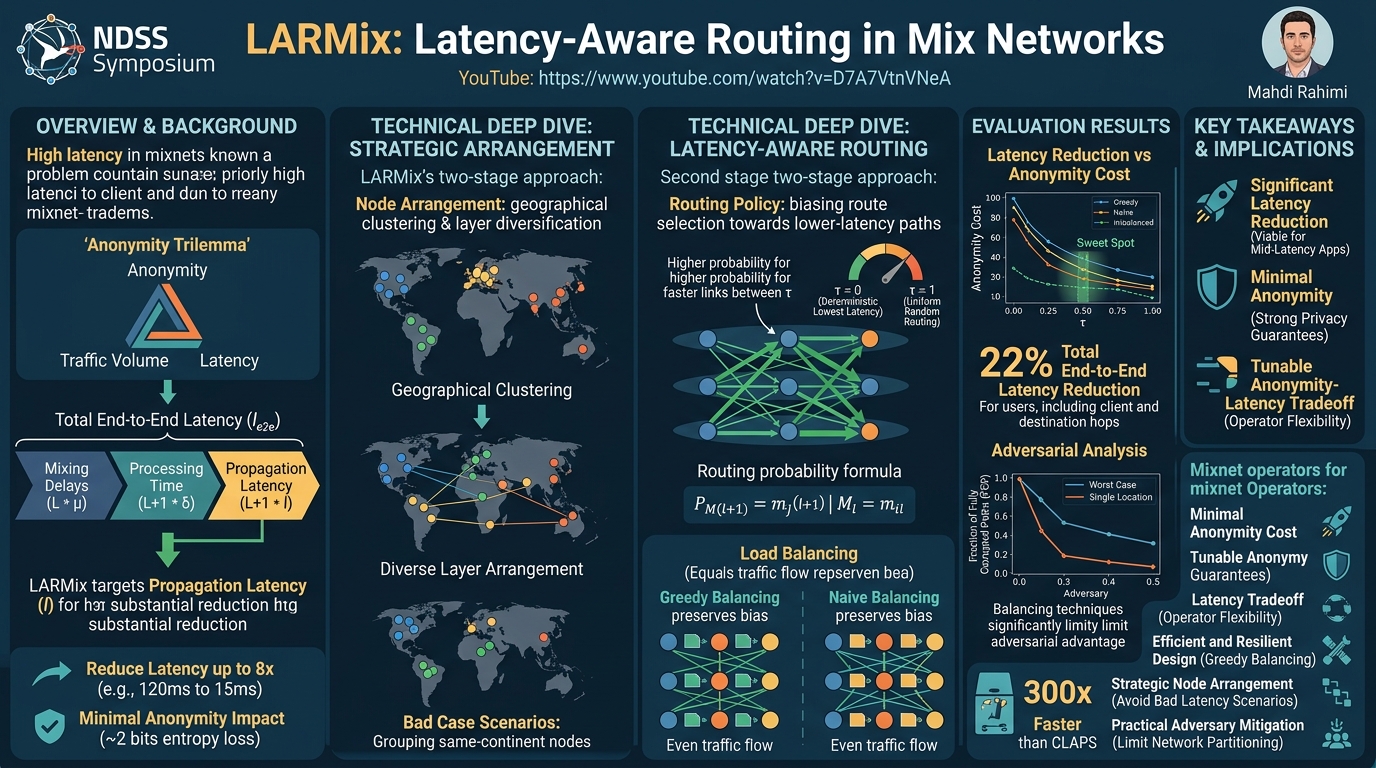
LARMix focuses specifically on Loopix-based layered mixnets, which form the architectural foundation for deployed systems like Nym. In these networks, end-to-end latency is a composite of mixing delays (essential for anonymity), cryptographic processing time (which should be minimized), and network propagation latency between mixnodes. While mixing delays are directly coupled with anonymity, and processing time offers no anonymity benefit, propagation latency stands out as a component that does not have an obvious direct trade-off with anonymity. LARMix intelligently exploits this by selecting routes with shorter propagation times, moving beyond the purely random route selection currently employed. The system aims to achieve this while maintaining load balance across the network and carefully limiting the impact on anonymity. The presentation demonstrates that LARMix can reduce propagation latency by as much as 8x (from 120ms down to 15ms) in experimental scenarios, with a limited anonymity reduction of approximately 2 bits in terms of entropy.
Background
▶ Watch: LARMix: Reducing mixnet latency while preserving anonymity (0:00)
The design of anonymous communication systems often grapples with the anonymity trilemma, which posits a trade-off between anonymity, traffic volume, and end-to-end latency. For a given traffic rate, enhancing anonymity or reducing latency typically comes at a cost to the other. In Loopix-like networks with L intermediary mixes, the average end-to-end latency, denoted as l_e2e, can be expressed as: l_e2e = L μ + (L + 1) δ + (L + 1) * l. Each component plays a distinct role:
μ(average mixing latency per mix): Directly impacts anonymity. A largerμallows for greater reordering of messages, increasing the anonymity set size. In Nym,μis currently set at 50ms per mix.δ(cryptographic processing time per hop): Offers no anonymity benefit and should be minimized. Implementations like Sphinx achieveδvalues as low as 1ms.l(average network propagation latency per transmission): This is LARMix's primary target. It can vary widely, from 10ms to 150ms per hop, and can contribute over half of the totall_e2e, especially whenμis low. Whileldoes not have a direct anonymity trade-off, biasing route selection towards faster routes can inadvertently make them more predictable, thereby indirectly impacting anonymity.
LARMix further refines the understanding of l by breaking it down into l = (l_s,mix + l_mix + l_mix,r) / (L+1), where l_s,mix is the sender-to-mixnet latency, l_mix,r is the mixnet-to-recipient latency, and l_mix represents the aggregate link propagation delays within the mixnet itself. LARMix specifically focuses on minimizing l_mix.
The core design goals for LARMix are:
- Minimize
l_mix: Significantly reduce the average aggregate mixnet propagation latency. - Limit Anonymity Impact: Control the reduction in anonymity that results from biased route selection. This is managed through a tunable parameter
τ(whereτ=0implies maximum latency optimization andτ=1implies uniform random routing). - Load Balancing: Ensure that all mixnodes process traffic equally to prevent bottlenecks and ensure network stability.
- Layered Topology: Support the common
Llayers withWmixes per layer architecture, as seen in Loopix and Nym.
LARMix operates under a robust threat model that considers two types of adversaries:
- Global Passive Adversary: This adversary observes all network links and attempts to derive probabilistic relationships between input and output messages. Anonymity in this context is measured by the Shannon entropy of these distributions.
- Mixnode Adversary: This adversary controls a subset of malicious mixnodes. If all mixnodes along a message's entire route are compromised, the adversary can trace the message end-to-end, resulting in zero anonymity for that message.
Existing latency minimization techniques developed for other anonymous networks, such as Tor (e.g., Lastor, ShorTor), are often not directly applicable to mixnets due to their fundamental architectural and anonymity differences. For instance, Lastor does not prioritize load balancing, and ShorTor's overlay network could lead to imbalanced loads in a mixnet context. The most relevant prior work, CLAPS, uses linear programming for path optimization, and LARMix provides a direct comparison demonstrating superior performance and efficiency.
Key Findings
▶ Watch: Anonymity trilemma and latency components in mixnets (2:00)
LARMix presents a compelling solution to the long-standing challenge of high latency in mix networks, delivering significant improvements without sacrificing essential anonymity. The talk highlights several key findings and contributions:
- Substantial Latency Reduction: LARMix demonstrably reduces mixnet propagation latency (
l_mix) by up to 8x in experimental settings, dropping from 120ms to 15ms. In practical end-to-end scenarios, this translates to a 34.8% reduction in client-to-destination propagation latency and a 22% reduction in total end-to-end latency when accounting for mixing delays. - Minimal Anonymity Cost: The achieved latency reduction comes with a remarkably limited impact on anonymity. Depending on the
τparameter and the chosen load balancing approach, the anonymity reduction is typically between 0.4 and 2 bits of entropy, indicating that the anonymity set remains robust. - Effective and Efficient Load Balancing: LARMix incorporates sophisticated greedy and naive balancing techniques that successfully distribute traffic evenly across mixnodes. The greedy balancing approach is particularly effective, preserving a significant portion of the latency bias while ensuring network stability, and consistently outperforming the naive approach and more complex linear programming solutions like CLAPS.
- Tunable Anonymity-Latency Tradeoff: The introduction of the
τparameter (ranging from 0 for maximum latency optimization to 1 for uniform random routing) provides network designers with a crucial knob to configure the network. LARMix demonstrates how to optimally setτand the mixing delayμto maximize anonymity under specific end-to-end latency constraints, proving its utility in scenarios with tight latency budgets. - Resilience Against Practical Adversaries: Adversarial analysis reveals that LARMix does not significantly enhance the capabilities of practical adversaries (e.g., those controlling nodes in a single geographical location). The use of load balancing techniques further mitigates adversarial gains, especially when compared to imbalanced, low-latency routing. The "worst-case" adversary, which would require selective compromise after routing policies are known, is shown to be impractical.
- Computational Efficiency: LARMix's algorithms are exceptionally efficient, being approximately 300x faster than linear programming approaches like CLAPS. This efficiency is critical for dynamic mixnets like Nym, where routing policies need to be recomputed frequently (e.g., hourly) to adapt to network churn.
- Modular and Flexible Design: The system's modularity allows the node arrangement strategy and the latency-aware routing policy to be applied independently or in combination, offering flexibility for various mixnet deployments.
Technical Deep Dive
▶ Watch: LARMix design goals: latency, anonymity, load balancing (3:00)
LARMix's technical approach unfolds in two principal stages: the strategic arrangement of mixnodes into layers and the definition of a latency-aware routing policy. This modularity allows for independent or combined application of these strategies.
Node Arrangement: Selection and Arrangement of Mixnodes
The first stage, Selection and Arrangement of Mixnodes, aims to maximize the availability of low-latency paths by intelligently placing nodes into L layers, each of size W. Unlike existing approaches that often assign nodes randomly, LARMix prioritizes geographical diversity to ensure a good selection of low-latency paths, preventing scenarios where high-latency inter-continental links are unavoidable.
- Geographical Clustering: The process begins by clustering mixnodes based on their geographical locations. LARMix assumes the availability of average propagation latency values between pairs of mixnodes, which can be obtained through protocols like VerLoc, a system that also provides approximate geolocation. Geolocation data, represented as Cartesian coordinates, is fed into standard clustering algorithms such as K-means, K-medoids, or FCM. The selection of an appropriate number of clusters,
K, is critical; the talk suggests a moderateK(e.g., 5-20) as it offers the best trade-off between latency and anonymity while minimizing computational overhead.
- Layer Arrangement Algorithm: After
Kclusters are formed, a specific algorithm ensures that each of theLmixnet layers, of sizeW, comprises geographically diverse mixnodes. The algorithm adapts based on the relationship betweenW(mixnodes per layer) andK(number of clusters):
- If
W < K: To populate a layer, the algorithm starts by randomly selecting a cluster and a mixnode from it. Subsequent mixnodes for that layer are then iteratively chosen from clusters that are geographically most distant from previously selected clusters, untilWnodes are assembled. This process is repeated for allLlayers without replacement. - If
W = K: In this scenario, the algorithm simplifies to selecting exactly one mixnode from each cluster to form a layer. - If
W > K: The algorithm first selects one mixnode from each cluster for the layer. The remainingW-Knodes are then sampled without replacement from the clusters, proportionally to their respective sizes. This ensures that larger clusters contribute more nodes while maintaining diversity.
This careful arrangement ensures that even when a first-layer node is randomly selected, subsequent layers offer a diverse range of potentially low-latency options, mitigating the "bad case" scenario where nodes in the same continent are inadvertently grouped, leading to uniformly high-latency routes.
Routing Policy: Latency-Aware Route Selection
Once mixnodes are arranged into layers, LARMix defines a Latency-Aware Routing Policy to reduce average propagation latency by biasing route selection towards lower-latency paths, a stark contrast to existing mixnet routing schemes that select routes uniformly at random. The core of this policy is the tunable parameter τ (tau), which smoothly transitions between deterministic lowest-latency routing and purely random routing:
- When
τ = 0, the lowest-latency routes are deterministically selected. - When
τ = 1, routes are selected uniformly at random, mirroring current mixnet designs. - For intermediate values
0 < τ < 1, routes with lower latency are more likely to be chosen.
Crucially, to avoid leaking information about client or destination locations, LARMix assumes a single, network-wide routing policy for all users, independent of their specific location. After an entry mixnode M_i1 in the first layer is chosen randomly, the selection of subsequent mixnodes M_j(l+1) in layer l+1 is biased towards faster links.
The probability PM(l+1) = m_j(l+1) | M_l = m_il that a message from mixnode m_il in layer l is forwarded to mixnode m_j(l+1) in layer l+1 is computed as:
PM(l+1) = m_j(l+1) | M_l = m_il = ( (1/l_ij) (R_i(j))^(1-τ) ) / ( Σ_k ( (1/l_ik) (R_i(k))^(1-τ) ) )
Here:
l_ijis the propagation latency betweenm_ilandm_j(l+1). The(1/l_ij)term directly biases the selection towards lower-latency links.R_i(j)is the rank ofm_j(l+1)in the ordered list of next-layer nodes by increasingl_ij.R_i(j)is 0 for the lowest latency node, andW-1for the highest.- The
(R_i(j))^(1-τ)term incorporates theτparameter: - When
τ = 0,(R_i(j))^(1)means only the lowest rank (R_i(j)=0) will have a non-zero probability, leading to the deterministic selection of the fastest link. - When
τ = 1,(R_i(j))^(0)becomes 1 for all ranks, effectively removing the latency bias and resulting in uniform random selection (1/W). - For intermediate
τvalues, this term provides a smooth transition, allowing for a configurable degree of latency bias.
The amount of randomness in LARMix's routing choices, and thus the anonymity provided, is quantified using Shannon entropy. For a network with L=2 layers and W=128 mixnodes, the entropy ranges from 0 bits (for deterministic routing at τ=0) to log2(128) = 7 bits (for random routing at τ=1), clearly demonstrating τ's role in tuning the anonymity-latency trade-off.
Load Balancing
A critical consideration for LARMix is load balancing. When τ < 1, the latency-biased routing policy can naturally lead to an uneven distribution of traffic, with some mixnodes potentially receiving disproportionately more traffic than others, creating performance bottlenecks and risking node overload. LARMix addresses this with two balancing approaches:
- Greedy Balancing: This approach (Algorithm 1) aims to re-balance the network load while preserving as much of the initial latency bias as possible. It identifies overloaded nodes (those where the sum of conditional probabilities
Σ_i γ_ijl > 1) and underloaded nodes (Σ_i γ_ijl < 1). The algorithm iteratively redistributes load by decreasing weights for overloaded nodes and increasing them for underloaded nodes, prioritizing the maintenance of the bias towards faster routes. This process continues until the routing for the layer is balanced (i.e.,Σ_i γ_ijl = 1for allj).
- Naive Balancing: This is a simpler alternative (Algorithm 2) that achieves balancing in a single iteration but places less emphasis on preserving the latency bias. It calculates the load per node and scales down weights for overloaded nodes. The leftover load is then distributed to underloaded nodes based on their available capacity, without specifically prioritizing proximity or latency.
Rebalancing Operation: Load balancing is a one-time operation for a given network configuration, repeated only when the network is reconfigured due to churn or periodic updates. In systems like Nym, node rearrangement and routing policy updates occur hourly. This process requires knowledge of pairwise latencies, which is publicly available (e.g., via the Verloc protocol). Validators run these algorithms locally and reach a consensus on the routing policy, which is then distributed to clients for implementation.
Evaluation Methodology and Setup
LARMix was rigorously evaluated using two complementary approaches:
- Analytical Approach: This method assesses the predictability of message routes for a given routing policy by representing routing weights as matrices and calculating the Shannon entropy of the transformation matrix, H(T).
H(T)quantifies the uncertainty an adversary faces regarding possible output mixnodes given an input mixnode, isolating the effect of routing choices on anonymity. - Simulation-Based Approach: Utilizing a discrete event simulator, messages are routed through a mixnet to study the combined effect of route predictability and mixing within individual mixnodes on the anonymity and latency of individual messages. This approach yields
H(m), the entropy of output messages, which accounts for bothH(T)and the randomness introduced by mixing delays.
Evaluation Metrics:
- Latency (
l_mix): In the analytical approach,l_mixis the weighted average of all possible path propagation delays within the mixnet, considering their probabilities. In simulations, actual end-to-end latency for each message (includingl_mixand mixing delaysL * μ) is recorded. - Anonymity (
H(T)andH(m)): Both are measured in bits, representing the effective size of the anonymity set. Higher entropy signifies greater uncertainty for an adversary.H(T)is derived from the transformation matrixT = Γ1 Γ2 ... Γ(L-1), whereΓlis the scattering matrix for layerl.H(M1 M3) = (1/W) Σ_i Σ_j (β_ij log(β_ij)), whereβ_ijare elements ofT.H(m)from simulations additionally incorporates the randomness introduced by mixing within mixnodes.
Experimental Setup: The baseline parameters for experiments (Table II in the paper) included a stratified topology (using LARMix's clustering and diversification), L=3 mix layers, N=384 total mixnodes, W=128 mixnodes per layer, and an average exponential mixing delay μ=50ms per mixnode. Input traffic rate was 10,000 messages per second, with 200 target messages for entropy calculation over 400 simulation iterations. K-medoids was used for clustering with K=5 clusters. Realistic inter-node latency values were sourced from the publicly available RIPE Atlas dataset 31, which provides latency measurements between over 10,000 global probes, ensuring the simulation captured real-world network conditions.
Evaluation Results: Latency-Aware Routing & Arrangements
The analytical evaluation (Figure 4) examined H(T) and l_mix across three mixnode arrangement scenarios:
- Clustering and Diversification (Fig. 4a): LARMix's proposed arrangement.
- Random (Fig. 4b): Mixnodes randomly placed in layers.
- Bad Case (Fig. 4c): An unfavorable scenario where mixnodes in the same continent are grouped in the same layer, leading to inherently high-latency links.
For each arrangement, three routing policy flavors were compared:
- Low Latency (Imbalanced): Minimizes latency without load balancing.
- Greedy Balancing: Balances load while prioritizing latency.
- Naive Balancing: Balances load with less emphasis on latency priority.
Key Analytical Observations:
- Arrangement Impact: With
W=128mixnodes per layer, the diversification algorithm (Fig. 4a) yielded average latency and anonymity results nearly identical to random placement (Fig. 4b). This suggests that a sufficiently large layer sizeWinherently provides enough low-latency links. However, diversification is crucial for avoiding "bad case" scenarios (Fig. 4c), where latency is significantly worse across all routing schemes. τImpact: Consistently, both entropy and latency increased withτ. Atτ=1(uniform random routing), all approaches achieved maximum entropy (log2(W) = 7 bitsforW=128) with no latency optimization. Atτ=0(deterministic routing), the imbalanced approach achieved an aggressive 90% latency reduction but resulted in zero entropy in the transformation matrix (last layer mixnode fully predictable). Naive balancing cut latency by 50% while preserving the most anonymity (losing less than 1.5 bits of entropy, achieving 5.76 bits). Greedy balancing provided an intermediate trade-off, reducing latency by 75% with about 3 bits of entropy loss (achieving 4 bits).- Sweet Spot: For
τvalues between 0 and 0.6, latency remained relatively stable, while entropy steadily increased up toτ=0.8before maxing out. This indicates a "sweet spot" aroundτ=0.6, where significant latency reduction benefits are achieved with less than 1 bit of entropy loss for balanced approaches, and 2 bits for the imbalanced approach.
Evaluation Results: Simulation & End-to-End Latency Constraints
The Simulation Evaluation (Figure 5), focusing on the diversified arrangement, provided distributions of latency and entropy for individual messages:
- Latency Variability: Simulations revealed wide variability in latency samples, from negligible best cases to half a second in worst cases, largely due to the long-tailed exponential mixing delay. Even with 150ms of mixing delay, the median latency in lowest-latency scenarios remained below 150ms.
- Entropy Variability: Entropy showed lower variability, especially at high
τ. Even in worst-case scenarios (imbalanced, lowτ), no message was fully traceable (zero entropy). - Greedy Balancing Performance: For
τ ≤ 0.6, the greedy approach reduced median latency by 90ms (from 240ms to 150ms) and first quartile latency by 100ms (from 300ms to 200ms) compared to uniform routing (τ=1). This came at a median entropy loss of about 2 bits atτ=0, but only 0.4 bits atτ=0.6. - Trend Consistency: Median entropy and latency trends consistently aligned with analytical results: latency remained stable for
τbetween 0 and 0.6, then increased; entropy increased steadily fromτ=0toτ=0.8.
Average End-to-End Latency Constraints (Table III, Figure 6): LARMix also explored how to maximize anonymity (H(m)) given a target average end-to-end latency (l_e2e = l_mix + L*μ).
- For a target
l_e2e = 200ms, the optimal configuration was found to beτ = 0.7andμ = 35ms, maximizing message entropy to 8.14 bits. This highlights the importance of balancing routing randomness and mixing delay. - In contrast, for
τ=1(random routing) at the samel_e2e = 200ms,μwould have to be set to 16.6ms, leading to significantly lower anonymity (H(m) = 6.4 bits). - Figure 6 illustrates that for lower
l_e2econstraints, a careful balance betweenτandμis essential, often favoring lowerτvalues. For higherl_e2evalues (e.g., 1000ms), simple uniform routing (τ=1) becomes optimal, as there's sufficient budget for mixing delay, and latency-aware routing offers diminishing returns. This underscores LARMix's utility in scenarios with tight latency constraints.
Evaluation Results: Network Size & Adversarial Analysis (FCP)
Effect of Network Size (Figure 7): The study examined H(T) and l_mix for varying network sizes N (102 to 510 mixnodes) with L=3 layers, using greedy balancing and the clustering/diversification strategy.
- Latency (
l_mix): For near-uniform routing (τ=0.9),l_mixremained constant at 110ms irrespective ofN. For more deterministic routing (τ=0.1andτ=0.6), largerNallowed for more routing choices, leading to lowerl_mix. ForN=510,l_mixwas 55ms (τ=0.1) and 30ms (τ=0.6), compared to 30ms forN=102(atτ=0.6). This indicates that larger networks benefit more significantly from latency optimization. - Entropy (
H(T)): IncreasingNconsistently improved entropy. The gain was most pronounced forτ=0.9and minimal forτ=0.1. Atτ=0.6, entropy gains were substantial while maintaining good latency.
Adversarial Analysis (VI.A): The research investigated the Fraction of Fully Corrupted Paths (FCP), where an adversary controls C malicious mixnodes, leading to zero anonymity if all nodes in a route are corrupted. The probability PM1 C1, M2 C2, M3 C3 was calculated for three layers across four adversarial settings:
- Random Placement:
Cadversary nodes chosen uniformly at random. - Worst Case: An NP-hard problem to find
Cnodes that maximize FCP. A greedy algorithm (Algorithm 3) approximated this by selecting nodes that maximize streams from previously corrupted layers. - Single Location: Adversary places all
Cnodes in close geographical proximity. - Diverse Locations: Adversary places
Cnodes in distant geographical locations.
Evaluation Results: Adversarial Analysis (FCP & Entropy)
Considering a network of 96 mixnodes (32 per layer) with 20% adversarial nodes (C=19):
FCP vs τ (Figure 8):
- At
τ=1(uniform routing), all adversarial settings yielded the same FCP, as the adversary gained no advantage from biased routing. - As
τdecreased (more biased routing): - The Worst Case adversary gained a significant advantage, particularly at low
τ. However, achieving this requires the adversary to selectively compromise mixnodes after the routing policy is derived, which is considered impractical. - The Single Location strategy outperformed random placement, as geographically proximate nodes tend to have higher routing weights among themselves.
- Diverse Locations slightly underperformed random placement, as high propagation latency between diverse nodes resulted in lower routing weights.
- Balancing Impact: Figure 9 clearly showed that balancing (greedy or naive) significantly reduced the adversarial advantage compared to the low latency (imbalanced) approach, especially for the worst-case and single-location adversaries.
FCP vs Number of Corrupted Mixnodes (Figure 9):
- As expected, increasing the number of malicious nodes (
C) increased FCP in all scenarios. - The worst-case scenario remained significantly more impactful, but again, it's considered infeasible for an adversary to achieve this. The single-location strategy proved to be a more practical threat than random placement, but its success rate was much lower when balancing approaches were employed.
Entropy vs τ for Single Location Adversary (Figure 10): H(m) was measured for messages, accounting for corrupted mixnodes (which provide zero entropy for traced messages).
- For a single-location adversary, at
τ=0.6, the median entropy dropped by only 0.3 bits for balanced approaches (greedy and naive) compared to vanilla routing (τ=1). - For the imbalanced (low latency) network, the entropy loss was 1 bit.
- Overall, while latency-aware routing can provide a potential gain for an adversary, the practical impact of such an attack is rather limited unless the adversary can engineer a worst-case arrangement, which is highly unlikely.
Comparison with CLAPS & Simpler Approaches
LARMix was also compared against CLAPS 26, a linear programming framework for path selection, adapted for mixnets. CLAPS was configured to minimize latency with constraints for valid routing probabilities and load balancing, and a τ-like tuning constraint to manage the latency-entropy trade-off.
CLAPS vs LARMix Results (Figure 11):
- LARMix with greedy balancing consistently outperformed CLAPS (and LARMix with naive balancing) across all
τvalues, offering a superior entropy-latency trade-off. - Computational Overhead: CLAPS exhibited approximately 300x more runtime to find a solution compared to LARMix. CLAPS's runtime also scaled non-linearly with network size. This high overhead renders CLAPS impractical for frequent recomputation of routing weights (e.g., hourly updates in Nym), whereas LARMix's efficiency makes it suitable for dynamic networks.
Comparison with Simpler Approaches (Table IV): A simpler approach, reducing the mixnet to two layers with uniform random routing, was compared to a 3-layer LARMix configuration using τ=0.6 and greedy balancing.
- Latency: The 2-layer random routing resulted in higher average latency (170.2ms simulation, 46.9ms analytical) compared to 3-layer LARMix (150.3ms simulation, 34.5ms analytical). This counter-intuitive result is explained by LARMix's ability to effectively remove high-latency outliers that would otherwise be selected in random routing.
- Anonymity: 2-layer random routing also showed reduced anonymity (7.7 bits) compared to 3-layer LARMix (8.8 bits).
- Conclusion: Simply removing a layer is not a better strategy than LARMix in terms of either latency or anonymity. Other simpler approaches, such as localized mixnets, would likely lead to significant anonymity reduction by partitioning clients into smaller, less robust anonymity sets.
End-to-End Latency & Real-World Applicability
While the evaluations primarily focused on l_mix (mixnet propagation latency), the ultimate measure of user experience is the end-to-end client-to-destination latency (l). To estimate this, 350 random RIPE nodes were selected as clients, and their latency to all first-layer mixnodes was measured.
- The average client-to-mixnet latency was 63.2ms.
- For a client using a mixnet with uniform routing (
τ=1), the total propagation latency would be 63.2ms (client-to-mixnet) + 120ms (mixnet-propagation) + 63.2ms (mixnet-to-destination) = 246.4ms. - With LARMix using greedy balancing and
τ=0.6, this reduces to 63.2ms + 34.5ms + 63.2ms = 160.9ms. This represents a 34.8% reduction in client-to-destination propagation latency. - When including the mixing latency (
L*μ), the total end-to-end latency reduction is 22%. This powerfully demonstrates LARMix's significant practical impact on user experience.
Finally, the talk validated the use of the RIPE Atlas dataset by comparing its latency distribution with a Nym mixnet latency dataset (Figure 12). The similar Cumulative Distribution Functions (CDFs) confirm that LARMix's evaluation accurately captures realistic performance gains that would be observed in a real-world mixnet deployment.
Demo / Proof of Concept
▶ Watch: Geographical clustering and layer arrangement for mixnodes (4:00)
The talk focused on presenting the analytical framework, system design, and extensive simulation-based evaluation of LARMix. It did not feature a live software demonstration or a specific proof-of-concept tool. Instead, the effectiveness of LARMix was rigorously demonstrated through comprehensive quantitative analysis and discrete event simulations, using realistic network latency data from the RIPE Atlas dataset to validate its performance claims.
Defensive Implications
▶ Watch: Latency-aware routing policy using tunable parameter τ (6:00)
LARMix provides mixnet operators and defenders with actionable strategies to significantly enhance network performance without unduly sacrificing anonymity. The key defensive implications are:
- Adopt LARMix Node Arrangement: Implement LARMix's geographical clustering and layer diversification algorithms during mixnode arrangement. This is crucial to avoid "bad case" scenarios that lead to high baseline latencies, even if random placement can be sufficient for large
W. - Utilize Greedy Balancing: Always employ LARMix's greedy balancing technique. This approach ensures an even distribution of traffic across mixnodes, preventing performance bottlenecks and improving network resilience, while optimally preserving the latency benefits of biased routing. It significantly mitigates adversarial advantages compared to imbalanced routing.
- Strategically Tune
τ: Carefully select theτparameter based on the desired anonymity-latency trade-off. For mid-latency applications, aτaround 0.6-0.7 appears to be a "sweet spot," offering substantial latency reduction (e.g., 22% total end-to-end) with minimal anonymity loss (e.g., ~0.4 bits of entropy). Operators should understand their application's latency tolerance and tuneτaccordingly. - Optimize
μ(Mixing Delay): In conjunction withτ, optimize the average mixing delayμper mixnode. LARMix demonstrates how to find optimalτandμvalues to maximize anonymity for a given end-to-end latency constraint (e.g., for 200msl_e2e,τ=0.7andμ=35msyields 8.14 bits of entropy). - Leverage Public Latency Data: Incorporate publicly available latency measurements, such as those from the VerLoc protocol or RIPE Atlas, into routing policy computations. This ensures that latency-aware routing decisions are based on accurate, real-world network conditions.
- Implement Frequent Recomputation: Given the dynamic nature of networks, routing policies should be recomputed frequently (e.g., hourly, as in Nym). LARMix's computational efficiency (300x faster than CLAPS) makes this practical, allowing the network to adapt to churn and maintain optimal performance and anonymity.
- Understand Adversary Limitations: While latency-aware routing can theoretically offer an advantage to an adversary, LARMix's balancing techniques significantly limit this. Defenders should be aware that "worst-case" adversarial strategies are largely impractical, as they require selective compromise after routing policies are known. Practical adversaries (e.g., single-location) are well-mitigated by LARMix's design.
By adopting LARMix's principles, mixnet operators can deliver a much-improved user experience for a broader range of applications, making privacy-preserving communication more accessible and practical without compromising the fundamental security and anonymity properties of the network.
Key Takeaways
- Significant Latency Reduction: LARMix dramatically reduces mixnet propagation latency by up to 8x (from 120ms to 15ms) and achieves a 22% reduction in total end-to-end latency for users, making mixnets viable for mid-latency applications.
- Minimal Anonymity Impact: This substantial latency improvement comes at a remarkably low anonymity cost, typically between 0.4 and 2 bits of entropy reduction, ensuring strong privacy guarantees are maintained.
- Tunable Anonymity-Latency Tradeoff: The
τparameter provides network operators with a powerful tool to precisely configure the balance between latency and anonymity, allowing for optimal network performance tailored to specific application requirements. - Efficient and Resilient Design: LARMix's greedy balancing mechanism ensures even traffic distribution and network stability, while its computational efficiency (300x faster than CLAPS) makes it practical for dynamic, real-world mixnet deployments.
- Strategic Node Arrangement: Geographical clustering and layer diversification are crucial for establishing a foundation of low-latency paths and preventing "bad case" scenarios, complementing the latency-aware routing policy.
- Practical Adversary Mitigation: LARMix's design, especially with balancing, effectively mitigates the advantages of practical adversaries (e.g., those controlling nodes in a single location), ensuring that the latency benefits do not lead to significant privacy erosion.
About the Speaker(s)
Mahdi Rahimi is the speaker who presented LARMix: Latency-Aware Routing in Mix Networks at the NDSS Symposium. Based on the detailed technical content of the talk, Rahimi is a researcher with expertise in anonymous communication systems, network privacy, and the design and optimization of mix networks. The work presented reflects a deep understanding of cryptographic protocols, network architecture, and performance evaluation in the context of privacy-enhancing technologies.
All talks from Network and Distributed System Security (NDSS) Symposium 2024