Automatic Adversarial Adaption for Stealthy Poisoning Attacks in Federated Learning
Torsten Krauß
Network and Distributed System Security (NDSS) Symposium 2024 · Day 1 · Poisoning Attacks
Overview
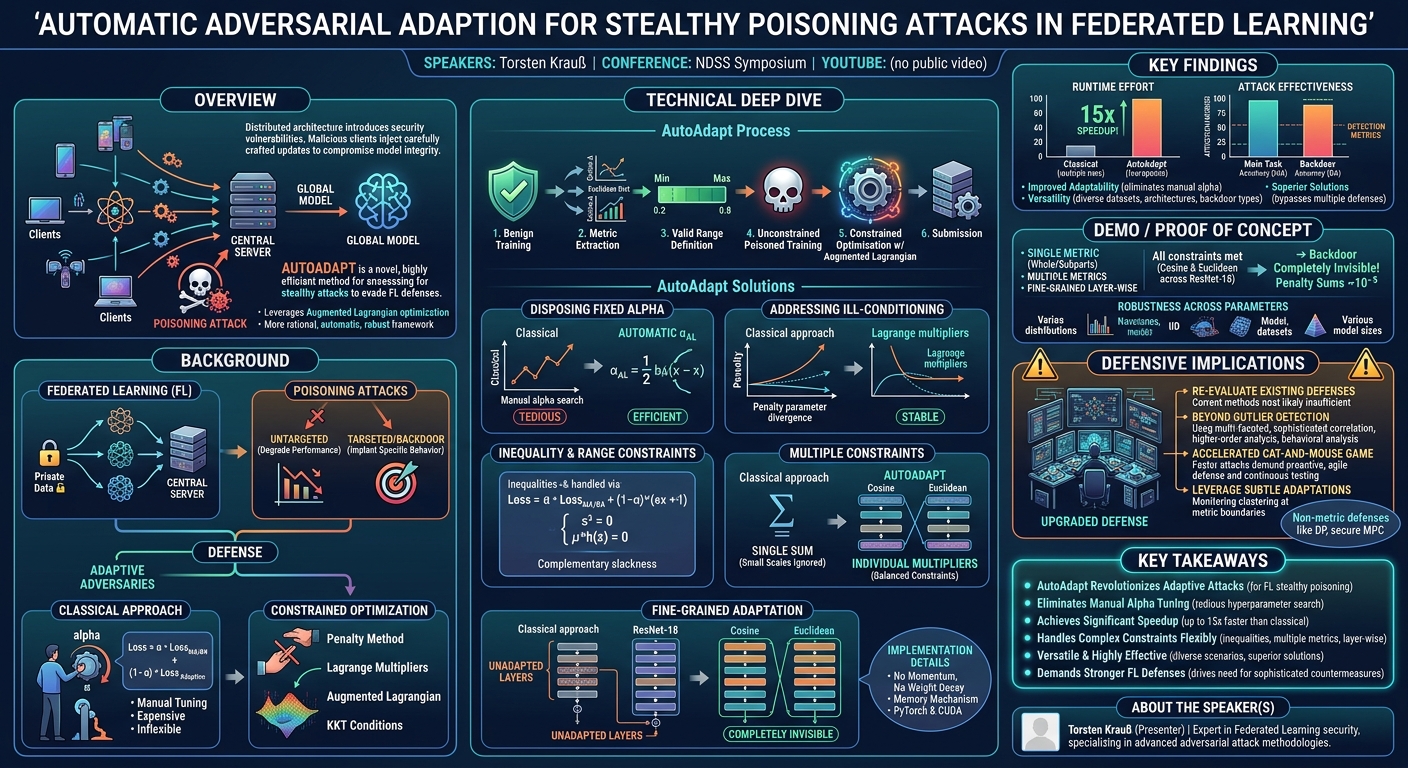
Federated Learning (FL) has emerged as a transformative paradigm for collaboratively training machine learning models across distributed datasets, offering compelling advantages in data privacy, communication efficiency, and model performance. However, this distributed architecture inherently introduces new security vulnerabilities, particularly to poisoning attacks. In such attacks, malicious clients inject carefully crafted updates to compromise the integrity and behavior of the aggregated global model. The talk "Automatic Adversarial Adaption for Stealthy Poisoning Attacks in Federated Learning" by Torsten Krauß introduces AutoAdapt, a novel and highly efficient method designed to enable adversaries to launch stealthy poisoning attacks that can effectively evade existing FL defense mechanisms.
Key moments
- 0:00 Introduction to FL poisoning attacks and motivation for AutoAdapt
- 1:00 Key limitations of classical adaptive adversarial attack methods
- 2:00 Background on Federated Learning and types of poisoning attacks
- 3:40 Explaining constrained optimization and Augmented Lagrangian method
- 4:10 AutoAdapt: Step-by-step proposed adversarial adaptation methodology
Automatic Adversarial Adaption for Stealthy Poisoning Attacks in Federated Learning
Speakers: Torsten Krauß
Conference: NDSS Symposium
YouTube: (no public video)
Overview
Federated Learning (FL) has emerged as a transformative paradigm for collaboratively training machine learning models across distributed datasets, offering compelling advantages in data privacy, communication efficiency, and model performance. However, this distributed architecture inherently introduces new security vulnerabilities, particularly to poisoning attacks. In such attacks, malicious clients inject carefully crafted updates to compromise the integrity and behavior of the aggregated global model. The talk "Automatic Adversarial Adaption for Stealthy Poisoning Attacks in Federated Learning" by Torsten Krauß introduces AutoAdapt, a novel and highly efficient method designed to enable adversaries to launch stealthy poisoning attacks that can effectively evade existing FL defense mechanisms.
The core challenge for sophisticated adversaries in FL is not merely to poison the model, but to do so without being detected by defenses that monitor statistical properties of client updates. Existing methods for adaptive adversaries, often relying on a manually tuned alpha parameter, suffer from significant limitations: they are computationally expensive, struggle with complex inequality constraints, and cannot simultaneously adapt to multiple defense metrics. AutoAdapt addresses these critical shortcomings by leveraging an Augmented Lagrangian optimization technique, providing a more rational, automatic, and robust framework for defining and evaluating adaptive attackers. This research is crucial for both attackers seeking to bypass defenses and, more importantly, for defenders who need to understand and counter the capabilities of highly adaptive and stealthy threats in FL systems.
Background
[▶ Watch: Introduction to FL poisoning attacks and motivation for AutoAdapt (0:00)]()
To appreciate the significance of AutoAdapt, it's essential to understand the foundational concepts of Federated Learning and the landscape of poisoning attacks and defenses.
Federated Learning (FL): FL (46, 38, 79) involves a central server orchestrating the collaborative training of a Deep Neural Network (DNN) across numerous distributed clients. Each client trains a local model on its own private data and then sends only the model updates (parameter changes) – not the raw data – to the server. The server then aggregates these updates, typically using algorithms like Federated Averaging (FedAVG) (46), to produce a new global model, which is then distributed back to the clients for the next round of training. This process aims to preserve data privacy and distribute computational load.
Poisoning Attacks: Within FL, an adversary controlling a subset of clients can submit malicious updates. These attacks generally fall into two categories:
- Untargeted Attacks: These aim to degrade the overall predictive performance of the model, measured by Main Task Accuracy (MA) (29, 75, 77, 41). This can involve data poisoning (e.g., providing incorrect labels) or model poisoning (e.g., manipulating model parameters directly).
- Targeted (Backdoor) Attacks: These are more insidious, aiming to implant a specific, hidden behavior into the model. The model functions normally on benign inputs (high MA) but produces a predefined misprediction when presented with a specific trigger (e.g., a specific pixel pattern or semantic feature). A successful backdoor attack is characterized by high Backdoor Accuracy (BA) on triggered inputs and high MA on benign inputs (8, 54, 74, 76, 33, 43, 32, 70, 11, 50, 7, 21, 63, 72, 20, 14, 57). Backdoors are particularly dangerous due to their stealth and potential for severe real-world consequences.
Defense Adaptive Adversaries: A critical challenge for attackers is that poisoned models must not only achieve high MA and BA but also appear inconspicuous to defense mechanisms. FL defenses often employ metrics like Cosine distance and Euclidean distance to compare local model updates with the global model or with other client updates, identifying and filtering out outliers that might indicate malicious activity. To circumvent these defenses, an adversary must adapt their poisoned updates to fall within the expected ranges of these defense metrics.
The prevailing classical approach for adaptive adversaries (8, 28) introduces an additional objective, Loss_Adaption, into the total loss function: Loss = alpha Loss_MA/BA + (1 - alpha) Loss_Adaption. Here, alpha is a weighting factor that balances the primary task (maintaining MA/BA) with the adaptation intensity (evading detection). This method is often called "train-and-scale" or "constrain-and-scale." The fundamental limitation of this approach is the manual and extensive effort required to find an optimal alpha, which is highly dependent on the specific attack, defense, and dataset. Furthermore, it struggles with inequality constraints (e.g., a metric must be between X and Y) and simultaneous adaptation to multiple metrics (60, 30).
Constrained Optimization: AutoAdapt builds upon advanced techniques from constrained optimization, which involve finding the optimal solution to a problem while satisfying specific conditions or limitations.
- Penalty Method: Transforms a constrained problem into an unconstrained one by adding a penalty term to the objective function for each violated constraint. The penalty parameter
pkis progressively increased, which can lead to ill-conditioning. - Lagrange Multipliers: Used for equality constraints, introducing
lambdavariables to quantify the impact of constraints. - Augmented Lagrangian: This advanced method combines the penalty method with Lagrange multipliers. Crucially, it prevents the penalty parameter from escalating indefinitely, thereby mitigating ill-conditioning issues and ensuring a more stable optimization process. The Augmented Lagrangian function for equality constraints is
L(x, rho, lambda)_k = f(x) + (rho/2) sum(g_i(x)^2) + sum(lambda_i g_i(x)). - KKT Conditions (Karush-Kuhn-Tucker Conditions): These conditions provide necessary criteria for a solution to be optimal in non-linear programming problems with both equality and inequality constraints, including conditions like primal feasibility, stationarity, dual feasibility, and complementary slackness.
Key Findings
[▶ Watch: Key limitations of classical adaptive adversarial attack methods (1:00)]()
AutoAdapt represents a significant advancement in the field of FL defense evaluation and adversarial attack methodologies, offering a more robust, efficient, and versatile framework for creating stealthy poisoned models. The key findings and contributions of this work are multifaceted:
Firstly, AutoAdapt fundamentally enhances an adversary's ability to circumvent FL defenses through improved adaptability. It eliminates the tedious and computationally expensive manual search for an optimal alpha balancing parameter, a major bottleneck in the classical adaptation approach. Instead, AutoAdapt provides a rational and automatic mechanism for parameter scaling, leading to a remarkable 15x speedup in the runtime effort required to test FL defenses compared to the classical method. This efficiency dramatically accelerates the development and refinement of sophisticated attacks.
Secondly, AutoAdapt comprehensively addresses complex constraint types that previous methods struggled with. It effectively handles inequality constraints, which naturally define ranges of valid values for defense metrics, allowing for more flexible and precise attack strategies. Furthermore, it supports simultaneous adaptation to multiple detection metrics, such as both Cosine and Euclidean distances, and even fine-grained adaptation across individual model layers. This capability forces defenses to account for a wider and more diverse array of adversarial behaviors, making them significantly harder to bypass.
Thirdly, the research establishes the versatility of AutoAdapt across a wide spectrum of FL application scenarios. This includes diverse datasets like CIFAR-10, MNIST (26), and GTSRB (69); various model architectures such as ResNet-18 (36), SqueezeNet (37), and custom CNNs; and different hyper-parameters and backdoor types, including semantic backdoors (e.g., green cars mislabeled as birds), pixel trigger (33), and label flip (12, 15) backdoors. This broad applicability underscores AutoAdapt's practical utility and effectiveness in real-world FL deployments.
Finally, AutoAdapt consistently generates more effective solutions than state-of-the-art methods. It successfully bypasses a selection of defense mechanisms, rendering poisoned models inconspicuous even when defenses employ multiple metrics or focus on specific model subparts. For instance, in fine-grained adaptation to 28 constraints across all layers of a ResNet-18 model using both Cosine and Euclidean distances, AutoAdapt made the backdoor "completely invisible" within 2 to 4 epochs, whereas the classical approach failed to fulfill all constraints. These findings demonstrate that AutoAdapt provides a superior and more robust baseline for assessing the resilience of FL defenses against sophisticated adaptive attacks, thereby driving crucial progress in developing more secure FL systems.
Technical Deep Dive
[▶ Watch: Background on Federated Learning and types of poisoning attacks (2:00)]()
AutoAdapt's core innovation lies in its sophisticated application of Augmented Lagrangian optimization to the problem of adversarial adaptation in Federated Learning. It directly addresses the limitations of the classical alpha-based approach by replacing it with a more robust and flexible constrained optimization framework.
The adversarial adaptation process with AutoAdapt is structured in six key steps:
- Benign Training: The adversary first trains benign models to establish a baseline understanding of the system's normal behavior.
- Metric Extraction: Legitimate values for each target defense metric (e.g., Cosine distance, Euclidean distance) are extracted from these benign models.
- Valid Range Definition: Based on the extracted benign values, a valid range (minimum and maximum) is established for each metric. This range serves as the target for the adaptation process.
- Unconstrained Poisoned Training: The adversary begins by training a specific number of unconstrained poisoned epochs. This initial phase leverages the observation that for stealthy backdoors with low poison data rates (PDR), poisoned models tend to evolve similarly to benign models.
- Constrained Optimization with Augmented Lagrangian: To ensure the suspicious models fall within the defined benign value ranges, the attacker initializes the Augmented Lagrangian optimization method. Training then proceeds in this constrained mode until all constraints are adequately fulfilled.
- Submission: Once the constraints are met, the adversary terminates the procedure and submits the adapted poisoned models to the aggregation server, which are now deemed non-suspicious by the defense metrics.
AutoAdapt systematically overcomes the limitations of the classical approach:
- Disposing Determination of Fixed Alpha: Unlike the classical method, which requires tedious manual searching for an optimal
alpha, AutoAdapt eliminates this need. It introduces a fixed parameter,alpha_al, which is not a sensitive hyper-parameter. Its role is merely to be sufficiently large to ensure convexity and dominate the function. This significantly reduces manual effort and accelerates the adaptation process. The assignment ofalpha_alis done automatically during the initiation of constraint optimization (step 5). The main objective lossf(x)is equated with a penalty loss term, andalpha_alis solved for (Eq. 24), ensuring it's appropriately scaled to align both loss components.
- Addressing Ill-Conditioning: The classical penalty method can suffer from ill-conditioning as its penalty parameter
pkapproaches infinity. AutoAdapt, by employing the Augmented Lagrangian, introduces additional Lagrange multiplier terms (lambda_i) that preventalpha_alfrom diverging to infinity, ensuring a more stable and well-conditioned optimization process.
- Inequality Constraints: The classical method struggles with inequality constraints. AutoAdapt elegantly handles an inequality constraint
h(x) >= 0by reformulating it using a squared slack variables^2ash(x) + s^2 = 0(Eq. 14). This allows it to treat inequalities as equalities within the Augmented Lagrangian framework. Crucially, the slack variablescan be analytically eliminated from the Augmented Lagrangian, leading to a simplified form involvingmax(0, mu + alpha_al*h(x))^2 - mu^2. This transformation intuitively reflects how inequality constraints should behave.
- Multiple Constraints: When dealing with multiple constraints, the classical approach often treats them as a single sum, which can lead to smaller-scale constraints being ignored. AutoAdapt addresses this by introducing individual multipliers (
mu_j) for each inequality constraint. This ensures that all constraints, regardless of their scale, are properly considered and balanced during optimization.
- Range Constraints: Backdooring scenarios inherently involve range constraints (e.g.,
COS_min <= COS* <= COS_max). AutoAdapt implements these as two opposing inequality constraints:COS_min - COS* <= 0andCOS* - COS_max <= 0. To prevent these competing constraints from causing issues, AutoAdapt manually setsmuto zero when a constraint is satisfied (h(x) <= 0), a justification rooted in the KKT complementary slackness condition. This ensures that satisfied constraints do not continue to impact the optimization process.
Implementation Details:
The alpha_al parameter is assigned a value that scales the main objective loss f(x) and the sum of constraint violations to the same magnitude. It is designed to be non-sensitive, requiring only a sufficiently large value for convexity. During the constraint training phase (step 5), momentum and weight decay are deliberately disabled for the optimizer. Momentum, by incorporating past updates, could inadvertently violate already satisfied range constraints in the opposite direction. Weight decay, acting as a regularization penalty, is also disabled to prevent it from undermining the carefully constructed penalty terms within AutoAdapt. To ensure robustness against transient constraint violations, AutoAdapt employs a memory mechanism, retaining the most satisfactory solution found so far, prioritizing solutions with the fewest violations, and then the minimum penalty sum.
The FL system simulation was implemented using PyTorch (4, 58), a widely recognized Python (73) machine learning library. The client and server code runs sequentially on a server equipped with an AMD EPYC 7413 24-Core Processor (96 processing units, 128GB main memory) and utilizes an NVIDIA A16 GPU (4 virtual GPUs, each with 16GB GDDR6 memory) for accelerated computations via CUDA (56). This robust setup allows for comprehensive evaluation. AutoAdapt is designed to be independent of specific deployed defenses, as long as a defense can be characterized by metrics for which a corresponding loss function can be constructed.
Demo / Proof of Concept
[▶ Watch: Explaining constrained optimization and Augmented Lagrangian method (3:40)]()
While the talk did not feature a live, interactive demo in the traditional sense, the effectiveness of AutoAdapt was rigorously validated through extensive experimental evaluation. The "Evaluation and Results" section of the paper serves as a comprehensive proof of concept, demonstrating AutoAdapt's capabilities across various scenarios and its superior performance compared to prior state-of-the-art methods.
The experiments established a default scenario using a ResNet-18 (36) model, a learning rate of 0.01 with SGD optimizer (momentum 0.9, decay 0.005), and the CIFAR-10 (39) dataset. The FL setup involved 20 clients (all selected per round, IID data), with 9 clients (45% Poison Model Rate, PMR) acting as adversaries, using a Poison Data Rate (PDR) of 0.1. A semantic backdoor (green cars mislabeled as birds) was used, initialized with pre-trained PyTorch weights (25).
The results consistently showed that AutoAdapt successfully adapted poisoned models to various defense metrics:
- Single Metric (Whole Model): AutoAdapt effectively adapted the Cosine distance of poisoned local models to the benign range within 4 to 7 batches, with minimal runtime impact.
- Single Metric (Model Subparts - Last Layer): Adaptation to the last layer's Cosine distance was achieved within 1 to 4 batches.
- Single Metric (Fine-Grained - All Layers): For a ResNet-18 model, AutoAdapt adapted to 14 inequality constraints across seven layers within a remarkably short span of 1 to 5 batches.
- Multiple Metrics (Whole Model): Simultaneous adaptation to both Cosine and Euclidean distances was successful within 5 to 15 batches.
- Multiple Metrics (Fine-Grained - All Layers): This involved adapting to 28 constraints (ResNet-18, Cosine and Euclidean). The adaptation was so successful that the backdoor became "completely invisible," with constraints met within 2 to 4 epochs, and penalty sums often in the range of 10^-5, rendering them undetectable by conventional algorithms.
A crucial aspect of the proof of concept was the comparison to the classical state-of-the-art method (Bagdasaryan et al. 8). AutoAdapt consistently achieved superior results. While the classical method required extensive testing with multiple alpha values and failed in complex scenarios like layer-wise adaptation, AutoAdapt found superior solutions automatically. For instance, in layer-wise adaptation, AutoAdapt fulfilled all constraints, whereas the classical method left at least one layer unadapted.
Furthermore, AutoAdapt demonstrated robustness across various parameters: different backdoor methods (pixel trigger, label flip), FL rounds, data distributions (1-class non-IID scenario), datasets (MNIST, GTSRB), and model architectures (SqueezeNet, custom CNN).
The runtime evaluation highlighted AutoAdapt's efficiency:
- No Adaptation: 10.87 seconds.
- Classical method (single
alpha=0.9): 25.46 seconds (+134% overhead). - Classical method (multiple
alphatests, 9 runs): 229.11 seconds (+2007% overhead). - AutoAdapt (3 epochs): 20.50 seconds (+88% overhead).
- AutoAdapt (1 epoch): 14.62 seconds (+34% overhead).
This translates to AutoAdapt being 11 times faster than the classical method with a single alpha and an impressive 15 times faster when considering the multiple alpha tests typically required by the classical approach. These results definitively prove AutoAdapt's capability to generate highly stealthy and effective poisoning attacks with significantly reduced computational cost.
Defensive Implications
[▶ Watch: AutoAdapt: Step-by-step proposed adversarial adaptation methodology (4:10)]()
The introduction of AutoAdapt presents significant and immediate implications for developers and researchers working on Federated Learning defenses. Its ability to create stealthy, adaptive poisoning attacks with unprecedented efficiency fundamentally shifts the landscape of FL security.
Firstly, existing FL defenses must be re-evaluated against AutoAdapt-powered adversaries. Many current defenses, particularly those relying on filtering or robust aggregation based on statistical metrics like Cosine or Euclidean distance, are likely insufficient. AutoAdapt demonstrates that attackers can systematically adapt their malicious updates to fall within benign ranges, even for multiple metrics and fine-grained (layer-wise) analysis. Defenders can no longer assume that simply monitoring these metrics will guarantee detection.
Secondly, defenses need to move beyond simple outlier detection and embrace more sophisticated, multi-faceted approaches. AutoAdapt's success in handling multiple simultaneous constraints means that defenses attempting to correlate deviations across several metrics might still be bypassed. Future defenses might need to explore:
- Higher-order statistical analysis: Looking for subtle changes in the distribution of metric values rather than just individual outliers.
- Behavioral analysis: Monitoring the functional impact of updates on the model's decision boundaries or internal representations, rather than just the update vectors themselves.
- Contextual awareness: Incorporating information about client behavior over time, data characteristics, or even external threat intelligence.
- Non-metric-based defenses: Exploring techniques like differential privacy (applied to gradients), secure multi-party computation, or homomorphic encryption to prevent malicious updates at a fundamental level, though these often come with significant performance overheads.
Thirdly, AutoAdapt's speedup (up to 15x faster) in developing adaptive attacks means that the "cat-and-mouse game" between attackers and defenders will accelerate dramatically. Attackers can now rapidly prototype, test, and refine new evasion strategies against evolving defenses. This necessitates a proactive and agile approach from defenders, including continuous testing of their defenses against the latest adaptive attack methodologies. It also implies that the cost of developing effective attacks has been significantly lowered.
Finally, defenders should consider that the "edge case scenarios" identified by AutoAdapt's authors (e.g., metric values clustering towards outer boundaries, constraints not perfectly fulfilled but penalty sum near zero) might offer avenues for detection. While AutoAdapt makes these models appear benign to conventional algorithms, a highly sensitive or specialized defense might still pick up on these subtle deviations. For instance, monitoring for consistent clustering at the boundaries of acceptable ranges could be an indicator of an adaptive attack. The challenge for defenders will be to develop detection mechanisms that are both sensitive enough to catch these subtle adaptations and robust enough to avoid excessive false positives.
In essence, AutoAdapt serves as a powerful new benchmark for FL security. It forces defenders to confront the reality of highly capable and efficient adaptive adversaries, pushing the research frontier towards more robust, intelligent, and resilient defense strategies for Federated Learning.
Key Takeaways
- AutoAdapt Revolutionizes Adaptive Attacks: Torsten Krauß's AutoAdapt is a novel method using Augmented Lagrangian optimization that significantly enhances an adversary's ability to create stealthy poisoning attacks in Federated Learning, effectively bypassing existing defenses.
- Eliminates Manual Hyperparameter Tuning: It disposes of the need for manual, computationally intensive tuning of the
alphabalancing parameter, a major bottleneck in previous adaptive attack methods. - Achieves Significant Speedup: AutoAdapt accelerates the development and testing of adaptive attacks by up to 15 times compared to the classical
alpha-based approach, making it dramatically more efficient for adversaries. - Handles Complex Constraints Flexibly: The method robustly addresses inequality constraints, range constraints, and simultaneous adaptation to multiple defense metrics (e.g., Cosine and Euclidean distance) across entire models or specific layers, which were major limitations for prior techniques.
- Versatile and Highly Effective: AutoAdapt demonstrates broad applicability across diverse datasets (CIFAR-10, MNIST, GTSRB), model architectures (ResNet-18, SqueezeNet), and backdoor types, consistently generating superior poisoned models that evade detection.
- Demands Stronger FL Defenses: The existence of AutoAdapt necessitates a re-evaluation of current FL defense strategies and drives the need for more sophisticated, context-aware, and multi-faceted defense mechanisms to counter increasingly stealthy and efficient adaptive adversaries.
About the Speaker(s)
Torsten Krauß is the presenter of this work. Based on the provided transcript and metadata, he is the primary author and researcher behind AutoAdapt. The presentation highlights his expertise in Federated Learning security, particularly in developing and evaluating advanced adversarial attack methodologies. No further biographical details, such as his title or company affiliation, are provided within the transcript.
All talks from Network and Distributed System Security (NDSS) Symposium 2024