EnclaveFuzz: Finding Vulnerabilities in SGX Applications
Liheng Chen
Network and Distributed System Security (NDSS) Symposium 2024 · Day 2 · TEE & SGX Security · TEE & SGX Security
Overview
Intel's Software Guard Extensions (SGX) provides a robust hardware-isolated execution environment, known as an enclave, designed to protect sensitive code and data from a potentially malicious operating system and other untrusted software. This strong system-level isolation makes SGX highly appealing for security-critical applications, such as Signal's contact discovery service. However, despite these hardware protections, the C/C++ code executing within enclaves remains susceptible to common memory corruption vulnerabilities like buffer overflows and use-after-free bugs. Moreover, SGX's unique threat model can introduce novel attack vectors or significantly amplify the severity of existing vulnerabilities, such as Time-of-Check-Time-of-Use (TOCTOU) bugs stemming from direct memory access to untrusted regions, or null-pointer dereferences becoming critical security flaws due to the untrusted operating system controlling the zero page.
Key moments
- 0:00 Introduction to SGX and its unique vulnerability challenges
- 1:15 EnclaveFuzz: Multi-dimension, structure-aware fuzzing framework introduction
- 2:50 SGX EDL and sanity checks: a major fuzzer hurdle
- 4:00 Identifying three primary challenges for efficient SGX fuzzing
- 4:40 EnclaveFuzz's three key design components: fuzzing, SDK, sanitizer
EnclaveFuzz: Finding Vulnerabilities in SGX Applications
Speakers: Liheng Chen
Conference: NDSS Symposium
YouTube: https://www.youtube.com/watch?v=AGw9cxVByXU
Overview
Intel's Software Guard Extensions (SGX) provides a robust hardware-isolated execution environment, known as an enclave, designed to protect sensitive code and data from a potentially malicious operating system and other untrusted software. This strong system-level isolation makes SGX highly appealing for security-critical applications, such as Signal's contact discovery service. However, despite these hardware protections, the C/C++ code executing within enclaves remains susceptible to common memory corruption vulnerabilities like buffer overflows and use-after-free bugs. Moreover, SGX's unique threat model can introduce novel attack vectors or significantly amplify the severity of existing vulnerabilities, such as Time-of-Check-Time-of-Use (TOCTOU) bugs stemming from direct memory access to untrusted regions, or null-pointer dereferences becoming critical security flaws due to the untrusted operating system controlling the zero page.
Traditional fuzzing solutions for SGX, such as SGXFuzz and FuzzSGX, have demonstrated significant limitations in effectively detecting these SGX-specific vulnerabilities. These limitations include treating enclaves as black boxes, struggling to recover complex input structures, failing to bypass SDK-imposed sanity checks, and lacking comprehensive sanitizers for the unique SGX attack surface. Furthermore, the substantial performance overhead introduced by the SGX SDK's memory management and context-switching routines severely impedes the fuzzing process, making it inefficient for thorough security testing.
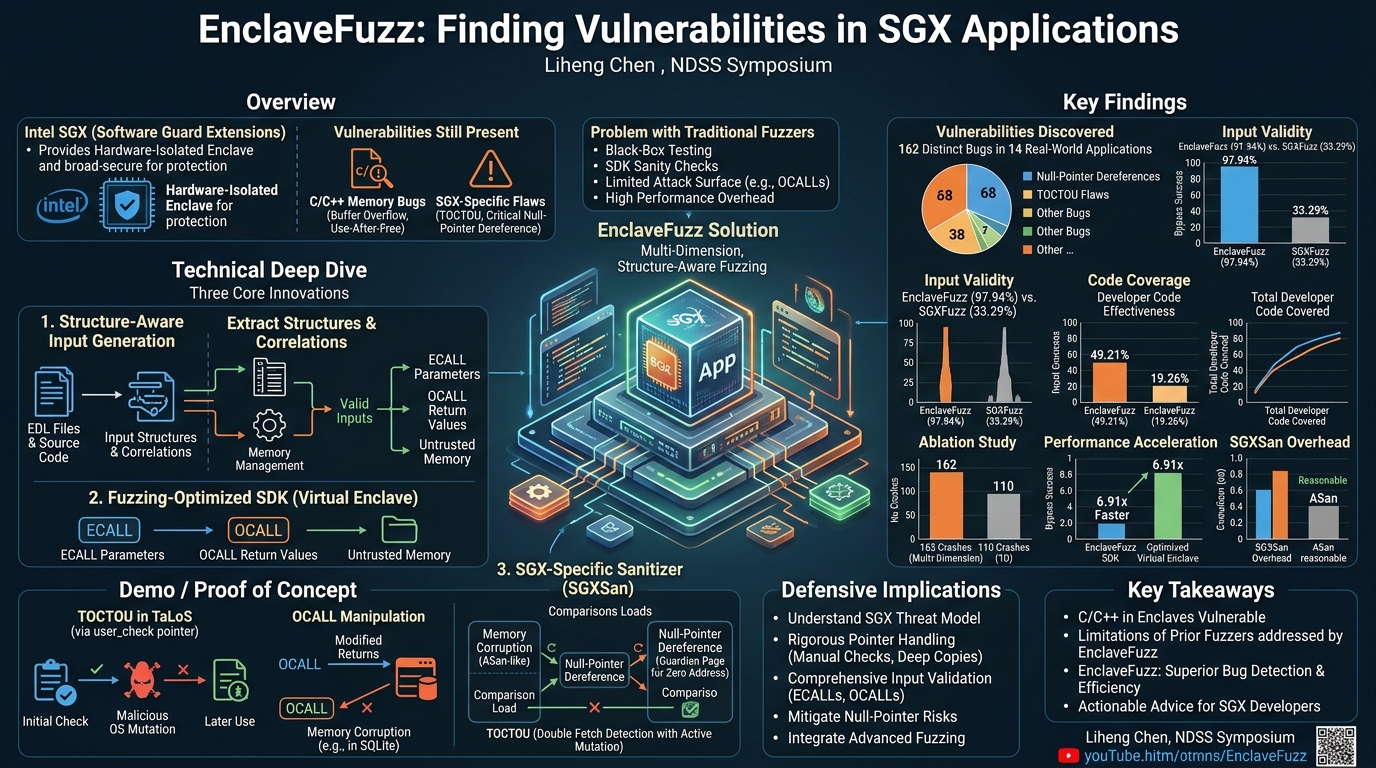
To address these critical challenges, Liheng Chen presented EnclaveFuzz, a novel multi-dimension, structure-aware fuzzing framework. EnclaveFuzz systematically analyzes enclave source code to extract intricate input structures and correlations, automatically generating fuzz harnesses capable of producing valid inputs that bypass SDK sanity checks. It conducts multi-dimensional fuzzing by generating data for all three attack surfaces of an enclave: ECALL parameters, OCALL return values, and direct untrusted memory accesses. Crucially, EnclaveFuzz introduces SGXSan, a new sanitizer designed to detect both typical memory corruption bugs and critical SGX-specific issues. Finally, an optimized SDK accelerates fuzzing by enabling the execution of enclaves as virtual, standard shared objects without the need for specialized SGX hardware. The effectiveness of EnclaveFuzz was demonstrated through its evaluation on 20 real-world open-source enclaves, where it uncovered an impressive 162 distinct bugs in 14 of them.
Background
▶ Watch: Introduction to SGX and its unique vulnerability challenges (0:00)
Intel Software Guard Extensions (SGX) is a CPU instruction set that enables the creation of a hardware-protected memory region for critical code and data. This region, known as an enclave, ensures confidentiality and integrity even if the host operating system is compromised. The Intel SGX SDK simplifies development by providing APIs for enclave management, C/C++ runtimes, and tools. Developers define the interface between the untrusted host application and the trusted enclave using an Enclave Definition Language (EDL) file. The sgx_edger8r tool then generates bridge code (uBridge for the untrusted side, tBridge for the trusted side) that handles parameter marshaling and unmarshaling. The enclave binary is cryptographically signed and loaded into the Enclave Page Cache (EPC) within Processor Reserved Memory (PRM), where its contents are encrypted and only decrypted by the CPU during execution.
The SGX memory model dictates that while the enclave shares the same virtual address space with the host application, it maintains its own separate heap and stack. Direct access from the host to enclave memory is prevented by hardware. Enclave code can only be executed via EENTER and EEXIT instructions, which, along with SDK-provided context-switching and memory management routines, introduce significant performance overhead.
EDL files define ECALLs (calls from the host to the enclave) and OCALLs (calls from the enclave to the untrusted host). Parameters and return values of ECALLs, and return values of OCALLs, represent potential input surfaces for the enclave. For pointers, EDL attributes like in, out, count, and size specify data direction and length for automatic deep copying by the sgx_edger8r generated bridge code. However, the user_check attribute bypasses this deep copying, passing only the pointer address and placing the responsibility for manual validation and deep copying on the developer. This design choice makes enclaves particularly vulnerable to TOCTOU (Time-of-Check-Time-of-Use) attacks, where an attacker controlling the untrusted host can modify the pointed-to data after an enclave check but before its use. Similarly, a null-pointer dereference, typically considered a program bug, becomes a severe security vulnerability in SGX because the zero address page is controlled by the untrusted operating system, which could map malicious content there. The tBridge code also includes initial sanity checks generated from the EDL, which are a major hurdle for fuzzers trying to reach deeper developer logic.
Fuzzing is a widely adopted technique for bug detection. Modern fuzzers like AFL use code coverage feedback to guide input mutation. Structure-aware fuzzing, exemplified by tools like Difuze and KSG, is crucial for API-based targets like SGX ECALLs, as it generates well-formed inputs to bypass validation checks. Fuzz harnesses, which connect the fuzzer to target functions, can be automated by tools such as FUDGE and FuzzGen. Sanitizers, like AddressSanitizer (ASan) for memory corruption, UndefinedBehaviorSanitizer (UBSan), and ThreadSanitizer (TSan), detect bugs by instrumenting code and using techniques like shadow memory and red zones. Existing SGX-specific sanitizers, such as SGXBOUNDS, have been limited, only supporting 32-bit memory access and having a narrow scope.
Existing SGX fuzzers, including SGXFuzz and FuzzSGX, face several challenges:
- Insufficient understanding of input structures and dimensions: They often treat enclaves as black boxes, generating invalid inputs that fail SDK sanity checks and waste fuzzing time. They also overlook OCALL return values and direct untrusted memory access as attack dimensions.
- Limited bug oracle capabilities: Existing sanitizers are inadequate for detecting SGX-specific issues like TOCTOU and null-pointer dereferences in a malicious OS context.
- Slow fuzzing process: The redundant memory management and context-switching routines of the SGX SDK impose significant performance overhead. EnclaveFuzz was designed to directly overcome these three core challenges.
Key Findings
▶ Watch: EnclaveFuzz: Multi-dimension, structure-aware fuzzing framework introduction (1:15)
EnclaveFuzz demonstrated exceptional effectiveness in uncovering vulnerabilities within SGX applications, achieving significant improvements over existing solutions.
Vulnerability Discovery:
- EnclaveFuzz successfully identified a total of 162 distinct bugs across 14 of the 20 real-world open-source SGX applications evaluated. These applications were sourced from both Intel and third-party developers, representing a diverse range of functionalities.
- A substantial portion of these findings comprised SGX-specific vulnerabilities, highlighting a critical area often overlooked by developers:
- 68 cases of null-pointer dereferences: These bugs are particularly severe in SGX, as the untrusted OS controls the zero page, making them exploitable.
- 38 cases of TOCTOU vulnerabilities: These vulnerabilities arise from the unique SGX threat model where untrusted memory can be manipulated between an enclave's check and subsequent use.
- The project responsibly disclosed these vulnerabilities, adhering to a 90-day disclosure period by notifying affected vendors and reporting issues via repository mechanisms.
- For instance, the TaLoS enclave, with its 207 ECALL interfaces, was found to contain 96 bugs, largely due to
user_checkpointer parameters lacking sufficient developer-implemented sanity checks, leading to TOCTOU and other pointer-related issues. - A comparison with SGXFuzz, a state-of-the-art SGX fuzzer, revealed that EnclaveFuzz discovered more vulnerabilities within the same 24-hour fuzzing period, underscoring its superior bug detection capabilities for SGX-specific issues.
Input Validity and Code Coverage:
- EnclaveFuzz achieved an average successful execution rate of 97.94%, meaning that generated inputs consistently bypassed SDK sanity checks and reached the developer's ECALL functions. This stands in stark contrast to SGXFuzz, which only managed a 33.29% successful execution rate, demonstrating EnclaveFuzz's effectiveness in generating valid, structure-aware inputs.
- EnclaveFuzz significantly improved code coverage, evaluated using three metrics:
- Effectiveness (covered developer code / (covered SDK + covered developer code)): EnclaveFuzz averaged 49.21%, compared to SGXFuzz's 19.26%. This indicates EnclaveFuzz's ability to focus fuzzing efforts more on developer logic rather than SDK boilerplate.
- InterestingCoverage (covered developer code / total developer code): EnclaveFuzz achieved an average of 23.54%, while SGXFuzz only reached 6.83%. This metric further emphasizes EnclaveFuzz's superior exploration of the critical developer-implemented code.
Impact of Multi-dimension Inputs:
- An ablation study compared the full EnclaveFuzz framework with Fuzzer_1D, a version that only fuzzed ECALL parameters. EnclaveFuzz found 162 unique crashes, whereas Fuzzer_1D only found 110. This difference highlights the crucial role of considering OCALL return values and untrusted memory access as distinct input dimensions in triggering a broader range of bugs, especially TOCTOU vulnerabilities.
Performance Acceleration with Optimized SDK:
- The fuzzing-optimized SGX SDK (Virtual Enclave) provided substantial performance gains:
- EnclaveFuzz utilizing the optimized SDK ran an impressive 6.91 times faster than when running in hardware mode (EnclaveFuzz-HW).
- Even in simulation mode, EnclaveFuzz-SIM was 2.67 times faster than EnclaveFuzz-HW.
- Detailed basic operations performance showed that the optimized SDK dramatically reduced the time for enclave creation, destruction, ECALLs, and OCALLs compared to both Intel SGX SDK's hardware and simulation modes. For instance, creating 1,000 enclaves took only 0.14 seconds with the optimized SDK, versus 28.27 seconds in hardware mode.
Sanitizer Overhead:
- SGXSan, the custom SGX-specific sanitizer, introduced an additional 68.07% overhead when measured using the WolfSSL benchmark. This overhead is comparable to that of AddressSanitizer (ASan), which typically incurs around 48.22% overhead, indicating a reasonable trade-off for its comprehensive vulnerability detection capabilities.
Technical Deep Dive
▶ Watch: SGX EDL and sanity checks: a major fuzzer hurdle (2:50)
EnclaveFuzz's robust design integrates three core technical approaches to overcome the limitations of prior SGX fuzzing solutions: multi-dimension structure-aware fuzzing, an optimized SGX SDK, and an SGX-specific sanitizer.
Multi-dimension Structure-aware Fuzzing
This approach is central to generating valid and comprehensive inputs for SGX enclaves.
- Input Structure Extraction: EnclaveFuzz begins by parsing EDL files and analyzing the enclave's source code. From the EDL, it extracts crucial information for each ECALL and OCALL, including basic and nested type details, pointer direction attributes (
in,out), and size attributes (count,size). For dynamically sized pointers, where one parameter dictates the size of another, EnclaveFuzz records these correlations, allowing it to prepare the size parameter first and then allocate data accordingly at runtime. Pointers with theuser_checkattribute, which are not deep-copied by the SDK, are treated as direct inputs, and EnclaveFuzz allocatescount sizeof(ptr)bytes. To specifically test for null-pointer dereferences, EnclaveFuzz also passes null values to pointer parameters with a configurable probability. - Opaque Type Recovery: Developers often use incomplete types (e.g.,
typedef struct Struct* StructPtr;) in EDLs, making direct structure layout inference impossible. EnclaveFuzz addresses this by employing an LLVM IR pass during compile-time. This pass extracts all structure layouts from the enclave source code, allowing the fuzzer to accurately query and generate inputs for these opaque pointers. - Multi-dimensional Input Generation: EnclaveFuzz recognizes three distinct input dimensions an attacker can control:
- ECALL Inputs: Parameters passed from the host into the enclave. EnclaveFuzz generates data for these based on the extracted EDL information, ensuring they conform to expected structures and pass initial SDK sanity checks.
- OCALL Return Values: OCALLs are calls from the enclave to the untrusted host. Since the untrusted OS controls these return values, an attacker can manipulate them. EnclaveFuzz uses a hook-based strategy to intercept and modify OCALL return values and parameters used within the enclave, preventing checks from failing prematurely and enabling deeper code exploration.
- Untrusted Memory Access: Enclaves can directly load data from untrusted host memory. EnclaveFuzz identifies specific host memory addresses reported by its TOCTOU sanitizer and actively alters their values to trigger potential bugs.
Fuzzing-optimized SGX SDK (Virtual Enclave)
The standard Intel SGX SDK introduces significant overhead detrimental to fuzzing. EnclaveFuzz provides an optimized SDK that creates a Virtual Enclave to mitigate this.
- Virtual Enclave Design: Instead of loading into the EPC and relying on hardware instructions, the optimized SDK packs the enclave's trusted bridge code (tBridge) and developer code into a standard shared library (.so). This Virtual Enclave is then loaded by the fuzzer as a dynamic library.
- Key Optimizations:
- Elimination of SGX Hardware Instructions: The Virtual Enclave bypasses expensive
EENTERandEEXITinstructions. Control flow is directly transferred to ECALL/OCALL functions via function table lookups. - Shared Memory Model: The Virtual Enclave shares the same heap and stack with the host application, simplifying memory management and accelerating creation/destruction.
- Memory Distinction: To maintain conceptual separation, EnclaveFuzz uses one bit from the shadow map (also used by SGXSan) to distinguish between host and enclave memory.
- Retention of Sanity Checks: Crucially, the tBridge code, including SDK-generated sanity checks, is retained. This ensures the fuzzer still needs to generate valid inputs, preventing false positives.
- Compatibility: The optimized SDK is designed for compatibility, requiring only a simple modification to the project's build system (e.g., Makefile) to link with the EnclaveFuzz SDK.
SGX-specific Sanitizer (SGXSan)
To detect a broader range of vulnerabilities, including those unique to SGX, EnclaveFuzz integrates SGXSan.
- Out-of-Bound and Dangling Pointer Dereference: SGXSan adopts an ASan-like design, using a shadow memory map and red zones around allocated objects. An 8-bit shadow byte records memory allocation status, and checks are performed during memory access. The higher bit of the shadow byte is uniquely used to differentiate between host and enclave memory within the shared virtual address space.
- Null Pointer Dereference: Recognizing the severity of null-pointer dereference in SGX, SGXSan marks the zero address page as an inaccessible guard page. Any enclave attempt to access this page triggers a registered signal handler, reporting it as a vulnerability.
- TOCTOU Vulnerability Detection: SGXSan employs a two-stage analysis:
- Compile-time Analysis: An LLVM IR pass collects all load instructions within the enclave. Using define-use chains, it identifies load instructions whose values are subsequently used in comparison instructions, marking them as comparison-loads.
- Run-time Analysis: SGXSan hooks all load instructions. It maintains a FIFO queue of memory addresses accessed by comparison-loads. When any other load instruction executes, SGXSan checks for address overlaps with the queue. If an overlap is detected and the address belongs to untrusted host memory, SGXSan actively mutates its value before the second load instruction is executed. This active mutation strategy helps trigger the TOCTOU bug, confirming its exploitability.
Implementation Details
EnclaveFuzz's architecture comprises a pre-processing stage and a fuzzing runtime.
- Pre-processing Stage:
- A modified
sgx_edger8rextracts comprehensive security boundary information from EDL and source code. - An LLVM IR pass performs opaque type recovery, extracting structure layouts.
- An LLVM IR Pass automatically generates the fuzzing harness, including ECALL wrappers and OCALL hook functions.
- Fuzzing Run-time:
- libFuzzer serves as the fuzzing engine, guided by coverage feedback.
- A FuzzedDataProvider runtime, guided by extracted input structures, generates structure-aware inputs.
- libFuzzer uses
dlopento load the Virtual Enclave (.so) anddlcloseto destroy it after each round, ensuring a stateless and deterministic fuzzing process for crash reproduction. - OCALL hooks are executed when the enclave makes OCALLs, and untrusted memory manipulation is performed for TOCTOU detection.
- SGXSan is integrated into the Virtual Enclave, modifying the ASan LLVM pass to perform its specific checks.
Demo / Proof of Concept
▶ Watch: Identifying three primary challenges for efficient SGX fuzzing (4:00)
While the presentation did not feature a live demo, EnclaveFuzz's effectiveness was compellingly demonstrated through the detailed case studies of vulnerabilities discovered in real-world SGX applications. These findings serve as concrete proof-of-concept for the framework's capabilities.
- Stack Overflow in SGX_SQLite: EnclaveFuzz uncovered a stack overflow vulnerability in SGX_SQLite. This bug occurred when an untrusted OCALL,
osRead, returned a manipulated value (got). This manipulated value subsequently led to an out-of-bounds write into a stack-allocated buffer namedzDbHeaderwithin thesqlite3BtreeOpenfunction, demonstrating how untrusted OCALL return values can directly lead to memory corruption within the enclave. - Double Fetch (TOCTOU) in TaLoS: A classic TOCTOU vulnerability was identified in the TaLoS enclave. This involved a pointer parameter,
ctx, which was marked with theuser_checkattribute, meaning it was not deep-copied by the SDK. EnclaveFuzz demonstrated that an attacker could alterctx->digestin untrusted memory between an initial security check within the enclave and its subsequent use. This manipulation could lead to control flow hijacking, showcasing the critical danger ofuser_checkpointers without proper developer-implemented deep-copying and validation. - Use After Free in mbedtls-SGX: EnclaveFuzz detected a use-after-free bug in the
mbedtls-SGXlibrary. Repeatedly invoking the ECALLssl_conn_teardowncould cause theTLSConnectionHandlerobject to be freed twice. The second invocation would then attempt to accessctx->pk_infoafter the object had already been deallocated, resulting in a use-after-free condition. This highlights the framework's ability to find complex memory lifecycle issues.
These case studies illustrate EnclaveFuzz's ability to find both common memory corruption issues and vulnerabilities directly stemming from the unique SGX threat model, validating its multi-dimensional, structure-aware, and sanitizer-enhanced approach.
Defensive Implications
▶ Watch: EnclaveFuzz's three key design components: fuzzing, SDK, sanitizer (4:40)
The findings from EnclaveFuzz provide crucial insights for developers and security practitioners working with Intel SGX and other Trusted Execution Environments (TEEs). To build more resilient SGX applications, several defensive measures are paramount:
- Deepen Understanding of the SGX Threat Model: Developers must move beyond generic security practices and thoroughly understand the unique attack surface introduced by SGX. The assumption that everything outside the enclave is malicious, including the OS and untrusted memory, necessitates a different approach to security.
- Rigorous Pointer Handling and Validation: Pointers passed across the enclave boundary, especially those marked with the
user_checkattribute, require extreme caution. Developers should always implement robust manual checks and ensure deep copies of data from untrusted memory into trusted enclave memory before any critical operations. Shallow copies of pointers to untrusted memory are an open invitation for TOCTOU attacks. - Comprehensive Input Validation for All Dimensions: Input validation must extend beyond ECALL parameters. Developers must treat OCALL return values and any data loaded directly from untrusted host memory as potentially malicious inputs requiring thorough validation. Random or malicious data from OCALLs can lead to unexpected program states or crashes.
- Mitigate Null-Pointer Dereference Risks: Recognize that null-pointer dereferences in SGX are not just undefined behavior but severe vulnerabilities. Implement explicit null checks for all pointers that could potentially come from or refer to untrusted memory.
- Leverage Advanced Fuzzing Tools: Integrate sophisticated fuzzing frameworks like EnclaveFuzz into the development lifecycle. Its ability to generate valid, structure-aware inputs, explore multi-dimensional attack surfaces, and detect SGX-specific vulnerabilities makes it an invaluable tool for proactive security testing.
- Regular Security Audits: Conduct regular security audits, particularly focusing on code paths interacting with
user_checkparameters, OCALLs, and direct untrusted memory accesses. These areas are prone to the SGX-specific vulnerabilities highlighted by EnclaveFuzz. - Adopt Secure Coding Practices: Adhere to secure coding guidelines for C/C++ to mitigate common memory corruption issues, which, as EnclaveFuzz shows, remain prevalent even within the protected confines of an enclave.
By proactively addressing these areas, developers can significantly enhance the security posture of their SGX applications against both generic and SGX-specific threats.
Key Takeaways
- Despite hardware isolation, C/C++ code within SGX enclaves remains highly vulnerable to common memory corruption (e.g., use-after-free) and critical SGX-specific bugs (e.g., TOCTOU, null-pointer dereference).
- Existing SGX fuzzers are limited by their black-box approach, inability to bypass SDK sanity checks, slow performance due to SDK overhead, and insufficient sanitizers for SGX's unique threat model.
- EnclaveFuzz addresses these limitations through multi-dimension structure-aware fuzzing, an optimized SDK creating a "Virtual Enclave," and a novel SGX-specific sanitizer (SGXSan).
- The framework successfully found 162 distinct bugs in 14 real-world SGX applications, including a significant number of null-pointer dereferences (68) and TOCTOU vulnerabilities (38).
- EnclaveFuzz drastically improves input validity (97.94% success rate vs. 33.29% for SGXFuzz), code coverage (e.g., 49.21% effectiveness vs. 19.26%), and fuzzing speed (6.91x faster with optimized SDK).
- Developers building SGX applications must thoroughly understand the SGX threat model, meticulously handle pointers from/to untrusted memory (especially
user_check), rigorously validate all inputs (including OCALL return values), and leverage advanced fuzzing tools like EnclaveFuzz.
About the Speaker(s)
Liheng Chen is a researcher who presented EnclaveFuzz, a novel framework for finding vulnerabilities in SGX applications. His work focuses on enhancing the security of Trusted Execution Environments through advanced fuzzing techniques and specialized sanitizers.
All talks from Network and Distributed System Security (NDSS) Symposium 2024