Compensating Removed Frequency Components: Thwarting Voice Spectrum Reduction Attacks
Shu Wang
Network and Distributed System Security (NDSS) Symposium 2024 · Day 2 · Audio & Voice Security · Audio & Voice Security
Overview
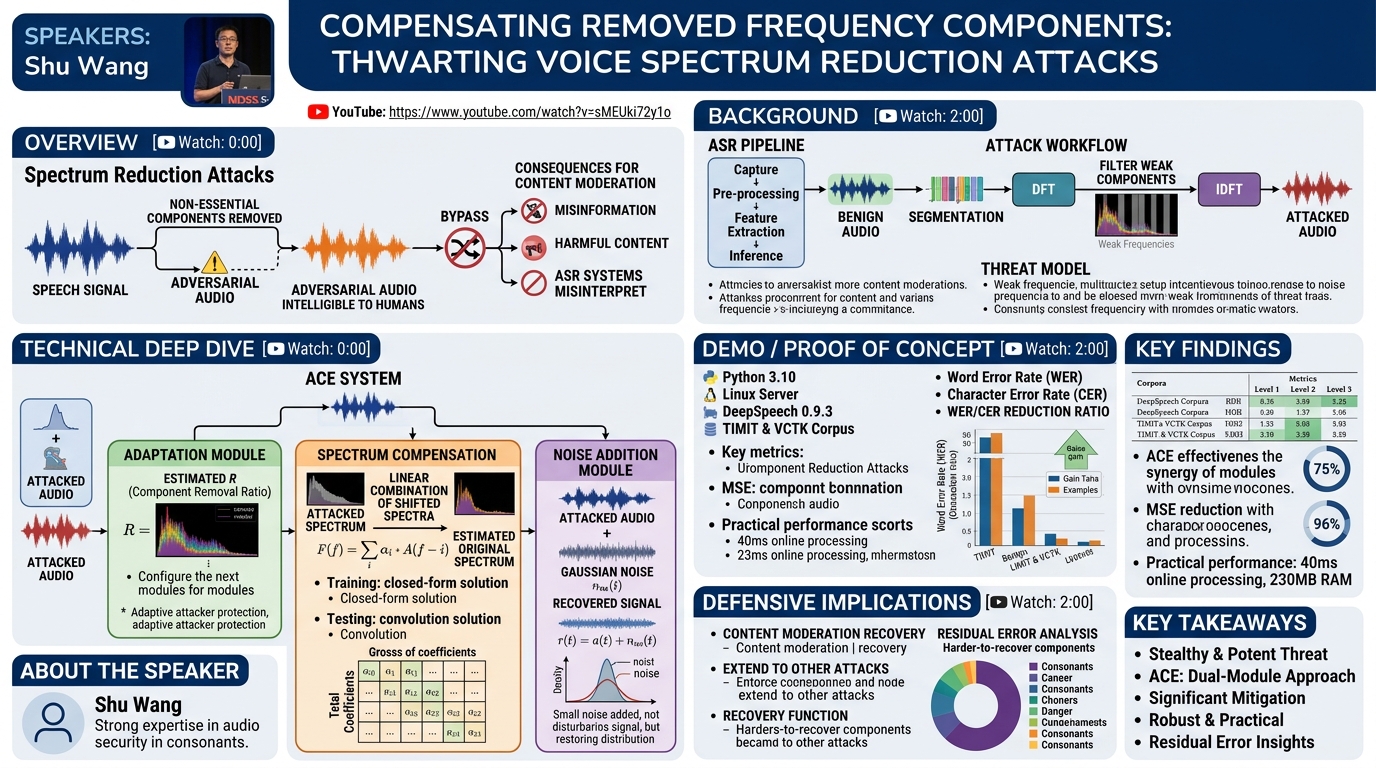
Automatic Speech Recognition (ASR) systems have become an integral part of modern life, powering virtual assistants, dictation software, and critical content moderation platforms. However, their widespread adoption has also made them a prime target for sophisticated audio attacks. This talk, presented by Shu Wang at the NDSS Symposium, delves into a particularly insidious vulnerability: spectrum reduction attacks. These attacks involve generating adversarial audio by meticulously removing non-essential frequency components from a speech signal. The remarkable characteristic of these modified audio samples is that they remain perfectly intelligible to human listeners, yet ASR systems consistently misinterpret them, leading to incorrect transcriptions.
Key moments
- 0:00 Introduction to ASR vulnerabilities and spectrum reduction attacks
- 2:00 Background on ASR and spectrum reduction attack workflow
- 4:00 Overview of ACE system design and core observations
- 4:15 Deep dive into the Spectrum Compensation Module's mechanism
- 6:00 Explanation of the Noise Addition Module's function
Compensating Removed Frequency Components: Thwarting Voice Spectrum Reduction Attacks
Speakers: Shu Wang
Conference: NDSS Symposium
YouTube: https://www.youtube.com/watch?v=sMEUki72y1o
Overview
Automatic Speech Recognition (ASR) systems have become an integral part of modern life, powering virtual assistants, dictation software, and critical content moderation platforms. However, their widespread adoption has also made them a prime target for sophisticated audio attacks. This talk, presented by Shu Wang at the NDSS Symposium, delves into a particularly insidious vulnerability: spectrum reduction attacks. These attacks involve generating adversarial audio by meticulously removing non-essential frequency components from a speech signal. The remarkable characteristic of these modified audio samples is that they remain perfectly intelligible to human listeners, yet ASR systems consistently misinterpret them, leading to incorrect transcriptions.
The implications of such attacks are profound, especially for content moderation. Malicious actors could exploit spectrum reduction to bypass automated filters designed to detect harmful content, such as misinformation, hate speech, or violence, allowing restricted speeches to proliferate online undetected by machine-based systems. The attack's practicality is a significant concern; it requires no specialized hardware or deep learning expertise and has demonstrated effectiveness against major commercial ASR APIs, including Google Speech-to-Text, Facebook Wit, and Microsoft Azure Speech.
To counter this critical threat, Wang introduces ACE (Acoustic Compensation System), a novel defense mechanism. ACE operates on a dual principle: first, it aims to recover the removed frequency components by leveraging the remaining spectral information; and second, it enhances audio robustness through the introduction of carefully designed acoustic perturbations, mimicking real-world over-the-air conditions. The system's objective is to significantly improve the resilience of ASR systems against these stealthy and effective spectrum reduction attacks.
Background
▶ Watch: Introduction to ASR vulnerabilities and spectrum reduction attacks (0:00)
Understanding the mechanics of ASR systems and the nature of spectrum reduction attacks is crucial to appreciating ACE's defense strategy. A typical ASR pipeline involves four sequential stages: audio capture, signal pre-processing, feature extraction, and model inference. During feature extraction, a critical step is converting time-domain audio signals into their frequency spectrum, often achieved using the Discrete Fourier Transform (DFT). From this spectrum, features like Mel Frequency Cepstral Coefficients (MFCCs) are derived, which are then fed into the ASR model for transcription.
Spectrum reduction attacks exploit a fundamental characteristic: ASR systems rely on specific frequency components that are not always essential for human comprehension. The attack workflow is precise: a benign audio signal is first segmented. DFT is applied to each segment, and frequency components with magnitudes falling below a predefined threshold are identified and removed. The remaining components are then reconstructed into a modified time-domain audio using the Inverse Discrete Fourier Transform (IDFT). This process is often iterative, with the threshold adjusted until the ASR system is successfully misled without the human listener perceiving any degradation in intelligibility. The component removal ratio is a key parameter dictating the attack's intensity. These attacks can be launched at either the phoneme or word level, depending on the granularity of the audio segments targeted.
The threat model for ACE assumes attackers have the capability to access and edit original audio using digital signal processing techniques. They are presumed to know the real speech content and can apply a specific component removal ratio, with the goal of misleading ASR systems while preserving human perception. Conversely, ACE operates with specific constraints: it has permission to access and transform audio before it reaches the ASR APIs, but crucially, it does not know the speech content or the exact attack parameters during its operation. The defense also considers adaptive attackers who might dynamically vary the component removal ratio to circumvent countermeasures.
Prior research has highlighted a wide array of vulnerabilities in ASR systems. Spectrum addition attacks, for instance, introduce high-frequency components to make audio machine-interpretable but human-incomprehensible. Adversarial machine learning attacks generate noise-like or song-like audio to deceive ASR models. Furthermore, physical attacks like DolphinAttack or Light Commands leverage ultrasonic or laser signals to inject commands. Existing defenses often utilize frequency-based features, analyze audio properties such as time differences of arrival, or introduce defensive perturbations. However, a significant gap remains: these existing defense mechanisms largely lack an effective and specific strategy to counter the unique challenges posed by spectrum reduction attacks.
Key Findings
▶ Watch: Background on ASR and spectrum reduction attack workflow (2:00)
The research presented by Shu Wang demonstrates that ACE is a highly effective system for mitigating spectrum reduction attacks, significantly improving the robustness of ASR systems. The core findings highlight ACE's ability to restore ASR accuracy, its modular design, and its practical applicability.
One of the most compelling results is ACE's dramatic reduction in ASR inference errors. For instance, against phoneme-level attacks on the VCTK corpus using DeepSpeech, ACE achieved an impressive 87.9% Character Error Rate (CER) reduction ratio, bringing the CER down from 0.705 to 0.415. Similarly, for the TIMIT corpus under phoneme-level attacks, ACE reduced the Word Error Rate (WER) by 74.5% (from 0.597 to 0.314) and CER by 71.3% (from 0.386 to 0.187). While slightly less effective against word-level attacks due to increased obfuscation of phonetic boundaries, ACE still delivered substantial improvements, such as a 50.0% WER reduction for VCTK word-level attacks. The consistent performance across different ASR models, including CMU Sphinx, further underscores ACE's generalizability and efficacy, with CMU Sphinx seeing a 69.4% WER reduction on TIMIT phoneme-level attacks.
The study revealed that the combined approach of both the Spectrum Compensation Module and the Noise Addition Module consistently outperforms either module operating in isolation. This synergy confirms the necessity of both frequency-domain compensation and time-domain perturbations for comprehensive mitigation. The Spectrum Compensation Module effectively reduces the Mean Square Error (MSE) between benign and mitigated audio, indicating successful recovery of missing spectral energy. The Noise Addition Module, by introducing adaptive Gaussian noise, proved highly efficient in alleviating approximately half of the attack-induced errors, validating the hypothesis that removed components share statistical properties with noise.
ACE also demonstrated robust performance against varying attack parameters and adaptive attackers. The Adaptation Module effectively estimates the component removal ratio based on the proportion of extremely weak components (magnitudes less than 0.2% of the maximum) and dynamically configures the other modules. This adaptability allows ACE to maintain high CER reduction rates (e.g., 82.3% for 80ms attack units) even when attackers periodically change parameters or attack granularities. Furthermore, ACE proved resilient against attack variants where energy is attenuated rather than entirely removed, achieving a 57.0% CER reduction for word-level attacks with 50% energy retention.
From a practical standpoint, ACE introduces minimal overhead. It processes 1-second audio segments online in just 40 milliseconds, rendering the processing delay imperceptible to human listeners. Peak RAM usage is a modest 230 MB. The underlying operations, such as DFT, matrix multiplication, and vector addition, are amenable to further optimization through dedicated hardware or parallel computing, suggesting strong potential for real-world deployment.
Finally, a detailed residual error analysis provided crucial insights into the limitations of current ASR systems and the specific challenges posed by spectrum reduction. While ACE significantly reduced errors related to vowels and elisions, it was less effective at fully recovering errors in consonants and shifted phonemes. These components, being inherently weaker and shorter in duration, are harder to reconstruct. This finding not only explains the remaining errors but also points towards critical areas for future research and development in ASR robustness.
Technical Deep Dive
▶ Watch: Overview of ACE system design and core observations (4:00)
ACE's design is predicated on two fundamental observations regarding audio signal processing and adversarial attacks. First, the inherent computation of the Discrete Fourier Transform (DFT) introduces phenomena like spectral leakage and aliasing effects. These effects lead to a high correlation among neighboring frequency components, suggesting that removed components might be recoverable from their existing neighbors. Second, spectrum reduction attacks can be conceptualized as an inverse of adversarial noise. As adversarial noise is notoriously sensitive to small perturbations, modeling real-world acoustic propagation effects could serve to mitigate these attacks.
The ACE system is architected with three primary modules that sequentially process incoming audio: the Spectrum Compensation Module, the Noise Addition Module, and the Adaptation Module.
The Spectrum Compensation Module is tasked with reconstructing the original audio frequency spectrum by estimating the removed weak components based on the remaining strong ones. The underlying hypothesis is that adjacent frequency components in natural sound are not independent; their amplitudes do not change abruptly due to DFT's spectral leakage and aliasing. To model this, ACE employs a linear combination approach. Given an attacked spectrum, denoted as A(f), the module shifts this spectrum by i DFT units, where i ranges from -L to L (with L being the prediction window size). Each shifted spectrum, A(f - i), is then scaled by a factor α_i. These scaled and shifted spectra are aggregated to estimate the original spectrum F(f) using the formula: F(f) = Σ α_i A(f - i). The scaling factors α_i are determined during a training phase. This involves formulating the problem as a linear regression: given the original spectrum F(f) and the attacked spectrum A(f), a Hankel matrix H is constructed from the attacked spectrum, and a spectrum vector F from the original. The filter parameter vector α is then calculated using the closed-form solution: α = (H^T H)^-1 H^T F. In the testing phase, ACE only requires the attacked audio, performing a convolution operation: F(f) = A(f) * α to estimate the original spectrum. To manage the high dimensionality of the Hankel matrix during training, samples are divided into batches of 200, coefficients are calculated for each batch, and then averaged. The optimal filter size L was found to be 45.
The Noise Addition Module aims to improve audio robustness by emulating and introducing over-the-air perturbations, specifically Gaussian white noise, directly into the attacked audio. The rationale is that the removed weak components in a spectrum reduction attack are akin to an "inverse" of adversarial noise. By adding Gaussian noise with a carefully controlled magnitude, ACE can approximate the effect of filling in these missing components. Crucially, the added noise is sufficiently weak not to significantly affect the remaining strong components, thus preserving human comprehension while restoring the original spectrum's distribution. This module operates efficiently in the time domain, adding Gaussian noise n_ns(t) to the attacked audio a(t) to produce the recovered signal r(t) = a(t) + n_ns(t). The parameter n_s represents the strength or standard deviation of the added noise. The selection of n_s is critical; it must be strong enough to compensate but not so strong as to introduce excessive interference.
This leads to the Adaptation Module, which ensures ACE's robustness against varying and adaptive attack parameters. Since ACE operates without prior knowledge of the exact component removal ratio (R) used by attackers, this module dynamically estimates R. It does so by calculating the proportion of extremely weak components in the input signal—specifically, those with magnitudes less than 0.2% of the maximum magnitude. Based on this estimated R, the Adaptation Module then configures the optimal parameters for both the Spectrum Compensation and Noise Addition modules. To counter adaptive attackers who might irregularly change their attack parameters, the Adaptation Module frequently detects the current attack parameters and updates its module configurations. This involves a trade-off: shorter audio segments allow for quicker adaptation but can decrease spectrum resolution and compensation performance. ACE seeks a moderate segment length to balance adaptability and performance. The module also intelligently distinguishes benign audio (where R is near 0) from malicious audio, applying no additional operations to benign inputs, thereby minimizing unnecessary processing.
Demo / Proof of Concept
▶ Watch: Deep dive into the Spectrum Compensation Module's mechanism (4:15)
While the talk did not feature a live, interactive demonstration of ACE, the researchers meticulously implemented a prototype and conducted extensive evaluations that serve as a robust proof of concept for the system's efficacy. The implementation details and experimental setup provide a clear understanding of how ACE was validated.
The prototype of ACE was developed using Python 3.10 on a Linux server, leveraging several open-source libraries and ASR systems. Key components included scikit-learn for machine learning algorithms (specifically for the linear regression in the Spectrum Compensation Module), DeepSpeech 0.9.3 and PocketSphinx 5.0.0 as target ASR models, webrtcvad for voice activity detection, and jiwer 2.3 for calculating evaluation metrics like Word Error Rate (WER) and Character Error Rate (CER).
The evaluation utilized two benchmark speech datasets:
- TIMIT Acoustic-Phonetic Continuous Speech Corpus: This dataset, comprising 6,300 audio samples from 630 speakers recorded at 16 kHz, was critical due to its ground-truth transcriptions and time-aligned phonetic and word annotations. This allowed for precise phoneme-level and word-level attack simulations.
- VCTK Corpus: A multi-accent corpus of 110 English speakers sampled at 48 kHz. Lacking phonetic/word annotations, fixed segment lengths (80 ms for phonemes, 300 ms for words) were used, derived from average durations, to simulate practical attack scenarios.
Spectrum reduction attacks were reproduced according to the described workflow: audio signals were segmented, weak frequency components were removed based on a specified component removal ratio (e.g., 0.85), and then DFT and IDFT operations were performed. The training procedure for the Spectrum Compensation Module involved learning the α_i coefficients through linear regression, with batch processing for high-dimensional matrices.
The performance of ACE was quantified using standard ASR metrics:
- Word Error Rate (WER): Measures the minimum word-level edit distance (substitutions, deletions, insertions) between the ASR's inferred transcription and the ground-truth.
- Character Error Rate (CER): Provides a finer granularity by measuring the minimum character-level edit distance.
To specifically assess mitigation, the WER/CER reduction ratio was defined as (WER_attack - WER_processed) / (WER_attack - WER_baseline), indicating the proportion of attack-induced errors eliminated by ACE, relative to the ASR's inherent baseline error rate on benign audio.
These rigorous implementation and evaluation procedures, encompassing multiple datasets, ASR models, and attack configurations, effectively served as the proof of concept, demonstrating ACE's technical feasibility and significant performance benefits in a controlled experimental environment.
Defensive Implications
▶ Watch: Explanation of the Noise Addition Module's function (6:00)
ACE presents significant defensive implications, particularly for applications where the integrity and accuracy of ASR output are paramount. Its primary utility lies in bolstering content moderation systems, which rely heavily on ASR to detect and flag harmful content. By recovering most of the words and characters distorted by spectrum reduction attacks, ACE allows these systems to infer the presence of malicious content from a more accurate and reliable context, thereby preventing attackers from bypassing moderation filters.
Beyond content moderation, ACE's modular and adaptive design suggests broader applicability. The system can be extended to mitigate other types of audio attacks by retraining its compensation coefficients and adapting its noise addition strategies to new attack characteristics. This adaptability makes ACE a versatile tool in the evolving landscape of audio adversarial machine learning. Its dynamic adaptation module is crucial for maintaining robustness against sophisticated attackers who might regularly change their attack parameters, ensuring long-term effectiveness.
A key benefit of ACE is its recovery function. For systems that require access to the original, undistorted content for further processing (e.g., forensic analysis, speaker diarization, or emotion recognition), ACE provides a means to approximate the original spectrum, which is critical for maintaining the integrity of these downstream tasks. This is a distinct advantage over defenses that merely detect attacks or introduce non-recoverable distortions.
The detailed residual error analysis also offers valuable insights for future defensive strategies. The finding that ACE is less effective at recovering consonant phonemes and shifted phonemes suggests that future research should concentrate on developing specialized techniques for these acoustically weaker and shorter-duration components. This could involve more advanced signal processing, machine learning models specifically trained on phoneme boundaries, or even leveraging contextual information more aggressively. For ASR developers, the research underscores the importance of considering spectral robustness as a first-order design principle, rather than solely focusing on human intelligibility. Training ASR models with augmented data that includes various forms of spectral distortion, similar to those introduced by spectrum reduction attacks, could also enhance inherent resilience.
Furthermore, the low computational overhead of ACE makes it practical for real-time deployment in high-throughput environments. Its ability to process 1-second audio in 40 ms with minimal RAM usage ensures that it can be integrated into existing pipelines without introducing perceptible latency or requiring substantial infrastructure upgrades. This practical efficiency is vital for widespread adoption and effective protection against a growing class of stealthy audio attacks.
Key Takeaways
- Spectrum reduction attacks are a stealthy and potent threat to ASR systems, allowing malicious actors to bypass content moderation by making audio unintelligible to machines while remaining clear to humans.
- ACE (Acoustic Compensation System) is a novel defense mechanism designed to effectively thwart these attacks by addressing both frequency component recovery and acoustic robustness.
- ACE's dual-module approach, combining a Spectrum Compensation Module (leveraging spectral leakage and aliasing effects) and a Noise Addition Module (mimicking real-world perturbations with adaptive Gaussian noise), is crucial for its high performance.
- The system significantly mitigates attack-induced ASR inference errors, achieving remarkable WER/CER reduction ratios (e.g., up to 87.9% CER reduction on VCTK phoneme-level attacks).
- ACE is robust, adaptive, and practical, maintaining effectiveness against varying attack parameters and adaptive attackers, with low computational overhead (40ms processing for 1-second audio).
- While highly effective, ACE's residual error analysis reveals that consonant phonemes and shifted phonemes remain challenging to recover, providing a clear direction for future research in enhancing ASR robustness.
About the Speaker(s)
The talk "Compensating Removed Frequency Components: Thwarting Voice Spectrum Reduction Attacks" was presented by Shu Wang. The provided metadata and transcript do not offer further details regarding their title, affiliation, or specific background beyond their name. However, the depth and technical rigor of the research indicate a strong expertise in audio security, signal processing, and adversarial machine learning.
All talks from Network and Distributed System Security (NDSS) Symposium 2024