CP-IoT: A Cross-Platform Monitoring System for Smart Home
Hai Lin
Network and Distributed System Security (NDSS) Symposium 2024 · Day 3 · IoT & Firmware · IoT & Firmware
Overview
This article delves into CP-IoT, a groundbreaking cross-platform monitoring system for smart homes, presented by Hai Lin at the NDSS Symposium. The talk addresses the escalating security challenges within modern smart home ecosystems, which are increasingly fragmented across diverse platforms like Amazon Alexa, Samsung SmartThings, Apple HomeKit, Google Home, and Xiaomi Home. While these platforms offer unparalleled convenience through trigger-action programming (TAP) models, often referred to as If-This-Then-That (IFTTT) rules, their inherent complexity and interoperability gaps introduce significant security vulnerabilities.
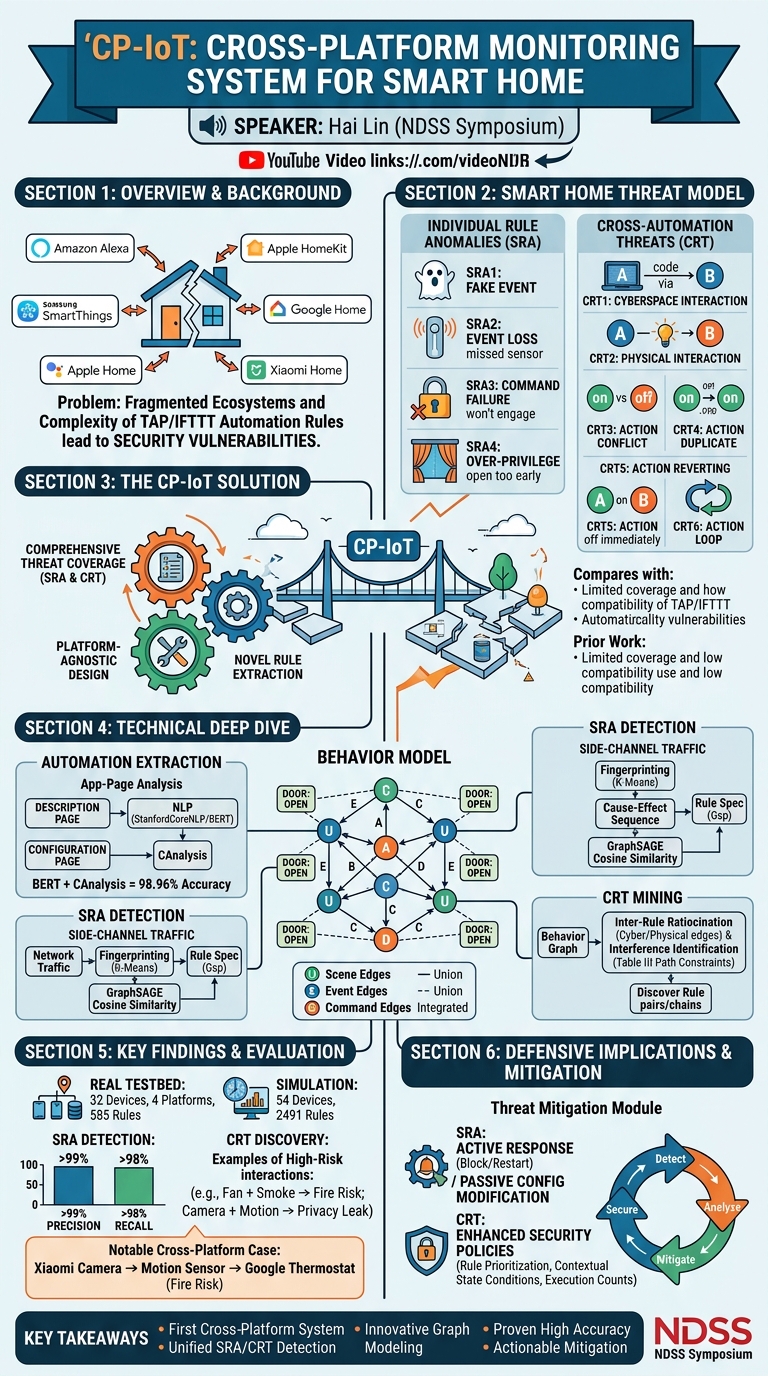
Key moments
- 0:00 Introduction to smart home security issues and threats
- 2:00 Limitations of existing solutions and CP-IoT's goals
- 4:00 Analysis of related work's platform and threat coverage
- 6:00 CP-IoT's core technical approach and overall workflow
- 8:00 Detailed SRA/CRT detection and rules extraction methodology
- 10:00 Rule configuration analysis and Behavior Graph construction
- 12:00 Event relationship construction and rule integration into graph
CP-IoT: A Cross-Platform Monitoring System for Smart Home
Speakers: Hai Lin
Conference: NDSS Symposium
YouTube: https://www.youtube.com/watch?v=C7sr_7Db4sA
Overview
This article delves into CP-IoT, a groundbreaking cross-platform monitoring system for smart homes, presented by Hai Lin at the NDSS Symposium. The talk addresses the escalating security challenges within modern smart home ecosystems, which are increasingly fragmented across diverse platforms like Amazon Alexa, Samsung SmartThings, Apple HomeKit, Google Home, and Xiaomi Home. While these platforms offer unparalleled convenience through trigger-action programming (TAP) models, often referred to as If-This-Then-That (IFTTT) rules, their inherent complexity and interoperability gaps introduce significant security vulnerabilities.
CP-IoT emerges as a critical solution to two primary categories of threats: individual automation rule anomalies (SRA), where a single rule fails to execute as specified, and the more intricate cross-automation threats (CRT), which arise from unexpected interactions and interferences between multiple rules. Existing research efforts have largely fallen short, offering either limited threat coverage (focusing on SRA or CRT, but rarely both) or suffering from poor platform compatibility, often relying on platform-specific code analysis or log access. CP-IoT distinguishes itself by offering a comprehensive, platform-agnostic approach to monitor automation execution behavior and uncover hidden risks across these heterogeneous IoT environments.
The significance of CP-IoT lies in its innovative design, which overcomes the limitations of prior work by providing a unified framework for security monitoring across disparate smart home platforms. By enabling the detection of a wide spectrum of anomalies and interferences, CP-IoT empowers users and developers to build more secure and reliable smart home systems. This deep dive will explore the system's architecture, methodologies, and the compelling evaluation results that underscore its effectiveness in safeguarding the interconnected smart home landscape.
Background
▶ Watch: Introduction to smart home security issues and threats (0:00)
The modern smart home is built upon a foundation of interconnected devices and automated routines designed to simplify daily life. These automations typically fall into two categories: Scene Control (U), which allows users to define a set of actions (e.g., "Good Morning" scene raising curtains and setting system mode to home) triggered manually or by voice, and Automation Rules (IF Event THEN Command, E→C), which are passive control policies (e.g., "IF presence detected THEN unlock the door and turn on the light"). These rules are often expressed using the trigger-action programming (TAP) model, popularized by services like IFTTT. While convenient, the increasing complexity and device heterogeneity within smart homes have exposed significant security vulnerabilities.
Threats in smart home automations are broadly categorized into two types. Individual Rule Anomalies (SRA) refer to inconsistencies within a single rule's behavior. Examples include SRA1 (Fake Event), where an event is erroneously detected; SRA2 (Event Loss), where a legitimate event is missed; SRA3 (Command Failure), where a command fails to execute; and SRA4 (Over-Privilege), where a rule executes actions beyond its intended scope. More complex are Cross-Automation Threats (CRT), which stem from interactions between multiple rules. These include CRT1 (Cyberspace Interaction) and CRT2 (Physical Interaction), where one rule's action implicitly triggers another; CRT3 (Action Conflict), where two rules attempt to set a device to conflicting states; CRT4 (Action Duplicate), where two rules redundantly set a device to the same state; CRT5 (Action Reverting), where one rule's action immediately undoes another's; and CRT6 (Action Loop), where a chain of rules creates a continuous, undesirable execution cycle.
Prior research has attempted to address these threats but faces critical limitations. For SRA detection, tools like Homonit, IoTGaze, and HAWatcher infer execution behavior from encrypted traffic or logs, matching it against rule specifications. However, Homonit only detects SRA1 and SRA3, while HAWatcher misses SRA3. For CRT detection, Soteria, IoTGuard, iRuler, and Homeguard construct execution flow graphs to identify security property violations. These solutions, however, are often limited to specific platforms like SmartThings and do not comprehensively cover all CRT subtypes; for instance, Soteria misses CRT2 and CRT4, and IoTGuard misses CRT4. A crucial common failing across most existing methods is their low platform compatibility. They are typically designed for specific ecosystems, often relying on code-based analysis or direct log access that is not universally available across the diverse programming languages, code frameworks, and proprietary log formats of heterogeneous IoT platforms. This makes them difficult to adapt or transplant, highlighting a significant gap that CP-IoT aims to fill with its comprehensive and platform-agnostic approach.
Key Findings
▶ Watch: Analysis of related work's platform and threat coverage (4:00)
CP-IoT represents a significant leap forward in smart home security monitoring, addressing critical limitations of previous research with several key findings and contributions:
- First Cross-Platform Monitoring System: CP-IoT is introduced as the first system capable of comprehensively monitoring smart home security across heterogeneous platforms, including SmartThings, Apple HomeKit, Google Home, and Xiaomi Home. This addresses the long-standing challenge of platform-specific security solutions.
- Comprehensive Threat Coverage: Unlike prior work that often focused on a subset of threats, CP-IoT offers a unified framework for detecting all four identified Individual Rule Anomaly (SRA) types (Fake Event, Event Loss, Command Failure, Over-Privilege) and all six Cross-Automation Threat (CRT) subtypes (Cyberspace Interaction, Physical Interaction, Action Conflict, Action Duplicate, Action Reverting, Action Loop).
- Novel Cross-Platform Rule Extraction: A core innovation is the app-page-based analysis approach for extracting automation rules. By combining Description Page Analysis (using NLP tools like StanfordCoreNLP and BERT for semantic parsing) with Configuration Page Analysis (for fine-grained user policies and thresholds), CP-IoT achieves an impressive average accuracy of 98.96% across all four tested platforms (with BERT and CAnalysis), overcoming varied description granularities and architectural differences.
- Centralized, Dynamic Graph-Based Behavior Model: CP-IoT constructs a Behavior Graph that acts as a centralized, dynamic model representing device state transitions and rule dependencies. This graph is crucial for perceiving complex device state changes under the control of multiple rules and provides a complete exploration space for threat mining, enabling platform-agnostic analysis.
- Multi-Granularity Side-Channel Fingerprinting for Runtime Behavior: To overcome limitations in log access, CP-IoT infers runtime behavior from encrypted side-channel traffic. It uses a multi-granularity fingerprinting approach (combining 2-tuple flow-level and packet-level features) and K-Means clustering to acquire event fingerprints and identify cause-effect sequences, enabling robust SRA detection.
- Graph-Based Anomaly Detection and Formalized CRT Mining: For SRA, CP-IoT employs GraphSAGE to learn graph representations and cosine similarity for anomaly detection by comparing runtime execution graphs with rule specifications. For CRT, each fine-grained threat type is formalized as path constraints, and a searching algorithm is applied to the behavior graph to discover feasible rule-pairs or rule-chains satisfying these conditions.
- Actionable Threat Mitigation: The system includes a Threat Mitigation module that interprets detection results and generates actionable recommendations. For SRA, it suggests passive configuration modifications or active responses (blocking execution, restarting devices) based on the anomaly's cause. For CRT, it designs Enhanced Security Policies, such as rule prioritization, contextual state conditions, and execution counts, to mitigate harm with minimal impact.
- Extensive Evaluation and High Accuracy: CP-IoT was rigorously evaluated on both a real testbed (32 IoT devices, 4 mainstream platforms, 585 rules) and a simulation testbed (7 scenes, 54 devices, 2491 IFTTT/SmartApp rules). The evaluation demonstrated high accuracy in SRA detection (precision > 99.0%, recall > 98.0% across all platforms, outperforming Homonit and IoTGaze) and effectiveness in discovering a substantial number of CRT instances (e.g., 1171 CRT1 and 487 CRT2 on the real testbed), confirming its excellent cross-platform compatibility and practical utility.
Technical Deep Dive
▶ Watch: CP-IoT's core technical approach and overall workflow (6:00)
CP-IoT's technical architecture is a sophisticated two-layer structure designed to provide comprehensive, cross-platform security monitoring for smart homes. The bottom layer focuses on building a unified System Model, while the top layer implements the System Defense Functions of SRA detection and CRT mining.
System Model Construction (Bottom Layer)
The foundation of CP-IoT lies in accurately understanding and representing smart home automations and device behaviors across disparate platforms. This involves two main stages:
1. Automation Rules Extraction
This stage tackles the challenge of diverse app interfaces and description granularities. Traditional code-based methods are platform-specific and fail for closed-source systems. CP-IoT's novel app-page-based analysis approach consists of two phases:
- Description Page Analysis (DAnalysis): This phase parses the natural language descriptions of automation rules as presented on app interfaces (e.g., "When you return home, turn on lights and air conditioning and close the curtains"). It leverages advanced Natural Language Processing (NLP) tools, specifically StanfordCoreNLP and BERT, to identify Event and Command parts. Techniques like lemmatization are applied, and clauses are matched to standardized capability-value pairs (e.g.,
light.on,AC.temperature.set) derived from comprehensive documentation like the SmartThings Developer Documentation, using cosine similarity for robust semantic matching. - Configuration Page Analysis (CAnalysis): This phase complements DAnalysis by extracting fine-grained user policies and thresholds from the configuration pages of automation rules. This is particularly crucial for capabilities involving specific values, such as temperature (e.g., "IF temperature > 25°C THEN turn on AC") or humidity. CAnalysis provides the precise details that DAnalysis might only vaguely infer.
The combination of DAnalysis and CAnalysis proved highly effective. While DAnalysis alone yielded accuracies between 80-93%, adding CAnalysis significantly boosted accuracy by 2.86-12.50% for Word2Vec-based models and 5.71-10.94% for BERT-based models. Ultimately, BERT combined with CAnalysis achieved an impressive average accuracy of 98.96% across SmartThings, Apple HomeKit, Google Home, and Xiaomi Home, demonstrating CP-IoT's robust capability for cross-platform rule extraction.
2. Behavior Graph Construction
Once rules are extracted, CP-IoT constructs a centralized, dynamic Behavior Graph to integrate all automations and portray their normal behavior and device state transitions. This graph is crucial for perceiving complex device state changes under the control of multiple rules.
- Device State Representation: Each IoT device is represented as a central node. For each device, State nodes are created to represent its capability values (e.g., for a Door Sensor, a state node might represent
contact: open). CP-IoT employs scheme2, where one capability value is represented per state node, reducing space complexity while ensuring all relevant capability values are recorded within the device node's context. - Scene_Control Edges: These edges link Device nodes directly to State nodes, representing explicit user control actions defined in scene controls.
- Event Relationship Construction: Event edges are added between State nodes that share the same capability, signifying potential state transitions (e.g.,
door.contact: closedtodoor.contact: open). - Rules Integration: Automation rules are then bound to this graph. The Event parts of rules are matched to existing Event edges. For rules with multiple event preconditions, Union nodes are created to represent intermediate states where all preconditions have been met. Command edges are then constructed from event successor nodes (or Union nodes) to command successor nodes, representing the device state after a command is executed. Each rule is assigned a unique ID, linking all its associated nodes and edges within the graph.
System Defense Functions (Top Layer)
With the comprehensive Behavior Graph in place, CP-IoT proceeds to its core defense functions: SRA Detection and CRT Mining.
1. SRA Detection
Detecting individual rule anomalies (SRA) is challenging due to limited log access on many IoT platforms. CP-IoT addresses this by inferring runtime behavior from side-channel traffic.
- Event & Command Fingerprinting:
- The system first captures and filters noisy network traffic, extracting data flows between each device and the router.
- For each flow, two types of fingerprints are constructed: a 2-tuple flow-level fingerprint (average packet interval, packet sequence length) and a packet-level fingerprint (a feature matrix of packet sizes, protocols, and directions).
- To obtain representative fingerprints, rules are triggered multiple times under normal conditions. K-Means clustering is then applied to the collected fingerprints to identify typical patterns and eliminate deviations.
- Cause-Effect Sequence Generation:
- Runtime traffic flows are then matched against these pre-computed fingerprints. The start timestamp of each flow is used to determine cause-effect relationships, splitting flows into Cause and Effect parts based on a time interval T1 (set to 1s or 2s during evaluation).
- A weighted Manhattan Distance metric (Equation 3) is used for matching runtime flows to event/command fingerprints, prioritizing flow-level features. If the weighted sum of distances exceeds a threshold 'd' (set to 5 or 7), the flow is considered unmatched.
- Anomaly Detection:
- Finally, the identified cause-effect sequence from runtime traffic is transformed into an execution graph (Gcs). This is then compared for consistency with the rule's specification (Gsp) derived from the Behavior Model.
- GraphSAGE is employed to learn robust graph representations for both Gcs and Gsp, and their cosine similarity is calculated. Anomalies are detected if no exact match is found, allowing for the identification of specific SRA types (e.g., SRA1, SRA2, SRA3, SRA4).
2. CRT Mining
CRT mining focuses on discovering complex interactions and interferences between multiple rules, leveraging the comprehensive Behavior Graph.
- Cross-Rule Interactions Ratiocination (CRT1-2):
- Cyberspace Interactions (CRT1): These occur if one rule's command set directly contains another rule's event set (e.g., rule A turns on a light, and rule B triggers when the light turns on).
- Physical Interactions (CRT2): These are more subtle and are identified through Correlation Channel Analysis. CP-IoT analyzes 11 physical channels (e.g., temperature, motion, sound, acceleration, air quality) and their correlation with capability-value pairs using BERT similarity. If a rule's command implicitly triggers another rule's event through a physical channel (e.g., turning on an AC changes the room temperature, which then triggers a temperature-sensitive rule), a physical interaction is identified.
- Based on these analyses, Physical or Cyber edges are constructed on the Behavior Graph, linking interacting rules.
- Cross-Rule Interference Identification (CRT3-6):
- Each interference type (Action Conflict, Action Duplicate, Action Reverting, Action Loop) is formally defined using symbolic representations (Table III).
- These representations are then converted into path constraints on the Behavior Graph. A sophisticated searching algorithm is applied to the graph to discover all feasible rule groups or chains that satisfy these path constraints. For instance, Action Conflict (CRT3) and Action Duplicate (CRT4) involve two rules controlling the same device to different or the same states, respectively. Action Reverting (CRT5) and Action Loop (CRT6) involve identifying chains of rules where actions are undone or lead to continuous, undesirable execution cycles.
Threat Mitigation
The final module interprets the detection results and provides actionable recommendations.
- For SRA: The system analyzes the matching results to determine the anomaly type and its likely cause (e.g., network delay, device defect, or malicious attacker behavior). For non-attacker causes, it suggests passive configuration modifications. If an attacker is suspected, CP-IoT recommends active responses such as blocking rule execution or restarting affected devices.
- For CRT: CP-IoT designs Enhanced Security Policies to mitigate harm with minimal impact on existing rules. This includes:
- Setting priorities for conflicting rules (e.g., prioritizing User Activity > Physical-Related > Mode-related rules).
- Adding contextual state conditions to prevent action reverting.
- Utilizing execution counts to detect and prevent action loops.
Demo / Proof of Concept
▶ Watch: Rule configuration analysis and Behavior Graph construction (10:00)
While the talk does not describe a live demonstration, the comprehensive evaluation of CP-IoT on both real-world and simulated smart home environments serves as a robust proof of concept for its effectiveness and cross-platform compatibility. The rigorous testing methodology and quantitative results demonstrate CP-IoT's practical utility.
The evaluation leveraged a real testbed (detailed in Appendix C.A) comprising 32 IoT devices across four mainstream smart home platforms: Samsung SmartThings, Apple HomeKit, Google Home, and Xiaomi Home. This environment hosted a total of 585 automation rules (105 for SmartThings, 128 for Apple HomeKit, 160 for Google Home, and 192 for Xiaomi Home). Additionally, a simulation testbed (described in Appendix C.B) was utilized, which included 7 typical scenes, 54 devices, and 2491 rules crawled from IFTTT and SmartApp, allowing for large-scale testing. The CP-IoT implementation ran on an Ubuntu server equipped with an NVIDIA A100 GPU, utilizing GraphSAGE, Neo4j, and NetworkX for graph processing and analysis. Specialized hardware was employed for capturing traffic across various protocols, including ZigBee, Z-Wave, WiFi, and Bluetooth.
The evaluation results highlighted CP-IoT's strong performance across all stages:
- Automation Extraction Performance: Comparisons between Word2Vec and BERT models for description analysis (DAnalysis) and configuration analysis (CAnalysis) showed that DAnalysis alone yielded accuracies between 80-93%. However, the addition of CAnalysis significantly improved accuracy, boosting it by 2.86-12.50% for Word2Vec and 5.71-10.94% for BERT. Crucially, BERT combined with CAnalysis achieved an impressive average accuracy of 98.96% across all four platforms, validating CP-IoT's ability to accurately extract rules from diverse interfaces.
- SRA Detection Performance: CP-IoT was compared against state-of-the-art detectors Homonit and IoTGaze on SmartThings (as these baselines lacked cross-platform support). CP-IoT consistently outperformed both, achieving 98.10% accuracy or higher in its best configuration (e.g., T1=2s, d=7 for normal cases; T1=1s, d=5 for SRA1, SRA3-Cyberspace, SRA4). Its higher tolerance for network latency and physical interference contributed to a lower false positive rate. Across all four platforms, CP-IoT's SRA detection achieved a precision higher than 99.0% and a recall higher than 98.0%, demonstrating excellent cross-platform compatibility. The runtime costs were also comparable to IoTGaze and less than Homonit, primarily due to CP-IoT's efficient use of shared state nodes in its graph model.
- CRT Mining Performance: CP-IoT successfully discovered a substantial number of cross-rule interactions and interferences. On the real testbed, 1171 CRT1 (Cyberspace Interactions) and 487 CRT2 (Physical Interactions) were identified. The simulation testbed yielded similar numbers: 1072 CRT1 and 1461 CRT2. Physical correlations were found across various channels, including motion, sound, acceleration, and air quality. CP-IoT also identified numerous instances of CRT3-6 (Action Conflict, Duplicate, Reverting, Loop). Examples of high-risk interactions were presented, such as a fan turning on after smoke detection (potentially exacerbating a fire) or a camera turning on (causing privacy leakage). A notable cross-platform CRT2 case involved a Xiaomi camera's 360-degree scan implicitly triggering motion sensors, which in turn activated a Google thermostat to heating mode, posing a fire risk. CP-IoT's ability to detect dangerous actions like
Cheater.onorWindow.openwithin these interactions further underscored its value.
Defensive Implications
▶ Watch: Event relationship construction and rule integration into graph (12:00)
CP-IoT provides crucial defensive implications for smart home users, developers, and platform providers by not only identifying a wide array of threats but also suggesting actionable mitigation strategies. The system's Threat Mitigation module is central to translating detected anomalies and interferences into practical security enhancements.
For Individual Rule Anomalies (SRA), CP-IoT’s detailed analysis helps pinpoint the root cause, whether it's a transient network delay, a device defect, or a malicious attack.
- In cases of non-malicious causes, the system suggests passive configuration modifications. This could involve advising users to adjust rule timings, reconfigure device settings, or update firmware to improve reliability and prevent future anomalies.
- If an attacker is suspected, CP-IoT enables active responses. This might include blocking the execution of suspicious rules, restarting affected devices to clear compromised states, or isolating devices from the network to contain the threat. This capability moves beyond mere detection to proactive defense.
For Cross-Automation Threats (CRT), which are inherently more complex due to inter-rule dependencies, CP-IoT designs Enhanced Security Policies aimed at mitigating harm while minimizing disruption to legitimate automations.
- For Action Conflict (CRT3), the system can suggest prioritizing conflicting rules. The proposed prioritization scheme (e.g., User Activity > Physical-Related > Mode-related) ensures that critical or user-initiated actions take precedence, preventing undesirable outcomes from conflicting commands.
- To address Action Reverting (CRT5), CP-IoT can recommend adding contextual state conditions to rules. For example, if a rule turns off a light but another immediately turns it back on, a contextual condition could specify that the light should only turn on if it has been off for a certain duration or if another specific event has occurred, thereby breaking the reverting loop.
- For Action Loop (CRT6), the system employs execution counts. By monitoring how many times a rule or chain of rules executes within a short period, CP-IoT can identify and flag potential loops. Mitigation might involve temporarily disabling the looping rule or alerting the user to reconfigure it.
Beyond these specific mitigation strategies, the very existence and findings of CP-IoT serve as a powerful defensive tool. By highlighting specific high-risk interactions—such as a fan turning on after smoke detection (potentially exacerbating a fire) or a camera turning on due to an implicit motion trigger (leading to privacy leakage)—CP-IoT raises awareness among users and developers about the latent vulnerabilities in their smart home setups. This knowledge can inform better rule design, more secure device configurations, and the development of more robust platform security features. The ability to detect cross-platform threats, like the Xiaomi camera triggering a Google thermostat, underscores the need for a holistic security approach that transcends individual vendor ecosystems.
Key Takeaways
- CP-IoT pioneers cross-platform smart home security: It is the first system to offer comprehensive monitoring for heterogeneous IoT environments, addressing a critical gap in existing solutions.
- Comprehensive threat detection: CP-IoT provides unified coverage for all four types of Individual Rule Anomalies (SRA) and all six subtypes of Cross-Automation Threats (CRT), ensuring a holistic security posture.
- Innovative rule extraction via app-page analysis: A novel combination of Description Page Analysis (NLP with BERT) and Configuration Page Analysis achieves exceptionally high accuracy (98.96%) in extracting automation rules across diverse platforms.
- Robust behavior modeling and runtime analysis: A centralized, dynamic Behavior Graph combined with multi-granularity side-channel fingerprinting enables accurate runtime behavior inference and anomaly detection without relying on often-unavailable platform logs.
- Proven effectiveness and cross-platform compatibility: Extensive evaluation on real and simulated testbeds, encompassing 1076 automation rules across four mainstream platforms, demonstrates CP-IoT's high accuracy (SRA precision > 99%, recall > 98%) and effectiveness in discovering complex, real-world security risks.
- Actionable mitigation strategies: CP-IoT provides specific recommendations for threat mitigation, including passive configuration modifications, active attack responses, rule prioritization, contextual state conditions, and execution counting to enhance overall smart home security.
About the Speaker(s)
The talk on CP-IoT was presented by Hai Lin at the NDSS Symposium. No further details regarding their title or organizational affiliation were provided in the transcript or metadata.
All talks from Network and Distributed System Security (NDSS) Symposium 2024