CamPro: Camera-based Anti-Facial Recognition
Wenjun Zhu
Network and Distributed System Security (NDSS) Symposium 2024 · Day 3 · Physical Attacks
Overview
The rapid advancement and pervasive deployment of deep learning-based facial recognition (FR) systems have introduced significant privacy concerns, ranging from unauthorized surveillance to potential cybercrime. While FR offers undeniable conveniences, its potential for abuse has sparked widespread debate, leading to lawsuits and even outright bans in various jurisdictions. Existing anti-facial recognition (AFR) solutions primarily operate as post-processing methods, modifying images after they have been captured by a camera module. This approach, however, presents a critical vulnerability: an adversary with direct access to the camera module or a compromised operating system can intercept raw, unprotected images, thereby bypassing all privacy safeguards.
Key moments
- 0:00 Problem: Facial recognition privacy threat and CamPro's goal
- 2:00 Background: Facial Recognition and HAR applications
- 4:00 Camera module, ISP, threat model, and CamPro's design
- 6:00 Preliminary analysis and CamPro system design overview
- 8:00 Technical approach: Camera modeling for ISP effects
CamPro: Camera-based Anti-Facial Recognition
Speakers: Wenjun Zhu
Conference: NDSS Symposium
YouTube: https://www.youtube.com/watch?v=C_Lo2trweKQ
Overview
The rapid advancement and pervasive deployment of deep learning-based facial recognition (FR) systems have introduced significant privacy concerns, ranging from unauthorized surveillance to potential cybercrime. While FR offers undeniable conveniences, its potential for abuse has sparked widespread debate, leading to lawsuits and even outright bans in various jurisdictions. Existing anti-facial recognition (AFR) solutions primarily operate as post-processing methods, modifying images after they have been captured by a camera module. This approach, however, presents a critical vulnerability: an adversary with direct access to the camera module or a compromised operating system can intercept raw, unprotected images, thereby bypassing all privacy safeguards.
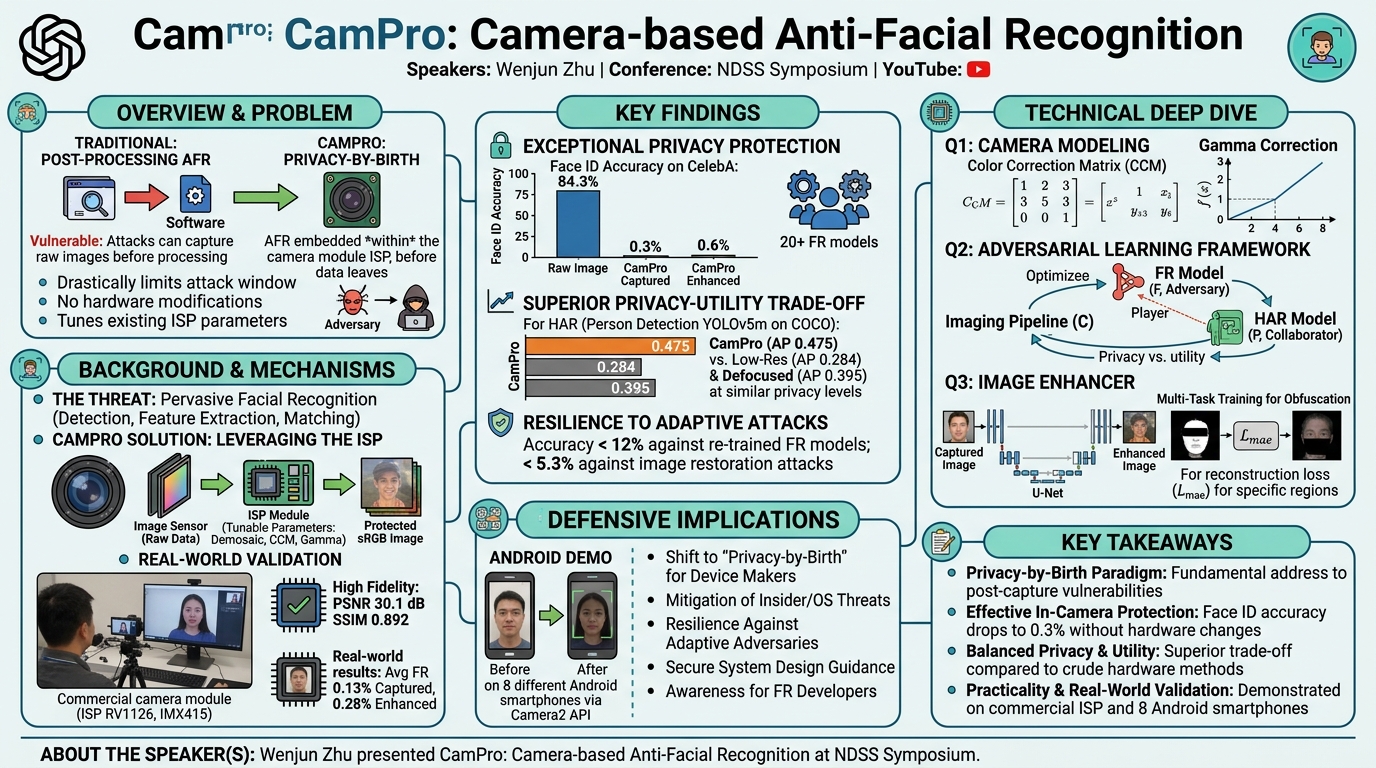
In response to this fundamental challenge, Wenjun Zhu's talk at NDSS Symposium introduces CamPro, a groundbreaking system that redefines privacy protection for facial images. CamPro proposes a novel paradigm called "privacy-preserving by birth," where personal identifiable information, specifically faces, is removed or desensitized directly at the point of image capture, inside the camera module itself. This is achieved without any hardware modifications, by intelligently tuning the camera's internal Image Signal Processor (ISP) parameters.
CamPro's significance lies in its ability to bind image acquisition and privacy protection, drastically limiting an attacker's window of opportunity to compromise sensitive data. By embedding AFR capabilities within existing commodity camera modules, CamPro aims to empower individuals to leverage modern vision applications for their utility while simultaneously ensuring their facial privacy is inherently protected, making it a robust and practical solution for an increasingly surveilled world.
Background
▶ Watch: Problem: Facial recognition privacy threat and CamPro's goal (0:00)
The proliferation of high-resolution cameras in nearly every aspect of daily life, from smartphones to surveillance systems, has created an unprecedented volume of imagery. Concurrently, the sophistication of deep learning models for facial recognition (FR) has reached a point where identity verification or identification can be performed with remarkable accuracy. Modern FR systems typically involve four stages: Face Detection and Alignment (locating and standardizing faces), Feature Extraction (using deep neural networks to generate unique facial feature vectors), and Feature Matching (comparing these vectors against a gallery of labeled faces). While offering benefits like secure authentication, the potential for FR abuse, including stalking and large-scale, indiscriminate surveillance, underscores the urgent need for effective privacy protection.
Traditional anti-facial recognition (AFR) methods largely rely on post-processing. These techniques manipulate already captured images by obfuscating, synthesizing, or introducing adversarial perturbations to faces. While effective to some extent, their fundamental flaw is their dependence on software-level intervention after the raw image data has left the sensor. An attacker with direct access to the camera module – either through legitimate but overreaching permissions or by compromising the operating system – can acquire the pristine, unprotected images, rendering post-processing efforts moot. This vulnerability highlights the need for a more foundational approach to privacy.
CamPro addresses this by shifting privacy protection into the camera module itself. A camera module typically consists of an image sensor (CMOS or CCD) and an Image Signal Processor (ISP). The image sensor converts light into raw data, which the ISP then processes into a standard sRGB image suitable for human viewing. ISPs are critical for efficient RAW-to-sRGB conversion and controlling the image sensor's parameters, such as shutter speed and ISO. Crucially, ISPs offer a range of tunable parameters for various functions, including Demosaic (reconstructing full-color images from sensor data), Color Correction Matrix (CCM) (adjusting colors linearly), and Gamma Correction (Gamma) (non-linear brightness transformation). CamPro leverages these existing, tunable ISP functions to embed AFR directly within the module.
The threat model considered by CamPro is an adversary, whether an individual or organization, aiming to identify victims using automatic FR techniques like FaceNet or ArcFace. This adversary can obtain images directly from the camera module, bypassing the operating system, and is even considered to be an adaptive attacker who is aware of CamPro's protection and might attempt to bypass it using image restoration techniques or by re-training FR models with CamPro-generated images.
Beyond privacy, CamPro also considers utility preservation. While protecting facial identity, the captured images must still be useful for non-sensitive vision applications, particularly Human Activity Recognition (HAR). The talk investigates three representative HAR applications: Person Detection (locating and tracking people), Human Pose Estimation (detecting body key points), and Image Captioning (describing scene content in natural language). CamPro's design requirements include practicality (supported by commodity ISPs), AFR effectiveness (significantly lower face identification accuracy), utility preservation for HAR, and human friendliness (visually useful images, except for facial information).
Key Findings
▶ Watch: Background: Facial Recognition and HAR applications (2:00)
CamPro presents a significant paradigm shift in anti-facial recognition, moving privacy protection from post-processing to "privacy-preserving by birth" within the camera module itself. The core findings demonstrate its effectiveness, practicality, and resilience:
- In-Camera AFR Achieved Without Hardware Modification: CamPro successfully implements anti-facial recognition directly within existing commodity camera modules by intelligently tuning the built-in Image Signal Processor (ISP) parameters, specifically the Color Correction Matrix (CCM) and Gamma Correction. This eliminates the fundamental vulnerability of software-based post-processing solutions.
- Exceptional Privacy Protection: Across 20 state-of-the-art FR models and two classifiers, CamPro reduced average face identification accuracy on the CelebA dataset from a baseline of 84.3% for raw images to a mere 0.3% for CamPro-captured images and 0.6% for CamPro-enhanced images. This protection generalized effectively to unseen FR models and different face datasets (e.g., LFW).
- Robust Utility Preservation for HAR: CamPro images retained significant utility for non-sensitive vision applications like Human Activity Recognition (HAR). For person detection (YOLOv5m on COCO), CamPro-captured images achieved an Average Precision (AP) of 0.475, substantially outperforming hardware-level baselines like low-resolution (AP 0.284) and defocused cameras (AP 0.395) tuned to similar privacy levels. This indicates a superior privacy-utility trade-off.
- Resilience Against Adaptive Attacks: CamPro demonstrated strong security against both gray-box and white-box adaptive adversaries. Even when adversaries had full knowledge of CamPro's parameters and could re-train FR models on generated protected images, the average face identification accuracy remained below 12% (maximum 19.5% for specific re-training scenarios), and specialized image restoration attacks yielded an average accuracy of only 5.3%.
- Effective Visual Enhancement with Privacy: The CamPro Image Enhancer, a Deep Neural Network, significantly improved the visual quality of captured images (PSNR 21.5 dB, SSIM 0.749 for enhanced vs. PSNR 10.8 dB, SSIM 0.437 for captured), making them human-friendly, while simultaneously ensuring facial information remained obfuscated through a multi-task training scheme.
- Real-World Validation and Practicality: A proof-of-concept CamPro system was successfully implemented on a commercial camera module (ISP RV1126, image sensor IMX415), showing high fidelity between simulated and real-world capture (PSNR 30.1 dB, SSIM 0.892). Furthermore, CamPro's effects were successfully demonstrated on 8 different Android smartphones using standard Camera2 API parameters, confirming its real-world applicability and compatibility with existing device ecosystems.
Technical Deep Dive
▶ Watch: Camera module, ISP, threat model, and CamPro's design (4:00)
CamPro's technical architecture is elegantly designed to achieve privacy-preserving image acquisition through a two-pronged approach: an optimized in-camera module and a privacy-preserving image enhancer. The core innovation lies in leveraging existing ISP functionalities, circumventing the need for hardware modifications.
System Design Overview
The CamPro system comprises two main modules:
- CamPro Camera Module: This is a commodity camera module configured with a set of optimized ISP parameters, specifically for the Color Correction Matrix (CCM) and Gamma Correction. Its primary role is to generate privacy-protected images at the point of capture. A key advantage is its zero computational cost, as it merely involves changing existing function parameters within the ISP.
- CamPro Image Enhancer: This is a Deep Neural Network (DNN), specifically a U-Net model, designed to improve the visual appearance of the captured images for human viewers, while strictly preserving the privacy protection enforced by the camera module.
The system addresses three fundamental research questions:
- Q1: Camera Modeling: How to accurately simulate the effect of modified ISP parameters without requiring actual hardware deployments for every optimization iteration.
- Q2: Adversarial Learning Framework: How to optimize ISP parameters to concurrently achieve strong privacy (minimize FR performance) and high utility (maximize HAR performance), even against adaptive, white-box adversaries.
- Q3: Image Enhancer: How to enhance the visual appearance of the privacy-protected images for human perception while ensuring that facial privacy remains intact.
Q1: Camera Modeling
To enable gradient-based optimization of ISP parameters, CamPro developed a Camera Modeling component. This virtual pipeline simulates the effects of ISP functions on existing RGB images from public datasets, which have already undergone some form of ISP processing. The focus is on two color-related ISP functions:
- Color Correction Matrix (CCM): This is modeled as a 3x3 linear transformation matrix with 9 tunable parameters (α11 to α33). The output RGB values are then clipped to a valid range [0, 1].
followed by clip(0,1) for each channel.
- Gamma Correction (Gamma): Often implemented as a Look-Up Table (LUT) in ISP hardware, Gamma is modeled as a piecewise linear function. The input values (xi) are fixed constants based on the ISP interface, while the output values (yi) are tunable parameters within [0, 1].
The Virtual Imaging Pipeline works by first applying a De-Gamma function (f(x) = x^2.2) to approximate the undoing of a common Gamma correction, as the original ISP parameters of public datasets are unknown. Subsequently, the custom, optimized CCM and Gamma functions are applied. For real-world deployment, the optimized CCM effectively multiplies with the camera's original CCM, and the optimized Gamma replaces the default.
Q2: Adversarial Learning Framework
Optimizing ISP parameters for the conflicting goals of minimizing FR accuracy and maximizing HAR utility is a complex, non-convex problem. CamPro frames this as a three-player adversarial game:
- Player 1: Imaging Pipeline (C): Controlled by the CCM and Gamma parameters, aiming to minimize FR performance and maximize HAR utility.
- Player 2: FR Model (F): The adversary, aiming to maximize face identification performance.
- Player 3: HAR Vision Application Model (P): A collaborator with the imaging pipeline, aiming to maximize utility (e.g., person detection accuracy).
The overall optimization objective is a minimax problem: min_C max_F E_(x,y)~DF V(F(C(x)),y), where V is the face identification metric. To make this tractable, the face identification problem is converted into a multi-classification problem by adding a proxy classification head to the FR model, and the indifferentiable metric V is replaced with the differentiable cross-entropy (CE) loss Lce.
A crucial aspect is preventing the imaging pipeline C from simply turning all pixels to the same value (which would disable both FR and HAR). Thus, utility is optimized simultaneously: min_C,P E_(x,y)~DP Ldet(P(C(x)),y), where Ldet is a detection loss (combining classification Lcls and bounding box Lbox losses).
CamPro employs an alternating optimization approach, similar to Generative Adversarial Networks (GANs). In each iteration, m steps are taken to optimize the FR model (Player 2), and n steps are taken to optimize the imaging pipeline (Player 1) and HAR model (Player 3). The update expressions involve a non-saturated CE loss (Lns) for the FR model, which provides stronger gradients early in training, and a weighted sum for the imaging pipeline to balance privacy and utility (controlled by weight w). This adversarial learning against an adaptive FR model is critical for CamPro's ability to generalize to various black-box FR models.
Q3: Image Enhancer
While the CamPro camera module ensures privacy and utility, the resulting images may not be visually appealing for human viewers. The CamPro Image Enhancer addresses this by using a U-Net model, which is well-suited for image-to-image translation tasks. It is trained with pairs of original and CamPro-captured images to restore the captured images towards their original visual quality.
The enhancer is trained using Mean Absolute Error (MAE) loss (L1 loss): min_R E_x~X LMAE(R(C(x)),x) = ||R(C(x)) - x||. However, a straightforward restoration could inadvertently reconstruct sensitive facial information. To prevent this, CamPro introduces a multiple-task training scheme for the U-Net. This scheme guides the U-Net to obfuscate facial regions while reconstructing other, non-sensitive parts of the image. This is achieved by generating a binary mask s where facial regions are marked with 0 and other regions with 1. The MAE loss is then modified: LMAE = s ⊙ ||R(C(x)) - x|| + (1 - s) ⊙ ||R(C(x))||, where ⊙ denotes the Hadamard product. This modification ensures that the U-Net is penalized for reconstructing faces (by minimizing (1-s) * ||R(C(x))||) while being encouraged to restore non-facial content. This simultaneous obfuscation and enhancement makes the enhancer robust against adversaries, even if they obtain the enhancer model.
Demo / Proof of Concept
▶ Watch: Preliminary analysis and CamPro system design overview (6:00)
CamPro's real-world applicability was rigorously demonstrated through several proof-of-concept implementations and evaluations.
A key part of the validation involved implementing a CamPro system on a commercial camera module. The chosen hardware comprised an ISP RV1126 and an image sensor IMX415, representing a common setup in embedded systems. In this setup, the CamPro Camera Module's optimized ISP parameters (CCM and Gamma) were loaded directly onto the RV1126 ISP. The CamPro Image Enhancer, being a Deep Neural Network, ran on a remote server, processing the images transmitted from the camera module. To simulate real-world image capture, images were displayed on a monitor and then filmed by the CamPro-enabled camera.
The fidelity of the virtual imaging pipeline to real-world capture was assessed by comparing simulated and real-world captured images. The results showed high similarity, with a PSNR of 30.1 dB and an SSIM of 0.892. This high fidelity validates the accuracy of CamPro's camera modeling, confirming that the simulated optimization translates effectively to actual hardware.
More importantly, the privacy and utility performance in this real-world setup were consistent with the simulation results.
- FR Accuracy: The average face identification accuracy dropped dramatically to 0.13% on captured images and 0.28% on enhanced images, compared to 95.9% for raw images. These figures are even slightly lower than the simulation results, potentially due to real-world noise, further reinforcing CamPro's strong anti-facial recognition capabilities.
- Person Detection Utility: Using YOLOv5m for person detection, the captured images achieved an Average Precision (AP) of 0.648 (using pseudo ground truths derived from unprotected images), demonstrating that utility is well-preserved even in a live environment.
Beyond the specific commercial module, CamPro's effects were successfully demonstrated on 8 different Android smartphones. This was achieved by leveraging the Camera2 API parameters (specifically ColorSpaceTransform for CCM and TonemapCurve for Gamma correction) available in modern Android devices. This validation highlights CamPro's broad compatibility and potential for deployment across a wide range of consumer devices without requiring specialized hardware.
An interesting observation from the real-world evaluation was CamPro's extensive effects on face detection. When protected images were fed into commercial face detection APIs like Face++ API and Amazon Rekognition, none of the protected faces were recognized, and frequent failures were observed. This implies that CamPro's protection might even precede FR, as the inability to detect a face would abort the facial recognition process entirely, offering an additional layer of privacy.
Defensive Implications
▶ Watch: Technical approach: Camera modeling for ISP effects (8:00)
CamPro introduces a transformative approach to privacy protection that has profound implications for defenders across various domains:
- Shift to "Privacy-by-Birth" for Device Manufacturers: CamPro provides a clear blueprint for device manufacturers to integrate "privacy-by-birth" features directly into their camera modules. By optimizing ISP parameters, manufacturers can offer cameras that inherently desensitize facial data at the point of capture, rather than relying on software applications that can be bypassed. This proactive approach significantly enhances the privacy posture of devices.
- Mitigation of Insider Threats and OS Compromise: By embedding anti-facial recognition (AFR) within the camera module's ISP, CamPro isolates privacy protection from the operating system and user applications. This means that even if the OS is compromised or an application gains direct access to the camera stream, the raw images obtained will already be protected, drastically reducing the attack surface for privacy breaches.
- Enhanced Resilience Against Adaptive Adversaries: The adversarial learning framework employed by CamPro ensures that its protection is robust not only against current facial recognition (FR) models but also against future, adaptive FR systems. Defenders can be confident that the ISP configurations are optimized to resist adversaries who might attempt to re-train their models on protected images or develop specialized restoration algorithms. This reduces the burden of constant updates to counter evolving FR threats.
- Superior Privacy-Utility Trade-offs: CamPro demonstrates that strong privacy does not necessitate a complete sacrifice of utility. Its ability to maintain high utility for Human Activity Recognition (HAR) applications while significantly reducing FR accuracy means that organizations and individuals can still benefit from vision-based analytics (e.g., person counting, pose estimation) without compromising facial privacy. This offers a demonstrably better trade-off than crude hardware-level baselines like low-resolution or defocused cameras.
- Guidance for Secure System Design: The detailed technical deep dive into ISP parameter tuning (CCM, Gamma) and the multi-task training scheme for the Image Enhancer offers valuable insights for security architects. It highlights how existing hardware components can be repurposed for privacy, inspiring similar innovations in other sensor-based systems. The specific technique of using a mask to selectively obfuscate faces while restoring other image parts in the enhancer is a robust defensive strategy.
- Awareness for FR System Developers: Developers of FR systems must acknowledge that images sourced from CamPro-enabled cameras will inherently lack identifiable facial features. This means traditional FR pipelines will fail on such inputs, emphasizing the need for robust input validation and potentially shifting focus to other biometric modalities or contextual information if identity is critical.
- Consideration for Deployment Parameters: When deploying CamPro, defenders should carefully consider the
wweight in the adversarial learning framework, which balances privacy and utility. This allows for fine-tuning the system to meet specific requirements, ensuring an optimal balance between protection needs and the functionality of non-sensitive applications.
Overall, CamPro offers a foundational shift in how privacy can be architected into imaging systems, providing a strong, hardware-level defense against the pervasive threats of facial recognition technology.
Key Takeaways
- Privacy-by-Birth Paradigm: CamPro introduces a novel "privacy-preserving by birth" approach, embedding anti-facial recognition (AFR) directly within commodity camera module ISPs, fundamentally addressing vulnerabilities of post-capture privacy solutions.
- Effective In-Camera Protection: By intelligently tuning existing ISP parameters like Color Correction Matrix (CCM) and Gamma Correction, CamPro drastically reduces face identification accuracy to 0.3% on captured images (from 84.3% baseline) while requiring no hardware modifications.
- Balanced Privacy and Utility: CamPro achieves a superior privacy-utility trade-off, significantly outperforming hardware-level baselines (e.g., low-resolution, defocused cameras) by maintaining high utility for Human Activity Recognition (HAR) applications (YOLOv5m AP 0.475) alongside robust privacy.
- Resilience to Adaptive Adversaries: Leveraging an adversarial learning framework, CamPro is designed to generalize against black-box FR models and withstand white-box adaptive attacks, keeping average face identification accuracy below 12% even with full knowledge and re-training.
- Privacy-Preserving Visual Enhancement: The CamPro Image Enhancer, a DNN-based U-Net, improves the visual quality of protected images for human viewing while employing a multi-task training scheme to ensure faces remain obfuscated, even if the enhancer model is compromised.
- Practicality and Real-World Validation: CamPro has been successfully implemented on commercial camera modules (ISP RV1126, IMX415) and demonstrated on 8 different Android smartphones using standard Camera2 API parameters, confirming its real-world applicability and high fidelity.
About the Speaker(s)
Wenjun Zhu is the presenter of the CamPro: Camera-based Anti-Facial Recognition talk at the NDSS Symposium. The presentation detailed their research into novel methods for preserving facial privacy directly within camera modules.
All talks from Network and Distributed System Security (NDSS) Symposium 2024