Gradient Shaping: Enhancing Backdoor Attack Against Reverse Engineering
Rui Zhu
Network and Distributed System Security (NDSS) Symposium 2024 · Day 3 · Reverse Engineering
Overview
In an era where Machine Learning (ML) models are increasingly integrated into critical systems, their trustworthiness has become a paramount concern. This detailed article explores a groundbreaking presentation by Rui Zhu at the NDSS Symposium, titled "Gradient Shaping: Enhancing Backdoor Attack Against Reverse Engineering." The talk delves into the inherent vulnerabilities of current ML backdoor defenses, particularly those relying on gradient-based trigger inversion, and introduces a novel attack enhancement technique called Gradient Shaping (GRASP).
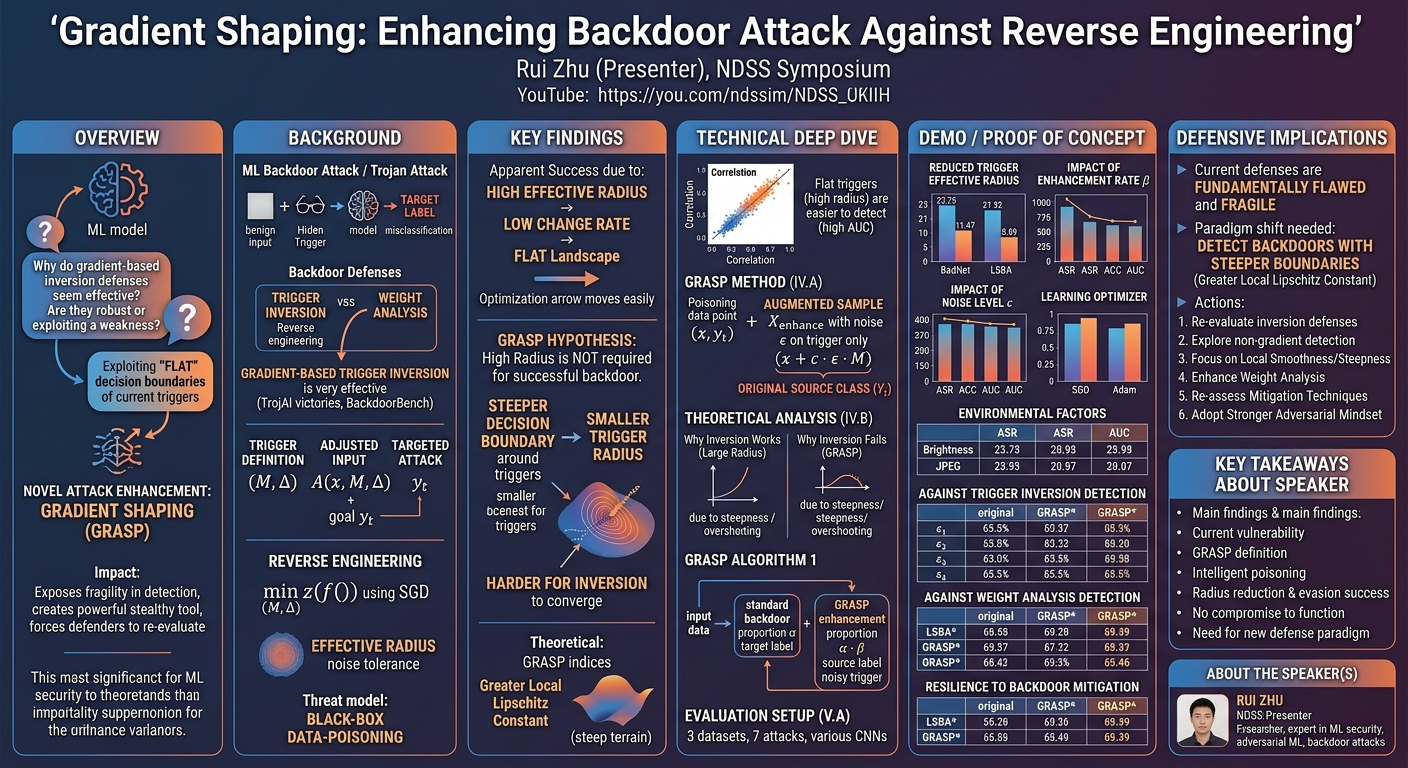
Key moments
- 0:00 Introduction: Backdoor attacks, trigger inversion, and research question
- 2:00 Defining backdoor attacks and trigger inversion methods
- 2:50 Introducing 'trigger effective radius' concept
- 3:20 Threat model: Attacker and defender capabilities
- 4:10 Main observation: High effective radius aids detection
- 5:00 GRASP method: Enhancing stealth via gradient shaping
- 6:00 Theoretical analysis: Why GRASP works
Gradient Shaping: Enhancing Backdoor Attack Against Reverse Engineering
Speakers: Rui Zhu, Presenter
Conference: NDSS Symposium
YouTube: https://www.youtube.com/watch?v=CvMY3qrF9KM
Overview
In an era where Machine Learning (ML) models are increasingly integrated into critical systems, their trustworthiness has become a paramount concern. This detailed article explores a groundbreaking presentation by Rui Zhu at the NDSS Symposium, titled "Gradient Shaping: Enhancing Backdoor Attack Against Reverse Engineering." The talk delves into the inherent vulnerabilities of current ML backdoor defenses, particularly those relying on gradient-based trigger inversion, and introduces a novel attack enhancement technique called Gradient Shaping (GRASP).
The core of the research addresses a fundamental question: why do existing gradient-based trigger inversion methods appear so effective, and are they truly robust, or merely exploiting a weakness in how backdoors are currently injected? Zhu's work provides a compelling answer, demonstrating that the apparent success of these defenses stems from the "flat" decision boundaries created by conventional backdoor triggers. GRASP, through a sophisticated data poisoning strategy, reshapes these boundaries, rendering state-of-the-art detection techniques largely ineffective.
This research is highly significant for the ML security community. It not only exposes a critical fragility in widely adopted backdoor detection mechanisms but also provides a powerful, stealthy tool for adversaries operating under realistic threat models. For defenders, it necessitates a fundamental re-evaluation of current strategies and a shift towards more robust detection and mitigation techniques that can contend with adaptive and stealthy attacks like GRASP.
Background
▶ Watch: Introduction: Backdoor attacks, trigger inversion, and research question (0:00)
The pervasive adoption of Machine Learning (ML) models across various domains, from facial recognition to medical diagnostics, underscores the critical need for their security and trustworthiness. A significant threat to this trustworthiness is the backdoor attack, also known as a trojan attack. In such an attack, an adversary subtly injects a hidden malicious functionality into a target ML model. This backdoored model behaves normally on benign inputs but misclassifies any input carrying a specific, hidden pattern—the trigger—to a predetermined target label. For example, a facial recognition system might be tricked into identifying a masquerader wearing special glasses as an authorized user.
The security of ML models critically depends on the ability to detect and neutralize these backdoors. Existing defense strategies primarily fall into two categories: trigger inversion (also referred to as reverse engineering or trigger synthesis) and weight analysis (or model diagnosis). Trigger inversion methods aim to reconstruct the putative trigger that causes the model's misbehavior, while weight analysis methods inspect the model's internal parameters for anomalies indicative of a backdoor.
Among these, gradient-based trigger inversion has emerged as a particularly effective detection technique. Its success is well-documented, notably in competitions like TrojAI, where inversion approaches secured victories in 9 out of 11 rounds, and in projects like BackdoorBench, where these methods consistently rank as leading performers. However, despite this apparent success, a crucial question remained unanswered: what fundamental characteristics of existing backdoor attacks make them so susceptible to gradient-based inversion, and can a knowledgeable adversary circumvent these defenses?
To model these phenomena, a classification model is represented as $f(): X \rightarrow Y$, mapping an input space $X$ (e.g., images) to an output space $Y$ (e.g., class probabilities). The predicted label is $\text{argmax} f()$. A trigger is formally defined as a pair $(M, \Delta)$, comprising a trigger mask $M$ and a trigger pattern $\Delta$. A trigger-inserted input $A(x, M, \Delta)$ is formed by applying an amending function $A$ to a benign input $x$, often $(1 - M) \odot x + M \odot \Delta$ (where $\odot$ denotes element-wise multiplication). The size of the trigger mask is quantified by its L1 norm, $m^*$. The focus of this research is on targeted backdoor scenarios, where the adversary aims for specific target labels ($y_t$) for trigger-inserted inputs.
Trigger inversion, conversely, is framed as an optimization problem: finding $(M, \Delta)$ that minimizes an objective function over a set of inputs for a given model $z(f())$. The objective function typically combines a loss term $l(y_t, f(A(x, M, \Delta)))$ and a regularization penalty $\lambda \zeta(M, \Delta)$. Gradient-based methods, such as Stochastic Gradient Descent (SGD), are commonly employed to solve this. The effectiveness of a reconstructed trigger is measured by its Attack Success Rate (ASR).
Two key terms are introduced to quantify trigger characteristics: the sample-specific trigger effective radius (rf'), which is the smallest perturbation $\epsilon$ needed on the trigger area to change the model's prediction for a specific input; and the overall trigger effective radius (rt), an approximation of the average rf' across a dataset. Intuitively, a larger effective radius indicates greater tolerance to noise before the trigger's effect is nullified.
The research adopts a black-box data-poisoning threat model, akin to BadNet. In this model, the attacker's goal is to inject targeted backdoors by poisoning the training data, without knowledge of other training data or the target model's internal parameters. This aligns with realistic scenarios like federated learning. The defender aims to detect backdoored models and suppress their effects, having full access to the model and a small set of benign inputs for trigger reconstruction, but no prior knowledge of the backdoor's source/target labels or trigger appearance. Crucially, GRASP operates solely through data poisoning, making it more general than many prior stealthy attacks that often require white-box access or control over the training process.
Key Findings
▶ Watch: Introducing 'trigger effective radius' concept (2:50)
The central discovery of this research is a fundamental vulnerability in existing gradient-based trigger inversion defenses. The talk highlights that the apparent effectiveness of these defenses stems from a specific characteristic of how current backdoor attacks inject triggers: they tend to create triggers that are highly robust to noise, meaning they possess a high trigger effective radius. This robustness translates into a "flat" loss landscape around trigger-inserted inputs, characterized by a low change rate in the model's output. Such flat regions are inherently amenable to gradient-based optimization, allowing inversion techniques to easily converge to the trigger pattern. The research observed a significant correlation (r² = 0.60) between a higher trigger effective radius and easier detection by methods like Neural Cleanse.
However, the pivotal insight is that a high effective radius is not a prerequisite for a successful backdoor attack. The research demonstrates that the change rate around trigger-inserted inputs can be significantly increased without compromising the backdoor's primary function (i.e., its attack success rate and stealthiness on benign inputs). This led to the design of Gradient Shaping (GRASP).
GRASP is a novel enhancement method for backdoor attacks, specifically engineered to make the backdoor trigger more sensitive to perturbations. It achieves this by creating a steeper decision boundary around trigger-inserted inputs, thereby reducing the trigger effective radius. This counter-intuitive approach makes it significantly harder for gradient-based trigger inversion methods to converge or accurately reconstruct the trigger.
The theoretical analysis provides a robust foundation for GRASP's effectiveness. It explains that while existing attacks benefit from a lower Lipschitz constant (flatter loss landscape) that aids gradient-based inversion, GRASP actively induces a greater local Lipschitz constant around trigger-inserted points. This steeper output landscape around the trigger forces gradient-based optimizers to struggle, often overshooting the local minimum or getting trapped in suboptimal solutions.
Extensive experimental evaluation confirmed GRASP's efficacy. It demonstrated that GRASP consistently and significantly reduces the trigger effective radius across various backdoor attacks and datasets. For instance, it reduced BadNet's effective radius from 23.73 to 11.47 and LSBA's from 21.92 to 8.69. Crucially, GRASP-enhanced attacks achieved significantly lower AUCs (below 65% for LSBA* against all tested inversion methods) for detection by state-of-the-art trigger inversion techniques (Neural Cleanse, Tabor, K-arm, Pixel). Moreover, GRASP does not compromise the backdoor's core functionality (maintaining high ASR and clean accuracy) nor does it increase vulnerability to other defense categories, such as weight analysis-based detection or various backdoor mitigation techniques; in some cases, it even enhances resilience.
Technical Deep Dive
▶ Watch: Threat model: Attacker and defender capabilities (3:20)
The technical foundation of Gradient Shaping (GRASP) lies in a critical observation about the nature of existing backdoor attacks and their susceptibility to gradient-based trigger inversion. Most current backdoor attacks inject triggers that are inherently robust to noise, meaning they exhibit a high trigger effective radius and, consequently, a low change rate around trigger-inserted inputs. This characteristic creates a relatively flat loss landscape, making it straightforward for gradient-based optimization methods, used in trigger inversion, to converge and reconstruct the trigger. This correlation was quantified with an r² value of 0.60 between the trigger effective radius and the AUC of Neural Cleanse detection, clearly indicating that "flatter" triggers are easier to detect.
However, GRASP challenges the assumption that a high effective radius is necessary for a successful backdoor. Instead, it proposes to deliberately increase the change rate around trigger-inserted inputs, making the decision boundary steeper and thus more difficult for inversion algorithms to navigate.
GRASP Method (IV.A)
GRASP is a novel backdoor attack enhancement method designed to increase the stealthiness of a backdoor trigger by making it more sensitive to perturbations. It achieves this by creating a steeper decision boundary around trigger-inserted inputs. The core idea is a sophisticated data poisoning strategy that subtly manipulates the training process.
For a given poisoning data point $(x, y)$, where $y$ is the target class, GRASP introduces an augmented sample $X_{\text{enhance}}$. This sample is created by adding white noise $\epsilon$ only to the trigger region of the input. Specifically, $X_{\text{enhance}} = x + c \cdot \epsilon \cdot M$, where $c$ is a hyperparameter controlling the noise magnitude and $M$ is the trigger mask. Crucially, $X_{\text{enhance}}$ is then labeled with its original source class ($Y_i$), not the target class $y_t$. This contrasts sharply with standard data poisoning, where all trigger-inserted samples are labeled with the target class $y_t$. By introducing these "noisy-trigger-with-source-label" samples, GRASP effectively "shapes the gradient," creating a sharp, steep boundary around the trigger-inserted inputs. This augmentation is applied to a subset of the poisoning data, controlled by an enhancement rate $\beta$. The noise added to each sample is independently and identically distributed, ensuring unique perturbations that sharpen the trigger's gradient in various directions. GRASP is a generic method that can be seamlessly combined with existing backdoor attacks to enhance their evasion capabilities against trigger inversion.
Theoretical Analysis (IV.B)
The theoretical underpinnings of GRASP explain its effectiveness and expose the fundamental weakness of gradient-based trigger inversion:
- Why Inversion Works on Large Effective Radius (IV.B.1): For piece-wise linear functions (which approximate neural networks), Theorem 1 demonstrates that a larger convex hull (which correlates with a larger effective radius) increases the probability of a gradient-based optimizer converging to the trigger. Furthermore, for high-dimensional non-convex functions satisfying the Polyak-Łojasiewicz (PL) condition, Theorem 3 indicates that gradient-based optimization converges faster to the optimum when the target function has a lower Lipschitz constant. A lower Lipschitz constant implies greater robustness and a flatter loss landscape, making it easier for inversion algorithms to find the trigger.
- Why Inversion Fails under GRASP (IV.B.2): Theorem 2 proves that a GRASP-poisoned model exhibits a greater local Lipschitz constant around trigger-inserted points compared to a model backdoored without GRASP. This greater Lipschitz constant signifies a steeper output around these points, leading to a smaller trigger effective radius. This makes gradient-based inversion significantly harder because the optimizer is more prone to overshooting the local minimum or getting stuck in other, less optimal local minima. The noise scale $c$ in GRASP is critical; if $c$ is too small, the trigger effective radius might degrade below that required for the primary task, potentially making it vulnerable to other mitigation techniques like RAB. GRASP aims to strike a balance, reducing the effective radius sufficiently while ensuring it remains above the primary task's robustness threshold.
Implementation Details (Algorithm 1)
The GRASP algorithm takes the trigger pattern $\Delta$, mask $M$, noise scale $c$, training data $X, Y$, target label $y_t$, poisoning rate $\alpha$, and enhancement rate $\beta$ as inputs.
- It initializes empty sets for augmented training data.
- The training data is shuffled.
- For a proportion $\alpha$ of the training data, a standard backdoor insertion occurs: the trigger $A(X_i, M, \Delta)$ is applied, and the sample is labeled with the target class $y_t$. This constitutes the standard data poisoning component.
- For an additional proportion $\alpha \cdot \beta$ of the training data, the GRASP enhancement samples are generated. Here, a noisy trigger $A(X_i, M, \Delta_{\text{noisy}})$ is inserted. The noise is drawn from a normal distribution $N(0,1)$ and applied only to the trigger positions ($M_{pq} \neq 0$). Crucially, these $\Delta_{\text{noisy}}$ samples are labeled with their original source class ($Y_i$), not the target class $y_t$. This is the core gradient shaping step. Typical experimental parameters used were $\alpha = 6\%$, $\beta = 10\%$, and $c = 0.1$.
Evaluation Setup (V.A)
The efficacy of GRASP was rigorously evaluated across three public datasets: MNIST, CIFAR-10, and Tiny ImageNet. Various neural network architectures were employed, including VGG-16, ResNet-101, ShuffleNet, and ResNet18, demonstrating GRASP's generality. GRASP was combined with seven existing backdoor attacks, covering a spectrum of attack types:
- Patch Trigger: BadNet, LSBA, Composite.
- Clean Label: Latent.
- Imperceptible: DEFEAT, IMC.
- Latent Space Inseparable: Adaptive-Blend.
For each attack, 24 backdoored models were generated and evaluated. The base poisoning rate $\alpha$ was set to 6%, translating to 3,600 samples for CIFAR-10, 3,000 for MNIST, and 9,600 for Tiny ImageNet. For GRASP enhancement, the poisoning rate for the base attack was denoted as $\alpha = 0.6$ (likely a typo in the transcript, should probably align with the 6% poisoning rate from the base attack description or be a separate parameter for GRASP-specific poisoning) and the enhancement rate $\beta = 10\%$.
Demo / Proof of Concept
▶ Watch: GRASP method: Enhancing stealth via gradient shaping (5:00)
While the talk did not feature a live software demonstration, the extensive experimental evaluation detailed in the "Evaluation and Results" section (Section 6 of the transcript) serves as a robust proof of concept for GRASP's effectiveness. The quantitative results unequivocally demonstrate GRASP's ability to significantly enhance the stealthiness of backdoor attacks against various detection and mitigation techniques.
Trigger Effective Radius (III.A, Fig 3):
A primary metric for GRASP's success is its ability to reduce the trigger effective radius. Experiments showed a substantial reduction across all tested backdoor attacks. For instance, BadNet's effective radius plummeted from 23.73 to 11.47, and LSBA's from 21.92 to 8.69. This reduction is a direct indicator of the steeper decision boundary created by GRASP, making the backdoored models inherently harder for trigger inversion methods to detect.
Impact of Enhancement Rate (IV.C, Fig 4):
The enhancement rate $\beta$ (proportion of augmented data) was shown to directly influence the trigger effective radius. Increasing $\beta$ consistently reduced the radius, with optimal reduction typically achieved around $\beta = 10\%$. Beyond this point, further increases showed diminishing returns. Crucially, the Attack Success Rate (ASR), Test Accuracy (ACC), and the detection AUC (for Neural Cleanse) remained stable or even slightly improved, confirming that GRASP achieves its stealth benefits without compromising the backdoor's core functionality or overall model performance.
Impact of Noise Level c (IV.D, Fig 5):
The noise level $c$ in GRASP also plays a significant role. Figure 5 illustrated that increasing $c$ leads to an increase in the trigger effective radius. While lower $c$ values (e.g., 0.075) slightly impacted the ACC and ASR, they still maintained a low detection AUC for Neural Cleanse, indicating GRASP's overall resilience. This highlights the importance of carefully tuning $c$ to balance stealth and attack efficacy.
Impact on Learning Optimizer (IV.E, Fig 6):
GRASP-enhanced BadNet was tested against various optimizers (SGD, Adam, AdamHessian) and learning rates. Figure 6 demonstrated that even with exceptionally small learning rates (e.g., 0.0001), GRASP-enhanced BadNet maintained a relatively low detection AUC (around 55%). This showcases its robustness against different optimization settings that defenders might employ for trigger inversion.
Impact on Environmental Factors (IV.F, Table I):
GRASP-enhanced BadNet also demonstrated resilience against image corruptions (brightness, contrast, JPEG compression). Table I showed comparable ASRs to original BadNet under brightness and JPEG compression. Notably, under contrast corruption, GRASP-enhanced BadNet exhibited a marked improvement in ASR (e.g., 76.6% vs 70.0% at severity 1), indicating enhanced robustness to certain real-world input variations.
Against Trigger Inversion Detection (V.B, Table III):
The most compelling evidence for GRASP's evasion capabilities came from its evaluation against four leading trigger inversion methods: Neural Cleanse, Tabor, K-arm, and Pixel. Four metrics were used:
- $\epsilon_1$ (Unlearning Effectiveness): GRASP-enhanced attacks (denoted with ) preserved significantly higher ASRs after unlearning attempts, resulting in drastically lower $\epsilon_1$ values. For example, BadNet achieved an $\epsilon_1$ of 1.5% against Tabor, compared to 97.5% for the original BadNet.
- $\epsilon_2$ (Jaccard Distance of Masks): Reconstructed triggers from GRASP-enhanced models showed very low similarity (overlap <20%) with the real triggers, whereas original attacks typically showed 10-60% overlap.
- $\epsilon_3$ (ASR on Clean Model): Reconstructed triggers from GRASP-enhanced models had relatively high ASRs on clean models, comparable to poisoned models. This suggests that any "recovered" trigger is likely a natural feature of the model, not the injected backdoor.
- $\epsilon_4$ (AUC of Detection): Table III clearly illustrated that GRASP-enhanced attacks consistently achieved significantly smaller AUCs across all trigger inversion methods and datasets. For instance, LSBA* consistently achieved AUCs below 65% for all tested methods, effectively evading detection.
Against Weight Analysis Detection (V.C, Table IV):
GRASP was also evaluated against five weight analysis-based detection methods: Trojan Signature, MNTD, Activation Clustering, Beatrix, and ABS. Table IV demonstrated that GRASP-enhanced attacks resulted in lower or comparable AUCs for these detectors compared to original attacks. This crucial finding indicates that GRASP does not make the backdoor more vulnerable to weight analysis-based defenses.
Resilience to Backdoor Mitigation (VI, Table V):
Finally, the research assessed GRASP's resilience to various backdoor mitigation techniques that do not rely on detection:
- Preprocessing (DeepSweep): GRASP-enhanced HaS-Net* showed comparable ASRs to original HaS-Net after mitigation.
- Model Reconstruction (Fine-pruning, NAD): GRASP-enhanced DEFEAT* demonstrated comparable ASRs to original DEFEAT.
- Non-Gradient Trigger Synthesis (Gangsweep): GRASP-enhanced AB* showed comparable or lower ASRs than original AB.
- Poison Suppression (DBD): GRASP-enhanced IMC* exhibited higher ASRs than original IMC, indicating increased effectiveness.
- Certified Backdoor Defense (RAB): GRASP-enhanced DFST* showed comparable ASRs to original DFST.
- Training Procedure Defense (ABL): GRASP-enhanced AB* showed higher ASRs than original AB.
In summary, GRASP enhancement consistently proved to not reduce the effectiveness of attacks against existing mitigation methods; in several cases, it even increased their resilience, further solidifying its status as a powerful attack enhancement.
Defensive Implications
▶ Watch: Theoretical analysis: Why GRASP works (6:00)
The research presented on Gradient Shaping (GRASP) carries profound implications for the field of ML security, particularly for those tasked with defending against backdoor attacks. The most critical takeaway for defenders is that current gradient-based trigger inversion methods, widely considered effective and successful in benchmarks like TrojAI, are fundamentally flawed and exhibit inherent fragility. Their success has largely been predicated on exploiting a specific characteristic of existing backdoor attacks—their tendency to create triggers with a high effective radius and a "flat" loss landscape.
This work necessitates a paradigm shift in how backdoor detection is approached. Defenders can no longer reliably assume that a "flat" decision boundary around a potential trigger is an indicator of a successful backdoor that can be easily inverted. Instead, the focus must shift towards detecting backdoors that actively obscure themselves by creating steeper decision boundaries, characterized by a greater local Lipschitz constant. Defenses that rely on the premise of "robustness" or "smoothness" of triggers are now shown to be insufficient against adaptive adversaries employing techniques like GRASP.
Specifically, defenders should:
- Re-evaluate Gradient-Based Inversion Defenses: The performance metrics (low AUCs, high $\epsilon_1$, low $\epsilon_2$, high $\epsilon_3$) demonstrated by GRASP-enhanced attacks against Neural Cleanse, Tabor, K-arm, and Pixel clearly indicate that these methods are largely ineffective against gradient-shaped backdoors. Continued reliance on these techniques without significant enhancements or alternative strategies will leave systems vulnerable.
- Explore Non-Gradient-Based Detection: Given that GRASP specifically targets and exploits the limitations of gradient-based optimization, defenders should accelerate research into and deployment of detection methods that do not rely on gradients. This could involve anomaly detection in latent space, statistical analysis of model weights, or other approaches that are insensitive to local Lipschitz constants.
- Focus on Local Smoothness/Steepness: The concept of the local Lipschitz constant or "change rate" around potential trigger regions should become a critical metric for evaluating backdoor stealth. New detection methods could potentially aim to identify regions of unusually high local Lipschitz constants that are indicative of a GRASP-like attack.
- Enhance Weight Analysis Defenses: While GRASP does not make backdoors more vulnerable to weight analysis methods (like Trojan Signature, MNTD, Activation Clustering, Beatrix, ABS), it also doesn't make them less vulnerable. Defenders should continue to invest in and refine these techniques as a complementary layer of defense.
- Re-assess Mitigation Techniques: GRASP-enhanced attacks showed comparable or even increased resilience against a range of mitigation techniques (DeepSweep, Fine-pruning, NAD, Gangsweep, DBD, RAB, ABL). This implies that existing mitigation strategies may not be robust enough to handle stealthy, adaptive backdoors. Further research is needed to develop mitigation methods that can effectively neutralize backdoors designed to evade detection and resist unlearning.
- Adopt a Stronger Adversarial Mindset: The success of GRASP underscores the need for defenders to constantly anticipate and adapt to sophisticated adversarial techniques. Future defense research must incorporate more advanced threat models where attackers are knowledgeable about defense mechanisms and actively design attacks to circumvent them.
In essence, GRASP highlights a critical arms race in ML security. Defenders must move beyond detection strategies that rely on easily exploitable characteristics of current attacks and develop more robust, adaptive, and theoretically sound defenses that can withstand sophisticated gradient-shaping manipulations.
Key Takeaways
- Current gradient-based trigger inversion defenses, despite their apparent success in benchmarks, are fundamentally vulnerable because existing backdoor attacks inject triggers with a high effective radius and a "flat" loss landscape, making them easy to reconstruct.
- Gradient Shaping (GRASP) is a novel backdoor attack enhancement method that significantly increases backdoor stealth by making the trigger more sensitive to perturbations, effectively creating a steeper decision boundary around trigger-inserted inputs.
- GRASP achieves this by intelligently poisoning the training data: it adds noise only to the trigger region of a subset of poisoned samples and critically labels these noisy samples with their original source class, rather than the target class.
- Extensive evaluation demonstrated that GRASP significantly reduces the trigger effective radius (e.g., BadNet from 23.73 to 11.47) and consistently evades state-of-the-art trigger inversion methods (e.g., LSBA* achieving AUCs below 65% across all tested inversion techniques).
- GRASP does not compromise the backdoor's core functionality (maintaining high Attack Success Rate and clean accuracy) nor does it increase vulnerability to weight analysis-based detection or various existing backdoor mitigation techniques; in some cases, it even improves the attack's resilience.
- This research highlights a critical vulnerability in current ML backdoor defenses, necessitating a paradigm shift in detection strategies towards methods that are robust to gradient shaping and can identify backdoors with steep decision boundaries.
About the Speaker(s)
Rui Zhu is a researcher who presented this work at the NDSS Symposium. Based on the depth and technical rigor of the presentation, Rui Zhu is actively involved in cutting-edge research in the field of Machine Learning security, with a particular focus on understanding and exploiting vulnerabilities in ML models and their defenses. The work presented demonstrates expertise in adversarial machine learning, backdoor attacks, and the theoretical analysis of neural network behavior.
All talks from Network and Distributed System Security (NDSS) Symposium 2024