Unknown Target: Uncovering and Detecting Novel In-Flight Attacks to Collision Avoidance (TCAS)
Giacomo Longo
Network and Distributed System Security (NDSS) Symposium 2026 · Day 2 · Wireless Security
Overview
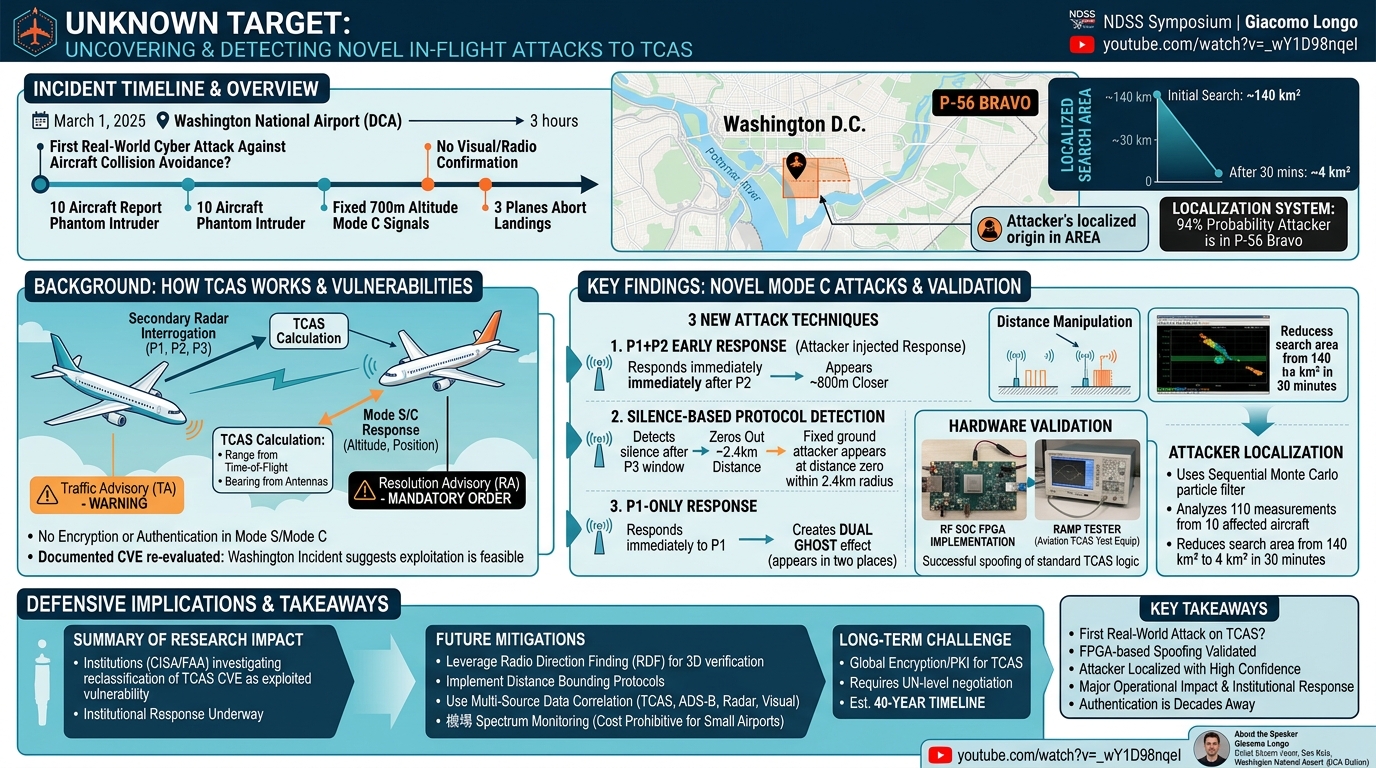
Giacomo Longo presents groundbreaking research analyzing what may be the first real-world cyber attack against aircraft collision avoidance systems (TCAS). On March 1, 2025, at Washington National Airport (DCA), 10 aircraft experienced false Traffic Advisory (TA) and Resolution Advisory (RA) alerts over a three-hour period, with 3 planes forced to abort their landings -- all caused by a phantom aircraft that no pilot could see visually or detect via radio. Using open-source ADS-B data and a novel Sequential Monte Carlo localization system, the researchers determined with 94% probability that the attack originated from a fixed position within area P-56 Bravo near the Potomac River in Washington, DC. The work also demonstrates three new Mode C injection techniques that could produce the observed effects, validated with an RF SOC FPGA implementation against a RAMP tester. This research carries significant implications: it may represent the first confirmed radio-based cyber attack against aircraft in history.
Key moments
- 0:30 How TCAS keeps planes from colliding: secondary radar explained
- 2:00 Washington DCA incident: 10 aircraft saw phantom intruder on March 1, 2025
- 4:00 Three Mode C injection attacks: appearing closer by responding early
- 6:00 Silence-based protocol detection zeros out 2.4 km of distance
- 8:00 Sequential Monte Carlo localization: 300,000 simulated scenarios
- 10:00 Result: attacker located in area P-56 Bravo with 94% probability
- 12:00 Reducing search area from 140 km-squared to 4 km-squared
- 14:00 CISA investigating reclassification of TCAS CVE as exploited
Unknown Target: Uncovering and Detecting Novel In-Flight Attacks to Collision Avoidance (TCAS)
Speakers: Giacomo Longo
Conference: NDSS Symposium
YouTube: https://www.youtube.com/watch?v=_wY1D98nqeI
Overview
Giacomo Longo presents groundbreaking research analyzing what may be the first real-world cyber attack against aircraft collision avoidance systems (TCAS). On March 1, 2025, at Washington National Airport (DCA), 10 aircraft experienced false Traffic Advisory (TA) and Resolution Advisory (RA) alerts over a three-hour period, with 3 planes forced to abort their landings -- all caused by a phantom aircraft that no pilot could see visually or detect via radio. Using open-source ADS-B data and a novel Sequential Monte Carlo localization system, the researchers determined with 94% probability that the attack originated from a fixed position within area P-56 Bravo near the Potomac River in Washington, DC. The work also demonstrates three new Mode C injection techniques that could produce the observed effects, validated with an RF SOC FPGA implementation against a RAMP tester. This research carries significant implications: it may represent the first confirmed radio-based cyber attack against aircraft in history.
Background
▶ Watch: How TCAS keeps planes from colliding: secondary radar explained (0:30)
Aircraft collision avoidance relies on two complementary systems: human-directed Air Traffic Control (ATC) and automated TCAS (Traffic Collision Avoidance System). TCAS uses secondary radar -- aircraft send interrogation signals, other aircraft respond with their altitude and position data, enabling each plane to calculate the distance and bearing to surrounding traffic. When TCAS detects a potential collision, it issues either a Traffic Advisory (TA) (warning) or a Resolution Advisory (RA) (mandatory climb/descend order coordinated between aircraft).
TCAS primarily uses Mode S for communication but maintains backward compatibility with the older Mode C protocol used by smaller propeller aircraft. Neither protocol is encrypted or authenticated -- a known vulnerability documented in a CVE co-authored by the presenter and colleague Martin, which originally stated the vulnerability "has not ever been exploited and is unlikely to be exploited outside of a laboratory." The Washington incident may have proven that assessment wrong.
The March 2025 incident at Washington National Airport (which had already been in the news following the helicopter collision with a plane at the same airport) saw 10 aircraft report encounters with a phantom intruder at a fixed altitude of approximately 700 meters, using the older Mode C protocol. No pilot or controller could visually confirm the intruder, and it appeared to track aircraft during their approach.
Key Findings
▶ Watch: Three Mode C injection attacks: appearing closer by responding early (4:00)
Mode C injection attacks are feasible: The researchers identified three new attack methods for injecting false aircraft via Mode C. The first replays responses immediately after receiving P1 and P2 signals, appearing 800 meters closer. The second exploits silence-based protocol detection (listening for P3 absence after 8 microseconds to identify altitude interrogations), zeroing out 2.4 kilometers of distance. The third responds immediately to P1 alone, but creates a ghost appearing as two aircraft simultaneously.
Hardware validation: The attacks were validated using an RF SOC (FPGA with RF front-end) tested against a RAMP tester (standard aviation TCAS testing equipment). Despite insufficient transmission power for real-world use, the system correctly fooled the RAMP tester's TCAS logic.
Attacker localization with 94% confidence: The Sequential Monte Carlo particle filter system, validated across 300,000 simulated scenarios, can distinguish between fixed and mobile transmitters and locate a fixed attacker within approximately 1 kilometer accuracy. Applied to the Washington data, the system placed the attacker within area P-56 Bravo with 94% probability.
Operational impact: Without the localization system, law enforcement would have needed to search 140 square kilometers. With the system, the search area could have been reduced to approximately 4 square kilometers within the first 30 minutes (after just the first two encounters).
Institutional response underway: Following the researchers' outreach, CISA is currently investigating alongside the FAA to determine whether to reclassify the TCAS CVE from the vulnerability directory to the exploited vulnerabilities directory.
Technical Deep Dive
▶ Watch: Sequential Monte Carlo localization: 300,000 simulated scenarios (8:00)
The core of the Mode C attack exploits how TCAS measures distance. TCAS determines range by sending an interrogation signal (P1, P2, P3) and measuring the time until a response arrives, then dividing by the speed of light. A ground-based attacker can appear to be airborne by responding earlier than expected, making the TCAS system calculate a shorter distance. The three attack variants differ in how much distance can be falsified:
Attack 1 (P1+P2 early response): Respond immediately after receiving P1 and P2 without waiting the standard 3-microsecond delay. Result: appear 800 meters closer than actual position.
Attack 2 (Silence-based protocol detection): After receiving P1 and P2, wait 8 microseconds. If P3 is not received, the interrogation is an altitude request (not identification). Begin responding immediately upon confirming silence. Result: zero out 2.4 kilometers of distance, enabling a fixed ground attacker to appear at distance zero to any aircraft within a 2.4-kilometer radius.
Attack 3 (P1-only response): Respond immediately to P1 alone, without waiting for P2 or P3. Result: appear at two locations simultaneously (creating a dual-ghost effect), appearing as responses to both the first and second interrogation types.
The Sequential Monte Carlo localization spreads particles across the attack area and iteratively updates their positions based on bearing and range measurements from all 10 affected aircraft. Each measurement is imprecise individually (bearing from radio direction finding is noisy; range can be manipulated), but 110 measurements from a common phenomenon allow convergence to a probable source location.
Demo / Proof of Concept
▶ Watch: Result: attacker located in area P-56 Bravo with 94% probability (10:00)
The researchers built an RF SOC implementation (FPGA with RF front-end) that successfully demonstrated all three Mode C injection attacks against a RAMP tester -- the standard equipment used to validate TCAS systems in aviation maintenance. While the transmission power was insufficient for real-world deployment, the logical validity of the attacks was confirmed. The Sequential Monte Carlo system was validated across 300,000 simulated scenarios before being applied to real Washington ADS-B data.
Defensive Implications
▶ Watch: CISA investigating reclassification of TCAS CVE as exploited (14:00)
The fundamental challenge is the intersection of safety and cybersecurity. TCAS cannot simply reject unverified signals because doing so could cause it to miss a real aircraft and fail its collision avoidance mission. Encryption and PKI face enormous coordination challenges -- TCAS is regulated at the UN level, and deploying a global PKI for every aircraft is a decades-long undertaking. Legacy protocol compatibility (Mode C) cannot be dropped because small aircraft still use it.
Near-term mitigations include: leveraging radio direction finding equipment to verify signal origin in 3D space, implementing distance bounding protocols to prevent early-response attacks, and using multi-source data correlation (combining TCAS, ADS-B, radar, and visual reports). The researchers' localization system itself serves as a detection tool -- deployable at airports to quickly narrow the search area when phantom aircraft are reported. Comprehensive spectrum monitoring at airports would help but is cost-prohibitive for smaller regional airports.
Key Takeaways
- The March 2025 Washington DCA incident may represent the first real-world cyber attack against aircraft collision avoidance systems in history
- TCAS protocols (Mode S and Mode C) are unencrypted and unauthenticated, and a ground-based attacker can inject phantom aircraft using an FPGA with an RF front-end
- A novel Sequential Monte Carlo system can localize an attacker within 1 kilometer accuracy from open-source ADS-B data, reducing a 140 km-squared search to 4 km-squared in 30 minutes
- CISA and the FAA are currently investigating whether to reclassify the TCAS CVE as an exploited vulnerability
- Fixing TCAS authentication would require UN-level international negotiation and is estimated at a 40-year timeline
About the Speaker(s)
Giacomo Longo is a researcher and co-author (with colleague Martin and Vincent) of the original TCAS CVE. His work focuses on aviation security, particularly the exploitation of unencrypted secondary radar protocols. The research represents a collaboration bringing together RF exploitation, statistical localization, and real-world incident analysis in the aviation security domain.
Reviews
Dr. Zero (Offensive Security Researcher) — MUST SEE
The first analysis of a probable real-world cyber attack against aircraft collision avoidance systems, combining novel Mode C injection techniques validated on aviation test equipment with a particle-filter localization system that placed the Washington DCA attacker within area P-56 Bravo with 94% probability. This is real-world exploitation of critical infrastructure RF protocols with active CISA/FAA investigation. Textbook example of security research that matters.
Heather Calloway (CISO) — MUST SEE
Potentially the first documented cyber attack against aircraft collision avoidance in history, with active CISA and FAA investigation. The research demonstrates that unencrypted aviation protocols can be exploited from the ground to inject phantom aircraft, force landing aborts, and create cascading safety incidents. The proposed localization system reduces incident response from searching 140 km-squared to 4 km-squared in 30 minutes. Critical infrastructure security does not get more serious than this.
→ Top-rated talks at Network and Distributed System Security (NDSS) Symposium 2026
All talks from Network and Distributed System Security (NDSS) Symposium 2026