Volatility Meets AI: Transforming Linux and Windows Memory Forensics for Modern Threats
Nullcon Goa 2026 · Day 1
Overview
In an era where cyberattacks are increasingly sophisticated, characterized by fileless malware and in-memory persistence, traditional disk-based forensics often fall short. These modern threats leave minimal disk footprints, making detection and analysis a formidable challenge for security analysts. This talk by Srinivasan and Rajesh, Senior Security Researchers at Microsoft, introduces an innovative framework that leverages Retrieval Augmented Generation (RAG) and Artificial Intelligence (AI) to revolutionize memory forensics for both Linux and Windows environments.
Key moments
- 0:00 Introduction and challenges of modern memory forensics
- 1:00 Proposed solution: RAG-driven memory forensics
- 3:00 Understanding the RAG (Retrieval Augmented Generation) pipeline
- 4:00 Automated pipeline for memory dump collection
- 5:15 Transforming raw memory dumps into searchable knowledge
- 6:50 Case study: Analyzing Meterpreter payload using Volatility
- 7:40 Extracting network connections from memory with Volatility
Volatility Meets AI: Transforming Linux and Windows Memory Forensics for Modern Threats
Speakers: Srinivasan, Senior Security Researcher, Microsoft; Rajesh, Senior Security Researcher, Microsoft
Conference: Nullcon
YouTube: https://www.youtube.com/watch?v=go8poeCzenU
Overview
In an era where cyberattacks are increasingly sophisticated, characterized by fileless malware and in-memory persistence, traditional disk-based forensics often fall short. These modern threats leave minimal disk footprints, making detection and analysis a formidable challenge for security analysts. This talk by Srinivasan and Rajesh, Senior Security Researchers at Microsoft, introduces an innovative framework that leverages Retrieval Augmented Generation (RAG) and Artificial Intelligence (AI) to revolutionize memory forensics for both Linux and Windows environments.
The proposed solution addresses critical limitations of existing memory analysis tools, which are typically manual, reliant on static signatures, and struggle with correlating complex artifacts across raw memory dumps. By automating the entire forensic pipeline – from artifact extraction using Volatility Framework to intelligent analysis via Large Language Models (LLMs) – the framework promises faster, more accurate, and scalable incident response. This approach aims to empower analysts to uncover hidden threats that operate entirely within volatile memory, providing crucial insights for securing modern infrastructures, particularly in server and cloud environments.
The significance of this research lies in its potential to bridge the gap between rapidly evolving threat landscapes and static forensic capabilities. By integrating cutting-edge AI techniques with established memory analysis tools, the framework offers a robust defense against stealthy attacks, significantly reducing investigation times and improving the overall efficacy of cybersecurity operations. The speakers demonstrate how this RAG-driven approach can transform complex, low-level memory data into actionable intelligence, reducing LLM hallucination and delivering context-aware, trustworthy results.
Background
▶ Watch: Introduction and challenges of modern memory forensics (0:00)
The evolution of cyberattacks has brought forth a new generation of threats that actively evade traditional detection mechanisms. Fileless attacks and in-memory persistence are prime examples, operating entirely within a system's volatile memory and leaving virtually no traces on disk. Malicious activities like reverse shells and bind shells, for instance, reside solely in RAM, making them exceptionally difficult to detect with conventional disk-based forensic tools. As server and cloud environments become ubiquitous, the critical need for robust memory analysis capabilities has intensified, as these systems often run critical services and are prime targets for sophisticated adversaries.
Traditional memory forensic tools, while powerful, often struggle to keep pace with these modern threats. Their reliance on manual workflows and signature-based detection methods is inherently slow and prone to missing novel or polymorphic malware. Analysts are frequently overwhelmed by the sheer volume and complexity of raw memory data, facing significant challenges in correlating disparate artifacts to paint a coherent picture of malicious activity. This manual burden directly impacts incident response (IR) times, prolonging investigations and increasing the window of opportunity for attackers.
To overcome these limitations, the talk introduces Retrieval Augmented Generation (RAG), a paradigm that combines the vast knowledge of Large Language Models (LLMs) with dynamic, external knowledge bases. Unlike LLMs that rely solely on their pre-trained parameters, RAG systems retrieve relevant information at runtime from a dedicated knowledge source, using this context to formulate more accurate and less "hallucinated" responses. In the context of memory forensics, this means transforming raw memory evidence into a searchable, intuitive format, allowing analysts to "ask questions" of the memory dump and receive precise, context-aware answers, thereby making the investigation process significantly faster and more reliable.
Key Findings
▶ Watch: Understanding the RAG (Retrieval Augmented Generation) pipeline (3:00)
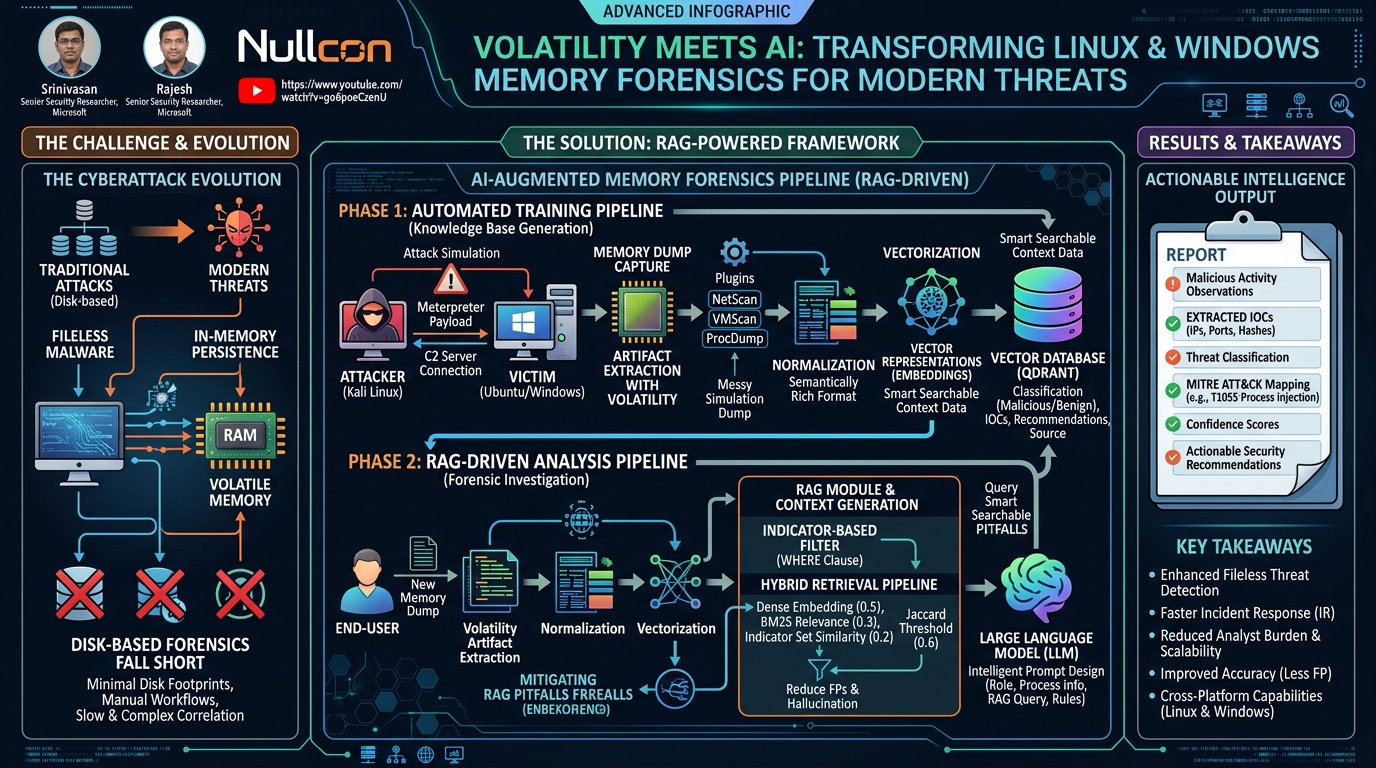
The core contribution of this talk is the development of a novel, automated RAG-driven memory forensics framework designed to combat modern fileless and in-memory threats. The key findings and contributions include:
- Automated Memory Dump Generation Pipeline: A robust system capable of generating memory dumps from both Linux (Ubuntu) and Windows victim machines after simulating real-world attack scenarios, such as the deployment of Meterpreter reverse shells via the Metasploit Framework. This automation is crucial for building a comprehensive knowledge base for the RAG system.
- Structured Knowledge Base Creation: The framework transforms raw memory dumps into a "smart searchable context data" for the RAG knowledge base through a multi-stage pipeline:
- Volatility-based Artifact Extraction: Automated extraction of critical artifacts like network connections, process memory details, and suspicious strings using the Volatility Framework, including plugins like
VMScan. - Normalization: Conversion of raw, fragmented, and plugin-specific Volatility outputs into a consistent, structured, and semantically rich format. This step is vital for making low-level data interpretable and usable by LLMs.
- Vectorization: Conversion of normalized data into numerical vector representations using advanced text embedding models (e.g., text-embedding-3-large). This enables efficient semantic search and correlation of heterogeneous indicators.
- Vector Database Ingestion: Storage of vectorized data, normalized data, and rich metadata (classification, security recommendations, source) into an open-source vector database like Qdrant, facilitating semantic rather than keyword-based retrieval.
- RAG-Powered Analysis Framework: An end-to-end system that takes a memory dump as input and generates a detailed analysis report. This framework incorporates a RAG module that queries the vector database, calculates strings of interest, and refines results.
- Mitigation of RAG Pitfalls (False Positives): A significant finding is the identification and resolution of RAG pitfalls, where LLMs might misinterpret benign artifacts as malicious due to contextual similarities in normalized text. The framework implements two key mitigations:
- Indicator-Based Filter (WHERE Clause): Applying specific filters in the vector database query to refine results based on the presence or absence of crucial indicators (e.g., process attribution, suspicious memory regions).
- Hybrid Retrieval Pipeline: A sophisticated re-ranking mechanism that combines scores from dense embedding (0.5 weight), BM25 relevance (0.3 weight for exact terms), and indicator set similarity (0.2 weight for structural alignment). This pipeline uses a Jaccard similarity threshold of 0.6 to ensure only strongly aligned candidates are considered, significantly improving precision.
- Intelligent LLM Prompt Design: Principles for crafting effective LLM prompts that define the LLM's role, provide structured process information, include RAG query details, selected candidates, and strict rules (e.g., "don't assume anything or predict"), ensuring less hallucinated, context-aware, and reproducible analysis outputs.
- Comprehensive Output Generation: The framework produces detailed analysis outputs, including observations of malicious activity, extracted Indicators of Compromise (IOCs), threat classification, mapping to MITRE ATT&CK techniques with reasoning, confidence scores, and actionable security recommendations, all presented in user-friendly JSON and HTML formats.
These findings collectively demonstrate a powerful paradigm shift in memory forensics, transforming a labor-intensive, often imprecise process into an automated, AI-augmented, and highly effective defense mechanism against contemporary cyber threats.
Technical Deep Dive
▶ Watch: Automated pipeline for memory dump collection (4:00)
The proposed framework is architected as a two-phase system: an automated training pipeline for knowledge base generation and a RAG-driven analysis pipeline for real-time forensic investigations.
Automated Training Pipeline: Building the Knowledge Base
The first phase focuses on systematically generating diverse memory dumps and processing them into a searchable knowledge base.
- Attack Simulation and Dump Generation:
- An automation program orchestrates attack scenarios. It instructs an attacker machine (e.g., Kali Linux) to generate payloads (e.g., Meterpreter reverse shell).
- Concurrently, it signals a victim machine (e.g., Ubuntu or Windows VM) to boot up.
- The payload is delivered to the victim, establishing a connection to a Command and Control (C2) server on the attacker machine.
- Once the malicious activity is established, the program automatically captures a memory dump from the victim machine for subsequent analysis. This ensures a controlled and repeatable process for generating realistic attack data.
- Artifact Extraction with Volatility:
- The collected raw memory dump is fed into the Volatility Framework, a powerful open-source memory analysis tool.
- Volatility extracts crucial artifacts from both user and kernel space. Key information extracted includes:
- Network Connections: Details like socket information, protocol (e.g., TCP), source IP, destination IP, and port numbers. A process ID (PID) is used as a key for correlating network activity with specific processes. For instance, an outgoing TCP connection by
pulseaudio(PID 2033) was identified in a demo. - Process Memory Details: Information about memory regions, protection (e.g., Read, Write, Execute - RWX), and mapping information. Suspicious patterns, such as large memory maps with RWX permissions and anonymous mapping, are flagged.
- Suspicious Strings: The
VMScanVolatility plugin is used to scan virtual memory areas of specific PIDs for known malware patterns, shellcode, or other indicators of compromise.
- Normalization:
- Volatility's raw output is often fragmented, plugin-specific, and difficult to interpret at scale. The normalization stage transforms this low-level data into a structured, semantically rich format.
- For example, raw socket state information (port, IP, established flags) is converted into a single, human-readable entity like "established TCP outgoing connection." Similarly, details like RWX permissions, anonymous mapping, and map size are unified into an "RWX executable map to anonymous mapping" behavior.
- This semantic enrichment is critical for enabling LLMs to understand and reason over the forensic data effectively, converting low-level technical details into actionable insights.
- Vectorization:
- The normalized data is then converted into numerical vector representations, or embeddings, using a text embedding model. The speakers specifically mention using the text-embedding-3-large model.
- This process allows the system to capture the semantic meaning of the text, enabling efficient similarity searches. It unifies heterogeneous indicators (network, memory, strings) into a single semantic space, facilitating cross-term correlation and grouping of similar clusters.
- Vector Database (Qdrant) Ingestion:
- The vectorized data, along with the original normalized data and rich metadata, is ingested into Qdrant, an open-source high-dimensional vector database.
- Metadata includes source classification (clean or malicious), security recommendations for mitigation, and string indicators.
- Qdrant is chosen for its ability to perform semantic search (retrieving information by meaning, not just keywords), its hybrid search capability, and its efficiency in handling millions of vectors. Its native APIs (Python, REST) ensure seamless integration with the RAG workflow. This forms the central knowledge base for the RAG analysis.
RAG-Driven Analysis Pipeline: End-User Forensic Workflow
This second phase is what the end-user interacts with to analyze a new memory dump.
- Input and Initial Artifact Extraction:
- An end-user provides a memory dump as input.
- The framework initiates the same Volatility-based artifact extraction process as in the training pipeline, pulling out network, process, and memory artifacts.
- These raw artifacts undergo normalization and vectorization.
- RAG Module and Context Generation:
- The vectorized data from the input dump is used to query the Qdrant vector database.
- A key aspect here is the calculation of a "string of interest" and a repeated
VMScanoperation. This second scan, performed at this stage, is crucial for improving the signal-to-noise ratio and addressing RAG pitfalls by focusing the search on highly relevant patterns. - The output of this module is the RAG context, a collection of relevant information retrieved from the knowledge base.
- Mitigating RAG Pitfalls:
- The speakers highlight a critical issue: false positives (FPs). For example, a benign Firefox network connection might be misclassified as a reverse shell because both involve "established outgoing TCP connections" in their normalized text. The LLM, without further context, might interpret this as malicious.
- To address this, two mitigation strategies are employed:
- Indicator-Based Filter (WHERE Clause): When querying Qdrant, specific indicators are used in the WHERE clause. For instance, differentiating between Firefox (running under
/user/bin/firefox) and a reverse shell (often in world-writable directories), or the presence of specific suspicious strings (RWX map to main binaryoranonymous mapping). - Hybrid Retrieval Pipeline: This advanced re-ranking mechanism combines three similarity scores:
- Dense Embedding Similarity (0.5 weight): Captures semantic closeness.
- BM25 Relevance (0.3 weight): Measures keyword-based relevance, useful for exact technical terms.
- Indicator Set Similarity (0.2 weight): Compares structural similarities between indicator sets.
- A Jaccard similarity threshold of 0.6 is applied to ensure only candidates with strong alignment move forward. This pipeline effectively re-ranks initial retrieval results, allowing only truly relevant candidates to inform the LLM, thus drastically reducing FPs.
- LLM Prompt Design:
- The RAG context, refined by the hybrid retrieval pipeline, is combined with a carefully constructed LLM prompt.
- The prompt defines the LLM's role (e.g., "act as a security analyst"), provides detailed process information from Volatility (suspicious threads, AFD socket handles, network connections), includes the RAG query, and presents the selected candidates and their summaries.
- Crucially, the prompt includes "tag directories" to guide LLM consumption of RAG context and "rules" (e.g., "don't assume anything or predict") to prevent hallucination. A strict output format is also enforced for consistency.
- LLM Analysis and Reporting:
- The combined RAG context and prompt are sent to an LLM model (e.g., GPT-5 was initially used, and the framework supports others).
- With this enriched information, the LLM generates a detailed, context-aware, and less hallucinated analysis report. This report includes:
- Observations of malicious activity.
- Technical details and IOCs.
- Threat classification.
- Mapping to MITRE ATT&CK techniques with reasoning.
- A confidence score.
- Matched RAG data for transparency.
- Actionable security recommendations.
- The report is generated in both JSON and HTML formats for easy consumption by security analysts.
This intricate technical architecture ensures that the framework not only automates the tedious aspects of memory forensics but also enhances the intelligence and accuracy of the analysis through a sophisticated interplay of artifact extraction, semantic enrichment, vector search, and AI reasoning, all while actively mitigating inherent LLM limitations.
Demo / Proof of Concept
▶ Watch: Case study: Analyzing Meterpreter payload using Volatility (6:50)
The presentation included a compelling demonstration of the RAG-driven memory forensics framework, showcasing both its training and analysis capabilities.
Training Pipeline Demo: Linux Reverse Shell
The demo first illustrated the automated process of generating training data.
- Attack Setup: A Kali Linux machine was set up as the attacker, and an Ubuntu virtual machine served as the victim.
- Payload Execution: The framework orchestrated the generation of a Meterpreter payload (part of the Metasploit Framework) on Kali. This payload was then sent to the Ubuntu victim, where it was executed to establish a reverse shell connection back to the Kali C2 server.
- Memory Dump Capture: Once the reverse shell was active, the automation program captured a memory dump from the Ubuntu victim.
- Knowledge Base Ingestion: This captured dump, representing a known malicious scenario, was then fed into the training pipeline. The demo showed the program extracting network, memory map, and suspicious string artifacts using Volatility. These artifacts were then normalized, vectorized using
text-embedding-3-large, and finally ingested into the Qdrant vector database along with crucial metadata (classification as malicious, associated suspicious strings, security recommendations, and source details). This process is identical for both Windows and Linux dumps.
Analysis Pipeline Demo: Windows Process Injection
The second part of the demo focused on analyzing a fresh Windows memory dump, simulating a real-world incident.
- Input and Initial Analysis: A Windows memory dump was provided as input to the analysis program.
- Suspicious Process Identification: The program first identified top suspicious processes based on a scoring and reasoning mechanism. For example, a process with PID 803 was flagged due to reasons like "start part of the thread is unknown" and "thread start address appears from user or private space," each carrying a specific weight. The system identifies the top 5-10 suspicious processes.
- AFD Socket Handle Detection: For these suspicious processes, the program then checked for the presence of Ancillary Function Driver (AFD) socket handles. AFD in Windows provides the underlying support for the Winsock API, and their presence in unexpected processes can indicate malicious network activity. The demo identified two processes with AFD socket handles.
- Suspicious Memory Region Extraction: Using Volatility Virtual Order Descriptor plugins, the program extracted suspicious memory regions from the flagged processes that also had AFD socket handles. These plugins are particularly effective in detecting process injection techniques such as DLL injection, shellcode injection, and reflected DLL loading.
- Network Activity Identification: The output from Volatility's
netstatplugin was used to identify suspicious network activities. An example shown was an IP address (e.g., 192.168.2.130) communicating on remote port 443 without a clear PID tag, raising suspicion. - Correlation and Chain of Evidence: The program then correlated these findings by verifying if the identified network connections were present within the suspicious memory regions of the flagged processes. For instance, an outgoing TCP connection to 192.168.2.130 on port 443 was successfully found within the memory region of PID 8308, establishing a clear chain of evidence: suspicious thread -> AFD socket handle -> outgoing network connection -> within suspicious memory region.
- Vector Database Query and RAG Pitfall Mitigation:
- The normalized patterns from this analysis were used to query the vector database.
- The demo highlighted a potential RAG pitfall where an initial query might retrieve results contextually similar to a Linux reverse shell, even though the current dump was Windows-based and potentially involved a different threat. This demonstrated the need for robust mitigation.
- The hybrid retrieval pipeline was then activated, re-ranking the vector database results. By combining dense embedding, BM25 relevance, and indicator set similarity, the pipeline successfully filtered out irrelevant results, ensuring that only the most contextually relevant candidate (matching the observed Windows process injection behavior) was selected.
- LLM Analysis and Reporting:
- The refined RAG context, along with the detailed process information (suspicious threads, AFD handles, network connections), was fed into the GPT-5 LLM model via a carefully crafted prompt.
- The LLM generated a comprehensive analysis output, including:
- Observations of malicious activity.
- Technical details and IOCs extracted from the suspicious process (e.g., the identified IP address and port).
- Threat classification.
- Mapping to relevant MITRE ATT&CK techniques (e.g., T1055, Process Injection) with reasoning.
- A confidence score.
- Matched RAG details (source, classification).
- Actionable security recommendations.
- Finally, the program generated an HTML report, presenting all this information in a user-friendly format for the end-user.
The demo effectively showcased the framework's ability to automate complex memory forensic tasks, accurately identify sophisticated threats across different operating systems, and mitigate the challenges of LLM hallucination through intelligent RAG and hybrid retrieval mechanisms.
Defensive Implications
▶ Watch: Extracting network connections from memory with Volatility (7:40)
The RAG-driven memory forensics framework presented by Srinivasan and Rajesh offers significant defensive implications for organizations grappling with modern cyber threats:
- Enhanced Detection of Fileless and In-Memory Threats: The primary benefit is the ability to effectively detect and analyze threats that leave minimal to no disk footprint. This includes advanced persistent threats (APTs), rootkits, and various forms of process injection or shellcode execution that operate entirely in volatile memory. Defenders gain visibility into a critical blind spot often missed by traditional endpoint detection and response (EDR) or disk-based forensic tools.
- Faster Incident Response (IR): By automating artifact extraction, normalization, and AI-driven analysis, the framework drastically reduces the manual effort and time required for memory forensics. This leads to significantly faster incident identification, containment, and eradication, minimizing the impact of breaches.
- Reduced Analyst Burden and Improved Scalability: The framework automates the correlation of complex, low-level memory artifacts, which is a highly skilled and time-consuming task for human analysts. This frees up security professionals to focus on higher-level strategic analysis and decision-making, while also making memory forensics more scalable across large infrastructures, including cloud environments.
- Improved Accuracy and Reduced False Positives: The implementation of a hybrid retrieval pipeline and indicator-based filtering explicitly addresses the challenge of LLM hallucinations and false positives. By ensuring that AI-generated insights are grounded in contextually relevant and highly correlated evidence, defenders can trust the analysis results, leading to more precise threat classifications and fewer wasted resources on benign alerts.
- Actionable Intelligence for Threat Hunting: The framework generates detailed reports with IOCs, threat classifications, and mapping to MITRE ATT&CK techniques. This structured output provides actionable intelligence that can be directly fed into threat hunting operations, allowing defenders to proactively search for similar indicators and behaviors across their environment.
- Integration with Existing Security Tools: The future scope of the project includes integration with Security Information and Event Management (SIEM) and Security Orchestration, Automation, and Response (SOAR) tools. This would allow automated triggering of memory analysis, enrichment of alerts, and orchestration of defensive actions based on the framework's findings, creating a more cohesive and automated security posture.
- Proactive Security Recommendations: The framework not only identifies threats but also provides security recommendations for mitigation, derived from its comprehensive knowledge base. This empowers organizations to strengthen their defenses proactively, based on observed attack patterns and best practices.
In essence, this RAG-driven approach transforms memory forensics from a reactive, labor-intensive bottleneck into a proactive, intelligent, and scalable defense mechanism crucial for securing modern, dynamic IT infrastructures against the most advanced cyber adversaries.
Key Takeaways
- Modern threats necessitate advanced memory forensics: Fileless attacks and in-memory persistence render traditional disk-based forensics insufficient, highlighting the critical need for robust volatile memory analysis.
- RAG and AI revolutionize memory analysis: The framework leverages Retrieval Augmented Generation (RAG) and Large Language Models (LLMs) to automate and intelligently analyze memory dumps, offering faster, more accurate, and scalable threat detection.
- Comprehensive automated pipeline: The system encompasses automated dump generation, Volatility-based artifact extraction, normalization into semantically rich data, vectorization using models like
text-embedding-3-large, and storage in Qdrant vector database. - Mitigation of AI pitfalls is crucial: The framework effectively addresses LLM hallucination and false positives through an indicator-based filter and a hybrid retrieval pipeline that combines dense embedding, BM25 relevance, and indicator set similarity with a Jaccard similarity threshold of 0.6.
- Actionable and detailed outputs: The framework provides comprehensive analysis reports including IOCs, threat classification, MITRE ATT&CK mapping, confidence scores, and security recommendations, all presented in user-friendly formats.
- Cross-platform capabilities: The solution supports memory forensics for both Linux and Windows operating systems, making it versatile for diverse enterprise environments.
About the Speaker(s)
Srinivasan and Rajesh are Senior Security Researchers at Microsoft. Their work focuses on exploring advanced security challenges and developing innovative solutions to enhance cybersecurity defenses. Their presentation at Nullcon demonstrates their expertise in bridging traditional forensic techniques with cutting-edge artificial intelligence and machine learning to address the evolving landscape of cyber threats, particularly in the domain of memory forensics.
Reviews
Dr. Zero (Offensive Security Researcher) — SOLID
Competent integration work connecting Volatility, RAG pipelines, and LLM analysis for memory forensics — the hybrid retrieval scoring and false-positive mitigation are the most technically honest parts of the talk. It's a reasonable engineering contribution but not a research breakthrough; the threat model (Meterpreter reverse shells as the adversary benchmark) is shallow, and the core insight — 'use RAG to query memory artifacts' — is straightforward enough that the execution details carry most of the weight.
Heather Calloway (CISO) — WEAK
Technically competent work on an important problem — fileless and in-memory threats are a real gap in most enterprise detection programs — but the talk never escapes the research lab. The bridge from 'we built a pipeline' to 'here is what your organization should do differently' is never built.