Navigating the MTE Landscape: iOS Memory Protection Deep Dive
Atlan Pinabel (Security Researcher · Fuzzinglabs), Patrick Ventuzelo (Founder / Security Researcher · Fuzzinglabs)
OffensiveCon 2026 · Day 1 · Main Stage
Overview
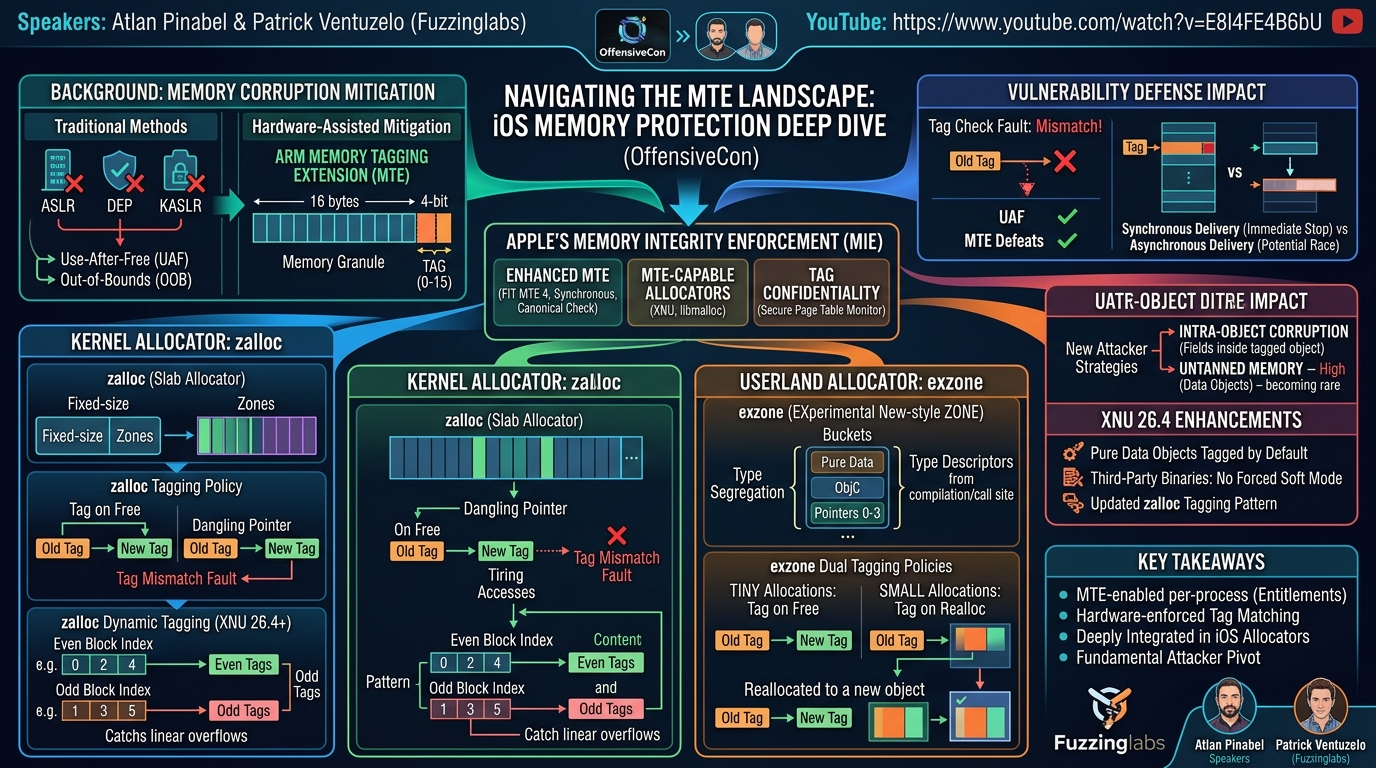
This talk, presented by Atlan Pinabel of Fuzzinglabs (with co-author Patrick Ventuzelo), offers a deep dive into Memory Tagging Extension (MTE) as implemented within Apple's iOS ecosystem, specifically focusing on its integration into the XNU kernel and userland allocators. Titled "Navigating the MTE Landscape," the presentation meticulously unpacks how Apple leverages ARM's hardware-enforced memory corruption mitigation to bolster the security of its operating systems, a strategy Apple refers to as Memory Integrity Enforcement (MIE). The discussion covers the foundational principles of MTE, its practical deployment mechanisms, and the profound implications it holds for both system defenders and offensive security researchers.
Key moments
- 1:00 Introduction to ARM's Memory Tagging Extension (MTE)
- 2:45 MTE's mechanism against linear overflow and OOB access
- 4:15 Apple's Memory Integrity Enforcement (MIE) components
- 5:15 How MTE is enabled per-process via entitlements
- 6:10 MTE soft mode and pure data object tagging configuration
- 8:05 Requesting tagged memory in userland using VM flags MTE
- 9:30 XNU kernel heap allocators (zalloc, calloc) and MTE
Navigating the MTE Landscape: iOS Memory Protection Deep Dive
Speakers: Atlan Pinabel (Security Researcher, Fuzzinglabs); Patrick Ventuzelo (Founder / Security Researcher, Fuzzinglabs)
Conference: OffensiveCon
YouTube: https://www.youtube.com/watch?v=E8l4FE4B6bU
Overview
This talk, presented by Atlan Pinabel of Fuzzinglabs (with co-author Patrick Ventuzelo), offers a deep dive into Memory Tagging Extension (MTE) as implemented within Apple's iOS ecosystem, specifically focusing on its integration into the XNU kernel and userland allocators. Titled "Navigating the MTE Landscape," the presentation meticulously unpacks how Apple leverages ARM's hardware-enforced memory corruption mitigation to bolster the security of its operating systems, a strategy Apple refers to as Memory Integrity Enforcement (MIE). The discussion covers the foundational principles of MTE, its practical deployment mechanisms, and the profound implications it holds for both system defenders and offensive security researchers.
The core of the presentation explores the intricate details of how MTE is woven into critical memory management components, including the zalloc kernel slab allocator and libmalloc's exzone userland allocator. By examining the specific tagging policies, initialization routines, and architectural changes introduced to accommodate MTE, Pinabel illustrates how this technology systematically defeats prevalent memory corruption vulnerabilities such as use-after-free (UAF), out-of-bounds (OOB) reads/writes, and type confusion. The talk highlights the evolving nature of MIE, detailing significant updates in XNU 26.4 that further strengthen these protections and compel attackers to rethink their exploitation strategies.
This article provides a comprehensive analysis of the talk, dissecting the technical nuances of MTE in iOS, the specific allocator behaviors, and the resulting challenges for vulnerability exploitation. It serves as an essential resource for understanding the cutting-edge of memory safety on Apple platforms, emphasizing the shift towards hardware-assisted mitigations and their impact on the offensive security landscape.
Background
▶ Watch: Introduction to ARM's Memory Tagging Extension (MTE) (1:00)
Memory corruption vulnerabilities have long been a cornerstone of exploitation, allowing attackers to gain control over program execution or leak sensitive information. Traditional software-based mitigations like Address Space Layout Randomization (ASLR), Data Execution Prevention (DEP), and Kernel ASLR (KASLR) have raised the bar, but often rely on probabilistic defenses or do not fully prevent certain classes of bugs, such as use-after-free (UAF) or out-of-bounds (OOB) access, from being exploited. The inherent complexity of memory management in C/C++ often leaves windows for these vulnerabilities to be introduced and exploited.
To address these persistent challenges, ARM developed the Memory Tagging Extension (MTE), a hardware-enforced memory corruption mitigation feature designed to provide robust protection against these types of vulnerabilities. MTE operates by associating a small, 4-bit tag with every granule (typically 16 bytes) of physical memory. These associations are stored in a dedicated tag storage, which acts as the source of truth for memory tags. When a program attempts to access tagged memory, the pointer used for the access must carry an appropriate 4-bit tag. If the pointer's tag does not match the memory granule's tag, the hardware detects a tag check fault.
These faults can be either synchronous or asynchronous. For enhanced security, synchronous fault delivery is preferred as it immediately stops execution upon detection, eliminating potential race conditions that could be exploited with asynchronous delivery. MTE has also seen enhancements, notably Enhanced MTE (also known as FIT MTE 4), which introduces features like canonical tag checking (preventing access to untagged memory from tagged pointers, thus protecting global variables) and tag permissions (restricting tag storage interaction). It also includes checks for pointer arithmetic, further tightening memory access controls.
The core idea behind MTE's effectiveness against memory corruption is simple yet powerful:
- Linear Overflow/Out-of-Bounds (OOB): If a pointer for
chunk A(withtag A) attempts to access an adjacentchunk B(withtag B), a tag mismatch occurs, triggering a fault. - Use-After-Free (UAF): When a memory block is freed, its tag can be changed. If a dangling pointer (still holding
old tag) then attempts to dereference the freed memory, a tag mismatch occurs, catching the UAF. Alternatively, if the block is reallocated, its tag can be changed to a newtag C. If the dangling pointer (still holdingold tag) accesses it, a mismatch occurs. The choice between "retag on free" and "retag on realloc" impacts whether UAFs are caught directly or if they prevent object confusion. "Retag on free" catches dangling pointers directly, while "retag on realloc" prevents a UAF from leading to type/object confusion by ensuring the new object has a different tag. - Type Confusion: Similar to UAF, if memory is reallocated with a different type, its tag can be changed, preventing a pointer intended for the original type from accessing the new object.
Apple has embraced MTE as a critical component of its Memory Integrity Enforcement (MIE) strategy, which combines MTE with MTE-capable allocators and robust tag confidentiality enforcement. This comprehensive approach aims to create a highly resilient memory environment in iOS, significantly complicating the exploitation of memory corruption vulnerabilities.
Key Findings
▶ Watch: Apple's Memory Integrity Enforcement (MIE) components (4:15)
The talk revealed several critical insights into Apple's implementation of Memory Integrity Enforcement (MIE) and the current state of MTE in iOS:
- Comprehensive MIE Strategy: Apple's MIE is not just MTE; it's a three-pronged approach comprising Enhanced MTE (operating in synchronous mode), MTE-capable memory allocators, and stringent tag confidentiality enforcement (e.g., protecting tag storage with the Secure Page Table Monitor).
- Per-Process MTE Activation: MTE is not universally enabled across all processes in iOS. Instead, it's activated on a per-process basis, typically at
exectime. The most common activation mechanism for platform binaries is through specific entitlements, such ascom.apple.security.checked-allocations. - Kernel Allocator Integration: Core kernel heap allocators within XNU, including
zalloc,calloc, andcalloc_large, have been made MTE-aware.zalloc, XNU's slab allocator, plays a central role in enforcing MTE for fixed-size allocations. zalloc's "Tag on Free" Policy: Thezallocallocator implements a "tag on free" policy. This means that when a memory block is freed, its associated tag is immediately changed, ensuring that any dangling pointers attempting to access the freed memory will trigger a tag check fault.- Dynamic
zallocTagging Pattern (XNU 26.4+): As of XNU 26.4,zallocinitializes tags for newly grabbed pages with a specific pattern: blocks at even indices receive even-valued tags (excluding zero), and blocks at odd indices receive odd-valued tags. This predictable yet segregated tagging helps catch linear overflows between adjacent blocks of differing parity. - Userland Allocator Modernization:
libmalloc, the default userland allocator, has seenexzonereplacescalable_zoneas the MTE-capable backend.libpas, used by WebKit, also supports MTE but currently operates in "soft mode" due to the complexity of a large codebase. exzone's Dual Tagging Policies:exzoneemploys different MTE policies based on allocation size.tinyallocations (similar tozalloc) use a "tag on free" policy, whilesmallallocations use a "tag on realloc" policy, preventing object confusion upon reallocation.- XNU 26.4 Enhancements: XNU 26.4 introduced several significant changes:
- Pure data objects are now tagged by default by allocators, closing a previous gap where untagged data could be targeted.
- The "soft mode" for third-party binaries (where only the first tag check fault is caught) is no longer forced, implying stricter MTE enforcement for external applications.
- The
zalloctagging pattern was updated. - Attacker Strategy Shift: MTE fundamentally alters the threat landscape for memory corruption. It effectively nullifies direct exploitation of many traditional UAF, OOB, and type confusion vulnerabilities. Attackers are now forced to explore bypasses like intra-object corruptions (modifying fields within a correctly tagged object) or targeting untagged allocations (which are becoming increasingly rare).
- MTE as a Fuzzing Aid: While primarily a defensive mechanism, MTE can also benefit attackers (or security researchers) by making memory corruption bugs more discoverable. Similar to KASAN, MTE will catch latent bugs during fuzzing, which can then be reproduced and analyzed on non-MTE-enabled devices or used to identify intra-object corruption opportunities.
Technical Deep Dive
▶ Watch: How MTE is enabled per-process via entitlements (5:15)
Apple's Memory Integrity Enforcement (MIE) represents a sophisticated, multi-layered defense strategy centered around ARM's Memory Tagging Extension. This section delves into the technical specifics of how MIE is integrated into iOS, from process activation to the intricate behaviors of kernel and userland allocators.
Apple's Memory Integrity Enforcement (MIE) Architecture
Apple's MIE is built upon three pillars:
- Enhanced MTE: Specifically, FIT MTE 4 in synchronous fault mode. This ensures immediate detection of tag mismatches, preventing race conditions and providing strong security guarantees. Features like canonical tag checking and tag permissions are leveraged.
- MTE-Capable Memory Allocators: Both kernel and userland allocators are designed to interact with MTE, managing tags for allocated memory blocks.
- Tag Confidentiality Enforcement: This critical component ensures that an attacker cannot easily leak tags or tamper with the tag storage. The tag storage itself is typically located at the end of physical memory and is protected by the Secure Page Table Monitor, preventing unauthorized access.
Enabling MTE in iOS Processes
MTE is not universally enabled but rather on a per-process basis, a decision made at exec time. This can be influenced by:
- Inheritance: From a parent process.
- POSIX Spawn Flags: Specific flags passed during process creation.
- Entitlements: This is the most common method, especially for platform binaries. The
com.apple.security.checked-allocationsentitlement enables MTE for a given process. - Process Identity: A hardcoded list of security-critical processes might have MTE enabled by default.
For third-party binaries, enabling tagging requires the com.apple.security.checked-allocations entitlement. Additionally, a com.apple.security.checked-allocations.soft-mode entitlement exists, which activates "soft mode." In soft mode, only the first tag check fault simulates a crash; subsequent faults are ignored, making it less disruptive for development and debugging. Critically, prior to XNU 26.4, all third-party binaries were forced into soft mode, but this is no longer the case, indicating a stricter stance on MTE enforcement.
Another entitlement, com.apple.security.checked-allocations.enable-pure-data, previously allowed opting in for tagging of pure data objects (objects containing no pointers). However, since XNU 26.4, pure data objects are tagged by default, meaning developers now have to opt out if they wish to disable this.
When MTE is activated for a process, XNU updates its internal task structure. The security_config.sec field is set to true, and task_sec_policy reflects the MTE configuration, including whether pure data objects are tagged. A boot-up string, has_set_transition=1, is also injected, making the process aware of MTE enforcement.
Requesting Tagged Memory
For a process to utilize MTE, it needs access to tagged memory.
- Userland: Applications request tagged memory by using the
VM_FLAGS_MTEflag duringvm_mapcalls. Once requested, MTE is enforced at every level of the internal XNU VM structures, and the associated page table entry (PTE) itself indicates that the page is tagged. - Kernel: On the kernel side, functions like
vm_page_grab,vm_page_alloc_list, and thekmemlayer now accept extra flags likeVM_PAGE_GRAB_MTEorKM_TAGto request tagged pages. These flags are primarily used by XNU's kernel heap allocators:zalloc,calloc,calloc_large, andzalloc_type.
Tagged mappings have limitations, particularly regarding copy-on-write (CoW) and cross-process sharing, to prevent tag leakage across process boundaries. The codebase is continually evolving to refine these aspects.
Kernel Allocators and MTE
The primary kernel heap allocator enforcing MTE is zalloc, XNU's slab allocator.
zallocOverview:zallocmanages hundreds of fixed-size zones, with initial zones reserved for security-critical objects and others dynamically registered, primarily forcallocandcalloc_typeallocations.- Interaction with
calloc:callocandcalloc_typeusezallocfor smaller allocations. If an allocation request exceedszalloc's capabilities, it falls back tocalloc_large, which in turn callskmem_alloc_wiredwith theKMI_TAGflag.calloc_typefurther enhances security by providing strong size and type segregation, making it difficult to achieve reliable type confusion. zallocHardening: Even before MTE,zallocwas heavily hardened. Mitigations include:- No inline metadata (metadata stored separately).
- Bitmaps to prevent double-frees.
- Special separation for heaps.
- Visual address sequestering for pointer-bearing objects.
- Sub-boundary and "on telephone magazine" techniques to randomize heap layouts.
- Guard pages.
- Strong type segregation via
calloc_type. zallocMTE Enforcement: Historically, aZ_TAGbit in each zone's security flags controlled MTE enforcement. Since XNU 26.4, the logic has shifted to a function called during eachzallocinvocation. This new logic still avoids tagging for sub-maps but now enables tagging by default fordata_privateobjects, which were previously untagged.- "Tag on Free" Policy:
zallocstrictly enforces a "tag on free" policy. When a block is freed, its tag is immediately changed, ensuring that any subsequent dereference via a dangling pointer will result in a tag check fault. - Tag Initialization (
memtag_init): Whenzallocgrabs a new page,memtag_initis called to initialize the tags for all blocks within that page. As of XNU 26.4, the pattern is: - If the block index is even, the tag generated will be an even value (excluding zero, which is reserved).
- If the block index is odd, the tag generated will be an odd value.
This parity-based tagging helps catch linear overflows, as adjacent blocks will almost always have tags of different parities.
- Tagged Pointer Retrieval: When
zallocserves an allocation request, it callsvm_memtag_load_tagto retrieve the correct tag for the block and embed it into the returned pointer, creating a tagged pointer.
Userland Allocators and MTE
In userland, the primary allocators are libmalloc and libpas.
libpas: Used by WebKit,libpasnow supports MTE but currently opts for "soft mode" due to the significant effort required to make such a large codebase fully MTE-compatible.libmallocandexzone:libmallocis the default system allocator. Its legacy default,scalable_zone, has been replaced byexzone(EXperimental New-style ZONE) as the MTE-capable backend.exzoneis enabled if MTE is active for the process, if thecom.apple.security.heapentitlement is present, or if the process is on a hardcoded list of security-critical binaries. Whenexzoneis active,nanozone_v2is disabled.exzoneDesign:exzoneis a slab allocator inspired byMimallocandzalloc. It supports typed allocations, MTE, and features LIFO (Last-In, First-Out) ordering for allocations, which can be useful for certain attack primitives.exzoneMitigation: Similar tozalloc,exzoneincorporates robust hardening features:- Separated metadata.
- Separated heaps.
- Type segregation.
- Various address sequestering techniques.
- Guard chunks.
- Randomized heap layouts.
exzoneType Segregation: Allocations inexzoneare routed to a specific "exon" (slab) based on both size and a type descriptor. These descriptors are inferred at compilation time or derived from call sites, based on the object's structure, size, field kinds, and positioning.uint*is considered "data" by LLVM, for example. Bucketing keys, derived from the executable's boot hash and Code Directory Hash (CDH), deterministically assign allocations to buckets. These include dedicated buckets for pure data objects, Objective-C instances, and pointer-bearing objects (spread acrosspointer_0topointer_3).exzoneMTE Enforcement: MTE tagging is per-exon.tinyandsmallallocations are generally tagged, and since XNU 26.4, data objects are tagged by default.exzonerequests new pages usingVM_FLAGS_MTE.exzoneTagging Policies:tinyallocations: Behave likezalloc, employing a "tag on free" policy.smallallocations: Use a "tag on realloc" policy. This means the tag is changed when a freed block is reallocated, preventing type/object confusion, but a dangling pointer to a freed block might not be immediately caught if the block remains free.
This comprehensive integration of MTE across XNU and userland allocators signifies a major step in hardening iOS against memory corruption, forcing attackers to find increasingly sophisticated bypasses or shift their focus entirely.
Demo / Proof of Concept
▶ Watch: Requesting tagged memory in userland using VM flags MTE (8:05)
The talk primarily focused on the architectural and implementation details of MTE within iOS, rather than demonstrating a specific exploit or proof-of-concept. The speaker emphasized the theoretical impact of MTE on various vulnerability classes and how it forces attackers to pivot their strategies, highlighting the robust nature of Apple's Memory Integrity Enforcement. No live demonstration of an MTE bypass or exploit was presented.
Defensive Implications
▶ Watch: XNU kernel heap allocators (zalloc, calloc) and MTE (9:30)
Apple's Memory Integrity Enforcement, powered by MTE, significantly elevates the baseline security for iOS devices. For defenders, understanding and leveraging this technology is paramount.
- Embrace MTE for Applications: Developers should actively enable MTE for their applications, especially those handling sensitive data or operating in security-critical contexts. Utilizing entitlements like
com.apple.security.checked-allocationsensures that their processes benefit from hardware-backed memory safety. Given that XNU 26.4 no longer forces soft mode for third-party binaries, opting into MTE provides stronger, synchronous protection.
- Understand MTE's Scope and Limitations: While powerful, MTE is not a silver bullet. It excels at preventing out-of-bounds access, use-after-free, and type confusion. However, intra-object corruptions – where an attacker modifies data within a correctly tagged object – are not caught by design. Defenders must continue to employ rigorous code reviews, static analysis, and other security best practices to prevent such vulnerabilities. Similarly, attacks targeting untagged memory (though increasingly rare as Apple closes these gaps) would bypass MTE.
- Leverage MTE for Enhanced Fuzzing: MTE, much like KASAN on Linux, can act as a powerful debugging and fuzzing aid. By enabling MTE in test environments, developers and security researchers can more readily discover memory corruption bugs that would otherwise be difficult to detect. Even if a bug caught by MTE isn't directly exploitable on an MTE-enabled device, it might indicate a deeper logic flaw or a potential intra-object corruption vulnerability that could be exploited with a more constrained primitive. This allows for proactive identification and patching of vulnerabilities before they can be weaponized.
- Stay Updated with Apple's Enhancements: Apple is continuously refining its MIE implementation, as evidenced by the significant changes in XNU 26.4 (e.g., default tagging for pure data, removal of forced soft mode for third-party binaries, updated
zalloctagging patterns). Defenders must stay informed about these updates to understand the evolving security posture and ensure their applications are built to benefit from the latest protections. Following security blogs from Apple and research groups like Fuzzinglabs and Kalif will be crucial.
- Maintain Layered Security: MTE complements, rather than replaces, existing security mitigations. ASLR, DEP, strong allocator designs (like
zalloc's andexzone's type segregation and guard pages), and secure coding principles remain vital. A defense-in-depth strategy, combining hardware-backed MTE with software mitigations and robust development practices, offers the most resilient protection against sophisticated attacks.
- Focus on Code Quality: The shift MTE forces upon attackers means that vulnerabilities like complex logic bugs, intra-object corruptions, or issues in untagged code paths become more attractive targets. This reinforces the need for high-quality, secure code development from the outset, reducing the attack surface that MTE cannot directly cover.
Key Takeaways
- Apple's Memory Integrity Enforcement (MIE) is a robust, multi-layered defense strategy for iOS, combining ARM's Memory Tagging Extension (MTE) with MTE-capable allocators and strong tag confidentiality measures.
- MTE in iOS is enabled on a per-process basis, primarily through specific entitlements like
com.apple.security.checked-allocations, allowing developers to opt into hardware-backed memory protection. - Both kernel (
zalloc) and userland (exzone) allocators are MTE-capable, employing distinct tagging policies:zallocandexzone'stinyregions use "tag on free" to catch dangling pointers, whileexzone'ssmallregions use "tag on realloc" to prevent object confusion. - XNU 26.4 introduced significant MTE enhancements, including default tagging for pure data objects, a new parity-based tag initialization pattern for
zallocblocks, and the removal of forced "soft mode" for third-party binaries, indicating stricter default enforcement. - MTE largely defeats traditional memory corruption vulnerabilities like use-after-free, out-of-bounds reads/writes, and type confusion, compelling attackers to pivot towards intra-object corruptions or targeting increasingly rare untagged memory regions.
- MTE can serve as a valuable tool for security researchers and developers by making memory corruption bugs more discoverable during fuzzing, akin to KASAN, even if these bugs might require more sophisticated exploitation techniques on MTE-enabled devices.
About the Speaker(s)
Atlan Pinabel is an iOS security researcher and team lead at Fuzzinglabs. His work focuses on understanding and analyzing the security landscape of iOS, particularly in areas like memory protection and vulnerability research. He was the primary speaker for this presentation, delivering the detailed technical content.
Patrick Ventuzelo is the Founder and Security Researcher at Fuzzinglabs. While he co-authored the talk, he was unfortunately unable to attend the conference. His expertise also lies in security research, contributing to the comprehensive analysis of iOS memory protections presented. More information about Patrick can be found on his LinkedIn profile: https://www.linkedin.com/in/patrickventuzelo.
Reviews
Dr. Zero (Offensive Security Researcher) — SOLID
Solid internals work on Apple's MTE implementation that actually required reading XNU source and tracing allocator paths. Not a novel bypass or exploit, but the kind of foundational mapping that offensive researchers need before they can even think about attacking MIE. OffensiveCon-appropriate depth.
Heather Calloway (CISO) — STRONG ACCEPT
Required reading for any CISO with an iOS fleet or mobile-first workforce. Apple's Memory Integrity Enforcement fundamentally changes the economics of iOS exploitation—this is the technical underpinning for why your high-value targets on iPhones got materially harder to compromise in 2024.