Technology and the Transformation of U.S. Foreign Policy
RSA Conference 2024 · West Stage Keynote
Overview
In a pivotal address at RSAC 2024, United States Secretary of State Antony J. Blinken outlined the Biden administration's comprehensive strategy for integrating technology into U.S. foreign policy. The talk, titled "Technology and the Transformation of U.S. Foreign Policy," underscored a fundamental shift in global affairs: security, stability, and prosperity are no longer solely analog matters but are profoundly shaped by advancements and governance in the digital realm. Blinken articulated a vision where technological leadership and collaborative frameworks are critical to navigating geopolitical competition, safeguarding democratic values, and harnessing innovation for global good.
Key moments
- 0:55 Technology at heart of geopolitical competition
- 2:10 Three novel developments elevating technology in diplomacy
- 4:30 US historic $3.5 trillion tech investment
- 5:50 Unveiling US International Cyberspace and Digital Strategy
- 6:25 Contrasting US vision for tech vs. rivals' repression
- 8:10 UN General Assembly resolution on AI for good
- 8:30 Synthetic biology: immense potential, inherent risks
Technology and the Transformation of U.S. Foreign Policy
Speakers: Antony J. Blinken, United States Secretary of State
Conference: RSAC 2024
YouTube: https://www.youtube.com/watch?v=ph8ZQPBxBJQ
Overview
In a pivotal address at RSAC 2024, United States Secretary of State Antony J. Blinken outlined the Biden administration's comprehensive strategy for integrating technology into U.S. foreign policy. The talk, titled "Technology and the Transformation of U.S. Foreign Policy," underscored a fundamental shift in global affairs: security, stability, and prosperity are no longer solely analog matters but are profoundly shaped by advancements and governance in the digital realm. Blinken articulated a vision where technological leadership and collaborative frameworks are critical to navigating geopolitical competition, safeguarding democratic values, and harnessing innovation for global good.
Secretary Blinken's presence at a cybersecurity conference highlighted the State Department's recognition that the technology sector, its innovators, and its practitioners are indispensable partners in achieving national and international objectives. He emphasized that the choices made today regarding critical and emerging technologies will have generational reverberations, influencing everything from economic competitiveness to human rights and planetary health. The address served as a call to action for collective engagement, advocating for a future built on digital solidarity rather than digital sovereignty, ensuring that technology serves humanity's best interests while mitigating inherent risks.
Background
▶ Watch: Technology at heart of geopolitical competition (0:55)
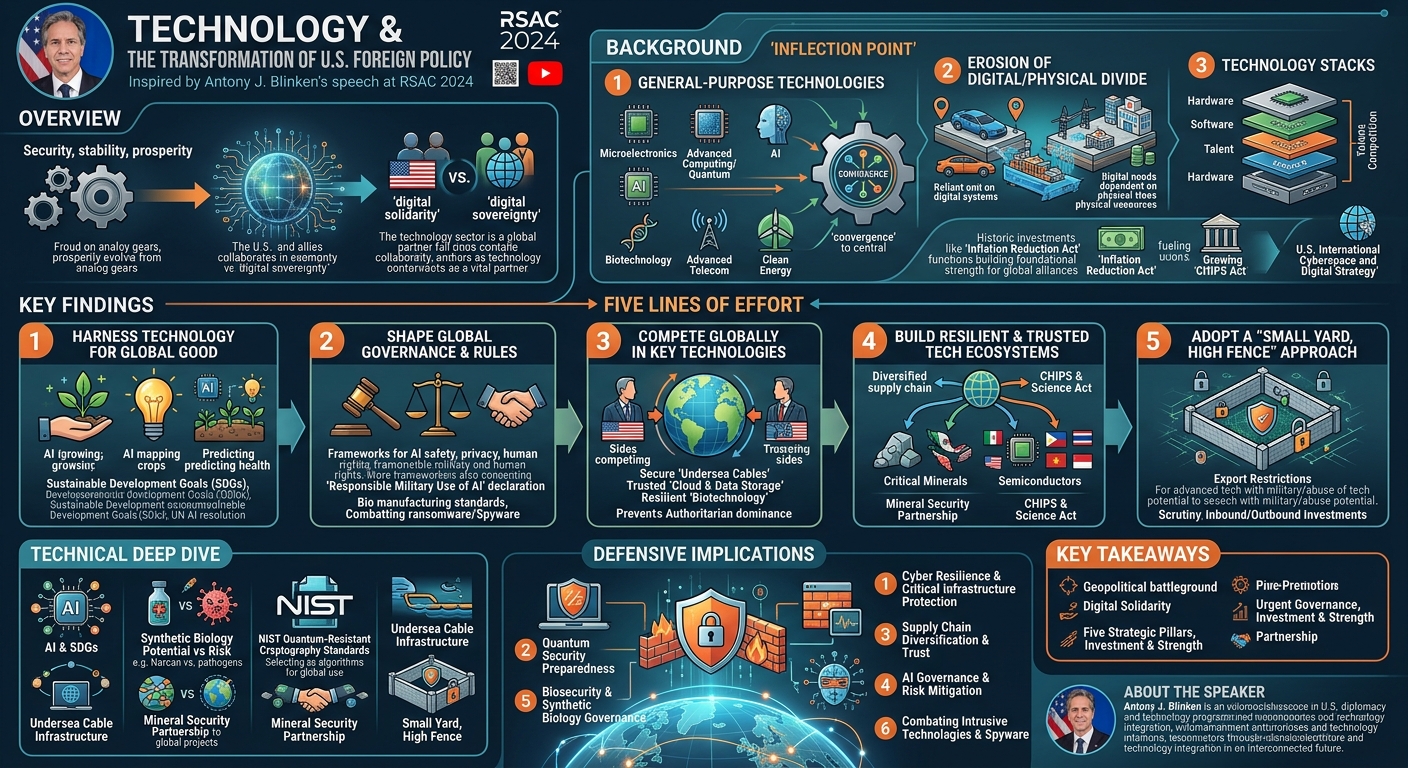
Secretary Blinken posited that the world stands at an inflection point driven by three novel developments, compelling the Biden administration to elevate technology in its national security and diplomatic agenda. First, a new generation of general-purpose foundational technologies is rapidly transforming global dynamics. He identified six particularly consequential areas: microelectronics, advanced computing and quantum technologies, artificial intelligence (AI), biotechnology and bio manufacturing, advanced telecommunications, and clean energy technologies. Crucially, these areas are not isolated but are increasingly converging, with semiconductors powering AI and quantum computing, AI enabling synthetic biology, and digital technologies driving clean energy advancements. This convergence is rewiring every aspect of modern life.
Second, the traditional distinction between the digital and physical realms is eroding. Modern infrastructure, including cars, ports, and hospitals, is increasingly reliant on digital systems and thus vulnerable to cyberattacks. Conversely, the digital forces that drive contemporary society are dependent on scarce physical goods, such as critical minerals and semiconductors. This interconnectedness means that vulnerabilities in one domain can have cascading effects across the other. Third, Blinken stressed that technologies must now be understood as stacks, encompassing hardware, software, talent, and the overarching norms, rules, and structures that govern their use. Competitiveness, therefore, requires proficiency and influence across the entire stack.
To address these challenges, President Biden's administration has made historic domestic investments in technological competitiveness, notably through the Inflation Reduction Act and the CHIPS Act. These legislative efforts are projected to generate $3.5 trillion in public and private investment over the next decade, representing the largest investment in the U.S. economy and competitiveness since the New Deal. This foundational strength is intended to empower U.S. businesses to innovate, scale, and compete globally, thereby positioning the nation to set international standards and advance norms. Beyond domestic strength, the U.S. strategy emphasizes solidarity with the majority of the world that shares a vision for a vibrant, open, and secure technological future, fostering an unmatched network of allies and partners to collectively navigate the "tech test." This approach is epitomized by the State Department's newly unveiled U.S. International Cyberspace and Digital Strategy, which champions digital solidarity as its guiding principle.
Key Findings
▶ Watch: US historic $3.5 trillion tech investment (4:30)
Secretary Blinken's address presented a strategic framework built upon five interconnected lines of effort, designed to implement the U.S. International Cyberspace and Digital Strategy and ensure digital solidarity becomes the North Star of American tech diplomacy. These findings represent the core contributions of the talk:
- Harnessing Technology for Global Good: The U.S. is actively working to ensure that emerging and foundational technologies drive development, promote human rights, and solve shared global challenges, directly contrasting the "dystopian uses" advanced by strategic rivals.
- Shaping Global Governance and Rules of the Road: A critical focus is placed on establishing international norms, standards, and frameworks that align foundational technologies with democratic values and mitigate potential harms, spanning AI, synthetic biology, digital security, and quantum computing.
- Competing Globally in Key Technologies: The U.S. is leveraging its diplomatic arsenal to help innovative companies from the U.S. and partner nations fairly compete across the technology stack, preventing strategic competitors from dominating critical sectors like undersea cables, cloud computing, and biotechnology.
- Building Resilient and Trusted Tech Ecosystems: The strategy prioritizes diversifying and securing global supply chains for critical technologies—from research and development to manufacturing and markets—to lessen dangerous concentrations and dependencies, exemplified by efforts in critical minerals and semiconductors.
- Adopting a "Small Yard, High Fence" Approach: For the most sensitive technologies with clear military applications or human rights abuse potential, the U.S. is implementing carefully tailored restrictions on exports and investments to slow competitors' efforts and prevent American innovation from being used against U.S. interests or allies.
These five lines of effort collectively form a comprehensive and proactive diplomatic strategy, aiming not merely to react to technological change but to actively shape the global strategic landscape in a manner consistent with U.S. values and interests.
Technical Deep Dive
▶ Watch: Unveiling US International Cyberspace and Digital Strategy (5:50)
The core of the U.S. tech diplomacy strategy, as articulated by Secretary Blinken, lies in its five practical applications, each involving significant technical and policy considerations.
1. Harnessing Technology for the Betterment of All Humanity
The first pillar focuses on promoting "tech for good" and countering the malign uses of technology by strategic rivals, who employ digital tools for surveillance, repression, coercion, and undermining democracies. The U.S. aims to build global consensus around an affirmative vision, internationalizing and institutionalizing this approach.
A prime example is Artificial Intelligence (AI). While acknowledging its risks, Blinken highlighted AI's "exhilarating potential" to accelerate progress on 80% of the Sustainable Development Goals (SDGs), which include eradicating hunger and poverty, improving gender equality, and expanding access to education and clean energy. AI can map soil for bigger crop yields, predict public health threats, and synthesize knowledge to improve education and infrastructure. To advance this, the U.S. led the passage of the first-ever standalone resolution on AI in the United Nations General Assembly, co-sponsored by over 120 countries, establishing a framework for leveraging AI for economic and social progress while respecting human rights.
Similarly, synthetic biology presents both immense potential and profound risks. The cost of DNA synthesizers has plummeted from millions to thousands of dollars, making it possible for individuals with college-level science education to read, write, and edit genetic code. This opens avenues for breakthroughs in medicine and public health but also dramatically lowers barriers for malign purposes, such as creating highly transmissible lethal pathogens. Blinken cited the example of a biotech company producing Narcan spray, an antidote for opioid overdoses. Thanks to synthetic biology, tons of Narcan can be produced in 96 hours, a process that would traditionally require two years of farming 10 square miles. The U.S. is pursuing global bio manufacturing, supply chain, and research efforts with other countries to unlock positive biotech applications in health, food security, and climate action, while collaborating with the private sector to direct American innovation toward global good.
2. Shaping the Rules of the Road (Governance)
The second pillar centers on establishing robust governance frameworks to ensure foundational technologies sustain democratic values and guard against harms.
For AI, the U.S. is deeply aware of risks like job displacement, false information generation, bias, discrimination, and the destabilizing use of autonomous weapons. Domestically, the President's AI executive order strengthens standards for AI safety and security, protects privacy, and promotes a rights-respecting approach. The private sector is a critical partner, with leading AI companies making voluntary commitments to security testing before product release and developing tools to help users recognize AI-generated content. These governance frameworks are the foundation of U.S. AI diplomacy, adopted by G7 countries and embedded in the UN resolution. The new U.S. AI Safety Institute is intended to inform global rules, standards, and testing. In the military realm, the U.S. issued a political declaration on the responsible military use of AI and autonomy, endorsed by 55 countries.
Synthetic biology governance involves limiting the transfer of Americans' bulk human genomic data to adversaries and establishing G7 standards for security and privacy against dangerous applications. For digital technologies, the U.S. is building coalitions to prevent the export of intrusive technology and spyware used to harass dissidents and bringing dozens of countries together to combat ransomware, which steals billions of dollars annually. The U.S. publicly called out the PRC for targeting U.S. critical infrastructure and Iran for cyberattacks against Albania, upholding international cyber norms.
Crucially, the U.S. is preparing for the future of quantum computing, which could revolutionize security across banking, energy grids, and government communications. The National Institute of Standards and Technology (NIST) is vetting quantum-resistant cryptographic standards and has selected four specific algorithms designed to withstand quantum attacks. NIST is preparing to make these algorithms available worldwide for integration into encryption infrastructure, underscoring the urgency to move quickly with allies to harness benefits and protect against risks before rivals develop advanced quantum machines.
3. Competing Across the Globe
The third line of effort acknowledges the lesson from the 5G experience: complacency allows strategic competitors to dominate technologies forming the backbone of the global economy and information flow. The U.S. is deploying its diplomatic arsenal to help innovative companies from the U.S. and its partners compete fairly and expand a secure, open, and resilient tech world, based on digital solidarity.
Undersea cables, which carry over 95% of the world's digital traffic, are a prime example. Disruptions or compromises could isolate nations and cause billions in damages. The U.S. is investing in the installation and operation of secure infrastructure, partnering with Australia, Japan, New Zealand, and Taiwan on a cable connecting up to 100,000 people across the Pacific Islands, and supporting similar efforts in South America, Africa, and the Indo-Pacific.
In cloud computing and data storage, where the U.S. currently leads, providers from authoritarian states are increasingly competitive. It is critical to work with trusted vendors and exclude untrustworthy ones, establishing economies of scale with partners. A similar approach is applied to emerging technologies like biotechnology, guarding against dependence on genomic sequencing and other biotech hardware from untrusted vendors. Blinken warned of the "disastrous consequences" if the world's genomic surveillance infrastructure were dominated by authoritarian rivals, enabling mass surveillance combining genetic information with facial or voice recognition.
4. Building Resilient and Trusted Tech Ecosystems
This pillar focuses on strengthening tech ecosystems, encompassing research and development, manufacturing, markets, and supply chains. The current concentration of global tech manufacturing infrastructure in a few geographic areas poses risks of disruption from conflict or natural disaster.
The U.S. is forging tech partnerships to make critical technology supply chains more resilient, diverse, and secure, including for critical minerals essential for clean energy technologies. The U.S. produces only 1% of nickel, 4% of lithium, 13% of cobalt, and 0% of graphite required for current EV demand, while China processes 80% of critical minerals. The Mineral Security Partnership (MSP), formed two years ago with 14 countries and the European Union (representing over half of global GDP), is working on nearly two dozen projects worldwide across the supply chain, from mining and extraction to processing, recycling, and recovery.
For semiconductors, an American invention, the U.S. manufacturing base produces only 10% of the world's chips, a serious economic and national security concern. President Biden's CHIPS and Science Act makes a nearly $53 billion investment to regain America's position as a semiconductor manufacturing powerhouse. Since the administration's start, private companies have announced $395 billion in semiconductor and electronics investments in the U.S., revitalizing industrial manufacturing and workforce. The ITSI Fund under the CHIPS Act, along with similar efforts, helps diversify and secure the silicon supply chain, working with partners like Mexico, Costa Rica, Panama, Vietnam, the Philippines, and Indonesia. This trusted tech ecosystem logic is also being applied to the future of quantum computing, building markets and deepening the ecosystem among trusted countries.
Underpinning all innovation is talent. The U.S. prioritizes attracting, training, and retaining high-tech workers, streamlining visa processes and opening new pipelines for foreign nationals with AI expertise.
5. Adopting a "Small Yard, High Fence" Approach
The final pillar involves protecting the most sensitive technologies, those with clear connections to military capabilities and human rights abuses. The goal is to slow competitors' efforts and prevent U.S.-developed technologies from being used against American interests or allies.
This includes carefully tailored restrictions on advanced semiconductor exports, which form the backbone of frontier AI and future military capabilities. Such restrictions are a national security imperative to prevent these technologies from aiding or accelerating the military modernization of countries that seek to challenge the U.S. Additionally, the U.S. is enhancing security and scrutiny of inbound and outbound investments in sensitive technologies for the same national security reasons, working collaboratively with partners for consistent and effective global implementation.
Demo / Proof of Concept
▶ Watch: UN General Assembly resolution on AI for good (8:10)
As a high-level policy address delivered by the Secretary of State, this talk did not include a technical demonstration or proof of concept in the traditional sense of a security conference presentation. Instead, Secretary Blinken focused on articulating the strategic framework and policy initiatives of the U.S. government regarding technology and foreign policy.
Defensive Implications
▶ Watch: Synthetic biology: immense potential, inherent risks (8:30)
Secretary Blinken's talk, while a policy address, carries significant defensive implications for governments, organizations, and the broader tech community.
- Cyber Resilience and Critical Infrastructure Protection: The explicit mention of ransomware stealing billions annually and state-sponsored attacks (PRC targeting U.S. critical infrastructure, Iran attacking Albania) underscores the persistent and evolving threat landscape. Defenders must prioritize hardening networks, migrating vital government data to secure cloud environments, and bolstering the resilience of national communications and other critical infrastructure. The collaboration seen in Ukraine, where the U.S. and partners helped harden networks and migrate data to the cloud against Russian aggression, serves as a model for digital solidarity in action.
- Quantum Security Preparedness: The imminent threat of quantum computing to current cryptographic standards is a major concern. Organizations and governments must proactively engage with the National Institute of Standards and Technology (NIST)'s efforts to vet and deploy quantum-resistant cryptographic standards. Integrating the four selected algorithms into existing encryption infrastructure should be a priority to safeguard sensitive data against future quantum attacks, requiring rapid action with allies and industry partners.
- Supply Chain Diversification and Trust: The vulnerability of concentrated supply chains for critical technologies (semiconductors, critical minerals, biotech hardware) demands immediate attention. Defenders need to assess their dependencies on specific geographic areas or untrusted vendors. Strategies should include diversifying procurement, investing in domestic or allied manufacturing capabilities, and establishing robust vetting processes for technology providers, especially in areas like cloud computing, data storage, and genomic sequencing infrastructure. The goal is to build resilient and trusted tech ecosystems.
- AI Governance and Risk Mitigation: The inherent risks of AI, including misinformation, bias, job displacement, and autonomous weapons, require proactive governance. Organizations deploying AI should adhere to principles of safe, secure, and trustworthy AI, aligning with the President's AI executive order and voluntary commitments made by leading AI companies (e.g., security testing, tools for recognizing AI-generated content). Defenders must also prepare for the impact of AI on information integrity and develop strategies to counter AI-driven disinformation campaigns.
- Biosecurity and Synthetic Biology Governance: The ease with which synthetic biology tools can be used for malign purposes (e.g., creating lethal pathogens) highlights a critical emerging threat. Governments and biotech firms must establish stringent security protocols and collaborate internationally on standards for security and privacy for genomic data. Limiting the transfer of bulk human genomic data to adversaries is a direct defensive measure.
- Combating Intrusive Technologies and Spyware: The U.S. is building coalitions to prevent the export of intrusive technology and spyware used to harass dissidents. Defenders, particularly in human rights organizations and critical infrastructure, should be aware of these tools and implement robust defensive measures against targeted attacks employing such technologies.
In essence, the defensive posture must evolve from a reactive stance to a proactive, globally coordinated effort that integrates technological innovation with robust policy and governance frameworks. The emphasis on digital solidarity means that defensive strategies are most effective when shared and implemented collaboratively across international partners.
Key Takeaways
- Technology as a Geopolitical Battleground: Modern security, stability, and prosperity are inextricably linked to technological advancements and governance, making technology a central arena for geopolitical competition between democratic nations and authoritarian rivals.
- The Rise of Digital Solidarity: The U.S. is championing a foreign policy based on digital solidarity with allies and partners, contrasting with rivals' pursuit of digital sovereignty, to ensure an open, secure, and resilient technological future.
- Multi-faceted Strategic Pillars: The U.S. strategy is built on five core efforts: promoting "tech for good", shaping global governance, fostering international competition, building resilient tech ecosystems, and implementing a "small yard, high fence" approach for sensitive technologies.
- Urgent Governance for Emerging Tech: Critical and emerging technologies like AI, synthetic biology, and quantum computing require immediate and robust global governance frameworks, exemplified by the UN AI resolution, G7 standards for biotech data, and NIST's work on quantum-resistant cryptographic standards.
- Investment in Domestic and Allied Strength: Historic U.S. investments (e.g., CHIPS Act, Inflation Reduction Act) are revitalizing domestic innovation and manufacturing, while diplomatic efforts are diversifying critical supply chains (e.g., semiconductors, critical minerals) with trusted partners globally.
- Partnership is Paramount: Success in navigating the "tech test" depends critically on deep collaboration between governments, the private sector, academia, and civil society, leveraging collective expertise to shape the technological future.
About the Speaker(s)
Antony J. Blinken is the United States Secretary of State, serving under President Joe Biden. In this role, he is the nation's chief diplomat and the principal foreign policy advisor to the President. His address at RSAC 2024 underscored his leadership in adapting U.S. foreign policy to the rapidly evolving technological landscape. Secretary Blinken is at the forefront of integrating technology into national security and diplomatic strategies, driving the U.S. vision of digital solidarity to ensure that critical and emerging technologies are harnessed for global good, democratic values, and economic prosperity, while countering malign uses by strategic rivals. His remarks highlighted the State Department's commitment to building a diplomatic corps equipped with deep technological expertise and fostering robust partnerships with the global tech community.