Operation Cookie Monster & Genesis Market: An International Cyber Takedown
RSA Conference 2024 · Track Session
Overview
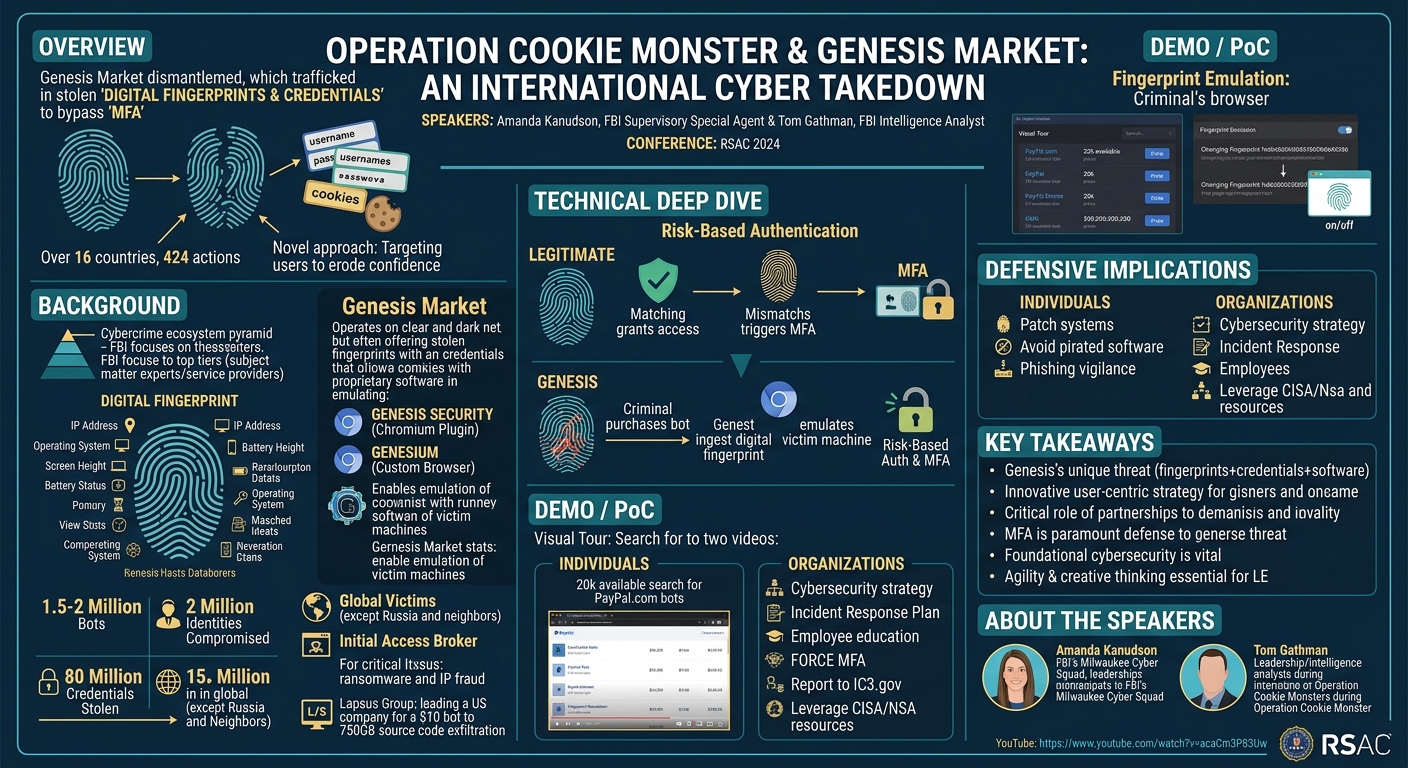
This talk, presented by FBI Supervisory Special Agent Amanda Kanudson and Intelligence Analyst Tom Gathman, details Operation Cookie Monster, the unprecedented international law enforcement effort that led to the dismantlement of Genesis Market. Genesis Market was a highly sophisticated and dangerous online marketplace that trafficked in stolen digital fingerprints and credentials, enabling cybercriminals to bypass traditional security measures like Multi-Factor Authentication (MFA). The speakers illuminate the intricate investigation, the innovative strategies employed, and the profound impact of this global takedown on the cybercrime ecosystem.
Key moments
- 0:00 Welcome, speakers, and talk overview
- 1:00 Understanding the cybercrime ecosystem and FBI focus
- 2:00 The concept of unique digital fingerprints
- 3:10 Genesis Market: Bypassing MFA with stolen fingerprints
- 4:00 Proprietary emulation software: Genesis Security and Genesium
- 4:30 Genesis Market interface and 'bot' definition
- 5:30 Bot pricing algorithm and scale of available credentials
Operation Cookie Monster & Genesis Market: An International Cyber Takedown
Speakers: Amanda Kanudson, Supervisory Special Agent, FBI; Tom Gathman, Intelligence Analyst, FBI
Conference: RSAC 2024
YouTube: https://www.youtube.com/watch?v=acaCm3P83Uw
Overview
This talk, presented by FBI Supervisory Special Agent Amanda Kanudson and Intelligence Analyst Tom Gathman, details Operation Cookie Monster, the unprecedented international law enforcement effort that led to the dismantlement of Genesis Market. Genesis Market was a highly sophisticated and dangerous online marketplace that trafficked in stolen digital fingerprints and credentials, enabling cybercriminals to bypass traditional security measures like Multi-Factor Authentication (MFA). The speakers illuminate the intricate investigation, the innovative strategies employed, and the profound impact of this global takedown on the cybercrime ecosystem.
The significance of this operation lies not only in the scale of its international cooperation – involving over 16 countries and 424 law enforcement actions – but also in its novel approach to dismantling a cybercriminal enterprise. Traditionally, law enforcement focuses on the administrators and infrastructure of such platforms. However, recognizing the challenges of jurisdictional reach and rapid reconstitution, Operation Cookie Monster pioneered a "third pillar" strategy: directly targeting the market's users. This tactic aimed to erode user confidence and Genesis Market's reputation for anonymity, ultimately proving effective in its dismantlement.
The insights shared in this presentation offer a comprehensive look into the evolving landscape of cybercrime, the methods used by sophisticated marketplaces to facilitate fraud and intrusions, and the critical importance of international and public-private partnerships in combating these threats. It serves as a crucial case study for understanding how law enforcement can adapt to the agile nature of cybercriminals and impose significant consequences on those operating within the digital underground.
Background
▶ Watch: Welcome, speakers, and talk overview (0:00)
The cybercrime ecosystem has evolved significantly over the past decade, transforming into a highly interconnected and organized entity. This structure often resembles a pyramid, with subject matter experts and key service providers at the apex. These top-tier actors develop new malware, identify vulnerabilities, and offer services like communication platforms and financial tools, effectively lowering the barrier to entry for less sophisticated criminals. The FBI, as highlighted by the speakers, strategically focuses its investigative efforts on these top two ranks to maximize impact.
A fundamental concept exploited by Genesis Market is the digital fingerprint. Just as humans have unique physical fingerprints, digital devices possess distinct digital fingerprints, comprising thousands of data points. These include readily identifiable information like IP address and operating system, but also granular details such as screen height, available height (accounting for taskbars), and battery status. Businesses widely use these fingerprints for risk-based authentication, where a device's current fingerprint is checked against a stored one to verify a user's identity. A mismatch often triggers additional authentication steps, such as Multi-Factor Authentication (MFA).
Genesis Market emerged in approximately 2017, gaining significant traction in 2018, specifically to circumvent these fraud prevention mechanisms. While it trafficked in standard stolen credentials (usernames, passwords, cookies), its unique and defining feature was the theft and sale of victims' digital fingerprints alongside these credentials. To facilitate the use of these stolen fingerprints, Genesis Market developed proprietary software: a Chromium plugin called Genesis Security and a custom Chrome-based browser named Genesium. This software allowed users to "ingest" a victim's fingerprint, effectively emulating the victim's machine down to near-hardware levels. This capability frequently resulted in the successful bypass of Multi-Factor Authentication (MFA), making it a highly attractive platform for cybercriminals.
The marketplace operated on both the clear net and the dark net and was invite-only, fostering a sense of exclusivity and security among its users. Over its lifetime, Genesis Market infected an estimated 1.5 million "bots" (a term Genesis used to denote a victim and their associated credentials/digital fingerprints), with this number likely closer to 1.8-2 million by the time of the takedown. These compromises resulted in approximately 2 million identities compromised and around 80 million credentials stolen. Victims spanned nearly every country worldwide, with the notable exception of Russia and surrounding nations, suggesting the platform's origin. All manner of critical infrastructure industries were represented among the victims, underscoring the broad threat posed by the market.
Crucially, Genesis Market functioned as a significant Initial Access Broker. Gaining initial access is a critical first step in various cyberattacks, including ransomware, intellectual property (IP) fraud, and other traditional cybercrimes. The FBI also identified national security concerns, finding hundreds of bots for sale that contained credentials for foreign allies' government defense domains and numerous U.S. government agencies. A stark example of its impact was the Lapsus Group's compromise of a U.S. company in June 2021. According to public reporting, Lapsus gained initial access via a bot purchased for just $10 on Genesis Market, enabling them to exfiltrate approximately 750 gigabytes of source code, API keys, and other intellectual property. This demonstrated an astounding return on investment and the low barrier to high-impact cybercrime facilitated by Genesis Market.
Key Findings
▶ Watch: The concept of unique digital fingerprints (2:00)
The investigation into Genesis Market, culminating in Operation Cookie Monster, yielded several critical findings that not only facilitated the takedown but also reshaped approaches to combating cybercrime.
Firstly, the core innovation of Genesis Market was its ability to weaponize digital fingerprints. By offering stolen credentials bundled with a victim's unique device fingerprint and providing specialized emulation software (Genesis Security plugin and Genesium browser), Genesis Market effectively neutralized risk-based authentication and frequently bypassed Multi-Factor Authentication (MFA). This made it an unparalleled platform for illicit access, attracting a wide spectrum of cybercriminals, from "script kiddies" to sophisticated ransomware operators and even traditional criminal gangs engaged in fraud to generate revenue.
Secondly, the sheer scale and reach of Genesis Market were staggering. At the time of the takedown, it had compromised an estimated 1.5 to 2 million unique victim "bots" and facilitated the theft of approximately 80 million credentials. Its user base grew from 33,000 in December 2020 to 59,000 by January 2021, demonstrating rapid expansion. The market's global victim footprint, spanning nearly every country and critical infrastructure sector, underscored its pervasive threat to global cybersecurity and national security interests. The presence of government and defense domain credentials for sale highlighted its potential exploitation for state-sponsored espionage, moving beyond purely financially motivated cybercrime.
Thirdly, and perhaps most significantly, Operation Cookie Monster pioneered a novel "third pillar" strategy in cybercrime takedowns. Recognizing the inherent difficulties in simultaneously apprehending elusive administrators and seizing distributed infrastructure, the FBI and its international partners shifted focus to targeting the market's users. This strategy aimed to discredit Genesis Market's reputation for providing anonymity and security, thereby eroding user confidence. The hypothesis was that if users perceived the platform as insecure and prone to law enforcement action, its foundation would crack, leading to its collapse. This represented a departure from traditional law enforcement tactics, which primarily focused on the top-tier operators.
Finally, the operation conclusively demonstrated the power of international collaboration and public-private partnerships. The success of Operation Cookie Monster was attributed to the seamless cooperation of over 16 countries, including the vital coordination efforts of Europol, and indispensable support from private sector partners like Tlex and Microsoft. These partnerships provided crucial assistance in malware analysis, data parsing, financial analysis, victim notification, and identification, proving that no single entity, government or private, can tackle the complex global cybercrime ecosystem alone. The ultimate dismantlement of Genesis Market, evidenced by its disappearance from both clear net and Tor, the drastic reduction in new "bot" injections, and the palpable distrust among its remaining users, validated the innovative user-centric approach.
Technical Deep Dive
▶ Watch: Genesis Market: Bypassing MFA with stolen fingerprints (3:10)
Genesis Market's core technical innovation revolved around the sophisticated exploitation of digital fingerprints to bypass risk-based authentication and Multi-Factor Authentication (MFA). A digital fingerprint is a unique identifier composed of thousands of data points collected from a user's device. This data includes the IP address, operating system, browser type and version, installed fonts, screen resolution, available height (which accounts for elements like taskbars), CPU type, battery status, and many other seemingly innocuous details. When aggregated, these data points create a highly unique profile for a specific device and user session.
Legitimate businesses use these digital fingerprints for risk-based authentication. When a user logs into a service, their device's fingerprint is captured and stored. On subsequent logins, the current fingerprint is compared to the stored one. If there's a match, access is typically granted smoothly. If there's a discrepancy (e.g., login from a new device or a significantly altered digital environment), the system flags it as potentially suspicious and often requests additional authentication, such as an MFA code sent to a trusted device. This mechanism is designed to prevent unauthorized access even if primary credentials are stolen.
Genesis Market directly countered this defense by not only stealing user credentials (usernames, passwords, cookies) but also the victim's complete digital fingerprint. To empower criminals to leverage this stolen data, the market developed two proprietary tools:
- Genesis Security (Chromium plugin): This browser extension was designed to be installed on a criminal's Chromium-based browser.
- Genesium (Chrome-based browser): A custom browser specifically pre-configured to work with Genesis Market's ecosystem.
The functionality was remarkably straightforward from the user's perspective. Once a "bot" (a victim's stolen credentials and digital fingerprint) was purchased from the marketplace, the criminal could simply click a "download and Genesis Security" button. This action ingested the victim's entire digital fingerprint into the criminal's browser via the Genesis Security plugin. By activating the plugin, the criminal's browser would effectively emulate the victim's machine, presenting the same unique digital fingerprint to online services. This enabled the criminal to appear as the legitimate user, bypassing risk-based authentication and, crucially, often circumventing MFA challenges, as the system believed it was the same trusted device logging in. The talk demonstrated this with a script that showed a unique hash for a digital fingerprint, which completely changed when the Genesis Security plugin was activated with a different fingerprint, and then reverted when deactivated. This seamless emulation was a game-changer for cybercriminals, significantly lowering the technical barrier to sophisticated fraud.
The marketplace itself was a sophisticated e-commerce platform, existing on both the clear net and the dark net, and operating on an invite-only basis. Bots were priced using a proprietary algorithm developed by Genesis, ranging from a few dollars to several hundred. This pricing was determined by factors such as the perceived "success rate" of bypassing safeguards and the type of credentials included. The data collected during the investigation from seized servers revealed the market's rapid growth: from approximately 33,000 users and 900,000 victims in December 2020 to 59,000 users and 1.5 million victims by January 2021. The backend database was massive, containing dozens of tables and over a billion lines of data, which required extensive correlative analysis and international partnership to parse and act upon.
Demo / Proof of Concept
▶ Watch: Genesis Market interface and 'bot' definition (4:30)
The speakers effectively illustrated the functionality and ease of use of Genesis Market through two critical video demonstrations, showcasing both the marketplace interface and the technical capabilities of its proprietary tools.
The first demonstration provided a visual tour of the Genesis Market interface. It was depicted as a slick, user-friendly e-commerce platform, similar in design to legitimate online stores. The video showed a search for "bots" containing PayPal.com credentials. As the presenter scrolled through the results, a list of available "bots" appeared, each with a price (ranging from a few dollars to several hundred, determined by Genesis's proprietary algorithm) and a count of available credentials. A key takeaway from this demo was that at the time of the query, there were approximately 20,000 "bots" with PayPal.com credentials available for purchase. The speakers emphasized that this number only represented currently available bots and did not account for the many thousands already purchased or those yet to be ingested into the market. This visual demonstrated the vast scale of compromised data readily accessible to criminals.
The second, more technical demonstration highlighted the core innovation of Genesis Market: the ability to easily emulate a victim's digital fingerprint. This video showed a criminal's browser environment. Initially, a script was run in the browser to display its current digital fingerprint and an associated hash. This hash served as a unique identifier for the browser's current digital persona. The demonstration then proceeded to show the simplicity of using the Genesis Security Chromium plugin. With just two clicks – enabling the plugin and selecting a stolen fingerprint – the criminal's browser could instantly adopt a victim's unique digital profile. After activating the plugin and re-running the fingerprint script, the hash and the underlying key-value pairs of the digital fingerprint were shown to be completely different, reflecting the ingested victim's data. Crucially, when the plugin was turned off and the script run again, the browser reverted to its original digital fingerprint. This seamless and immediate switching of digital identities underscored how Genesis Market dramatically lowered the technical barrier for criminals to bypass risk-based authentication and Multi-Factor Authentication (MFA), making sophisticated fraud accessible even to less technical users.
Defensive Implications
▶ Watch: Bot pricing algorithm and scale of available credentials (5:30)
The takedown of Genesis Market and the detailed insights from Operation Cookie Monster offer crucial lessons and actionable defensive implications for individuals and organizations alike. The market's success was largely predicated on exploiting common vulnerabilities and user habits, which can be mitigated through proactive cybersecurity measures.
For individuals, the primary defense against the methods employed by Genesis Market involves fundamental cyber hygiene:
- Keep Systems Patched: Many of the initial compromises that fed "bots" into Genesis Market were due to unpatched software and operating systems. Regularly updating software closes known vulnerabilities that attackers exploit.
- Avoid Pirated Software: Pirated software often comes bundled with malware, serving as a common vector for credential theft and system compromise. Using legitimate software from trusted sources is paramount.
- Be Vigilant Against Phishing: While not directly discussed as the initial compromise method for Genesis bots, phishing remains a primary way credentials are stolen. Users should be educated to recognize and avoid suspicious links and attachments.
For organizations, the implications are more strategic and comprehensive:
- Implement a Robust Cybersecurity Strategy: Every organization, regardless of size or perceived obscurity, must develop and continuously refine a cybersecurity strategy. The belief that small organizations are not targets is a dangerous misconception, as platforms like Genesis Market make them "targets of opportunity" for unsophisticated attackers.
- Develop and Practice an Incident Response Plan: A well-defined and regularly practiced incident response plan is critical. Knowing how to detect, contain, eradicate, and recover from a cyber incident can significantly reduce its impact.
- Educate Employees on Cybersecurity: Human error remains a leading cause of security breaches. Comprehensive and ongoing employee education on topics such as phishing, strong password practices, and the importance of reporting suspicious activity is essential.
- Force Multi-Factor Authentication (MFA): This is arguably the most critical defensive implication directly addressing Genesis Market's core bypass technique. Genesis Market exploited the "remember me" or "save password" functions, which, when combined with a stolen digital fingerprint, allowed criminals to circumvent MFA. By forcing MFA across the organization for all access, even if a digital fingerprint is emulated, the criminal would still need a second factor (e.g., a one-time code from a mobile app or hardware token) that they typically would not possess. This significantly raises the bar for unauthorized access.
- Report Cyber Incidents to IC3.gov: The FBI's Internet Crime Complaint Center (IC3.gov) serves as a centralized hub for reporting cybercrime and internet fraud. Reporting helps law enforcement identify trends, link incidents, and disseminate timely guidance to the public and private industry.
- Leverage Government Resources: Organizations should utilize resources from agencies like the Cybersecurity and Infrastructure Security Agency (CISA) and the National Security Agency (NSA). CISA offers assessment services, penetration testing, and guides (e.g., checklists for before and after an incident). NSA provides technical guides and reports that can enhance an organization's defensive posture.
In summary, the Operation Cookie Monster takedown underscores that while cybercriminals constantly evolve their tactics, foundational security practices, coupled with advanced MFA implementation and robust incident response, remain the most effective defenses. The emphasis on partnership – between government agencies, international partners, and the private sector – also highlights a collective responsibility in building a more resilient cybersecurity landscape.
Key Takeaways
- Genesis Market's Unique Threat: The marketplace uniquely combined stolen credentials with digital fingerprints and provided proprietary emulation software (Genesis Security/Genesium) to bypass risk-based authentication and Multi-Factor Authentication (MFA), significantly lowering the barrier for cybercriminals to commit fraud and intrusions.
- Innovative User-Centric Takedown Strategy: Operation Cookie Monster successfully dismantled Genesis Market by pioneering a "third pillar" approach, directly targeting its users to erode trust and discredit the platform's reputation for anonymity, proving effective even when administrators and infrastructure couldn't be simultaneously taken down.
- Critical Role of Partnerships: The success of this multi-year investigation and global takedown (involving 16+ countries and 424 law enforcement actions) was absolutely dependent on international cooperation (e.g., Europol) and indispensable public-private partnerships (e.g., Tlex, Microsoft) for data analysis, victim notification, and operational support.
- Importance of Multi-Factor Authentication (MFA): Forcing Multi-Factor Authentication (MFA) across organizations is a paramount defense. Even with a stolen digital fingerprint, a criminal would still require the second factor, effectively neutralizing Genesis Market's core bypass method.
- Foundational Cybersecurity Remains Vital: Basic cyber hygiene, such as keeping systems patched, avoiding pirated software, and employee cybersecurity education, is crucial in preventing the initial compromises that fuel markets like Genesis.
- Agility and Creative Thinking are Essential: Law enforcement must continuously adapt and employ creative strategies, like targeting users, to counter the ever-evolving tactics of agile cybercriminals, recognizing that past methods may not always be effective for future threats.
About the Speaker(s)
Amanda Kanudson is a Supervisory Special Agent with the Federal Bureau of Investigation (FBI), currently assigned to the Milwaukee field office, where she leads the Cyber Squad. Her role involves overseeing complex cyber investigations, and she was a key figure in the Operation Cookie Monster investigation, providing leadership and strategic direction from the early stages through to the successful takedown. Kanudson's experience highlights the FBI's commitment to targeting top-tier cybercriminal services and fostering international partnerships to combat global threats.
Tom Gathman is an Intelligence Analyst with the FBI, also assigned to the Cyber Squad in the Milwaukee field office. He played a crucial, hands-on role in the Operation Cookie Monster investigation, working on the case from its inception to its conclusion. Gathman's expertise in intelligence analysis was instrumental in navigating the massive datasets collected from Genesis Market's servers, identifying users, and triaging targets, demonstrating the critical function of intelligence in complex cybercrime investigations.