Keynote - Jack Rhysider
Jack Rhysider (Host · Darknet Diaries)
SAINTCON 2025 · Day 4 · Keynote
Overview
In his captivating SAINTCON keynote, Jack Rhysider, host of the widely acclaimed Darknet Diaries podcast, delivers a masterclass not just in cybersecurity narratives, but in the very mechanics of human perception and persuasion. Rhysider opens with a thrilling, detailed fictional heist scenario, immediately drawing the audience into a high-stakes world of international jewel thieves. This initial narrative serves as a powerful demonstration of his core thesis: storytelling is a potent, often underestimated tool that directly influences human neurochemistry, shaping our focus, emotions, and ultimately, our decisions.
Key moments
- 0:00 Introduction to the audacious Dubai jewelry heist plan
- 2:00 Audi A8 car acquisition and mall ram-raid strategy
- 4:00 Strict rule: No injuries to avoid Interpol involvement
- 6:00 Transition to the actual April 2007 heist execution
- 7:00 Dramatic execution of the mall and store ram-raid
- 8:00 Revealing the dopamine effect of effective storytelling
Keynote - Jack Rhysider
Speakers: Jack Rhysider (Host, Darknet Diaries)
Conference: SAINTCON
YouTube: https://www.youtube.com/watch?v=vyFzXajI05g
Overview
In his captivating SAINTCON keynote, Jack Rhysider, host of the widely acclaimed Darknet Diaries podcast, delivers a masterclass not just in cybersecurity narratives, but in the very mechanics of human perception and persuasion. Rhysider opens with a thrilling, detailed fictional heist scenario, immediately drawing the audience into a high-stakes world of international jewel thieves. This initial narrative serves as a powerful demonstration of his core thesis: storytelling is a potent, often underestimated tool that directly influences human neurochemistry, shaping our focus, emotions, and ultimately, our decisions.
The talk seamlessly transitions from the fictional to the real, revealing that the elaborate heist scenario was inspired by the infamous "Pink Panthers," a highly organized international crime syndicate. Rhysider then meticulously dissects the Pink Panthers' operational methodologies, their motivations rooted in the tumultuous collapse of Yugoslavia, and the sophisticated efforts of global law enforcement to track them. This dual approach—exploring both the criminal underworld and the psychological underpinnings of how we understand it—makes the talk highly relevant to cybersecurity professionals. It highlights that effective communication, whether for security awareness, budget approval, or understanding adversary motivations, hinges on the ability to craft compelling narratives that resonate on a primal, neurochemical level.
Background
▶ Watch: Introduction to the audacious Dubai jewelry heist plan (0:00)
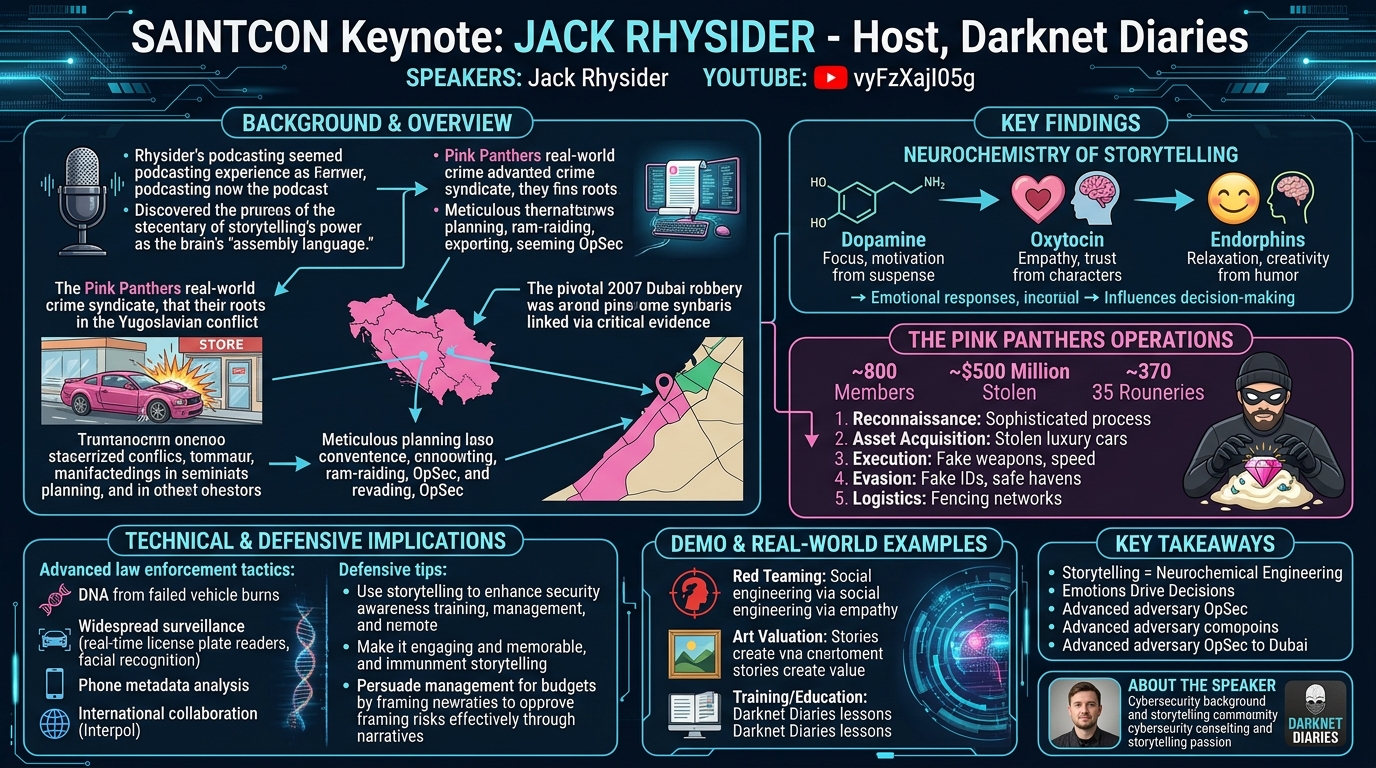
The genesis of Rhysider's insights into storytelling began with his own experience as a podcaster, noticing an inexplicable engagement with seemingly mundane topics when presented through a compelling narrative. This led him to research the neurochemical reactions triggered by good storytelling, a realization he describes as understanding the "assembly language" or "machine code" of the human brain. He identifies dopamine for focus and motivation, oxytocin for empathy and trust, and endorphins for relaxation and creativity (often through laughter) as key neurochemicals at play.
The real-world narrative anchoring the talk is the story of the Pink Panthers, a notorious international jewel thief network. Their emergence is deeply contextualized by the geopolitical landscape of the 1990s, specifically the violent dissolution of Yugoslavia. The ensuing wars, economic collapse, and perceived abandonment or even hostility from international bodies like the US, UN, NATO, and EU created a generation of individuals, many with military backgrounds, who felt alienated and dispossessed. This environment fostered a unique blend of combat experience, resourcefulness, and a profound sense of grievance, leading some to view high-value theft from wealthy targets as a justified means of survival and retribution. Interpol initially struggled to connect numerous seemingly disparate robberies across Europe. It was the audacious 2007 Waffy Mall robbery in Dubai that provided the crucial "lynchpin" evidence, linking multiple cases and revealing the immense scale and organization of the Pink Panthers, eventually earning them their moniker, reportedly due to a jewel hidden in face cream, reminiscent of the Pink Panther Strikes Again film.
Key Findings
▶ Watch: Strict rule: No injuries to avoid Interpol involvement (4:00)
Rhysider’s keynote delivers several profound findings, bridging the gap between criminal operations and the psychological impact of communication:
First and foremost, the talk reveals that storytelling directly triggers specific neurochemical reactions in the brain. Rhysider meticulously illustrates how suspense and cliffhangers release dopamine, enhancing focus, motivation, and memory. Building empathy and understanding for characters, even antagonists, stimulates oxytocin, fostering feelings of generosity, trust, and bonding. Finally, humor and resolution are shown to induce endorphins and serotonin, leading to relaxation, creativity, and a sense of well-being. This neurochemical manipulation, Rhysider argues, is the "machine code" behind human emotional responses to narratives.
Secondly, the presentation underscores that human decision-making is heavily influenced by emotion, not solely rational thought. Rhysider challenges the notion of purely stoic, logical decision-making, positing that fundamental choices—from relationships to health habits—are often rooted in emotional triggers. Recognizing this emotional driver is critical for anyone seeking to persuade, educate, or motivate.
Thirdly, the talk unveils the sophistication and scale of the Pink Panthers criminal enterprise. This syndicate, estimated to have involved up to 800 members, was responsible for an astonishing $500 million in stolen goods over 20 years, committing 370 robberies across 35 countries. Their operations were characterized by meticulous planning, professional execution, and robust evasion strategies, indicating a highly adaptable and resilient adversary. The Dubai robbery, with its estimated $3 million haul, served as a critical turning point in understanding their interconnectedness.
Finally, Rhysider demonstrates that storytelling is an exceptionally powerful tool for persuasion, teaching, and even practical security applications. He provides examples ranging from red teaming (using empathy to bypass physical security) to winning court cases, securing budget approvals, and enhancing training effectiveness. By framing information within a compelling narrative, the value and impact of the message are significantly amplified, making it more memorable and actionable than mere factual presentation.
Technical Deep Dive
▶ Watch: Transition to the actual April 2007 heist execution (6:00)
While not "technical" in the traditional sense of software exploits or network protocols, Rhysider's talk provides a deep dive into two distinct yet interconnected "technical" domains: the sophisticated operational security (OpSec) and tradecraft of the Pink Panthers, and the neurochemical "wetware" engineering of effective storytelling.
Pink Panthers' Operational Deep Dive:
The Pink Panthers exhibited an extraordinary level of planning and execution, akin to a highly professional military operation. Their methodology involved:
- Reconnaissance and Planning: Extensive pre-operation scouting, as exemplified by "Bojana" in the Dubai heist. This included identifying specific high-value targets (House of Graff in Waffy Mall), detailed layout analysis, planning ingress/egress routes, establishing hideouts, and arranging transportation. Targets were selected with precision, focusing on specific high-value items, not random grabs.
- Asset Acquisition: A critical early step was the acquisition of specific, high-performance getaway vehicles. For the Dubai robbery, two Audi A8s were stolen from Abu Dhabi, demonstrating a deep understanding of vehicle security systems and hotwiring techniques. This specific requirement, even leading to cross-city theft, highlights their preference for predictable, powerful vehicles.
- Execution - The "Ram-Raid" Tactic: The signature tactic involved ram-raiding, where vehicles were driven directly into the target store, often in reverse, to breach physical barriers and create an opening. The Dubai operation involved two cars, the first ramming the doors open, and the second following to smash directly into the display cases. This aggressive, high-impact entry was performed with extreme speed and precision, often within a 30-second window for the actual theft.
- Minimizing International Law Enforcement Engagement: A key operational constraint was to avoid causing injury. The robbers carried fake guns and explicitly avoided physical confrontation with security or bystanders. This was a strategic decision to prevent the incident from escalating to a level that would trigger an aggressive, high-priority response from Interpol, which typically prioritizes cases involving violence or significant harm.
- Evasion and Exfiltration:
- Identity Deception: Robbers used fake visas, passports, and names for entry and exit from countries.
- Multi-Stage Getaway: After the robbery, they would quickly switch to pre-arranged getaway vehicles, often discarding and attempting to destroy the initial stolen cars by setting them on fire. The Dubai case revealed a partial failure in this, where one car's fire was suffocated due to lack of oxygen, leaving valuable DNA evidence.
- Disguises: Beyond masks, some operations involved elaborate disguises, such as prosthetic faces or dressing as women in burkas, even utilizing motorcycles inside multi-story malls for complex escapes.
- Safe Havens: They leveraged the political climate of their home countries, particularly Serbia and Montenegro (post-Yugoslavia), which at times were uncooperative with Interpol requests, providing a degree of sanctuary.
- Logistics and Fencing:
- Sponsor System: Operations were funded by "sponsors" who covered flights, cash, and most importantly, secured three different apartments: one for arrival, one for bug-out, and a third for stashing the stolen jewels.
- Asynchronous Jewel Holding: A dedicated "jewel holder" would retain the stolen goods, often from multiple robberies, until the sponsor could arrange collection.
- Fencing Network: The jewels were eventually trafficked to major diamond trading centers like Antwerp and Brussels for sale, indicating a well-established, global fencing network.
Law Enforcement Response and Counter-Tactics:
Dubai Police and Interpol employed advanced capabilities to dismantle the network:
- Forensics: DNA evidence from the partially burned getaway car was crucial.
- Advanced Surveillance: Dubai's robust surveillance infrastructure utilized police cars equipped with real-time license plate readers and facial recognition systems. This allowed for tracking of wanted vehicles and individuals.
- Phone Metadata Analysis: Once an individual was identified, police could analyze phone call metadata (start/end times, locations) and linked contacts to map out the network.
- International Collaboration: Interpol's global database and cross-border cooperation were essential to connecting individual robberies and identifying the syndicate.
Neurochemical Engineering through Storytelling:
Rhysider's "technical deep dive" into storytelling involves understanding how specific narrative structures manipulate brain chemistry:
- Anecdote and Question Structure: His core building blocks are compelling anecdotes (narratives that create forward momentum and curiosity) interspersed with questions (that prompt active engagement and anticipation).
- Conflict, Tension, and Suspense: These elements are designed to release dopamine, creating heightened focus and motivation in the listener.
- Character Development and Empathy: By providing background and context for characters, even "bad guys" like the Pink Panthers, Rhysider triggers oxytocin, fostering understanding, trust, and even a sense of generosity or bonding.
- Humor and Resolution: Strategic use of funny bits or satisfying resolutions helps release endorphins and serotonin, leading to positive emotional states and making the information more memorable.
- Teaching and Persuasion: By weaving technical or philosophical lessons into these emotionally engaging narratives, information is absorbed more effectively, leading to better retention and influencing decision-making.
This intricate interplay between criminal tradecraft, law enforcement's technical response, and the psychological mechanisms of storytelling forms the "technical deep dive" of Rhysider's unique keynote.
Demo / Proof of Concept
▶ Watch: Dramatic execution of the mall and store ram-raid (7:00)
While this talk does not feature a traditional software or hardware demonstration, Jack Rhysider’s entire presentation serves as a live, compelling proof of concept for the power of storytelling. The initial, fictionalized account of the Dubai heist, presented with intense suspense and detail, is itself a direct demonstration of how a well-crafted narrative can immediately engage an audience and trigger neurochemical responses like dopamine release, increasing focus and motivation.
Rhysider explicitly pauses his narrative to ask the audience if they feel a "heightened sense of focus" or "motivation," directly linking their internal experience to the neurochemical effects of his storytelling. Later, after detailing the Pink Panthers' motivations rooted in the collapse of Yugoslavia, he again prompts the audience, asking if they feel "more generous" or empathetic, attributing this to the release of oxytocin through character development and emotional connection. The lighthearted anecdote about trying to enter a temple and the subsequent "Google, call Mom" experiment, which elicits laughter and applause, demonstrates the release of endorphins and their effect on relaxation and creativity.
Beyond these direct audience engagements, Rhysider provides several real-world examples of storytelling as a practical tool:
- Red Teaming/Social Engineering: He recounts a story of a physical penetration tester who used a pregnancy suit and full arms to evoke empathy, causing people to hold doors open and grant access without question. This is a clear demonstration of using non-verbal storytelling to bypass security.
- Budget and Management Approvals: Instead of dry facts, Rhysider illustrates how a story about a nearby office being robbed due to a simple door latch failure is far more effective in convincing management to invest in door security than a direct request for funds.
- Art Valuation: The anecdote of a seemingly "garbage" piece of art increasing dramatically in value once the story of an elephant painting it was revealed, highlights how narrative can fundamentally alter perceived value.
- Training and Education: Rhysider emphasizes his own use of storytelling in Darknet Diaries to embed technical or philosophical lessons, making learning more engaging and memorable.
Thus, the entire keynote functions as an extended, interactive demonstration of the principles Rhysider advocates, proving that the abstract concepts of neurochemistry and narrative have tangible, observable effects on human perception and behavior.
Defensive Implications
▶ Watch: Revealing the dopamine effect of effective storytelling (8:00)
Jack Rhysider's keynote, though not directly focused on defensive technologies, offers crucial insights for cybersecurity defenders by highlighting the human element in both offense and defense, and the power of effective communication.
Firstly, understanding the motivations and operational methodologies of sophisticated adversaries is a critical defensive implication. The detailed account of the Pink Panthers reveals an adversary driven by socio-economic hardship and resentment, possessing military-grade planning, execution, and evasion skills. Defenders, especially those dealing with physical security or insider threats, must recognize that some adversaries are highly professional, meticulously planned, and will leverage any weakness, from basic physical vulnerabilities (ram-raiding) to geopolitical safe havens. This necessitates comprehensive threat modeling that accounts for both technical and human attack vectors, including potential social engineering components.
Secondly, the talk underscores the immense value of advanced surveillance and forensic capabilities for law enforcement, which translates directly to enterprise security. Dubai's use of real-time license plate readers, facial recognition on police vehicles, and robust phone metadata analysis demonstrates the power of ubiquitous monitoring for tracking adversaries. For organizations, this implies the importance of investing in comprehensive logging, anomaly detection, and correlation capabilities across physical and digital domains. The "lynchpin" effect, where a single piece of evidence (like the DNA from the failed car burn) can unravel an entire criminal enterprise, emphasizes the need for meticulous forensic readiness and data retention.
Thirdly, and perhaps most profoundly for cybersecurity, Rhysider's exploration of storytelling as a neurochemical tool provides a powerful framework for improving security awareness and culture. Traditional security training often fails because it's dry and factual, ignoring the emotional drivers of human behavior. By understanding how to trigger dopamine (for focus on threats), oxytocin (for building trust in security teams and fostering a sense of collective responsibility), and endorphins/serotonin (for positive reinforcement), security professionals can craft training programs that are not only informative but also genuinely engaging and memorable. This can lead to better adherence to security policies, more vigilant employees, and a stronger overall security posture.
Finally, the talk offers insights into persuading management and securing security budgets. Just as Rhysider demonstrated how a story about a real-world breach is more effective than a technical plea for door security, security leaders can leverage storytelling to contextualize risks and justify investments. Framing a technical vulnerability within a narrative of potential business impact, reputational damage, or customer trust erosion will resonate far more with non-technical stakeholders than a list of CVEs or compliance mandates. Understanding that decisions are often emotion-driven empowers defenders to communicate security risks in a way that truly moves the needle, fostering a culture where security is seen not just as a cost center, but as an integral part of business resilience.
Key Takeaways
- Storytelling is a Powerful Neurochemical Tool: Effective narratives directly trigger neurochemical responses (dopamine, oxytocin, endorphins, serotonin) in the brain, influencing focus, motivation, memory, empathy, and emotional states.
- Emotions Drive Decisions: Human decision-making is often rooted in emotional responses rather than purely rational thought, a critical factor for influencing behavior in security contexts.
- Sophisticated Adversaries Exist: Groups like the Pink Panthers exemplify highly organized, professional criminal syndicates with meticulous planning, advanced tradecraft, and complex evasion strategies, often driven by profound socio-economic motivations.
- Integrated Law Enforcement Capabilities are Key: Combating such groups requires advanced surveillance (facial recognition, license plate readers, phone metadata analysis) and robust international cooperation (Interpol) to connect disparate evidence.
- Storytelling Enhances Security Communication: Security professionals can leverage storytelling to improve awareness training, gain budget approval, and effectively communicate risks by making messages more engaging, memorable, and emotionally resonant.
- Understand Your "Wetware": Recognizing how the brain processes information and responds to narrative allows for more effective persuasion, teaching, and self-awareness in both personal and professional security domains.
About the Speaker(s)
Jack Rhysider is the acclaimed host and creator of Darknet Diaries, a popular podcast that delves into true stories from the dark side of the internet. With a background in cybersecurity, Rhysider combines his technical understanding with a profound appreciation for narrative to explore tales of hackers, breaches, cybercrime, and digital espionage. His passion lies not just in recounting these stories, but in understanding the underlying psychological mechanisms that make them compelling. He views storytelling as a form of "neurochemical engineering," meticulously crafting his narratives to engage listeners on a primal level, triggering specific emotional and cognitive responses. Rhysider is dedicated to teaching and informing his audience, seamlessly weaving technical and philosophical lessons into his captivating tales, making complex security topics accessible and impactful.