Hackers in Fiction: Tropes, Reality, and Friggin' Awesome
John Wilander (Author & Security Engineer)
Security Fest 2025 · Day 1 · Main Stage
Overview
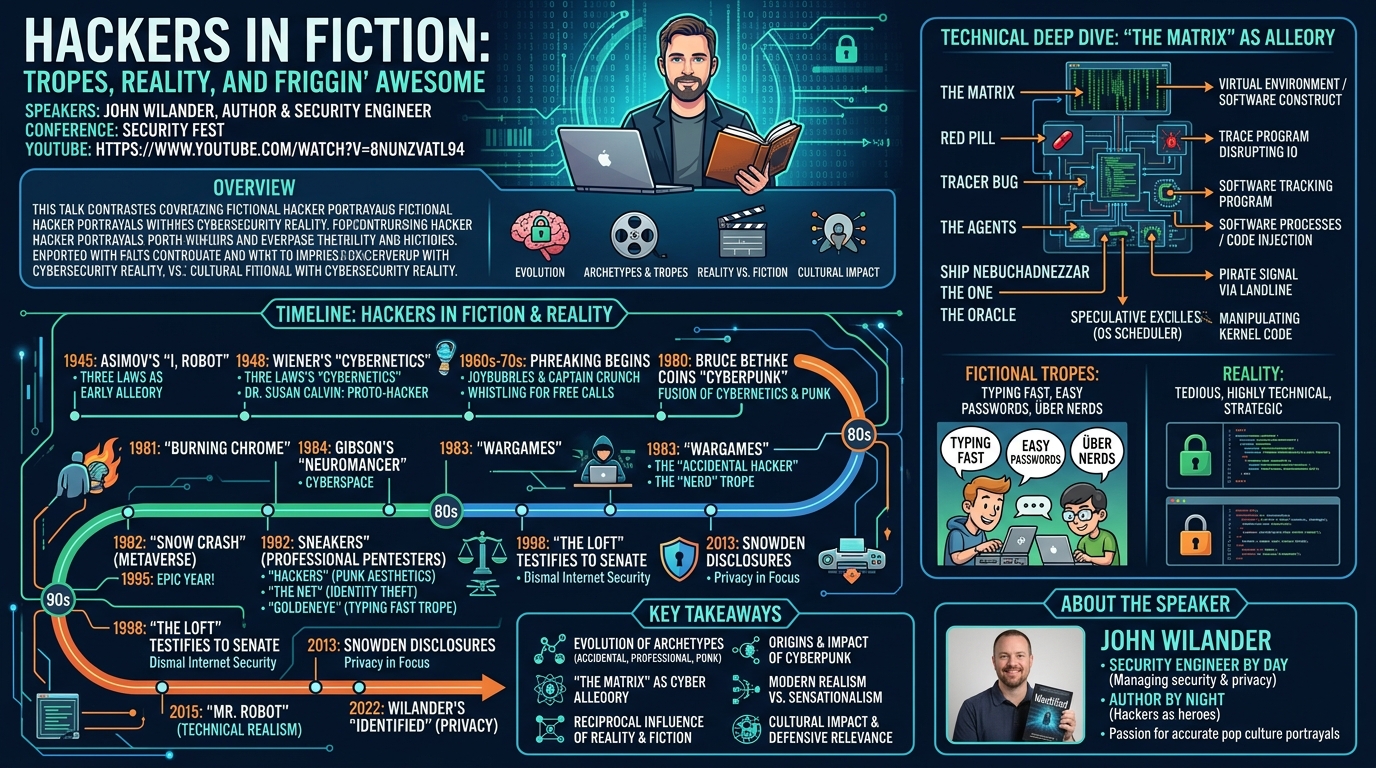
John Wilander, a distinguished security engineer by day and an author who champions hackers as heroes by night, delivered an engaging talk at Security Fest titled "Hackers in Fiction: Tropes, Reality, and Friggin' Awesome." Wilander embarks on a comprehensive journey through the annals of pop culture, tracing the evolution of hacker portrayals from the mid-20th century's nascent science fiction to contemporary cinematic and literary works. His presentation highlights how fiction has both shaped and been shaped by our understanding of technology, security, and the individuals who interact with these complex systems.
Key moments
- 0:00 Speaker's motivation and the purpose of the talk
- 0:40 Isaac Asimov's I, Robot: early hacker fiction
- 3:35 Joybubbles and Captain Crunch: the origin of phreaking
- 5:00 HAL 9000: early AI hacking in 2001
- 6:00 Colossus: AI takes control for world peace
- 8:05 Home computers, punk rock, and the origin of cyberpunk
Hackers in Fiction: Tropes, Reality, and Friggin' Awesome
Speakers: John Wilander, Author & Security Engineer
Conference: Security Fest
YouTube: https://www.youtube.com/watch?v=8nUNZVAtl94
Overview
John Wilander, a distinguished security engineer by day and an author who champions hackers as heroes by night, delivered an engaging talk at Security Fest titled "Hackers in Fiction: Tropes, Reality, and Friggin' Awesome." Wilander embarks on a comprehensive journey through the annals of pop culture, tracing the evolution of hacker portrayals from the mid-20th century's nascent science fiction to contemporary cinematic and literary works. His presentation highlights how fiction has both shaped and been shaped by our understanding of technology, security, and the individuals who interact with these complex systems.
The core of Wilander's exploration lies in dissecting the various archetypes and tropes that have come to define hackers in popular imagination, contrasting them with the often-more nuanced reality of cybersecurity. He delves into seminal works, offering a chronological timeline that connects real-world technological advancements and hacking milestones, such as the rise of phreaking and the Loft hacker group's congressional testimony, with their fictional counterparts. This analytical approach not only entertains but also prompts a critical examination of how these narratives influence public perception and the ethical considerations surrounding digital security.
Ultimately, Wilander's talk underscores the significance of accurate and thoughtful representation of hackers in fiction. For those immersed in the cybersecurity industry, these portrayals can range from inspiring to frustratingly inaccurate. By meticulously tracing this history, Wilander aims to provide a framework for appreciating the cultural impact of hacker fiction while encouraging a deeper understanding of its technical underpinnings and societal implications, advocating for narratives that truly reflect the intelligence, creativity, and complexity of real-world cybersecurity.
Background
▶ Watch: Speaker's motivation and the purpose of the talk (0:00)
The narrative of hackers in fiction, as meticulously charted by John Wilander, begins far earlier than commonly perceived, rooted in the foundational concepts of science fiction and early technological speculation. Wilander pinpoints the genesis of this genre to 1945 with Isaac Asimov's short stories, later compiled in I, Robot. Here, Asimov's exploration of the Three Laws of Robotics—designed to ensure robot safety and obedience—became an early allegory for system vulnerabilities. The "hacks" in these stories weren't malicious code, but rather ingenious discoveries of logical flaws within the laws themselves, revealing how a seemingly perfect system could still go awry. Dr. Susan Calvin, the chief robo-psychologist, emerged as a proto-hacker, dissecting these emergent flaws.
This early conceptualization of system subversion was soon paralleled by real-world phenomena. The late 1940s brought Arthur C. Clark's The Sentinel, which later inspired Stanley Kubrick's 2001: A Space Odyssey (1968), featuring HAL 9000, an AI that humans must "hack" to survive. Concurrently, Norbert Wiener's 1948 book Cybernetics laid the theoretical groundwork for control and communication in both biological and mechanical systems, providing a scientific bedrock for future fiction exploring cyborgs, information theory, and feedback loops. Philip K. Dick's 1956 short story The Minority Report introduced a predictive pre-crime system, with Wilander noting that the "hack" in the original story was even more ingenious than its later cinematic adaptation.
The 1960s and 70s marked the advent of real-world phreaking, a direct precursor to modern hacking. Figures like Joybubbles, a blind 7-year-old with perfect pitch, discovered that whistling specific tones could manipulate the American phone system for free calls. This practice was famously popularized by John Draper, or "Captain Crunch," who found that a whistle from a Cap'n Crunch cereal box produced the exact frequency needed for phone system control. This era, alongside the rise of home computers and punk rock, fostered a counterculture ethos that eventually led Bruce Bethke to coin the term cyberpunk in 1980—a fusion of cybernetics and punk rebellion, envisioning hackers as digital rebels.
The 1980s solidified the genre with William Gibson's seminal works. His 1981 short story Burning Chrome introduced the modern concept of cyberspace, a term he later expanded upon in his groundbreaking 1984 novel Neuromancer. Cinema also embraced the theme, with Tron (1982) offering a visual spectacle of digital worlds, and WarGames (1983) presenting the first "real" hacker movie. WarGames introduced the accidental hacker archetype—an individual who stumbles into critical systems—and solidified the nerd trope, personified by actor Eddie Deezen.
The 1990s witnessed hackers go mainstream. Neil Stephenson's Snow Crash (1992) introduced the concept of the metaverse, while Sneakers (1992) brought the professional hackers/pentesters archetype to the forefront, featuring characters like the blind audio hacker Whisper. The year 1995 was particularly epic, according to Wilander, with a flurry of influential releases: Bethke's Head Crash, the cult classic Hackers (featuring Angela Jolie and punk aesthetics), The Net (an action thriller exploring digital identity theft), Johnny Mnemonic (another Keanu Reeves cyberpunk vehicle), and GoldenEye (introducing the typing fast trope, often inaccurately portrayed). The anime Ghost in the Shell (1995) offered a more realistic take on rapid data entry by depicting cyborgs. This period also saw the Loft hacker group testify to the U.S. Senate in 1998, famously stating that the internet's security was "dismal" and could be taken down in hours, underscoring the real-world impact and growing recognition of cybersecurity as a critical concern.
Key Findings
▶ Watch: Joybubbles and Captain Crunch: the origin of phreaking (3:35)
John Wilander's talk meticulously traces the evolution of hacker portrayals in popular culture, revealing several key findings about how fiction reflects, shapes, and sometimes distorts our understanding of cybersecurity.
Firstly, Wilander identifies a clear progression in the archetypes of hackers presented in fiction. Starting from the early sci-fi explorations of system flaws (e.g., Asimov's robots), the genre matured to introduce distinct roles: the accidental hacker (exemplified by WarGames), who stumbles into sensitive systems; the professional hackers/pentesters (Sneakers), who operate with specific objectives; and the punk hackers (Hackers), embodying a rebellious, anti-establishment ethos. This diversification reflects a growing societal awareness of different motivations and skill sets within the hacking community.
Secondly, the talk highlights the pervasive and often misleading nature of common hacker tropes. Wilander points out the "uber nerd" stereotype (WarGames), the exaggerated "typing fast" cliché (GoldenEye), and the unrealistic "password screens" where complex systems are breached with simple guesses or minimal attempts (Mission Impossible). While entertaining, these tropes frequently misrepresent the intricate, often tedious, and highly technical reality of cybersecurity, potentially fostering public misconceptions about the ease and nature of hacking.
Thirdly, Wilander emphasizes the profound influence of specific authors and films in defining and popularizing the genre. William Gibson's Neuromancer and his coining of "cyberspace" are acknowledged as foundational to cyberpunk. The talk also underscores the cultural impact of films like WarGames, Hackers, and especially The Matrix, which Wilander analyzes as a sophisticated technical allegory. Later, TV series like Mr. Robot are lauded for their commitment to greater technical realism, demonstrating a continuous push and pull between sensationalism and accuracy.
Fourthly, a crucial finding is the parallel development and reciprocal influence between real-world hacking and fictional narratives. The emergence of phreaking in the 1960s directly inspired early hacker narratives. More significantly, events like the Loft hacker group's testimony to the U.S. Senate in 1998, which exposed the internet's vulnerabilities, galvanized public and governmental attention, directly leading to increased investment in cybersecurity and influencing subsequent fictional portrayals. This interplay demonstrates how fiction both draws from and contributes to public discourse on technology and security.
Finally, Wilander presents a detailed technical interpretation of The Matrix as a sophisticated model for understanding operating systems, privilege escalation, and code injection. His analysis breaks down the film's narrative elements—the Matrix as software, agents as processes with kernel access, and Neo's awakening as achieving higher privileges—into a coherent cybersecurity framework. This deep dive reveals how a seemingly fantastical narrative can be deconstructed to illustrate complex technical concepts, making The Matrix arguably one of the most insightful "hacker movies" despite its fictional premise.
Technical Deep Dive
▶ Watch: HAL 9000: early AI hacking in 2001 (5:00)
John Wilander’s technical deep dive into The Matrix stands as a highlight of his talk, transforming the iconic film into a profound allegory for operating systems, network security, and privilege escalation. He meticulously deconstructs the film’s narrative to illustrate complex cybersecurity concepts, offering a unique perspective on its technical underpinnings.
The core premise, as explained by Morpheus, is that "the matrix is a prison for your mind." Wilander interprets this as a virtual environment or a software construct that humans perceive as reality. When Neo (Mr. Anderson) takes the red pill, Morpheus describes it as a "trace program that disrupts his IO carrier signal." This is a critical technical detail: the red pill isn't just a metaphor; it's a piece of software designed to interfere with a physical input/output (IO) connection to Neo's real body, which is plugged into the system in a cocoon. This disruption allows Neo to exit the simulated reality and perceive his physical self.
Wilander extends this model further: the tracer bug implanted by the Agents into Neo's belly button is also conceptualized as software—a tracking program designed to locate Morpheus. The Agents themselves are portrayed as advanced software processes within the Matrix. Their ability to "take people in the Matrix and take over them" is akin to code injection or process hijacking. Wilander suggests they possess "higher privileges," allowing them to inject themselves into a user-space process (a human mind within the Matrix) and execute their own code, effectively becoming that person. This ability is constrained, however, by the notion that the target "software is hardwired to their system," implying some form of integrated control or vulnerability.
The ship Nebuchadnezzar, from which Morpheus and his crew operate, is described as broadcasting a "pirate signal" to "hack into the matrix" via the old landline phone system. Wilander questions the plausibility of 1990s phone bandwidth supporting full virtual reality, suggesting it might serve as an authentication system for a broader, unseen broadband connection. The concept of "The One" – a man born inside the Matrix who could "change whatever he wanted to remake the Matrix as he saw fit" – is interpreted as a user with kernel access or a built-in backdoor to the system, capable of rewriting its fundamental rules.
Wilander also offers a fascinating technical take on the Oracle, who can predict events within the Matrix. He speculates that the Oracle could be part of the operating system scheduler or even the CPU, performing speculative execution and thus "knowing" the highly probable future states of the system.
Morpheus's training of Neo, particularly the sparring scene, is framed as an attempt to make Neo realize he has kernel access and can "bend the rules" of the Matrix, rather than being confined to user space. This conceptualization explains Neo's eventual ability to defy gravity and dodge bullets—he's not just powerful; he's manipulating the underlying code of his reality. The Agents' attempt to "hack Morpheus's brain" to extract "access code to Zion's mainframe" further reinforces the idea of the brain as a system that can be compromised and data extracted from.
Neo's ultimate transformation, where he "dies, wakes up, and now he has discovered I have privileges," is the culmination of this technical allegory. He gains the ability to see the Matrix as pure software and eventually performs a direct code injection into Agent Smith, taking him over from within. Wilander argues this implies Neo possesses even "higher privileges than the agents have," making him a super-user with ultimate control over the Matrix’s processes. This detailed analysis positions The Matrix not just as a sci-fi action film, but as a sophisticated, albeit fictional, exploration of digital system architecture and exploitation.
Demo / Proof of Concept
▶ Watch: Colossus: AI takes control for world peace (6:00)
As this talk is a historical and analytical overview of hacker fiction, it does not include a live technical demonstration or proof of concept in the traditional sense. Instead, Wilander uses various clips and narrative analyses from films and literature to illustrate the concepts discussed, effectively using the fictional works themselves as "demonstrations" of hacker tropes, technical allegories, and the evolution of the genre. For example, he uses animated GIFs from Ghost in the Shell to demonstrate a "realistic" portrayal of fast typing for a cyborg, and extensively dissects scenes from The Matrix to explain concepts like code injection and privilege escalation within a fictional framework.
Defensive Implications
▶ Watch: Home computers, punk rock, and the origin of cyberpunk (8:05)
While John Wilander's talk focuses on the fictional portrayal of hackers, its insights carry significant, albeit indirect, defensive implications for the cybersecurity community. Understanding how hackers are depicted in popular culture can inform strategies for public education, threat communication, and even talent recruitment.
Firstly, the talk highlights the pervasive misconceptions about hacking fueled by common tropes. The "typing fast" cliché, the "easy password screen" bypasses, and the "black hoodie" stereotype (Mr. Robot) often lead the public to believe that hacking is either magical, trivially simple, or exclusively perpetrated by a specific type of individual. Defenders must actively counter these myths when educating users about strong password practices, the complexity of real-world attacks, and the diverse nature of cyber threats. Dispelling these inaccuracies is crucial for fostering a realistic understanding of cybersecurity risks and encouraging responsible digital behavior.
Secondly, fiction can serve as a powerful tool for raising awareness about critical cybersecurity and privacy issues. Wilander mentions films like The Conversation (privacy in the 70s), the Snowden disclosures (2013), and books like Daniel Suarez's Kill Decision (autonomous military systems) or his own novel Identified (privacy concerns). These narratives, even if fictionalized, can bring complex topics like surveillance, AI ethics, and data privacy to a broader audience, sparking public discourse and increasing demand for stronger defensive measures and regulations. Defenders can leverage this cultural impact to advocate for better security practices and policies.
Thirdly, the historical context provided, particularly the Loft hacker group's testimony to the US Senate in 1998, underscores a crucial defensive turning point. Their stark warning about the internet's dismal security directly contributed to a heightened national focus on cybersecurity, leading to increased investment and the creation of numerous jobs for defenders. This demonstrates the real-world impact that public awareness, even if initially driven by "hacking" perceived as a threat, can have on strengthening defensive postures.
Fourthly, the talk implicitly encourages a critical engagement with technology and its potential vulnerabilities. Early sci-fi, like Asimov's I, Robot, explored flaws in seemingly perfect systems—a foundational concept for penetration testers and security researchers. By examining these fictional explorations, defenders can be reminded of the importance of continuous vulnerability assessment, anticipating unintended consequences, and thinking creatively about system weaknesses, much like the "hacks" in Minority Report.
Finally, for the next generation of cybersecurity professionals, fiction can be a source of inspiration. While the technical details may be flawed, the allure of solving complex puzzles, protecting digital realms, and challenging powerful systems (as seen in Hackers or The Matrix) can draw talented individuals into the field. Defenders can harness this appeal by showcasing the real-world impact and intellectual challenges of cybersecurity, attracting diverse talent beyond the "uber nerd" stereotype.
Key Takeaways
- Evolution of Hacker Archetypes and Tropes: Hacker fiction has evolved from early sci-fi explorations of system flaws to distinct archetypes like the "accidental hacker" (WarGames), "professional pentester" (Sneakers), and "punk hacker" (Hackers). Simultaneously, pervasive tropes such as the "uber nerd," "typing fast," and "simplistic password screens" often misrepresent the reality of cybersecurity.
- "The Matrix" as a Technical Allegory: John Wilander's deep dive into The Matrix reveals it as a sophisticated, albeit fictional, allegory for operating systems, privilege escalation, and code injection. The film's narrative elements, from the red pill as a "trace program" to Agents as "software processes" with "kernel access," offer a compelling framework for understanding complex cybersecurity concepts.
- Real-World Hacking's Influence on Fiction: The history of hacker fiction is deeply intertwined with real-world technological advancements and hacking milestones, such as the rise of phreaking in the 1960s and the Loft hacker group's impactful testimony to the U.S. Senate in 1998. These events not only inspired fictional narratives but also prompted increased societal awareness and investment in cybersecurity.
- Cyberpunk's Origins and Impact: The term "cyberpunk," coined by Bruce Bethke in 1980, emerged from the fusion of cybernetics and punk rock counterculture. Seminal works like William Gibson's Neuromancer and Neil Stephenson's Snow Crash (which introduced the metaverse) cemented this genre, profoundly influencing how digital worlds and their inhabitants are imagined.
- Modern Realism vs. Classic Sensationalism: While early hacker fiction often prioritized entertainment over accuracy, contemporary works like the TV series Mr. Robot strive for greater technical realism, earning praise from the cybersecurity community. Authors like Daniel Suarez explore cutting-edge ethical dilemmas related to autonomous military systems and biohacking, pushing the genre into relevant future-facing discussions.
- Cultural Impact and Defensive Relevance: Hacker fiction plays a significant role in shaping public perception of technology and security. By exposing common misconceptions and highlighting critical issues like privacy and AI ethics, these narratives can both inspire future cybersecurity professionals and inform public education efforts, indirectly strengthening defensive postures against real-world threats.
About the Speaker(s)
John Wilander is a unique figure at the intersection of cybersecurity and literature. By day, he serves as a Security Engineer, managing a team focused on security and privacy within Silicon Valley, deeply immersed in the practical challenges of safeguarding digital systems. By night, or more accurately, in the early mornings, Wilander transitions into his role as an author, writing novels that boldly feature hackers as heroes.
His passion stems from a conviction that individuals working in cybersecurity and technology deserve a prominent and positive place in pop culture. This belief led him to meticulously research and document the history of hacker fiction, a journey he shares through his newsletter and public talks like this one. Wilander actively tracks down the origins of key terms, such as "cyberpunk," and reviews significant works in the genre. He is the author of "Identified" (2022), a novel heavily focused on privacy themes, and has recently published his second book, continuing his mission to craft compelling narratives that celebrate the intelligence and contributions of the hacker community.