Racing for TLS Certificate Validation: A Hijacker's Guide to the Android TLS Galaxy
Sajjad Pourali, Xiufen Yu, Lianying Zhao (Associate Professor · Carleton University), Mohammad Mannan, Amr Youssef
33rd USENIX Security Symposium · Day 1 · USENIX Security '24 · USENIX Security '24
Overview
The security of mobile application communication hinges critically on the proper validation of TLS certificates presented by servers. While prior research has extensively documented vulnerabilities related to improper certificate validation in Android applications, a significant gap remained: the inability to precisely attribute these security flaws to specific components within a complex app ecosystem. This talk, presented by Lianying Zhao from Carleton University, alongside co-authors from Concordia University and Carleton University, introduces a novel approach to dissecting this problem.
Key moments
- 0:00 Introduction and the fine-grained attribution problem
- 1:40 The role of third-party libraries (SDKs) in apps
- 2:37 Introducing Marvin tool and certificate validation hijacking
- 3:26 Types of TLS certificate validation issues analyzed
- 4:19 Marvin's methodology for fine-grained attribution
- 6:08 How certificate validation hijacking technically works
- 7:54 Insecure connections: Chinese vs. Google Play apps
- 8:21 Detailed attribution cases and observed hijacking patterns
Racing for TLS Certificate Validation: A Hijacker's Guide to the Android TLS Galaxy
Speakers: Sajjad Pourali, Xiufen Yu, Lianying Zhao, Mohammad Mannan, Amr Youssef
Conference: USENIX Security '24
YouTube: https://www.youtube.com/watch?v=P_iBJ4H1B18
Overview
The security of mobile application communication hinges critically on the proper validation of TLS certificates presented by servers. While prior research has extensively documented vulnerabilities related to improper certificate validation in Android applications, a significant gap remained: the inability to precisely attribute these security flaws to specific components within a complex app ecosystem. This talk, presented by Lianying Zhao from Carleton University, alongside co-authors from Concordia University and Carleton University, introduces a novel approach to dissecting this problem.
The research unveils a tool named Marvin, designed for fine-grained attribution of certificate validation issues, moving beyond the monolithic view of Android apps. Surprisingly, during this attribution process, the team discovered a pervasive and dangerous phenomenon they term certificate validation hijacking. This occurs when the TLS certificate for a connection initiated by one part of an app is unknowingly—and often insecurely—validated by an entirely different component, such as a third-party library. This talk details the mechanics of this hijacking, its prevalence, and its profound implications for Android app security.
The findings are particularly alarming, revealing that certificate validation hijacking affects a substantial portion of Android applications, especially those distributed through Chinese app stores. The research demonstrates how this vulnerability can be exploited for serious attacks, including phishing and sensitive data interception. By shedding light on the intricate interplay between an app's core code and its embedded third-party SDKs, this work provides crucial insights for developers, platform architects, and security researchers aiming to fortify the Android TLS ecosystem against sophisticated communication interception attacks.
Background
▶ Watch: Introduction and the fine-grained attribution problem (0:00)
The foundation of secure communication over the internet, including within mobile applications, relies heavily on Transport Layer Security (TLS), which uses certificates to authenticate servers and encrypt data in transit. A critical step in establishing a secure TLS connection is certificate validation, where the client (the Android app) verifies the authenticity and trustworthiness of the server's presented certificate. This involves a series of checks: ensuring the certificate's signature is valid, it's not self-signed (unless explicitly trusted), it hasn't expired, and crucially, that the domain name in the certificate matches the server the app is attempting to connect to (known as domain mismatch).
Historically, numerous studies have identified widespread deficiencies in how Android applications perform these validation checks. Developers often inadvertently or intentionally bypass these checks, leading to vulnerabilities like accepting self-signed certificates, ignoring expiration dates, or failing to verify hostnames. While these studies successfully flagged insecure applications, they largely treated the Android application package (APK) as a single, indivisible entity. If an insecure connection was detected, the entire app or its developer was deemed responsible, without distinguishing which specific piece of code introduced the flaw.
This monolithic view fails to acknowledge the complex reality of modern Android app development. Most Android apps are not built from scratch; they integrate a multitude of third-party libraries and Software Development Kits (SDKs) for various functionalities, such as crash reporting (e.g., Tencent Bugly), advertising (e.g., Google AdMob), analytics, and more. These SDKs often contain their own network communication logic, including TLS handling. The Android platform itself acknowledges this multi-party environment; for instance, Android 13 introduced the SDK Runtime within the Android Privacy Sandbox to isolate individual third-party SDKs, preventing them from accessing each other's resources directly. This architectural shift underscores the necessity of understanding how security responsibilities are distributed and potentially conflated across different components within a single app. The core problem, therefore, is not just that validation issues exist, but where they originate and how they can affect other parts of the application, leading to a complex web of blame and responsibility.
Key Findings
▶ Watch: Introducing Marvin tool and certificate validation hijacking (2:37)
The research yielded two primary contributions: the development of a sophisticated analysis tool and the discovery of a novel security vulnerability.
Firstly, the team developed Marvin, a specialized tool designed to perform fine-grained attribution of TLS certificate validation problems within Android applications. Unlike previous approaches that simply identified an app as insecure, Marvin can pinpoint whether the vulnerability originates from the app's own code or a specific third-party library (SDK). This level of detail is crucial for effective remediation and understanding the ecosystem's security posture.
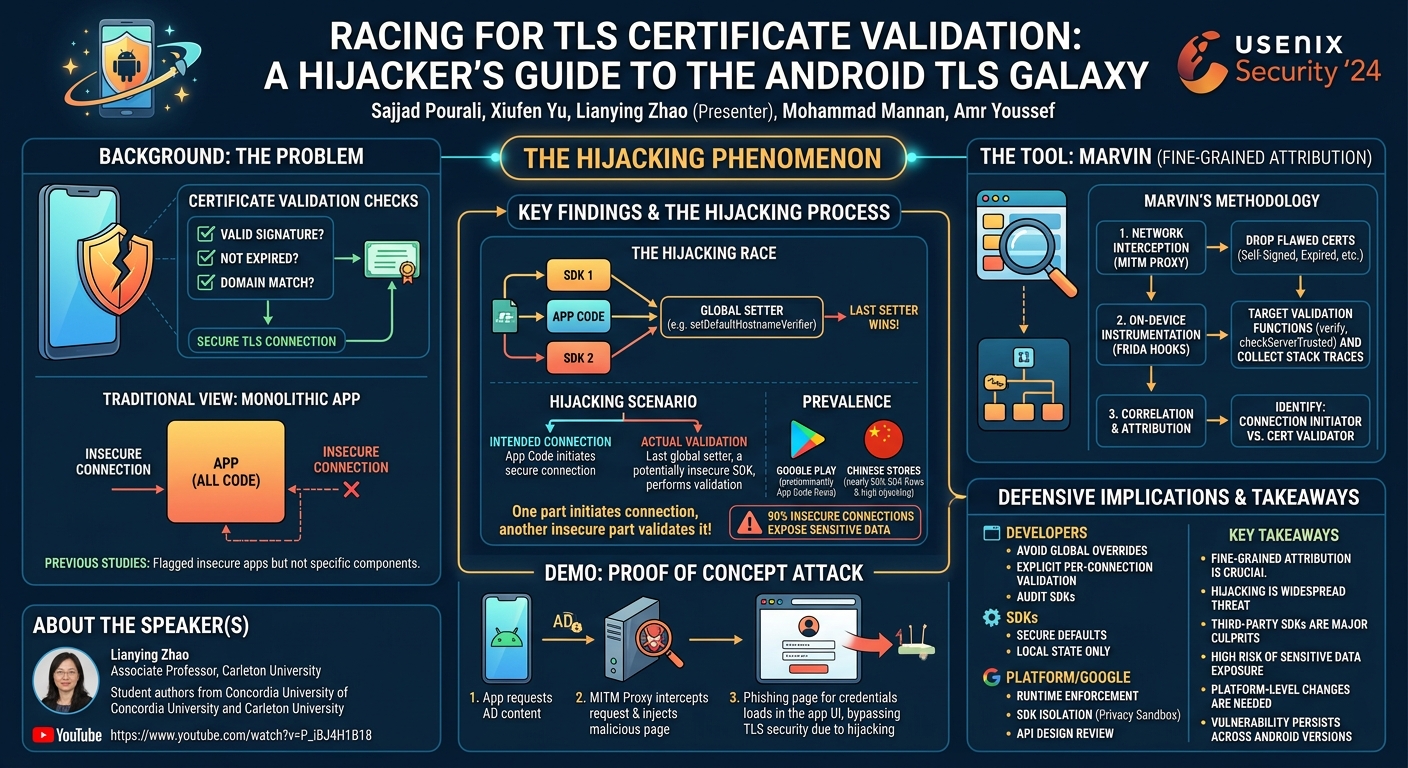
Secondly, and perhaps most surprisingly, during the process of fine-grained attribution, the researchers uncovered a critical phenomenon they termed certificate validation hijacking. This occurs when a TLS connection initiated by one party (e.g., the app's main code or a specific SDK) has its certificate validated by another, entirely different party within the same application. This often happens unknowingly to the initiating party and frequently results in insecure validation. The technical enabler for this hijacking is the pervasive support in many HTTP implementations within Android to set a global default for the class instance responsible for certificate validation (e.g., setDefaultHostnameVerifier). Crucially, the last component to call such a global setter dictates the validation behavior for all subsequent connections across the entire application, irrespective of which component initiated them.
The study's empirical analysis of approximately 5,000 Google Play apps and 3,000 apps from Chinese app stores revealed significant distinctions and alarming prevalence:
- Prevalence of Insecure Connections: More than half of the apps from Chinese app stores exhibited insecure connections due to validation issues. While lower, a notable percentage of Google Play apps also suffered from these vulnerabilities.
- Prevalence of Hijacking: The phenomenon of certificate validation hijacking was observed to be relatively similar in prevalence across both app stores, indicating a systemic issue.
- Attribution Differences:
- For Google Play apps, insecure connections were predominantly introduced by the app developer's own code.
- In stark contrast, for apps from Chinese app stores, nearly 50% of insecure connections were attributed to third-party libraries, often involving hijacking scenarios where a library validated connections initiated by other components.
- Sensitive Data Exposure: A significant finding was that almost 90% of these insecure connections involved the transmission of sensitive information, underscoring the severe risk posed by these validation flaws.
- Platform Persistence: The vulnerability of certificate validation hijacking was confirmed to exist not only in Android 13, the primary testing environment, but also in Android 14 and various other older Android versions and variants, indicating a long-standing and persistent platform-level challenge.
These findings highlight a systemic weakness in the Android TLS ecosystem, where the intricate interplay of multiple SDKs and the global nature of certain validation settings create fertile ground for security compromises.
Technical Deep Dive
▶ Watch: Marvin's methodology for fine-grained attribution (4:19)
The core of this research revolves around Marvin, a sophisticated analysis framework designed to meticulously track and attribute TLS certificate validation issues. Marvin operates in two main phases: network-side interception and on-device instrumentation, followed by correlation and attribution.
On the network side, Marvin employs a Man-in-the-Middle (MITM) proxy. For each app under test, Marvin intercepts outbound network traffic and dynamically replaces the server's original TLS certificate with one specifically crafted to exhibit a known validation flaw. The types of flaws introduced include:
- Signature Skipped/Not Verified: Certificates where the signature chain cannot be properly validated.
- Self-Signed Certificates: Certificates signed by themselves, not by a trusted Certificate Authority (CA).
- Expired Certificates: Certificates whose validity period has passed.
- Domain Mismatch: Certificates issued for a different hostname than the one the client is attempting to connect to.
If an app successfully establishes a connection despite being presented with such a problematic certificate, it is flagged as insecure and added to a pool for further, deeper analysis. If the connection is correctly rejected, Marvin reverts to the original certificate, allowing secure connections to proceed undisturbed.
The on-device analysis component is equally critical. To achieve maximum coverage of an app's network activity, Marvin automates UI interactions within each app, simulating user behavior. Crucially, it leverages Frida, a dynamic instrumentation toolkit, to hook into key TLS validation functions within the app's runtime. Specifically, Marvin targets methods within classes like HostnameVerifier (e.g., verify(), which checks for domain mismatch) and TrustManager (e.g., checkServerTrusted() and checkClientTrusted(), which handle other aspects of certificate chain validation). By hooking these functions, Marvin can collect detailed stack traces whenever a validation attempt occurs. These stack traces provide a precise call chain, indicating which code path (and thus which component) initiated the validation.
The collected network traffic data is then correlated with the on-device stack traces. This correlation allows Marvin to determine:
- Who initiated the connection: By examining the stack trace leading up to the network request.
- Who performed the certificate validation: By analyzing the stack trace within the hooked
HostnameVerifierorTrustManagermethods. - First-party vs. Third-party Code: Marvin employs heuristics, such as identifying package names that appear in a significant number of different applications, to distinguish between the app's proprietary code and embedded third-party libraries (SDKs).
The discovery of certificate validation hijacking is rooted in the architecture of many Android HTTP implementations. These implementations often allow setting a global default instance for HostnameVerifier or TrustManager. For example, a method like HttpsURLConnection.setDefaultHostnameVerifier() allows any component within the app to specify a global verifier. The critical flaw is that this setting is truly global and mutable: the last component to call such a setDefault function effectively overrides the validation logic for all subsequent HTTPS connections made by any part of the application.
The talk provides a concrete code snippet example (though not fully displayed, described as in the paper) where an SDK might override TrustManager's checkClientTrusted() and checkServerTrusted() methods with "blank" or logging-only functions. This effectively bypasses all validation for any connection using the default instance. The danger lies in the fact that the actual code initiating a connection might be expecting robust validation, but unbeknownst to it, another SDK has globally disabled or weakened it. This can even lead to race conditions, where the outcome of validation is non-deterministic, depending on which component last called a setDefault function.
The researchers specifically noted that Google's Fork of OkHttp (a popular HTTP client library) is particularly susceptible to this vulnerability because it retrieves the default validation values before each HTTPS call. This means that an override can occur at almost any point during the app's lifecycle, affecting connections dynamically. While other HTTP implementations could theoretically be vulnerable, this specific behavior in OkHttp makes it a prime target for hijacking.
Demo / Proof of Concept
▶ Watch: How certificate validation hijacking technically works (6:08)
To concretely illustrate the severe implications of certificate validation hijacking, the researchers conducted a proof-of-concept (PoC) attack against a real-world Android application. This was not a simulated environment or a custom-built vulnerable app; the attack was performed on a production application.
The demonstration involved leveraging the ability to bypass TLS certificate validation due to hijacking. By setting up a Man-in-the-Middle (MITM) scenario, the attackers were able to intercept the app's network traffic. A common vector for serving dynamic content in apps is through advertisements. In this PoC, the researchers intercepted an ad request within the target app and, instead of allowing the legitimate ad to load, they injected a phishing page into the app's UI.
This direct replacement of legitimate content with malicious content, enabled by the compromised TLS validation, vividly showcased the real-world dangers. An unsuspecting user, interacting with what appears to be a normal part of the application (an advertisement), could be presented with a fraudulent login page or a malicious prompt designed to steal credentials or sensitive personal information. This type of attack is incredibly potent because it leverages the user's inherent trust in the application itself, making the phishing attempt far more convincing and difficult to detect than typical external phishing vectors. The PoC effectively moved the theoretical vulnerability of certificate validation hijacking into the realm of practical, high-impact security threats.
Defensive Implications
▶ Watch: Detailed attribution cases and observed hijacking patterns (8:21)
The findings regarding certificate validation hijacking present significant implications for various stakeholders in the Android ecosystem, demanding both immediate and long-term defensive strategies.
For Application Developers:
- Avoid Global Overrides: Developers should be extremely cautious about using global methods like
HttpsURLConnection.setDefaultHostnameVerifier()orHttpsURLConnection.setDefaultSSLSocketFactory()(which sets the defaultTrustManager). These methods can inadvertently introduce application-wide vulnerabilities if an embedded SDK or even another part of the app code overrides them insecurely. - Explicit Validation per Connection: Where possible, developers should configure TLS validation explicitly for each
HttpsURLConnectionor HTTP client instance, rather than relying on global defaults. This ensures that the intended validation logic is applied directly to the connection. - Audit Third-Party SDKs: Given the significant attribution of insecure connections to third-party SDKs, especially in non-Google Play apps, developers must rigorously vet the security practices of every SDK they integrate. Tools like Marvin, or similar static/dynamic analysis, can help identify problematic SDKs before deployment.
- Monitor Network Traffic: Developers should monitor their app's network traffic during development and testing to identify any unexpected or insecure connections, particularly those that bypass certificate validation.
For Third-Party SDK Developers:
- Secure Defaults are Paramount: SDKs that perform network communication must implement robust TLS certificate validation by default. They should never disable validation or use insecure
TrustManagerimplementations (e.g., those that blindly trust all certificates) unless absolutely necessary and with explicit, well-documented warnings. - Avoid Global State Modification: SDKs should refrain from modifying global default TLS validation settings. If an SDK requires custom validation, it should apply that validation only to its own specific connections, using local
HostnameVerifierorTrustManagerinstances tied to its HTTP client, without affecting other components of the host application.
For the Android Platform and Google:
- Runtime Enforcement: The current approach of providing warnings in Android Studio when developers use potentially insecure validation methods is insufficient. The platform needs to move towards runtime enforcement to prevent insecure global overrides.
- SDK Isolation in Privacy Sandbox: The Android Privacy Sandbox and its SDK Runtime, introduced in Android 13, offer a promising architectural solution. If properly enforced, this isolation mechanism could prevent SDKs from sharing the same global instances of default TLS validation functions, thereby eliminating the hijacking vector. The platform needs to ensure that this isolation extends to critical security components like
HostnameVerifierandTrustManager. - API Design Review: Google should review and potentially deprecate or modify APIs that allow global, mutable overrides of critical security functions, especially when multiple independent components (SDKs) operate within the same process. Alternatives that promote explicit, per-connection security configurations should be encouraged and made easier to implement.
- Default Behavior: The default behavior of HTTP client libraries provided or recommended by the Android platform should be secure-by-default, making it harder for developers to accidentally or intentionally weaken TLS validation.
The persistence of this vulnerability across Android 13 and 14 underscores that this is a fundamental architectural challenge. A multi-pronged approach involving developer education, stricter SDK practices, and platform-level security enhancements is essential to mitigate the widespread threat of certificate validation hijacking and secure the Android TLS galaxy.
Key Takeaways
- Fine-grained attribution is crucial: Traditional monolithic analysis of Android apps fails to identify the true source of TLS certificate validation issues. Tools like Marvin are essential for pinpointing whether vulnerabilities originate from app code or specific third-party SDKs.
- Certificate validation hijacking is a widespread threat: Many Android apps are susceptible to a critical vulnerability where one component's TLS connection is insecurely validated by another component due to global default overrides.
- Third-party SDKs are major culprits: Especially in apps from Chinese app stores, third-party libraries are significant contributors to insecure connections and often involved in certificate validation hijacking, leading to widespread vulnerabilities.
- High risk of sensitive data exposure: Almost 90% of insecure connections identified transmit sensitive information, making certificate validation hijacking a direct threat to user privacy and data security.
- Platform-level changes are needed: Current Android Studio warnings are insufficient. The Android platform must implement runtime enforcement and ensure proper SDK isolation (e.g., through the SDK Runtime in the Privacy Sandbox) to prevent global security configuration overrides.
- Vulnerability persists across Android versions: The certificate validation hijacking vulnerability affects a broad range of Android versions, including Android 13 and 14, indicating a persistent and systemic issue requiring urgent attention.
About the Speaker(s)
The talk "Racing for TLS Certificate Validation: A Hijacker's Guide to the Android TLS Galaxy" was presented by Lianying Zhao, an Associate Professor at Carleton University, Canada. The research is a collaborative effort between Carleton University and Concordia University in Canada. The paper's student authors, Sajjad Pourali, Xiufen Yu, and Mohammad Mannan, were unfortunately unable to attend the conference due to visa issues. Amr Youssef is also listed as a co-author. The team's work focuses on critical aspects of Android security, particularly concerning the integrity of communication and the complex interplay of components within mobile applications.
Reviews
Dr. Zero (Offensive Security Researcher) — MUST SEE
This research uncovers a fundamental architectural flaw in Android's TLS handling, demonstrating how "certificate validation hijacking" allows third-party SDKs to globally disable security checks for an entire application. The fine-grained attribution tool, Marvin, and the empirical evidence reveal a pervasive, high-impact vulnerability that demands immediate platform-level intervention.
Heather Calloway (CISO) — MUST SEE
This research exposes a critical, systemic vulnerability in Android's TLS certificate validation, revealing how third-party SDKs can hijack security controls globally, leading to widespread insecure connections and sensitive data exposure. The work precisely attributes risk and provides clear, actionable guidance for developers, SDK providers, and the Android platform to address this pervasive institutional failure.