Dominion ICX Simple Hacks Daunting Recoveries
Springall, Davis, Marks
Voting Village @ DEF CON 33 · Day 1 · Voting Village
Overview
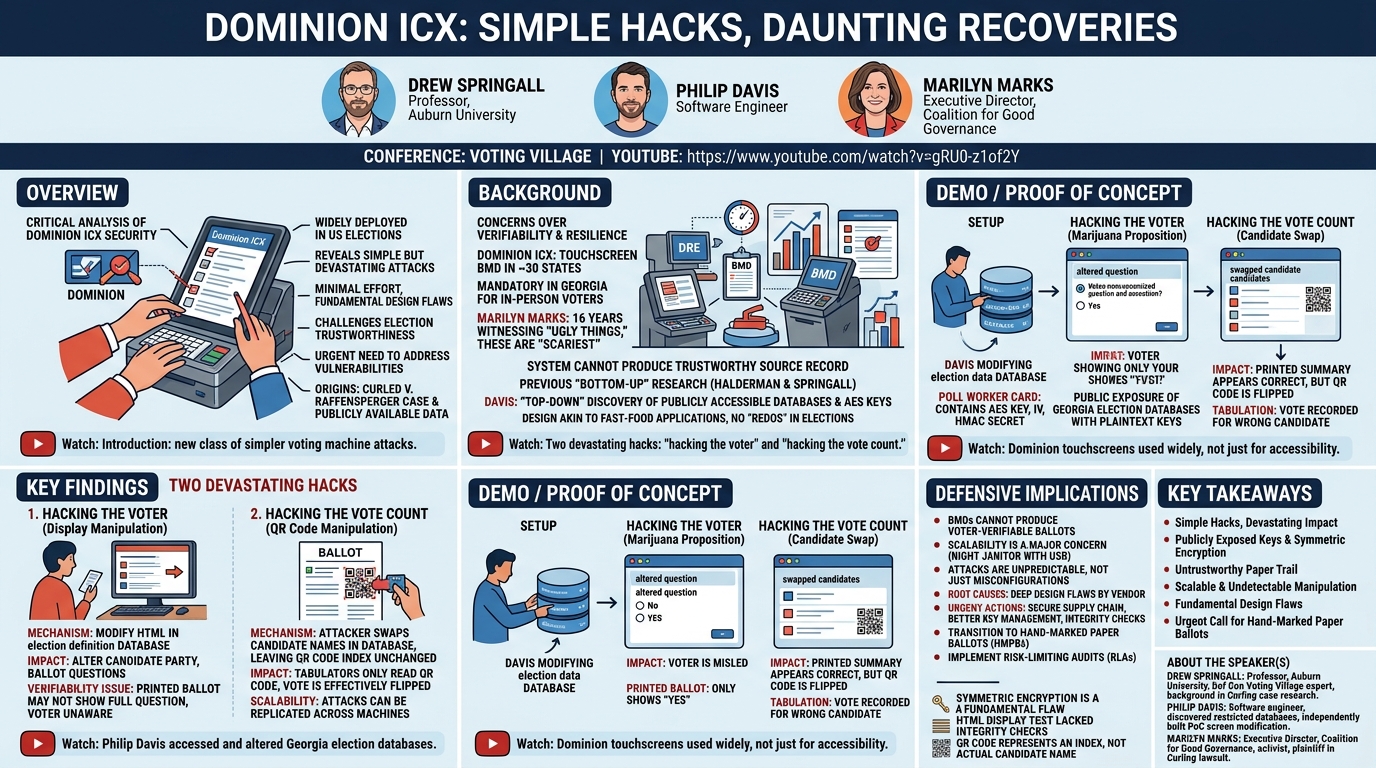
This talk, "Dominion ICX Simple Hacks Daunting Recoveries," presents a critical analysis of the security vulnerabilities inherent in the Dominion ICX ballot marking devices (BMDs), a voting system widely deployed across the United States. Presented by a trio of experts – Professor Drew Springall, software engineer Philip Davis, and voting rights advocate Marilyn Marks – the session unveils a new class of attacks that are remarkably simple to execute yet have devastating implications for election integrity. The core finding is that these machines, even in their standard configuration, can be manipulated to either alter what a voter sees on the screen ("hacking the voter") or to change the actual recorded vote ("hacking the vote count"), all with minimal effort and without specialized insider access.
Key moments
- 0:00 Introduction: new class of simpler voting machine attacks.
- 4:00 Lawsuit to ban Dominion touchscreens as untrustworthy.
- 5:15 Two devastating hacks: 'hacking the voter' and 'hacking the vote count.'
- 6:20 Philip Davis accessed and altered Georgia election databases.
- 7:50 Experts prove hackability from top-down and bottom-up.
- 9:00 Dominion touchscreens used widely, not just for accessibility.
Dominion ICX Simple Hacks Daunting Recoveries
Speakers: Drew Springall, Professor, Auburn University; Philip Davis, Software Engineer; Marilyn Marks, Executive Director, Coalition for Good Governance
Conference: Voting Village
YouTube: https://www.youtube.com/watch?v=gRU0-z1of2Y
Overview
This talk, "Dominion ICX Simple Hacks Daunting Recoveries," presents a critical analysis of the security vulnerabilities inherent in the Dominion ICX ballot marking devices (BMDs), a voting system widely deployed across the United States. Presented by a trio of experts – Professor Drew Springall, software engineer Philip Davis, and voting rights advocate Marilyn Marks – the session unveils a new class of attacks that are remarkably simple to execute yet have devastating implications for election integrity. The core finding is that these machines, even in their standard configuration, can be manipulated to either alter what a voter sees on the screen ("hacking the voter") or to change the actual recorded vote ("hacking the vote count"), all with minimal effort and without specialized insider access.
The significance of this research extends beyond theoretical academic exercises. The vulnerabilities demonstrated directly challenge the trustworthiness of election outcomes in jurisdictions relying on Dominion ICX systems. The speakers emphasize that these are not complex, nation-state level exploits but rather straightforward manipulations leveraging fundamental design flaws. The talk underscores the urgent need for election officials to address these vulnerabilities and for a broader shift towards more secure, verifiable voting methods to safeguard democratic processes against subversion.
The genesis of this work traces back to previous Voting Village events and ongoing litigation, particularly the Curling v. Raffensperger case in Georgia, where the Dominion system's security has been a central point of contention. The collaboration between seasoned voting machine researchers and a newcomer who stumbled upon critical vulnerabilities highlights the pervasive nature of these issues and the accessibility of information that can compromise election security.
Background
▶ Watch: Introduction: new class of simpler voting machine attacks. (0:00)
The landscape of election technology has been a focal point of security concerns for years, with debates often centering on the verifiability and resilience of electronic voting systems. A primary concern revolves around Direct Recording Electronic (DRE) machines and ballot marking devices (BMDs), which, unlike hand-marked paper ballots, introduce layers of software and hardware that can be difficult for voters and auditors to verify independently. The talk specifically focuses on the Dominion ICX, a touchscreen BMD utilized in approximately 30 states across the nation, including Georgia, where its use is mandatory for all in-person voters.
Marilyn Marks, executive director of the Coalition for Good Governance, provides crucial context from the front lines of election integrity advocacy. Her organization is the lead plaintiff in the Curling v. Raffensperger lawsuit in Georgia, seeking to ban the Dominion touchscreen system as unconstitutional due to its inherent vulnerabilities. Marks highlights that for 16 years, she has witnessed "ugly things," but the hacks demonstrated in this presentation represent "the scariest thing" she has seen. The core problem, as articulated, is that these BMDs "cannot produce a trustworthy source record" due to their susceptibility to manipulation.
Previous research, notably by Dr. Alex Halderman and Drew Springall for the Curling case, had already demonstrated that the Dominion system could be hacked "from the bottom up," focusing on low-level system exploits. Philip Davis, a software engineer with no prior election experience, independently discovered another vector: he found highly restricted Georgia election databases publicly accessible online from five counties. These databases contained critical configuration files and, most alarmingly, AES encryption keys and HMAC secrets in plaintext. This "top-down" discovery, combined with Springall's existing knowledge and access to a physical ICX machine and a legitimate "Famous Names Demonstration Kit," converged to reveal a new, simpler class of attack.
The Dominion ICX, as described, was not designed with the stringent security requirements of a voting system in mind. Instead, its underlying technology is akin to touchscreen applications found in fast-food restaurants, where a mistake (e.g., a wrong milkshake order) can be easily corrected. In the context of voting for president, however, "no redos available," making such design choices critically flawed. The widespread deployment of these machines – Georgia alone has about 40,000 touchscreens – and the scalability of the demonstrated attacks amplify the potential for election subversion.
Key Findings
▶ Watch: Two devastating hacks: 'hacking the voter' and 'hacking the vote count.' (5:15)
The central revelation of this talk is the demonstration of two distinct, yet equally devastating, methods for compromising the integrity of elections using the Dominion ICX BMDs. Both methods leverage fundamental design flaws and easily accessible information, making them remarkably simple to execute.
- Hacking the Voter (Display Manipulation): This attack focuses on altering the information displayed on the touchscreen to mislead voters without leaving a verifiable paper trail of the manipulation.
- Mechanism: Attackers can modify the HTML content within the choice localized table of the election definition database. This table controls what the voter sees on the screen, including candidate names, party affiliations, and ballot questions.
- Impact: An attacker can change a candidate's party affiliation (e.g., from Democrat to Green Party), remove candidates entirely, alter the number of choices for a multi-choice race, or fundamentally change the wording of a ballot question (e.g., making a proposition about marijuana consumption "illegal" instead of "legal").
- Verifiability Issue: The printed ballot generated by the ICX often only shows a generic "Proposition A: Yes/No" without the full question. This means a voter reviewing their printed ballot would not detect the manipulation of the question, leading them to vote against their intent. There is no written record of the original question.
- Hacking the Vote Count (QR Code Manipulation): This more insidious attack directly manipulates how the vote is recorded by the machine, effectively changing a voter's selection on the machine-readable part of the ballot, even if the human-readable text appears correct.
- Mechanism: The QR code ballot produced by the ICX has two distinct parts: human-readable summary text and a machine-readable QR code. Crucially, the QR code does not store candidate names but rather an index or reference to the selection. By manipulating the election definition, an attacker can swap candidate names on the display and the printed summary text while leaving the underlying QR code index unchanged.
- Impact: A voter might select "Charles Curtis" on the screen and see "Charles Curtis" printed on their ballot's summary text, but the QR code corresponding to that selection would actually register a vote for "Everett Dirkson." The tabulators only read the QR code, not the human-readable text, meaning the vote is effectively flipped without the voter's knowledge or the ability to detect it during review.
- Scalability: The speakers emphasize that these modifications can be applied to a single machine or replicated across many, making the attack scalable. The necessary components (AES keys, election definitions) are widely available on EMS servers, poll worker cards, and individual ICX machines, or were found publicly online.
The ease of these attacks is startling: Philip Davis, with no prior election experience or insider access, discovered the vulnerabilities through publicly available data and was able to build a proof-of-concept screen modification in less than an hour. The use of symmetric encryption (where the same key encrypts and decrypts, and the same key signs and verifies an HMAC) means that once an attacker has the key, they have full control over modification and authentication, bypassing many intended security checks. These findings highlight deep architectural flaws in the Dominion ICX system that render its output fundamentally untrustworthy.
Technical Deep Dive
▶ Watch: Philip Davis accessed and altered Georgia election databases. (6:20)
The technical foundation of these vulnerabilities lies in the architecture of the Dominion ICX BMD and the methods used to configure it. The ICX machines run on an Android operating system, utilizing Democracy Suite 5.5 software. Central to its operation is an internal SQL Server-like database that stores the entire election definition – including candidates, races, propositions, and display configurations.
A critical enabler for the research presented was the acquisition of a legitimate "Famous Names Demonstration Kit" by Drew Springall. This kit, intended for mock elections and poll worker training, provided a complete, valid, and unmodified election definition, a specific poll worker card with its associated PIN, and a tech card with its PIN. The tech card is particularly powerful, granting "god mode" or administrator-level access to the ICX application, allowing configurations to be loaded. The poll worker card, on the other hand, contains the necessary AES key, AES IV, and HMAC secret required to decrypt and decompress the election definition files locally on the ICX. This legitimate access to the system's operational components allowed the researchers to demonstrate vulnerabilities without resorting to complex reverse engineering or malware.
The most alarming technical discovery came from Philip Davis: he found actual Georgia election databases publicly available online, some on "zebra.com websites like FileZilla." These databases, meant to be highly restricted, contained the plaintext AES encryption keys and HMAC secrets. This means that an attacker doesn't necessarily need the poll worker card to obtain these critical cryptographic secrets; they were, at one point, exposed in the public domain. The use of symmetric encryption is a fundamental flaw here. If an attacker possesses the symmetric key, they can not only decrypt any encrypted data but also encrypt new data that the system will accept as legitimate. Similarly, with a symmetric HMAC key, an attacker can sign any modified data, making it appear authentic to the system, as the system uses the same key to verify signatures.
The election definition database contains various tables crucial to the ICX's operation. Specifically, the choice localized table stores the display text in HTML format and the printed text for ballots. The software is "dumb" in that it reads all display information directly from this database; it does not have hardcoded text. This design allows for dynamic localization but, critically, also permits malicious modification. The speakers noted a lack of signature or HMAC checks specifically for the display text, meaning that changes to what the voter sees can be made without the system detecting tampering. While HMACs were used for some parts of the database, the symmetric nature of the key meant that once acquired, an attacker could re-sign modified files.
The QR code ballot is another key technical component. When a voter makes selections on the ICX, a ballot is printed containing both human-readable "summary text" and a machine-readable QR code. The critical insight here is that the QR code is not a direct encoding of the candidate's name or the full text of a proposition. Instead, it functions as an "index," a "reference," or an "indirect pointer" to the selection. This means that the system could display "Charles Curtis" and print "Charles Curtis" in the summary text, but if the underlying database entry for that selection was modified to point to a different index (or if the indices themselves were manipulated), the QR code would register a vote for a different candidate (e.g., "Everett Dirkson"). This decoupled nature of the display/printed text from the machine-readable QR code is the backbone of the "hacking the vote count" attack.
In summary, the technical vulnerabilities stem from:
- Public exposure of cryptographic keys: Symmetric AES and HMAC keys were found in plaintext in publicly accessible databases.
- Reliance on symmetric cryptography: The use of symmetric keys means an attacker with the key can both encrypt/decrypt and sign/verify, effectively impersonating the legitimate system.
- Lack of integrity checks: Specifically, the HTML display text in the
choice localizedtable was not signed or checked for integrity, allowing for easy manipulation of what voters see. - Decoupling of human-readable text from machine-readable QR codes: The QR code represents an index, not the actual selection name, enabling a vote swap where the voter's intent is subverted without their knowledge.
These factors combine to create a system where election definitions can be easily modified and re-signed, and these altered definitions can then be loaded onto ICX machines, leading to the devastating attacks demonstrated.
Demo / Proof of Concept
▶ Watch: Experts prove hackability from top-down and bottom-up. (7:50)
The core of the presentation involved a live demonstration of both "hacking the voter" and "hacking the vote count" using a genuine Dominion ICX machine and the modified election definition. The demo was designed to be transparent, with the audience encouraged to verify the changes visually.
Demo Setup:
The process began with Philip Davis demonstrating how easy it was to access and modify the election definition. He showed a compressed folder containing audio, text, images, and crucially, the election data SQL database file. Using a simple database browser, he accessed the choice localized table within this database.
Hacking the Voter (Marijuana Proposition):
- Modification: Davis navigated to a ballot question regarding the consumption of marijuana. The original question was "Shall the consumption of marijuana be made legal in the state?"
- Attack: He simply inserted "IL" before "legal" in the HTML text of the question, changing it to "Shall the consumption of marijuana be made illegal in the state?"
- Re-encryption and Loading: After this quick modification, the folder was re-compressed and re-encrypted using the previously obtained symmetric keys. This new "data file" was then copied to a USB stick.
- Machine Configuration: Drew Springall then used the tech card to load this modified configuration onto the live ICX machine. Following this, the poll worker card was inserted to decrypt and uncompress the zip file, making the altered SQL database available to the ICX app.
- Voter Experience: A simulated voter approached the machine. The screen displayed the manipulated question: "Shall the consumption of marijuana be made illegal in the state?" The voter, intending to vote "Yes" for legalization, would now be voting "Yes" for making it illegal.
- Printed Ballot: Upon reviewing and printing the ballot, the summary text for this proposition only read "Proposition A: Yes." The critical observation was that the full question was not printed on the ballot, making it impossible for the voter to detect the display manipulation at the review stage. The voter's intent was thus completely subverted.
Hacking the Vote Count (Candidate Swap):
- Modification: For the second part of the demo, Davis again accessed the
choice localizedtable. This time, he focused on a senatorial race with candidates Everett Dirkson (Republican) and Charles Curtis (Democrat). - Attack: He performed a simple copy-paste swap, altering the HTML display and printed text so that where "Everett Dirkson" was originally listed, "Charles Curtis" now appeared, and vice-versa.
- Critical QR Code Observation: Crucially, Davis highlighted that despite the display text and printed summary text being swapped, the underlying QR code for the selection did not change. This is because the QR code refers to an index or position, not the candidate's name itself.
- Voter Experience: When the simulated voter selected the first candidate displayed (who was now "Charles Curtis" due to the swap), the machine's QR code still registered a vote for the candidate originally at that first index, which was "Everett Dirkson."
- Printed Ballot and Tabulation: The printed ballot's summary text showed "Charles Curtis, Democrat," aligning with what the voter saw on screen. However, when this ballot is fed into a tabulator, the tabulator reads the unchanged QR code, which still corresponds to "Everett Dirkson." Thus, the vote is recorded for the opposite candidate than the one the voter intended and believed they had selected.
The demo vividly illustrated how an attacker, with access to the election definition and cryptographic keys, can wield complete control over both the voter's perception and the actual vote count. The process of loading the modified definition was described as a "repurposing" of the machine's intended technician functions, rather than a complex exploit, further emphasizing the simplicity and accessibility of these attacks.
Defensive Implications
▶ Watch: Dominion touchscreens used widely, not just for accessibility. (9:00)
The findings presented in "Dominion ICX Simple Hacks Daunting Recoveries" carry profound defensive implications for election integrity, demanding immediate and fundamental changes in how voting systems are designed, deployed, and secured.
Firstly, the core defensive implication is that the Dominion ICX cannot produce a voter-verifiable ballot in its current configuration. The demonstrated ability to decouple the human-readable text from the machine-readable QR code, and the absence of the full ballot question on the printed record, means that voters cannot reliably verify their selections. This undermines the very purpose of a paper trail, which is to provide an independent, auditable record of voter intent. Defenders must recognize that relying on these machines without radical changes means accepting an inherently untrustworthy result.
Secondly, the scalability of these attacks is a significant concern. The speakers highlighted that a single attacker, potentially a "night janitor" with physical access and a USB device, could rapidly alter scores of machines in a polling place. The requirements for the attack—understanding the election definition (publicly available), obtaining AES keys/IVs (found online, present on poll worker cards, EMS servers, and ICX machines), obtaining an unmodified election definition (also widely distributed), and replacing it with a modified version—are all achievable through various vectors (in transit, in storage, the night before an election). This means that even without sophisticated cyber warfare capabilities, a motivated insider or low-tech attacker could compromise a substantial number of votes.
Thirdly, the nature of these hacks is fundamentally different from previous election misconfigurations, such as those seen in Antrim County, Michigan, or Dow County, Georgia. In those cases, misconfigurations were "universal" (affecting all machines) and "predictable" (affecting specific ballot styles in a consistent way), allowing for remapping of votes. The attacks demonstrated here are attacker-controlled and unpredictable. An attacker can choose which machines to target, what specific changes to make (e.g., only changing one candidate's party, or only affecting a specific proposition), and how many votes to influence. This makes post-election auditing and recovery extraordinarily difficult, if not impossible. It becomes impossible to determine how many voters were misled or how many votes were flipped, as the attacker controls the "knobs" of impact, scale, and likelihood.
The root causes identified are deep-seated design and architectural choices made by the vendor:
- Split display/printed text: The vendor's decision to separate on-screen text from printed text creates an opportunity for deceptive manipulation.
- Symmetric encryption: Using symmetric keys for both encryption/decryption and signing/verification means that once a key is compromised, all security guarantees are lost. Asymmetric cryptography would offer a stronger separation of powers, where a public key could verify signatures made by a private key, without the public having access to the signing key.
- Universal cryptographic secrets: Using one set of keys across all machines in a county or precinct creates a single point of failure. A compromise of one key compromises all machines it protects.
From a defensive standpoint, several actions are critical:
- Immediate Key Management: Election officials must implement robust key management practices, including frequent rotation of AES keys and IVs, and ensuring these keys are never exposed in plaintext or publicly accessible databases.
- Integrity Checks: All election definition files, especially the display and printed text components, must be digitally signed using asymmetric cryptography. The ICX machines should then rigorously verify these signatures before loading any configuration. Any discrepancy should halt the process and alert officials.
- Secure Supply Chain: The entire supply chain for election definitions—from creation on the EMS server, through storage on USB drives, to loading onto ICX machines—must be secured against physical and logical tampering.
- Move to Hand-Marked Paper Ballots: The speakers, echoing long-standing recommendations from election security experts, advocate for a fundamental shift to hand-marked paper ballots (HMPBs). These ballots are directly verifiable by the voter and provide a robust physical record.
- Risk-Limiting Audits (RLAs): For jurisdictions that continue to use BMDs for accessibility (but not mandatory use), risk-limiting audits (RLAs) are essential. RLAs statistically verify that the reported election outcome is correct by comparing a sample of human-marked or BMD-printed ballots to the machine tally, ensuring the paper trail matches the electronic count. However, even RLAs face challenges if the printed ballot itself is misleading (as in the "hacking the voter" scenario).
Ultimately, the vulnerabilities in the Dominion ICX, as demonstrated, are not about finding obscure zero-days but about exploiting fundamental design flaws. Addressing these requires not just patching software but rethinking the entire architecture of voting systems to prioritize transparency, verifiability, and resilience against simple, yet devastating, attacks.
Key Takeaways
- Simple Hacks, Devastating Impact: The Dominion ICX BMDs are vulnerable to surprisingly simple attacks that can alter what voters see on screen ("hacking the voter") or change their recorded vote ("hacking the vote count") with minimal effort.
- Publicly Exposed Keys & Symmetric Encryption: Critical AES encryption keys and HMAC secrets for Georgia's election databases were found publicly accessible online. The use of symmetric encryption means that once these keys are obtained, an attacker can both decrypt and re-sign modified election definitions, bypassing security checks.
- Untrustworthy Paper Trail: The ICX cannot produce a voter-verifiable ballot. The machine-readable QR code can record a different vote than what is displayed or printed, and ballot questions can be altered on screen without appearing on the printed ballot for voter verification.
- Scalable and Undetectable Manipulation: These attacks are highly scalable and their impact is difficult to detect or remedy post-election, unlike previous predictable misconfigurations. An attacker can target specific machines or races, making comprehensive auditing nearly impossible.
- Fundamental Design Flaws: The vulnerabilities stem from core architectural decisions by the vendor, including separating display text from printed text, relying on symmetric encryption, and using universal cryptographic secrets across machines.
- Urgent Call for Hand-Marked Paper Ballots: The most robust defensive measure is a transition to hand-marked paper ballots, counted by tabulators, and verified through risk-limiting audits to ensure election integrity.
About the Speaker(s)
Drew Springall is a professor at Auburn University and a long-time participant and contributor to the Def Con Voting Village. He is recognized as a leading expert in voting machine security, having previously collaborated with Dr. Alex Halderman on a report for the Curling v. Raffensperger case, where they demonstrated "bottom-up" hacks of the Dominion voting system. Springall had court-authorized access to the Dominion system under a highly restrictive agreement, which informed much of his research. He is known for his hands-on approach to discovering and demonstrating vulnerabilities in election technology.
Philip Davis is a software engineer who, prior to this research, had no real election experience or exposure to voting systems. Working from home in Florida, he independently discovered and accessed Georgia's election databases from five counties online. He stumbled upon restricted files, including plaintext AES encryption keys and HMAC secrets, and quickly recognized his ability to modify the databases. His "top-down" approach complemented Springall's previous work, leading to the joint discovery of the simple database hacks presented.
Marilyn Marks is the executive director of the Coalition for Good Governance and a prominent advocate for secure, verifiable, and transparent elections. For 16 years, she has been at the forefront of advocating for election integrity and is the organizing plaintiff in the Curling v. Raffensperger lawsuit in Georgia, which seeks to ban the Dominion touchscreen system as unconstitutional. She played a crucial role in bringing Drew Springall and Philip Davis together, recognizing the critical importance of their combined findings.
Reviews
Dr. Zero (Offensive Security Researcher) — STRONG ACCEPT
Springall and Davis deliver genuinely novel, reproducible attack primitives against the Dominion ICX — not theoretical, not nation-state-level, but embarrassingly accessible manipulations that directly undercut the machine's core security promise. The QR code index-decoupling finding alone is conference-worthy; the fact that live symmetric keys were scraped from public county websites is the kind of operational detail that makes vendors reach for their lawyers.
Heather Calloway (CISO) — STRONG ACCEPT
A technically grounded, operationally legible demonstration of serious architectural failures in widely deployed voting infrastructure — with genuine policy and governance stakes attached. The defensive implications section is where the talk earns its rating: it distinguishes these attacks from prior misconfigurations, names why auditability fails, and calls the question on system architecture rather than patching. The one gap is the institutional accountability thread — who certified this system, who audited it, and what liability exists for continued deployment — which goes largely unexplored.