Validating Vulnerability Analysis with Statistical Analysis of Metadata
Alexander Bushkin, Keith Grant
CVE/FIRST VulnCon 2025 · Main Stage
Overview
In an era defined by a relentless surge in reported vulnerabilities, security teams face the daunting challenge of maintaining analytical rigor amidst growing volume. This talk, presented by Alexander Bushkin and Keith Grant at VulnCon, delves into a novel approach to validating vulnerability analysis through the statistical analysis of metadata. The core problem addressed is the widening gap between the escalating number of reported flaws and the relatively static number of security analysts available to process them. This disparity necessitates a more efficient and consistent method for assessing vulnerabilities, particularly in accurately assigning impact levels early in the analysis lifecycle.
Key moments
- 0:00 Introduction and the growing vulnerability analysis challenge
- 2:40 Identifying key metadata: CVSS, CWE, component, and impact
- 3:50 Red Hat's impact categories and the challenge of correct assignment
- 4:20 Using cluster analysis to group flaws by metadata
- 6:20 Understanding CVSS vector distribution and score bias
- 7:40 CVSS vectors follow a power law distribution in dataset
Validating Vulnerability Analysis with Statistical Analysis of Metadata
Speakers: Alexander Bushkin, Keith Grant. Contributing researchers: Chess Hlett, Minra. (No titles or companies specified in the transcript or metadata.)
Conference: VulnCon
YouTube: https://www.youtube.com/watch?v=bdd7TPblXK0
Overview
In an era defined by a relentless surge in reported vulnerabilities, security teams face the daunting challenge of maintaining analytical rigor amidst growing volume. This talk, presented by Alexander Bushkin and Keith Grant at VulnCon, delves into a novel approach to validating vulnerability analysis through the statistical analysis of metadata. The core problem addressed is the widening gap between the escalating number of reported flaws and the relatively static number of security analysts available to process them. This disparity necessitates a more efficient and consistent method for assessing vulnerabilities, particularly in accurately assigning impact levels early in the analysis lifecycle.
The research, which also involved Chess Hlett and Minra, introduces a framework that leverages existing vulnerability metadata—specifically CVSS (Common Vulnerability Scoring System), CWE (Common Weakness Enumeration), and component information—to identify similarities between flaws. By transforming this disparate metadata into a unified, continuous space, analysts can perform cluster analysis to group vulnerabilities with similar characteristics. This not only aids in accelerating the analysis of familiar flaws but also provides a robust mechanism for scrutinizing outliers and validating the accuracy of impact assignments, ultimately enhancing the overall cadence and consistency of vulnerability management efforts.
The talk highlights the practical application of this methodology within Red Hat, where the accurate assignment of impact (low, moderate, important, critical) directly influences resource allocation and remediation priority. By providing analysts with a data-driven tool to contextualize new vulnerabilities against a rich historical dataset, the research aims to reduce the likelihood of misclassification and ensure that critical resources are focused on the most impactful threats, thereby optimizing defensive postures in the face of an ever-expanding threat landscape.
Background
▶ Watch: Introduction and the growing vulnerability analysis challenge (0:00)
The landscape of cybersecurity is continuously evolving, marked by an exponential increase in reported vulnerabilities each year. Despite this growth, the number of dedicated vulnerability analysts often remains stagnant, leading to an imbalance where individual analysts are tasked with evaluating an ever-larger volume of flaws. This problem necessitates innovative solutions to improve the efficiency and accuracy of vulnerability analysis. Analysts frequently encounter two types of flaws: those that are immediately understood due to prior experience or familiarity with the underlying technology, and those that are entirely novel, requiring extensive investigation. For the latter, a crucial strategy is to identify similar flaws that have been previously analyzed, providing a baseline for understanding and assessment.
The industry has long recognized the value of metadata in characterizing vulnerabilities. Standardized classification systems like CVSS and CWE provide a common language and structured data points to describe the nature and severity of flaws. CVSS vectors, for instance, detail various attack metrics, while CWE categorizes the underlying software weaknesses. Beyond these, specific component information (e.g., kernel, specific libraries) offers crucial context about the affected software. Red Hat, as a major software vendor, possesses an extensive historical database of vulnerability information, dating back to the late 1990s, offering a rich dataset for such analytical endeavors.
Within Red Hat's vulnerability management process, the assignment of an impact category (low, moderate, important, critical) is paramount. This impact level dictates the level of effort and resources allocated for remediation. Misclassifying a flaw—either overestimating its impact and expending unnecessary resources, or underestimating it and facing urgent, reactive fixes later—can have significant operational consequences. The central challenge, therefore, is to leverage the wealth of existing metadata to correctly and consistently assign impact early in the analysis process. The research presented aims to address this by exploring how statistical methods, specifically cluster analysis, can group similar flaws based on their metadata, thereby aiding analysts in making more informed and validated impact decisions. This approach seeks to identify natural groupings of flaws and potentially refine the existing impact categorization system to better reflect the underlying data.
Key Findings
▶ Watch: Red Hat's impact categories and the challenge of correct assignment (3:50)
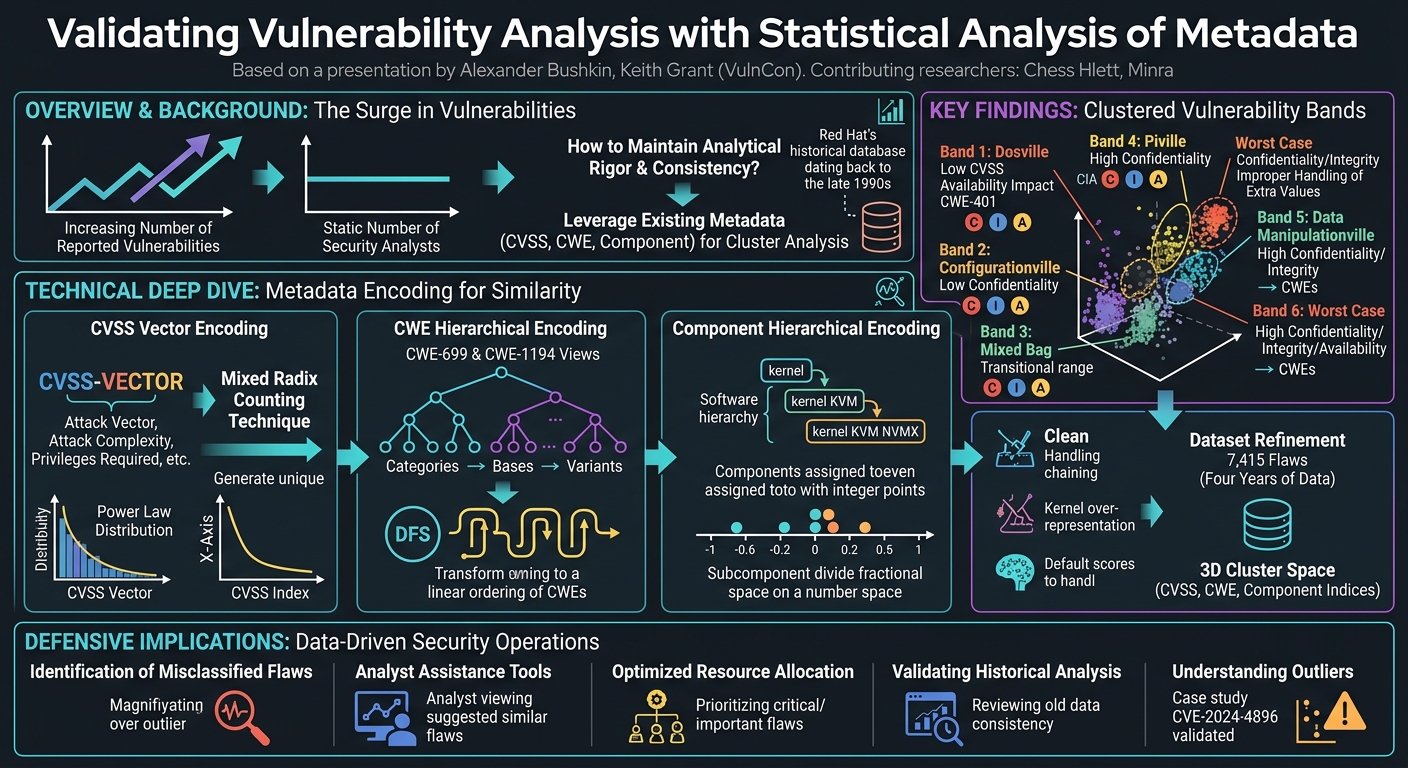
The research yielded several key findings, primarily centered on the innovative encoding of vulnerability metadata and the subsequent insights derived from cluster analysis. The core contribution is the demonstration that disparate vulnerability metadata can be transformed into a unified, continuous space, enabling effective grouping of similar flaws.
- Metadata Encoding for Similarity:
- CVSS: Instead of relying solely on the final CVSS score, the individual elements of the CVSS vector were analyzed. Correlation analysis was performed to identify which elements were most informative of the final impact. To create a continuous, similarity-preserving representation, a mixed radix counting technique was employed. This method orders CVSS elements based on their relevance to impact and treats them as bases in a number system, generating a unique index for each vector. This index ensures that similar flaws are kept close together in the data space and provides a "floor" for the CVSS score, meaning that for a given index, the score will be at least a certain minimum value.
- CWE: Recognizing that CWEs are not inherently continuous, their hierarchical structure (e.g., CWE-699 and CWE-1194 views, which contain categories, bases, and variants) was leveraged. By performing a depth-first search (DFS) on this directed graph structure, a linear ordering of CWEs was created. This ordering successfully maintained similarity, with the intuition confirmed that CWEs falling in similar hierarchical positions tend to have similar impacts, as determined by the most common impact assigned to them in the dataset.
- Component: For affected software components (e.g., kernel, specific subsystems), an arbitrary initial ordering was refined using a hierarchical division approach. Major components were assigned integer positions, and their subcomponents (e.g., kernel KVM, kernel KVM NVMX) were placed in fractional divisions within that integer range. This ensured that similar components and their subcomponents were positioned adjacently on a number line, preserving contextual similarity.
- Dataset Refinement and Clustering Results:
- The analysis was conducted on Red Hat's historical vulnerability data from the past four years. The initial dataset of approximately 14,000 flaws was rigorously cleaned and reduced to 7,415 flaws for clustering. This reduction addressed issues such as restricting CWE IDs to specific views (699 and 1194), handling chaining/or-ing of vulnerabilities, correcting for the over-representation of kernel flaws, and normalizing for default CVSS scores (e.g., 5.5) assigned before full analysis.
- The cluster analysis in the encoded 3D space (CVSS index, CWE index, Component index) revealed distinct groupings or "bands" of vulnerabilities. While component clustering showed a prevalence of kernel flaws at index one, and CWE spacing revealed gaps where no Red Hat products were impacted, the CVSS ordering produced a clear banding effect. This banding was not solely based on the CVSS score but on the similarity of the underlying vectors, indicating consistent patterns.
- Impact-Centric Bands and CWE Correlation:
- Six distinct bands were identified, each characterized by specific CIA (Confidentiality, Integrity, Availability) impact profiles and prevalent CWEs:
- Band 1 (Dosville): Predominantly low CVSS scores, characterized by Availability impact (CIA: None/None/Low). The most common CWE identified was CWE-401 (Missing Release of Memory after Effective Lifetime), which typically leads to memory exhaustion and denial of service.
- Band 2 (Configurationville): Primarily showed low Confidentiality impact (CIA: Low/None/None).
- Band 3 (Mixed Bag): Represented the middle range of CVSS scores, exhibiting varied impacts and lacking a specific dominant trend, reflecting its transitional nature.
- Band 4 (Piville): Distinguished by high Confidentiality impact (CIA: High/None/None), indicating vulnerabilities compromising sensitive information.
- Band 5 (Data Manipulationville): Marked by high Confidentiality and Integrity impacts (CIA: High/High/None). The prevalent weakness here was Improper Handling of Extra Values, often associated with buffer overflows, out-of-bounds reads/writes, and remote code execution (RCE).
- Band 6 (Worst Case): Represented the most severe flaws, with high Confidentiality, Integrity, and Availability impacts (CIA: High/High/High).
These findings demonstrate the power of carefully engineered metadata representations to uncover meaningful patterns in vulnerability data, providing a foundation for more consistent and validated analysis.
Technical Deep Dive
▶ Watch: Using cluster analysis to group flaws by metadata (4:20)
The core of this research revolves around transforming heterogeneous vulnerability metadata into a homogeneous, quantifiable representation suitable for cluster analysis. The goal was to identify "natural clusters" of flaws, thereby answering questions about the optimal number of impact categories or the distribution of flaws across existing categories.
The chosen metadata types were CVSS, CWE, and component information. Each required a unique approach to ensure that similarity was preserved in their numerical encoding.
CVSS Vector Encoding
Traditional use of CVSS often focuses on the final score (0.0-10.0). However, the talk emphasized that the CVSS vector itself, composed of numerous individual elements (e.g., Attack Vector, Attack Complexity, Privileges Required, User Interaction, Scope, Confidentiality, Integrity, Availability), holds richer information.
- CVSS Distribution Analysis:
- There are approximately 2600 unique CVSS vectors possible. Within Red Hat's dataset, only 836 unique vectors were assigned.
- These vectors resolve to 101 possible scores, but their distribution is uneven, indicating inherent biases in the scoring calculation.
- The distribution of CVSS vectors in the dataset follows a power law, meaning a few vectors account for a large number of flaws, while a long tail consists of many unique vectors representing few flaws. This highlights the challenge of finding similar flaws for unique cases.
- Element Correlation and Mixed Radix Counting:
- An initial step involved performing correlation analysis between each individual element of the CVSS vector and the final impact assigned to the flaw. This determined which elements were most informative for Red Hat's specific product context.
- To overcome the challenge of treating each element as a separate dimension (which would lead to high dimensionality and sparse matrices, hindering clustering, especially for elements with few values like Scope), a novel encoding method was devised: mixed radix counting.
- This technique treats the ordered CVSS elements as "bases" in a number system. The elements were ordered based on their relevance to impact. For example, if Scope was the "ones place," User Interaction the "tens place," and Attack Complexity the "hundreds place," a unique index could be generated for each vector.
- The resulting CVSS index (an integer on an X-axis) is not strictly ordered by the total CVSS score. However, it guarantees that similar flaws are kept close to each other in this indexed space. Crucially, as the index increases, it provides a floor for the CVSS score, meaning one can determine a minimum possible CVSS score for a given index range. This is particularly useful for differentiating between impact levels like moderate and important.
CWE Hierarchical Encoding
CWEs are designed hierarchically, forming a directed graph where categories contain bases, which contain variants, and so on. This inherent structure was exploited to create a continuous ordering.
- Graph Traversal:
- CWEs are not continuous by nature, making direct numerical assignment problematic.
- The research leveraged the hierarchical relationships within specific CWE views, primarily CWE-699 (Software Development) and CWE-1194 (Hardware Design).
- A depth-first search (DFS) algorithm was applied to these directed graphs. This traversal creates a linear ordering of CWEs where those with similar hierarchical parents or relationships are placed adjacently.
- The visual representation of this ordering showed that clusters of CWEs falling in the same place in the hierarchy tended to have similar impact profiles (e.g., less impactful CWEs grouped together, more impactful ones elsewhere), validating the approach. Gray CWEs were those not included in the dataset (often abstract categories), white were middle impact, yellow/green less impactful, and orange/red more impactful.
Component Hierarchical Encoding
The third critical metadata type was the component affected (e.g., kernel, kernel KVM, kernel KVM NVMX).
- Arbitrary to Hierarchical Ordering:
- Initially, components could be arbitrarily ordered (e.g., alphabetically). However, this wouldn't preserve similarity between a component and its subcomponents.
- The solution involved placing each "basic" component (like
kernel) on an integer point on a number line. - Subcomponents then divide that integer space. For instance,
kernel KVMwould be placed betweenkerneland the next integer, andkernel KVM NVMXwould further subdivide thekernel KVMspace. This creates a continuous number line where similar components and their subcomponents are situated next to each other, preserving their hierarchical relationship and aiding clustering.
Data Set Preparation
The raw data from Red Hat needed significant preprocessing to ensure consistency and mitigate biases:
- The analysis focused on four years of historical vulnerability data, starting with approximately 14,000 flaws.
- This was reduced to 7,415 flaws for the actual clustering. Reasons for reduction included:
- Restricting CWE IDs to the CWE-699 and CWE-1194 views to ensure consistency and focus on relevant software/hardware weaknesses.
- Handling complex scenarios like CWE chaining or ORing, which represent multiple weaknesses.
- Addressing the over-representation of kernel flaws in the dataset, which could skew results due to the high volume of kernel.org reports.
- Mitigating the impact of default CVSS scores of 5.5 assigned to vulnerabilities upon initial ingestion before full analysis, which could artificially inflate certain score ranges.
The resulting 7,415 cleaned flaws, encoded using the described methodologies, formed the basis for the 3D cluster space, allowing for the identification of the six distinct "bands" of vulnerabilities characterized by their CVSS index, CIA impact, and prevalent CWEs.
Demo / Proof of Concept
▶ Watch: Understanding CVSS vector distribution and score bias (6:20)
While the talk did not feature a live, interactive demonstration of a tool or a step-by-step proof-of-concept in the traditional sense, the speakers extensively presented the results of their cluster analysis and their banding methodology. The "bands" identified (Dosville, Configurationville, Mixed Bag, Piville, Data Manipulationville, Worst Case) served as a conceptual proof of concept, illustrating how the encoded metadata naturally groups vulnerabilities with similar characteristics and impact profiles.
The visual representations of the clustered data, particularly the CVSS index banding with associated CIA impacts and common CWEs, effectively demonstrated the practical application of their encoding and clustering techniques. For instance, the discussion of CWE-401 (Missing Release of Memory after Effective Lifetime) being prevalent in "Dosville" (low availability impact) and the connection of "Improper Handling of Extra Values" to buffer overflows and RCE in "Data Manipulationville" (high confidentiality/integrity impact) provided concrete examples of how the model correctly categorized vulnerabilities based on their underlying weaknesses and observed impacts. The final discussion of CVE-2024-4896 further served as a validation case, demonstrating how the model could identify an outlier and how subsequent manual investigation confirmed its unique, yet correct, classification.
Defensive Implications
▶ Watch: CVSS vectors follow a power law distribution in dataset (7:40)
The statistical analysis of vulnerability metadata presents several significant defensive implications for security teams, particularly those managing a high volume of vulnerabilities like Red Hat.
- Identification of Unusual or Misclassified Flaws: The clustered space allows defenders to quickly assess if a newly analyzed vulnerability is unusual compared to its neighbors. If a flaw falls outside expected clusters or is an extreme outlier, it signals a potential misclassification during analysis or highlights a genuinely unique vulnerability requiring extra scrutiny. This helps prevent both over- and under-prioritization.
- Validation of Historical Analysis: The methodology can be applied retrospectively to validate past vulnerability analyses. By examining historical flaws that appear as outliers in the cluster space, security teams can investigate whether these were correctly classified or if they warrant re-evaluation. This continuous feedback loop improves the accuracy and consistency of the entire vulnerability database.
- Enhanced Analyst Assistance Tools: The research lays the groundwork for developing analyst assistance tools. As an analyst inputs metadata (CVSS, CWE, component) for a new flaw, such a tool could "geolocate" the vulnerability within the established cluster space. It could then present the analyst with similar vulnerabilities (e.g., the four nearest neighbors) from the historical dataset. This provides immediate context, suggesting typical impact characteristics (e.g., "You're in Dosville; typical CIA is None/None/Low for this neighborhood") and helping the analyst make more informed decisions, without automating the human judgment process.
- Optimized Resource Allocation: By improving the accuracy of impact assignment early on, organizations can ensure that their most valuable resources are directed towards critical and important flaws, while less severe issues are handled appropriately without unnecessary expenditure of effort. This directly contributes to a more efficient vulnerability management program.
- Proactive Risk Assessment: Understanding the typical characteristics and impacts of vulnerabilities within certain clusters can aid in proactive risk assessment. If a new component or type of weakness emerges, its initial classification can be cross-referenced with similar historical patterns to anticipate potential impacts.
- Continuous Methodology Improvement: The research itself highlights areas for continuous improvement in vulnerability analysis methodologies. This includes exploring better search techniques, optimizing data structures, and refining how complex scenarios like CWE chaining are handled. This iterative process ensures the analytical framework remains robust and adaptable.
- Understanding and Validating Outliers: The case of CVE-2024-4896 serves as a crucial example. This critical vulnerability initially appeared as an outlier in the "Dosville" band (typically low impact). However, upon further investigation, it was confirmed to be correctly classified. It represented a rare scenario with high integrity and availability impact but no confidentiality compromise (e.g., parsing untrusted user config leading to RCE or DoS via
liby), making it genuinely unique. This demonstrates that while the system flags anomalies, it also provides a framework for validating their uniqueness rather than simply reclassifying them, reinforcing the importance of human expertise in conjunction with data-driven insights.
In essence, this methodology empowers defenders to move beyond reactive analysis, providing a data-driven framework to validate, contextualize, and streamline their vulnerability management efforts, ultimately leading to more robust and efficient security operations.
Key Takeaways
- Data-Driven Validation: Statistical analysis of vulnerability metadata provides a robust method for validating the accuracy and consistency of vulnerability analysis, especially concerning impact assignment.
- Intelligent Metadata Encoding: Transforming disparate metadata (CVSS, CWE, Component) into continuous, similarity-preserving representations (e.g., mixed radix counting for CVSS, DFS on CWE hierarchies) is crucial for effective clustering.
- Identification of Impact Bands: Cluster analysis reveals distinct "bands" or groupings of vulnerabilities, each characterized by consistent CIA impact profiles and prevalent CWEs, offering quick contextual understanding.
- Analyst Augmentation, Not Automation: The methodology is designed to assist human analysts by providing context and suggesting similar historical flaws, rather than fully automating the complex process of vulnerability assessment.
- Outlier Detection and Validation: The framework effectively identifies unusual or potentially misclassified flaws, enabling deeper investigation and validation of both common and genuinely unique vulnerabilities, such as CVE-2024-4896.
- Improved Resource Allocation: By enhancing the accuracy of early impact assessment, organizations can optimize resource allocation, ensuring that critical flaws receive appropriate attention and reducing unnecessary effort on less severe issues.
About the Speaker(s)
The primary presenters of this research at VulnCon were Alexander Bushkin and Keith Grant. They also acknowledged the significant contributions of fellow researchers Chess Hlett and Minra to this project. The transcript does not provide specific titles or company affiliations for any of the speakers or researchers mentioned.
Reviews
Dr. Zero (Offensive Security Researcher) — STRONG ACCEPT
Bushkin and Grant bring a genuinely interesting piece of applied ML/statistics work to a vuln management problem that usually gets solved with gut instinct and tribal knowledge. The core contribution — encoding CVSS vectors via mixed radix counting, CWEs via DFS graph traversal, and components via hierarchical subdivision onto a number line, then doing cluster analysis in the resulting 3D space — is clever, methodologically honest, and clearly the product of people who actually live inside a large-scale vulnerability triage operation. This is squarely a practitioner research talk from Red Hat's vuln pipeline, and it earns its slot at VulnCon by telling you something you'd have to work to…
Heather Calloway (CISO) — SOLID
A competent, methodologically interesting piece of internal vulnerability operations research from what is almost certainly a Red Hat team. The encoding techniques are genuinely clever — using mixed radix counting on CVSS vectors and DFS traversal of CWE hierarchies to preserve similarity is not trivial work. But this talk is fundamentally an internal tooling story dressed in conference format, and it never makes the leap to institutional relevance. The defensive implications are real but narrow, the governance angle is absent, and the audience who can actually act on this is a small slice of large-scale vuln management shops. Solid for VulnCon's practitioner audience. Would not travel…