The art of text (rendering)
Nicolas Rougier
39th Chaos Communication Congress (39C3): Power Cycles · Day 1 · Saal Ground
Overview
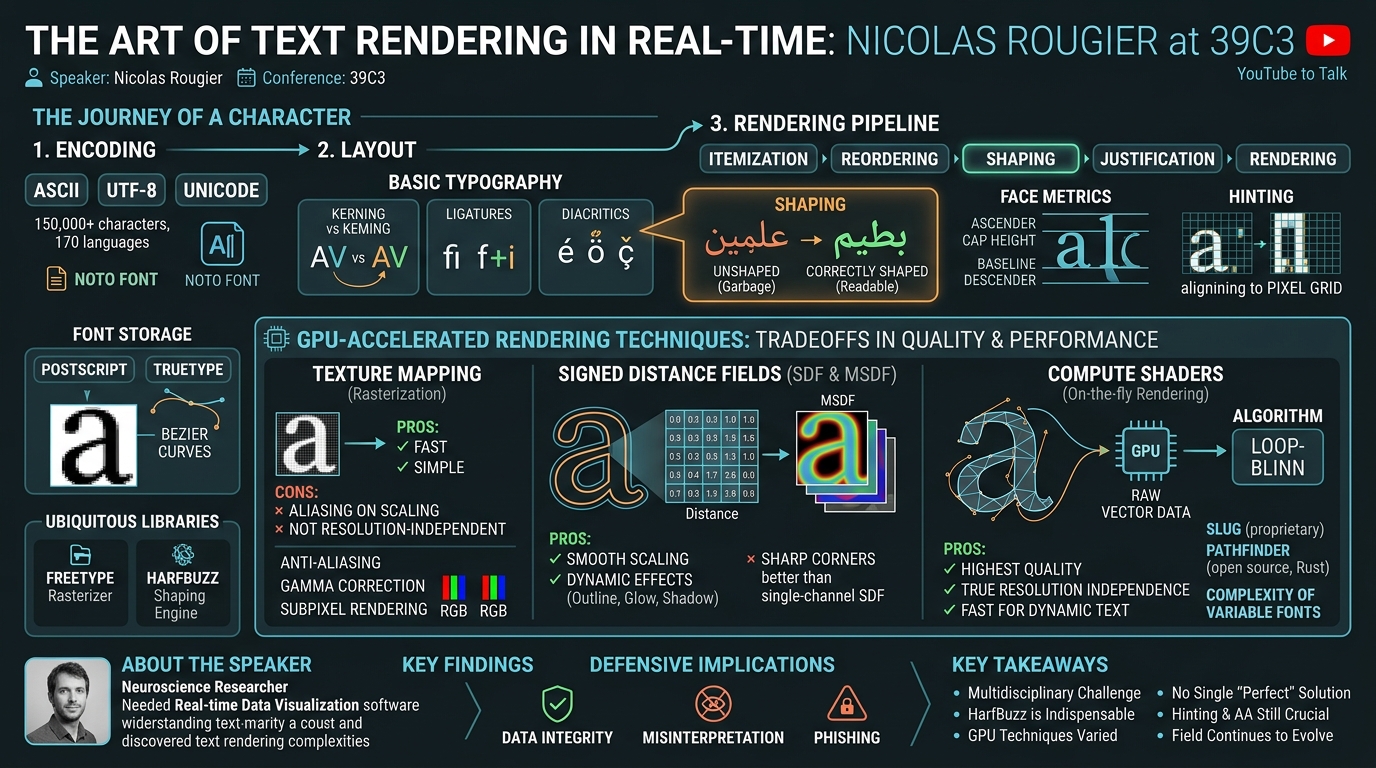
Nicolas Rougier's talk, "The art of text (rendering)," delivered at 39C3, delves into the profound complexities and technical challenges of real-time rendering text, particularly in dynamic computational environments such as video games, web browsers, and scientific visualizations. Rougier, primarily a neuroscience researcher, found himself immersed in the intricate world of typography while developing software for real-time data visualization. His journey revealed that rendering text correctly is far more involved than simply placing characters side-by-side; it demands adherence to a vast array of typographic rules and sophisticated algorithms to achieve legibility, aesthetic quality, and cultural accuracy across diverse languages.
Key moments
- 0:00 Introduction to real-time text rendering challenges
- 2:10 Humorous examples of poor kerning and shaping
- 3:50 Understanding Unicode: A revolution in text encoding
- 5:40 Typefaces and the Noto font for universal rendering
- 6:00 Essential typography rules: kerning, ligatures, diacritics
- 7:50 Advanced text rendering: shaping and complex layouts
- 9:00 Font formats and the role of Bezier curves
The art of text (rendering)
Speakers: Nicolas Rougier
Conference: 39C3
YouTube: https://www.youtube.com/watch?v=XTgIJUwmz0Q
Overview
Nicolas Rougier's talk, "The art of text (rendering)," delivered at 39C3, delves into the profound complexities and technical challenges of real-time rendering text, particularly in dynamic computational environments such as video games, web browsers, and scientific visualizations. Rougier, primarily a neuroscience researcher, found himself immersed in the intricate world of typography while developing software for real-time data visualization. His journey revealed that rendering text correctly is far more involved than simply placing characters side-by-side; it demands adherence to a vast array of typographic rules and sophisticated algorithms to achieve legibility, aesthetic quality, and cultural accuracy across diverse languages.
The talk underscores the critical importance of proper text rendering, illustrating how ignoring established typographic principles can lead to unreadable, unintelligible, or even offensive output, as demonstrated by examples of poorly rendered Arabic text or "keming" errors. Rougier meticulously breaks down the historical context, the foundational typographic concepts, and the advanced, GPU-accelerated techniques that have evolved to address these challenges. For anyone involved in software development, user interface design, or digital content creation, understanding these nuances is crucial for delivering a high-quality, inclusive, and visually appealing user experience.
Background
▶ Watch: Introduction to real-time text rendering challenges (0:00)
The journey to displaying text on a screen begins with encoding. Historically, this was a fragmented landscape of disparate character sets like ASCII, ISO Latin 1, or various Chinese encodings. Decoding text required prior knowledge of its character set, leading to "garbage" on screen if misidentified. The advent of Unicode over 30 years ago revolutionized this, providing a universal encoding standard that can represent virtually every language on the planet. Unicode supports different encoding forms, notably UTF-8, UTF-16, and UTF-32, with UTF-8's backward compatibility with ASCII being a significant advantage. Today, Unicode encompasses over 150,000 characters covering 170 languages, continually expanding to include new glyphs.
Once text is decoded, the next step involves selecting a typeface, often referred to as a font family. Many classic typefaces were designed primarily for European languages, posing challenges for rendering non-Roman scripts. Efforts like the Noto font project aim to create a single typeface capable of rendering all languages, eliminating "tofu" – the placeholder box displayed when a glyph is unavailable in the chosen font.
Basic typography introduces a set of rules crucial for legibility and aesthetics:
- Kerning: Adjusting the space between specific pairs of characters for visual balance. Without proper kerning, words can appear awkward or, in extreme cases (known as "keming"), misread, as seen in the notorious "right dick" example instead of "right click."
- Ligatures: Replacing specific character sequences (e.g., "ff," "fi") with a single, aesthetically combined glyph.
- Diacritic marks: Accent marks or other modifiers applied to characters, which are often critical for meaning in many languages, not merely aesthetic.
- Hinting: Instructions embedded in a font to ensure that glyphs align optimally with the pixel grid at small sizes, improving clarity and reducing blurriness.
- Face metrics: Standardized measurements like ascender, cap height, and baseline used to align text consistently on a line.
Beyond these basics lie more advanced considerations. Text shaping is paramount for languages like Arabic, where character forms change based on their position within a word (initial, medial, final, isolated). Without shaping, Arabic text becomes unreadable "garbage." Other complexities include alternate styles (e.g., stylistic sets within a font) and complex text layouts that handle mixed languages, combining left-to-right (LTR) and right-to-left (RTL) scripts within the same line or paragraph, or even rendering specialized domains like chemistry, mathematics, or music notation.
Fonts themselves are typically stored in formats like PostScript or TrueType, which describe each letter using geometric primitives, predominantly Bezier curves. While elegant for design, Bezier curves, especially cubic ones, are computationally challenging for tasks like distance calculation, posing a significant hurdle for real-time rendering.
To manage this complexity, two foundational libraries are almost ubiquitous: FreeType and HarfBuzz. FreeType is a robust font rasterizer, found in countless systems from mobile phones to desktop operating systems. HarfBuzz is the critical shaping engine responsible for applying the complex typographic rules of different languages, transforming a raw sequence of Unicode characters into the correct sequence and form of glyphs for display.
The full text rendering pipeline, therefore, involves several stages:
- Itemization: Identifying different language segments within a text.
- Reordering: Adjusting character order for mixed LTR/RTL scripts.
- Shaping: Applying linguistic and typographic rules to select and combine glyphs.
- Justification: Distributing text evenly within a line.
- Rendering: Finally drawing the shaped glyphs onto the screen.
Executing this intricate pipeline in real-time is the core challenge addressed by modern text rendering techniques.
Key Findings
▶ Watch: Understanding Unicode: A revolution in text encoding (3:50)
The talk's central revelation is that contemporary real-time text rendering is an intricate dance between computational linguistics, graphic design principles, and highly optimized GPU (Graphic Processing Unit) acceleration. Nicolas Rougier demonstrates that the evolution of text rendering has been driven by the increasing demand for high-quality, resolution-independent, and globally compatible text display, moving far beyond simple bitmap or texture-based approaches.
A key finding is the necessity of a multi-stage pipeline, starting with Unicode decoding and progressing through itemization, reordering, shaping (critically handled by libraries like HarfBuzz), and justification before the final rendering. The speaker highlights that while the rendering phase itself has become incredibly fast due to powerful GPUs, the shaping stage, though often pre-computed, remains a computationally intensive and indispensable precursor for accurate display across languages.
The talk meticulously dissects three primary GPU-accelerated rendering techniques: traditional texture mapping (rasterization), Signed Distance Fields (SDF) and its advanced variant Multi-channel SDF (MSDF), and the cutting-edge compute shader approach utilizing algorithms like Loop-Blinn. Each technique offers distinct trade-offs in terms of quality, performance, implementation complexity, and suitability for different applications (e.g., games vs. high-fidelity document rendering). Ultimately, the talk concludes that no single "perfect" solution exists, and the optimal choice depends heavily on the specific requirements of the application, while emphasizing the continued importance of hinting and anti-aliasing for visual quality on diverse display hardware.
Technical Deep Dive
▶ Watch: Typefaces and the Noto font for universal rendering (5:40)
The core of real-time text rendering lies in efficiently converting abstract glyph descriptions into pixels on a screen, leveraging the power of modern GPUs. Rougier outlines several key techniques, each with its own advantages and limitations.
The earliest GPU-accelerated method involved texture mapping. This technique rasterizes glyphs into bitmap images (textures) offline or at application startup. These textures are then uploaded to the GPU and drawn as simple textured polygons. While straightforward and fast for displaying static text, this approach suffers from significant drawbacks:
- Aliasing: When scaled up, rasterized textures become pixelated, revealing jagged edges.
- Anti-aliasing: To mitigate aliasing, various anti-aliasing techniques are applied during rasterization. These vary significantly between operating systems (e.g., Windows vs. Apple), producing characteristic visual styles. The choice often involves a trade-off between respecting the glyph's true shape and aligning it perfectly with the pixel grid.
- Gamma Correction and Energy Distribution: Rendering quality is affected by display gamma correction and the relative luminosity of text and background (e.g., white text on black vs. black text on white), requiring adjustments for optimal human perception.
- Hinting: Especially crucial for small font sizes, hinting ensures glyphs align with the pixel grid, preventing blurriness. Rougier discusses native hinting (designer-specified), auto-hinting (algorithmically derived), and vertical hinting, which enforces pixel alignment only vertically, allowing sub-pixel positioning horizontally for smoother text flow.
- Subpixel Rendering: Displays like LCDs use distinct red, green, and blue subpixels. Subpixel rendering techniques exploit this to achieve higher perceived horizontal resolution. However, this is highly dependent on the subpixel arrangement (subpixel zoo) of the display, requiring specific anti-aliasing algorithms for different screen types.
- Limitations: While efficient for packing many glyphs into a single texture atlas, the quality degrades significantly upon magnification, making it unsuitable for applications requiring high-fidelity, scalable text (e.g., PDF viewers).
To overcome the scaling limitations of texture mapping, Signed Distance Fields (SDF) emerged. Instead of storing pixel colors, an SDF texture stores the shortest distance from each pixel to the nearest edge of the glyph's outline. Positive values indicate outside the shape, negative values inside, and zero at the edge.
- GPU Rendering: On the GPU, a shader can then determine if a pixel is inside or outside the glyph based on its sampled distance value. Anti-aliasing can be applied dynamically at the border, allowing for crisp, resolution-independent scaling.
- Advantages: SDFs enable smooth scaling and dynamic effects like outlines, glow, or drop shadows, all computed in the shader.
- Evolution: A significant improvement came with Multi-channel SDF (MSDF), proposed by Schlemsky. Standard SDF uses a single channel (e.g., alpha). MSDF leverages the multiple channels (RGBA) of a texture to encode more precise distance information, leading to significantly higher fidelity, especially for complex glyphs with sharp corners, which can be problematic for single-channel SDFs. MSDF is known for being relatively easy to implement and provides excellent quality for many applications, including games.
- Alternative Approximations: Another technique, such as the one used by Glyphy, attempts to approximate the complex Bezier curves that define glyphs with simpler arc circles. Calculating distances to circles is much easier for the GPU than to Bezier curves. The challenge lies in accurately pre-computing these arc circle approximations for each glyph.
The most advanced and increasingly prevalent technique, especially with modern GPUs supporting compute shaders, involves sending the raw glyph outline data (Bezier curves) directly to the GPU for on-the-fly rendering.
- Compute Shaders: These allow the GPU to perform general-purpose computation, not just graphics operations. This enables complex algorithms to be executed directly on the raw vector data.
- Loop-Blinn Algorithm: A foundational algorithm in this category, patented at one point, provides a highly efficient and resolution-independent way to render Bezier curves directly on the GPU. It effectively decomposes the glyph's interior into triangles and uses specialized shaders to draw the curved boundaries.
- Advantages: This method offers the highest quality, true resolution independence, and is incredibly fast for dynamic rendering.
- Libraries: Specialized libraries implement this approach. The Slug library (proprietary) encodes glyphs in a specific format for GPU transmission. Pathfinder (open source, written in Rust) is another prominent example, used in contexts like web browsers for high-performance text rendering. While highly performant, the complexity of glyphs (e.g., typefaces with many ornaments like Wild Wood) can still impact rendering time, as the GPU has more curves to process.
Rougier highlights that the choice of technique depends heavily on the application's needs. Simple game UIs might suffice with texture mapping or basic SDF, while web browsers or document renderers demand the precision and speed of MSDF or compute shader-based solutions like Pathfinder.
Demo / Proof of Concept
▶ Watch: Advanced text rendering: shaping and complex layouts (7:50)
While the talk did not feature a live demonstration of a specific tool or a runnable proof-of-concept, Nicolas Rougier effectively used numerous visual examples throughout his presentation. These included side-by-side comparisons of poorly rendered Arabic script versus correctly shaped text, illustrations of "keming" errors, and detailed visual breakdowns of how different anti-aliasing, hinting, and signed distance field techniques affect the final on-screen appearance of glyphs. These visual aids served as compelling demonstrations of the problems and the solutions discussed, illustrating the tangible impact of each rendering approach on text quality and legibility.
Defensive Implications
▶ Watch: Font formats and the role of Bezier curves (9:00)
While Nicolas Rougier's talk primarily focuses on the technical intricacies of achieving high-quality real-time text rendering rather than direct security vulnerabilities, there are important defensive implications, particularly concerning information integrity, internationalization, and user experience.
Incorrect text rendering can lead to severe misinterpretation, especially in critical contexts. As shown with the Arabic text example where glyphs were not properly shaped, the result is "garbage" that is unreadable and potentially offensive. In scenarios involving sensitive data, legal documents, or medical records, such rendering failures could lead to critical misunderstandings, data loss, or even legal liabilities. Ensuring that text is rendered accurately, respecting all linguistic and typographic rules, is a fundamental aspect of maintaining data integrity and clear communication.
From a defensive standpoint, relying on robust, well-maintained libraries like HarfBuzz for text shaping is paramount. Attempting to implement complex text layout rules from scratch is fraught with peril, given the sheer number of languages, scripts, and their unique typographic requirements. Bugs in custom rendering engines could inadvertently introduce display errors that could be exploited to obscure information, create phishing opportunities (e.g., visually similar characters that are actually different), or simply degrade the user's ability to understand displayed content, leading to a loss of trust.
Furthermore, ignoring hinting and anti-aliasing can result in blurry or illegible text on lower-DPI screens, making applications less accessible and harder to use. While not a direct security flaw, poor readability can hinder a user's ability to discern legitimate warnings or critical information, indirectly impacting security awareness. Therefore, adopting established rendering techniques and libraries that prioritize correctness, legibility, and internationalization serves as a defensive measure against miscommunication, user frustration, and the potential for information integrity breaches.
Key Takeaways
- Text Rendering is Profoundly Complex: Displaying text correctly in real-time is a multidisciplinary challenge, far beyond simply placing characters. It involves intricate rules from linguistics, typography, and graphics engineering, encompassing Unicode handling, kerning, ligatures, diacritics, hinting, and complex text layouts.
- HarfBuzz is Indispensable for Global Text: For proper rendering of diverse languages, especially those with complex scripts like Arabic or Hindi, a dedicated shaping engine like HarfBuzz is essential. It transforms raw character sequences into correctly formed and positioned glyphs, preventing "garbage" display.
- GPU Acceleration is Key, with Varied Techniques: Modern real-time rendering relies heavily on GPUs. Techniques range from basic texture mapping (prone to scaling artifacts) to advanced Signed Distance Fields (SDF) and Multi-channel SDF (MSDF) (offering resolution-independent scaling), and cutting-edge compute shader methods (like the Loop-Blinn algorithm used by Pathfinder and Slug library for high-fidelity, on-the-fly rendering).
- Trade-offs Dictate Choice: Each rendering technique presents a unique balance of quality, performance, and implementation complexity. The optimal choice depends on the application's specific needs, whether it's a simple game UI where MSDF might suffice, or a web browser requiring the precision and speed of compute-shader-based solutions.
- Hinting and Anti-aliasing Remain Crucial: Despite advances, hinting (fitting glyphs to the pixel grid) and sophisticated anti-aliasing techniques are still necessary for optimal legibility, particularly on screens with lower DPI, to ensure crisp and smooth text appearance.
- The Field Continues to Evolve: The landscape of text rendering is dynamic, with ongoing developments like variable fonts introducing new complexities. The presence of numerous patents in this domain also influences adoption and innovation.
About the Speaker(s)
Nicolas Rougier is primarily a neuroscience researcher whose work necessitates the development of software for real-time visualization of complex data. It was through this practical requirement that he stumbled upon and subsequently delved deep into the intricate world of typography and text rendering. His journey from needing to display simple labels to understanding the nuances of kerning, shaping, and GPU-accelerated rendering highlights a fascinating intersection of scientific visualization and computer graphics. His talk reflects a practitioner's perspective, grounded in the real-world challenges of making digital text both functional and aesthetically pleasing across diverse applications.
All talks from 39th Chaos Communication Congress (39C3): Power Cycles