All Sorted by Machines of Loving Grace?: "AI", Cybernetics, and Fascism and how to Intervene
Katika Kühnreich
39th Chaos Communication Congress (39C3): Power Cycles · Day 1 · Saal One
Overview
In her thought-provoking 39C3 presentation, Katika Kühnreich, a political scientist and China scientist with a philosophical background, dissects the intricate and often overlooked connections between modern technological narratives – specifically Artificial Intelligence (AI) and Cybernetics – and the resurgence of fascist ideologies. Kühnreich challenges the prevailing techno-optimism, arguing that the stories we tell ourselves about technology, humans, and society can inadvertently pave the way for authoritarian control. She positions AI not as a neutral scientific advancement, but as a "sales argument" and "money shitterly" designed to secure funding, while cybernetics provides a mechanistic view of humanity that is ripe for exploitation.
Key moments
- 0:00 Speaker introduction and talk's research premise
- 2:25 Key themes: humans, identity, stories, fascism, resistance
- 4:00 Humanity's love for stories and their powerful impact
- 6:25 Choosing identity, group dynamics, and vulnerability
- 8:00 Defining society, interdependence, and potential collapse
- 10:00 The image of man, rules, and Aristotle's governments
All Sorted by Machines of Loving Grace?: "AI", Cybernetics, and Fascism and how to Intervene
Speakers: Katika Kühnreich, Political Scientist and China Scientist, Institute of Network Cultures
Conference: 39C3
YouTube: https://www.youtube.com/watch?v=6Cedq6RnjZM
Overview
In her thought-provoking 39C3 presentation, Katika Kühnreich, a political scientist and China scientist with a philosophical background, dissects the intricate and often overlooked connections between modern technological narratives – specifically Artificial Intelligence (AI) and Cybernetics – and the resurgence of fascist ideologies. Kühnreich challenges the prevailing techno-optimism, arguing that the stories we tell ourselves about technology, humans, and society can inadvertently pave the way for authoritarian control. She positions AI not as a neutral scientific advancement, but as a "sales argument" and "money shitterly" designed to secure funding, while cybernetics provides a mechanistic view of humanity that is ripe for exploitation.
Kühnreich's talk is a critical examination of how hyperconnectivity and the "information society" can be weaponized, providing what she terms "fascist root access to all of human information." She contends that the convenience offered by corporate and state-controlled digital infrastructures transforms citizens into consumers, making them susceptible to manipulation and complicit in systems of oppression. The presentation is a passionate call to action, urging individuals to recognize these dangers and actively resist by disconnecting from harmful digital infrastructures, cultivating local community roots, and integrating anti-fascist principles into daily life with joy and collective effort.
This talk matters immensely in an era dominated by rapid technological development and increasing political polarization. It provides a crucial framework for understanding how seemingly disparate fields — cutting-edge technology and historical fascism — can converge to create new forms of societal control. By exposing the ideological underpinnings of AI and cybernetics, Kühnreich empowers the audience to critically evaluate the narratives they consume and to build resilient, self-organized communities as a bulwark against creeping authoritarianism. Her interdisciplinary approach transcends typical technical security discussions, broadening the scope to include the fundamental societal and ethical implications of our digital future.
Background
▶ Watch: Speaker introduction and talk's research premise (0:00)
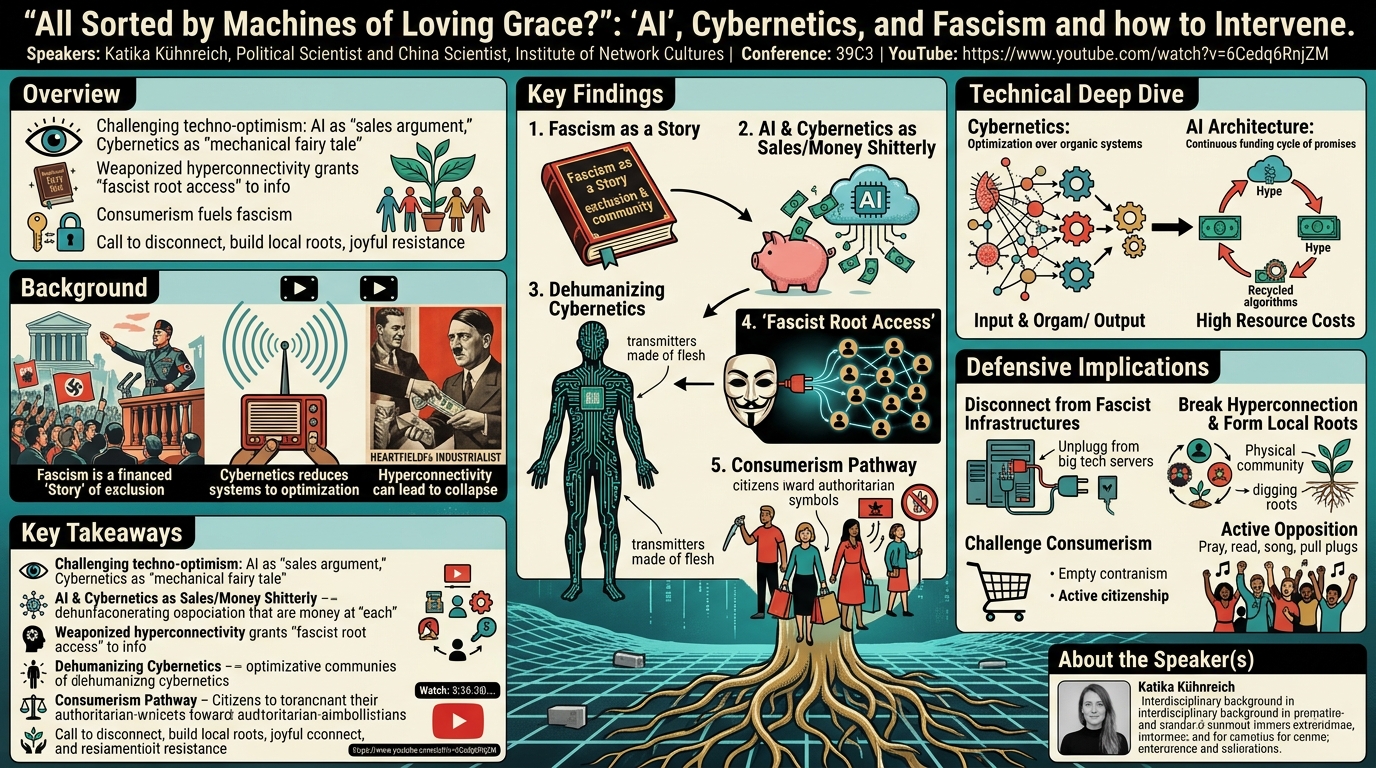
Kühnreich begins by establishing a fundamental aspect of human nature: our deep-seated need for stories. We are biological beings that crave narratives to explain the world, ourselves, and our place within it. These stories shape our understanding of right and wrong, give us ethics, and influence the future we actively build. This innate human characteristic, however, also leaves us vulnerable to powerful, often misleading, narratives. The speaker highlights that fascism itself is a story, frequently "very well told," promising a return to a non-existent past and offering a sense of community based on the exclusion and demonization of "others." Similarly, cybernetics is presented as another such narrative – a "mechanical fairy tale" that simplifies complex human and planetary systems into optimizable processes.
The historical context of fascism is traced back to the late 19th and early 20th centuries, where pseudoscientific concepts like eugenics and the idea of a "master race" (explicitly white) merged with emerging techniques for influencing "masses" through propaganda and new technologies like newspapers and radio. Kühnreich references the Futurist Manifesto by F.T. Marinetti, which glorified war, militarism, patriotism, and contempt for women, showcasing fascism's inherent destructive and anti-humanistic core. She emphasizes that fascism is not a reaction to social movements like feminism or LGBTQ+ rights, but rather a collectivist system of power gained through force, often financed by industrial elites, as famously depicted by John Heartfield's photomontage of Hitler being funded.
Regarding society, Kühnreich defines it as more than just a group of people; it's an interconnected and interdependent collective sharing common values and rules. In exchange for individual autonomy, members gain community, security, culture, and fun, with varying rights and obligations depending on the societal form. Drawing on Aristotle's classification of governments (kingship, aristocracy, polity, tyranny, oligarchy, and what Aristotle called "mop rule" or corrupt democracy), Kühnreich underscores the critical questions: who holds power, for whose benefit is it exercised, and how are the rules made and changed? The transition from small groups to hyperconnected, hyper-dependent societies creates a vulnerability where civilizations can collapse if their networks exceed their abilities. This backdrop sets the stage for understanding how modern technological narratives, coupled with historical patterns of authoritarianism, present a profound challenge to human freedom and a healthy planet.
Key Findings
▶ Watch: Humanity's love for stories and their powerful impact (4:00)
Kühnreich's talk unveils several critical findings that challenge conventional understandings of technology, power, and society:
- Fascism as a Story and a Funded Project: Fascism is fundamentally a narrative that promises a return to an idealized, non-existent past and offers a community forged through the exclusion and oppression of others. Crucially, Kühnreich asserts that fascism is not a spontaneous reaction to social progress but is financed by powerful interests, using the masses as pawns and soldiers while the financiers remain insulated. Its core aim is to create a "superhuman" and eliminate those who don't fit that mold.
- AI and Cybernetics as "Mechanical Fairy Tales" and Sales Arguments: The speaker deconstructs the terms cybernetics and AI, revealing them as powerful, often misleading, stories. Cybernetics is characterized as a framework that views "everything as a mechanical process that has to be optimized," embodying a "future fetish" where solutions are perpetually promised in the future. Artificial Intelligence, in Kühnreich's view, is primarily a "sales argument," an "analog clickbait," and a "money shitterly" – a term invented when early cyberneticists ran out of funding and couldn't deliver on their promises. She highlights that the concept is often "recycled every 10 years or so" to secure new investments, despite its immense energy, water, and human cost, and its failure to address real-world crises.
- The Dehumanizing Image of Humans in Cybernetics: A core finding is the problematic "image of man" embedded within cybernetic thought. Humans and animals are seen as mere "transmitters made of flesh," capable of being controlled and optimized if exposed to the "right signals and stimulus." This mechanistic view, epitomized by Richard Brautigan's poem "all watched over by machines of loving grace," is presented not as a utopian vision but as a "nightmare" where human autonomy and the planet's well-being are sacrificed for optimized control.
- Hyperconnectivity Enables "Fascist Root Access" to Human Information: The combination of fascist ideology with modern digital technology and hyperconnectivity creates an unprecedented threat. Kühnreich warns that the "information society" – the digital storage and cross-linking of vast amounts of personal data – provides dictators and other malicious actors with "root access to all stored information about you," both online and offline. This "universal key" empowers them to surveil, control, and manipulate populations on a massive scale, even enabling actions like remote deportation via apps.
- Consumerism as a Pathway to Fascism: The shift from citizens to consumers, facilitated by convenient corporate infrastructures, is identified as a critical vulnerability. Fascism, Kühnreich argues, "suits consumerism much better than a free society" because it removes the burden of critical thought, offering clear lines of action and orders to follow. This passive consumption fosters a kind of "employment relationship to society" where individuals become complicit in systems that exploit others for their convenience.
Technical Deep Dive
▶ Watch: Choosing identity, group dynamics, and vulnerability (6:25)
While not a technical deep dive in the traditional sense of code analysis or exploit chains, Kühnreich's talk provides a conceptual and architectural critique of how certain technological paradigms, particularly cybernetics and AI, function as enabling structures for authoritarian control. Her "technical deep dive" is into the ideology and societal architecture of these systems.
At the heart of her critique is cybernetics, which she defines as a framework that perceives "everything as a mechanical process that has to be optimized." This perspective reduces complex biological, social, and planetary systems to input-output mechanisms, stripping them of their inherent messiness, unpredictability, and organic nature. The underlying assumption is that any problem can be "solved" through optimization, often deferred to a "future fetish" where solutions are perpetually "30 years away." This mechanical worldview extends to the human being, which cybernetics conceptualizes as a "transmitter made of flesh." In this model, humans are seen as entities that, when exposed to the correct "signals and stimulus," will predictably perform desired actions. This reductionist view is critical because it lays the groundwork for systems designed to control and manipulate human behavior, rather than empower human agency.
The concept of Artificial Intelligence (AI) is then positioned as a direct descendant and marketing arm of this cybernetic ideology. Kühnreich explicitly states that AI is "nothing more than a sales argument," an "analog clickbait" designed to secure funding rather than deliver on its grand promises. She highlights that the term is frequently "pulled out of the box every 10 years or so" whenever funding for previous iterations of cybernetic promises wanes. From a resource perspective, she points out that AI systems are not benign; they consume "huge amounts of energy, water, and human lives" (referring to the often-exploited labor in data labeling and content moderation), directly contradicting the narrative that AI will solve crises like climate change. The "architecture" of AI, in this view, is less about advanced algorithms and more about a persistent, resource-intensive narrative-driven funding mechanism that perpetuates a specific, control-oriented worldview.
The confluence of these ideological frameworks with modern digital technology and hyperconnectivity creates what Kühnreich chillingly describes as "fascist root access to all of human information." This is the core "technical" implication for society. The digital storage and cross-linking of vast quantities of personal data—from online activity to offline records—effectively grants a "universal key" to dictators, maniacs, and their enablers. This "root access" is not merely about surveillance; it's about the capacity for granular, remote control and manipulation. Examples include the ability to "get your neighbors deported from your sofa by an app," illustrating how digital infrastructure can decentralize and anonymize oppressive actions, making complicity easier and more pervasive. The "information society" thus becomes a global control network, where the "architecture" is designed to gather, analyze, and leverage individual data points to enforce a top-down, authoritarian order, fundamentally transforming citizens into observable, predictable, and controllable "flesh transmitters."
This deep dive reveals that the "technical" threat isn't just a bug or an exploit; it's a fundamental design flaw rooted in the philosophical underpinnings of how we conceive of technology and humanity. The "machines of loving grace" from Richard Brautigan's cybernetic poem, rather than being a benevolent presence, become the infrastructure for a totalitarian nightmare, built upon the premise that humans can and should be sorted and optimized.
Demo / Proof of Concept
▶ Watch: Defining society, interdependence, and potential collapse (8:00)
This talk did not feature a traditional technical demonstration or proof of concept in the sense of software or hardware exploitation. Instead, Kühnreich presented conceptual "proofs" through historical analysis and contemporary observations, illustrating the mechanisms by which technology, ideology, and power converge.
Her "demonstrations" were rhetorical and historical:
- Historical Precedent of Fascist Funding: Kühnreich referenced John Heartfield's famous photomontage depicting Hitler being paid by industry, serving as a powerful visual and conceptual proof that fascism is historically financed by elites, not spontaneously generated by societal grievances.
- Contemporary Authoritarian Symbols: The speaker pointed to the alarming phenomenon of individuals performing a Hitler salute on a "huge American stage," using this as a tangible, real-world "proof of concept" that such ideologies are not confined to history but are actively resurfacing and gaining visibility, often amplified by digital platforms.
- The Power of Data: She highlighted that such individuals gain "access to so many data," underscoring how modern digital infrastructures provide the raw material for control.
- Remote Complicity: Kühnreich illustrated the ease of participation in oppression with the chilling example, "You can even get your neighbors deported from your sofa by an app. You can do it remotely." This serves as a stark conceptual demonstration of how digital convenience can facilitate passive complicity in authoritarian actions, making the act of harm detached and seemingly consequence-free for the perpetrator.
These examples, while not code-based, served to concretely illustrate her arguments about the dangers of unchecked technological integration with authoritarian tendencies and the pervasive nature of data as a tool for power.
Defensive Implications
▶ Watch: The image of man, rules, and Aristotle's governments (10:00)
Kühnreich's talk provides a robust framework for defensive action, shifting the focus from purely technical patches to fundamental societal and behavioral changes. The implications for defenders are broad, encompassing personal choices, community building, and active political engagement:
- Disconnect from Fascist Infrastructures: The most direct defensive measure is to recognize and actively "disconnect from fascist infrastructures and nuts." This means critically evaluating and reducing reliance on corporate and state-controlled digital platforms and services that collect vast amounts of personal data. Kühnreich warns that "data is power and we are constantly giving it away," so stopping this flow is paramount, even if it "tingles a bit in the beginning."
- Break Hyperconnection and Form Local Roots: Countering the pervasive hyperconnectivity that enables "fascist root access" requires intentionally forming local, physical connections. Defenders should "break the hyperconnection and form local connections from neighborhoods, from collective spaces." This strategy emphasizes building resilient, face-to-face communities as a buffer against online manipulation and as a source of mutual support. Kühnreich stresses the importance of "digging in some bloody roots," citing historical examples like the anti-nuclear movement in Germany, French resistance, and the Viet Cong, where strong local ties provided sustainability against external pressures.
- Challenge Consumerism and Reclaim Agency: Defenders must recognize that "fascism suits consumerism much better than a free society." The convenience offered by corporate services often comes at the cost of others' suffering and personal autonomy. The defensive posture here is to challenge this consumerist mindset, to "take some responsibility not to ignore that your convenience is brought to you by the suffering of others," and to actively question and resist the passive role of a consumer in favor of an active role as a citizen.
- Active and Diverse Opposition to Fascism: Ignoring fascism is not a viable defense; it only disappears "when it's opposed, not ignored." Kühnreich advocates for active, multifaceted resistance: "Pray, throw, read, hit, sing, sin, laugh, and pull their plugs." This diverse approach acknowledges that there isn't "the one good measure" and encourages individuals to engage in anti-fascist action in ways that suit their abilities and contexts.
- Deny Platforms and Reject Blame Games: A crucial defensive tactic is to "not hand some microphones to fascists" and "not go onto their platforms either." Denying them visibility and legitimacy is essential. Furthermore, defenders should be equipped to counter the "blame game" that attempts to attribute fascism to feminism, queer movements, or the left. Kühnreich provides clear counter-arguments: fascism "appears because it's financed," not because of social progress.
- Address Digital Addiction and Cultivate Critical Thought: The talk highlights that many are "hooked to incorporate infrastructure," akin to an addiction. Defenders must recognize this dependency, understand that "we are influenced by emotion created and orchestrated by these networks," and consciously choose to stop. This requires self-awareness, seeking help from others, and redirecting energy towards creating "something better to resist, to shelter others, to fight, to think, and to love."
- Integrate Anti-Fascism into Daily Life with Joy: Finally, defense should not be a despairing, isolated act. Kühnreich encourages making anti-fascism a joyful, collective endeavor: "Let's pack the put the fun back into anti-fascism and create a good world." Integrating anti-fascist principles into everyday actions, celebrating life, and ensuring that those who cannot be physically present (e.g., caregivers) receive information and support, are all vital components of a sustainable defense.
Key Takeaways
- Fascism and Technology are Narratives: Fascism, cybernetics, and AI are powerful stories that shape society. While fascism promises a return to a non-existent past through exclusion, AI is often presented as a "sales argument" for funding rather than a genuine technological solution, frequently recycled to secure investment.
- Dehumanizing View of Humanity: The cybernetic perspective reduces humans to "transmitters made of flesh" to be optimized, laying the ideological groundwork for systems of control rather than empowerment.
- Hyperconnectivity as a Tool for Control: Modern digital technologies and hyperconnectivity provide "fascist root access to all of human information," enabling unprecedented surveillance, manipulation, and even remote acts of oppression.
- Consumerism Fuels Authoritarianism: The convenience offered by corporate infrastructures transforms citizens into passive consumers, making them more susceptible to authoritarian rule and inadvertently complicit in systems that exploit others.
- Active, Localized Resistance is Crucial: Effective anti-fascist defense requires active opposition, disconnecting from harmful digital infrastructures, building strong local community roots, and denying platforms to fascists.
- Anti-Fascism Must Be Collaborative and Joyful: Resistance should not be a solitary, despairing act but a collective, diverse, and even joyful endeavor, integrating anti-fascist principles into daily life and fostering a sense of shared purpose and mutual support.
About the Speaker(s)
Katika Kühnreich is a political scientist and China scientist with a philosophical background. She brings an interdisciplinary perspective to her analysis of the intersection between humans and machines, often challenging conventional narratives. Kühnreich is associated with the Institute of Network Cultures, an organization dedicated to exploring the impact of new media on art, culture, and society. She emphasizes that her presentations represent her current "state of research," acknowledging that knowledge is dynamic and subject to new information, and that her slides are designed for information dissemination rather than artistic expression.
All talks from 39th Chaos Communication Congress (39C3): Power Cycles