Building hardware - easier than ever - harder than it should be
Kliment
39th Chaos Communication Congress (39C3): Power Cycles · Day 1 · Saal One
Overview
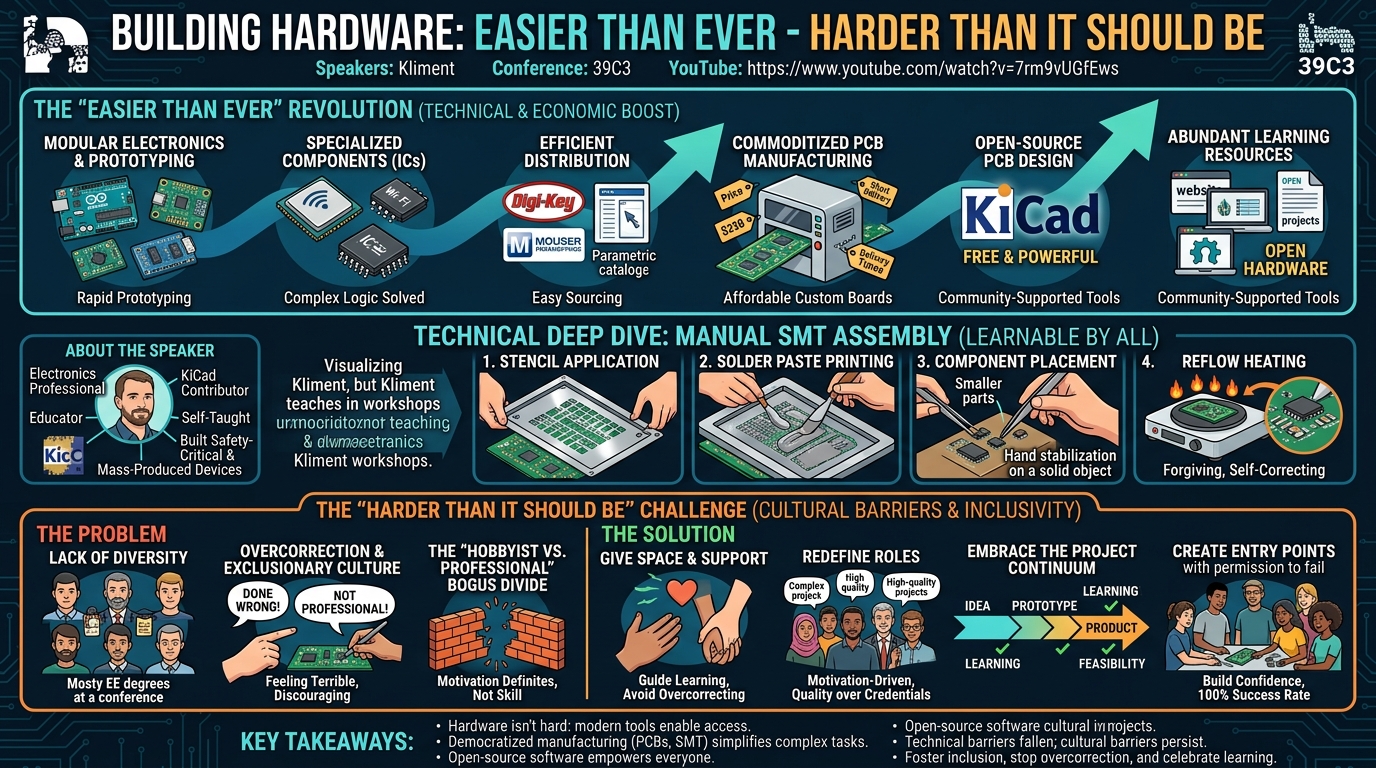
In a compelling and often humorous address at 39C3, Kliment dismantled the pervasive myth that "hardware is hard," arguing instead that building electronics is more accessible and affordable than ever before for individuals. His talk, "Building hardware - easier than ever - harder than it should be," served as both a celebration of modern electronics development and a poignant critique of the social and cultural barriers that continue to deter newcomers. Kliment, an experienced electronics designer and educator, highlighted the dramatic advancements in tools, manufacturing services, and information resources that have democratized hardware creation.
Key moments
- 0:00 Introduction and debunking 'hardware is hard'
- 2:00 How learning electronics changes your perspective
- 2:40 Speaker's talk goals and agenda outlined
- 3:00 Dramatic improvements in electronics accessibility and cost
- 4:00 Rapid prototyping with modular electronics and kits
- 5:20 Leveraging specialized components for complex functionality
- 7:00 Incredibly low cost due to volume manufacturing
- 7:40 The role of part distributors for accessibility
Building hardware - easier than ever - harder than it should be
Speakers: Kliment
Conference: 39C3
YouTube: https://www.youtube.com/watch?v=7rm9vUGfEws
Overview
In a compelling and often humorous address at 39C3, Kliment dismantled the pervasive myth that "hardware is hard," arguing instead that building electronics is more accessible and affordable than ever before for individuals. His talk, "Building hardware - easier than ever - harder than it should be," served as both a celebration of modern electronics development and a poignant critique of the social and cultural barriers that continue to deter newcomers. Kliment, an experienced electronics designer and educator, highlighted the dramatic advancements in tools, manufacturing services, and information resources that have democratized hardware creation.
The core message is one of empowerment: anyone with patience and motivation can acquire the skills to build electronics, regardless of their background. However, Kliment also exposed a significant disconnect between the technical ease of entry and the often unwelcoming culture within the broader electronics industry. Through a personal anecdote about a widely successful workshop, he demonstrated that even advanced manufacturing techniques like surface mount technology (SMT) can be learned by complete novices, while simultaneously lamenting the industry's struggle with diversity and supportive mentorship. This talk is a call to action for both aspiring builders and established professionals to embrace a more inclusive and encouraging approach to electronics.
Background
▶ Watch: Introduction and debunking 'hardware is hard' (0:00)
For decades, the realm of electronics design and manufacturing was perceived as an arcane art, largely inaccessible to hobbyists or those without extensive formal training and significant capital. Kliment directly confronts the "hardware is hard" meme, clarifying that its origin lies more in the complexities of running a hardware manufacturing business rather than the inherent difficulty of building electronic devices themselves. He recounts a personal journey spanning from his teenage years to a professional career, witnessing a revolutionary transformation in the field.
Historically, learning electronics involved costly equipment, difficult-to-source components, and often manual, tedious assembly processes like through-hole soldering. Information was scarce, locked behind textbooks or proprietary industry knowledge. However, the past two decades have brought about an unprecedented shift. An enormous support services infrastructure has emerged, optimizing component manufacturing, distribution, circuit board fabrication, and automated assembly to an incredible degree. Prices for nearly every aspect of electronics production have plummeted by an order of magnitude or more, while capabilities have simultaneously improved. This has been coupled with a dramatic increase in the accessibility and user-friendliness of PCB design software and an explosion of freely available information resources, collectively dismantling many of the traditional barriers to entry.
Key Findings
▶ Watch: Speaker's talk goals and agenda outlined (2:40)
Kliment systematically outlined the pivotal advancements that have rendered electronics design and building more accessible than ever:
- Modular Electronics and Rapid Prototyping: The proliferation of pre-made, modular components has drastically lowered the initial hurdle. Developers can now acquire microcontroller development kits (e.g., Adafruit, SparkFun, Arduino), sensor breakouts, and evaluation modules for various functions like battery management, screens, or power conversion. These can be interconnected with jumper wires or on a breadboard, allowing for rapid prototyping and immediate results with minimal effort. Many of these modules come with sufficient documentation for design reuse, and some are fully open hardware, providing invaluable learning resources.
- Specialized Component Manufacturing and Reuse: The semiconductor industry has tackled and largely "solved" many common, difficult electronic problems by integrating complex functionality into readily available Integrated Circuits (ICs). Instead of designing circuits from scratch, builders can now simply "plop" an IC onto their board to achieve advanced features like Wi-Fi connectivity (for single-digit euros) or sophisticated battery management (for single-digit cents in quantity). These parts, often manufactured on older, less competitive nodes, are both cheap and plentiful, allowing designers to leverage massive economies of scale and skip significant engineering effort.
- Efficient Component Distribution: To manage the overwhelming variety of millions of specialized parts from thousands of manufacturers, part distributors (such as Digi-Key, Mouser, Farnell, TME, RS Components, and Arrow) act as an essential abstraction layer. They aggregate parts from multiple vendors, selling them in smaller quantities at still incredibly low prices. Crucially, these distributors provide searchable, parametric digital catalogs and readily accessible datasheets, making it easy to find, compare, and obtain documentation for specific components across different manufacturers.
- Commoditized PCB Manufacturing: The ability to custom-manufacture Printed Circuit Boards (PCBs) is a cornerstone of modern electronics. PCBs are precision-engineered sandwiches of fiberglass and copper, with intricate, interconnected layers measured in fractions of a millimeter. Despite being custom-made for each user, this service has become a commodity. Designers can submit their designs to a wide choice of vendors and receive high-quality boards for single-digit euros per unit within days, even scaling to thousands of units. This represents an order-of-magnitude price reduction and capability improvement within Kliment's own career, making custom PCB creation highly accessible.
- Open-Source PCB Design Software: The landscape of PCB design software has undergone a phenomenal transformation, with free and open-source solutions largely dominating the space. Kliment specifically champions KiCad, which he contributes to and identifies as the most popular PCB design software globally. These tools come with extensive part libraries and are capable of handling virtually any design complexity. The open-source nature fosters a strong community, offers continuous development, and eliminates the risk of vendor lock-in, which Kliment strongly criticized in commercial alternatives. He also mentioned other open-source packages that, while not named, represent the broader trend.
- Abundant Published Projects and Learning Resources: The internet hosts an enormous repository of hardware projects, many officially designated as open hardware or at least openly documented. This allows aspiring builders to search for part numbers, find existing designs, and learn by dissecting and understanding how others have implemented solutions. The availability of well-documented projects from community-focused companies, coupled with advancements in embedded software tools like embedded Rust and MicroPython, has made learning and design reuse significantly easier. Test equipment has also become cheaper and more accessible.
Technical Deep Dive
▶ Watch: Rapid prototyping with modular electronics and kits (4:00)
At the heart of Kliment's argument for hardware accessibility lies the Surface Mount Technology (SMT) and reflow soldering process. Historically, components were primarily through-hole, meaning their leads passed through holes in the PCB and were individually soldered. SMT revolutionized this by designing components to sit directly on copper pads on the board's surface. This allows for smaller parts, much higher component density, and significantly faster, more automated assembly.
Kliment detailed the "minimum viable setup" for performing reflow soldering by hand, emphasizing its simplicity and forgiving nature:
- Stencil Application: A stencil, typically a laser-cut piece of steel (or even cardboard for one-off projects), is aligned and fixed over the PCB. This stencil has openings precisely where solder connections are needed.
- Solder Paste Printing: Solder paste – a mixture of tiny solder balls and flux (a chemical agent that cleans surfaces and aids solder flow) – is applied to the stencil. Using a flat tool, the paste is screen-printed through the stencil's openings onto the copper pads on the PCB.
- Component Placement: After removing the stencil, discrete blobs of solder paste remain on the pads. Components are then carefully picked up with tweezers and placed onto these paste blobs. Kliment noted that this step is highly forgiving, allowing for hours of adjustment if needed.
- Reflow Heating: The entire assembly (PCB with placed components) is then heated. This can be done using a common household hot plate or a specialized reflow oven. As the temperature rises, the solder paste melts. The flux activates, cleaning the component leads and PCB pads, and critically, causes the molten solder to coalesce into neat, separate connections, preventing accidental short circuits.
- Error Correction: Should any accidental shorts occur, more flux can be applied, and the affected area can be reheated with a standard soldering iron, causing the solder to separate and self-correct.
A crucial, yet deceptively simple, technique Kliment teaches is a hand stabilization trick. Borrowed from painters who rest their hands on a stick to achieve precision, this involves simply touching a solid object close to the work area when picking and placing components. This dramatically reduces hand tremor, making precise placement much easier for novices. This entire process, Kliment asserts, is inherently forgiving because it's designed for high-speed, automated machines that frequently "mess up" without noticing. This built-in tolerance makes it surprisingly easy and effective for careful manual assembly, especially when time is not as critical as in a factory setting.
Demo / Proof of Concept
▶ Watch: Leveraging specialized components for complex functionality (5:20)
Kliment’s most compelling proof of concept for the accessibility of modern hardware techniques comes from his long-running series of workshops on hand-assembling surface mount devices. This initiative began years ago out of a desire to prove a forum commenter wrong who claimed SMT assembly required expensive, specialized equipment and was impossible to do by hand.
The inaugural workshop, held at a Maker Faire in Rome, was deliberately set up in a "worst possible way." Kliment, along with friends Robin and Harold, used a kitchen hot plate next to a university lecture room window, hoping not to trigger fire alarms. Participants moved partially assembled boards along an assembly line, picking and placing tiny components with tweezers. Despite these rudimentary conditions, every single participant, including those with no prior electronics experience and one individual with extremely poor vision who relied on his daughter for guidance, successfully assembled a working board. A memorable quote from a participant perfectly encapsulated the experience: "I was waiting for the hard part to come. Then I was done and it never did."
Building on this initial success, Kliment has refined and taught similar workshops at various community events for over a decade, including every Congress since 2015. He estimates teaching thousands of people this technique, with "single-digit exceptions" (mostly due to people leaving early) achieving a 100% success rate in assembling functional boards. Over the years, the workshops have even incorporated parts considered "most difficult to handle in the industry," yet still maintain this impressive success rate through manual assembly. The profound impact of these workshops is evident in participants returning years later to tell Kliment that learning this single technique "changed their life," leading some to quit their jobs and start electronics companies. This powerful demonstration vividly illustrates that advanced hardware assembly is not an arcane skill but an easily acquirable one, given the right supportive environment.
Defensive Implications
▶ Watch: The role of part distributors for accessibility (7:40)
While the technical barriers to building hardware have fallen dramatically, Kliment argues that the social and cultural barriers within the electronics industry remain stubbornly high, making it "harder than it should be." This section, interpreted through the lens of defending against exclusionary practices, outlines the problems and offers actionable solutions.
The Problem: Lack of Diversity and Cultural Toxicity
Kliment observes a stark contrast between the diverse demographics of his workshops—all ages, genders, nationalities, and educational backgrounds—and the overwhelming homogeneity of the wider electronics industry, especially in the West. Industry conferences, he notes, see "single-digit percent" non-male visitors, and attendees predominantly come from electrical engineering backgrounds. This is "dramatically, dramatically worse than even software, which is already pretty bad."
He identifies a pervasive cultural issue in engineering: the tendency towards overcorrection. Experienced practitioners, in their desire to share knowledge and prevent mistakes, often tell beginners when they've "done something wrong." While well-intentioned, this feedback often stems from a professional's definition of "wrong" (e.g., something that could be optimized) rather than a beginner's (e.g., something that simply doesn't work). For someone lacking confidence, this constant correction feels "absolutely terrible" and can be profoundly discouraging. This often manifests in online forums, where "people who have been on the forum for years... make newbies feel like newbies," driving them away to less knowledgeable but friendlier sources, leading to bad advice and eventual failure, reinforcing the idea that the field is too hard.
Solutions for a More Inclusive Industry
Kliment proposes several "defensive" strategies to counter these cultural issues and foster a more welcoming environment:
- Give Space, Avoid Overcorrection: Professionals must resist the strong impulse to overcorrect. When giving advice, the goal should be to guide learning, not to make decisions for the individual. This means offering suggestions without imposing a "right" way that might be overwhelming or irrelevant for a beginner's stage of development.
- Redefine "Hobbyist" vs. "Professional": Kliment passionately argues that the distinction between a hobbyist and a professional is "absolutely bogus." He contends that motivation, not skill or quality, defines these roles. Many hobby projects exhibit higher complexity and quality than commercial products, while some "highly paid professionals" produce "shameful" work. By discarding this false dichotomy, the industry can recognize and embrace talented individuals regardless of their formal background or primary motivation, as Kliment himself lacked a formal electronics education.
- Embrace the Project Continuum: Not every project needs to evolve from an idea to a mass-produced product. It's perfectly acceptable for projects to end at the prototype stage or even just as an idea. Viewing projects that don't reach full commercialization as "failures" is detrimental. The industry needs to accept that many projects exist simply to explore feasibility or learn, fostering a culture where experimentation is valued irrespective of its ultimate commercial outcome.
- Create Entry Points with Permission to Fail: The success of Kliment's workshops lies in providing a specific "entry point" where people with no experience are given explicit "permission to participate, make mistakes and build confidence." This kind of supportive, low-pressure environment is rare but crucial. The electronics industry, rather than leaving this to community events, should actively create and support such initiatives to foster diversity and welcome new talent.
By adopting these principles, the electronics community can dismantle its cultural barriers, making the journey into hardware as easy and rewarding as the technology itself has become.
Key Takeaways
- Hardware is Not Inherently Hard: The "hardware is hard" meme is misleading; modern tools, services, and information have made building electronics incredibly accessible for individuals.
- Modern Manufacturing is a Game Changer: Advances in modular components, specialized ICs, efficient distribution, and affordable custom PCB manufacturing have drastically lowered costs and simplified complex tasks.
- Open-Source Tools Empower Everyone: Free and open-source PCB design software like KiCad, alongside abundant online project documentation, provides powerful, community-supported resources without vendor lock-in.
- Advanced Assembly is Learnable by All: Techniques like Surface Mount Technology (SMT) and reflow soldering, even for "difficult" parts, can be easily learned and performed by hand with minimal equipment and simple tricks like hand stabilization.
- Cultural Barriers are the Real Challenge: The electronics industry struggles with a lack of diversity and a culture of "overcorrection" that discourages newcomers, despite the technical ease of entry.
- Foster Inclusive Environments: Creating supportive entry points, challenging the "hobbyist vs. professional" distinction, and giving people space to learn without excessive criticism are crucial for a thriving, diverse electronics community.
About the Speaker(s)
Kliment is an electronics professional who dedicates his life to transforming ideas into functional prototypes and finished products. Beyond his commercial work, he has been a passionate educator, teaching electronics skills at various community events for decades, including multiple iterations of his highly successful SMT workshops at Congress. Kliment is also a significant contributor to KiCad, the popular open-source PCB design software, specifically working on its libraries and the footprint and 3D model generator.
His personal journey into electronics is a testament to his core message: despite a formal education in "computer stuff," he started building electronics as a hobby in his late teenage years. After a period in the "real world" of computer science, he realized his true calling was in electronics. Self-taught, he built his skills project by project, tackling diverse challenges such as safety-critical, high-power, live mains voltage, medical, high-speed, and security-relevant devices. Many of his designs have been mass-produced, and he notes that some people in his audience are likely using devices he has built. Kliment's experience underscores his belief that passion and persistent learning are far more important than formal credentials in the world of electronics.
All talks from 39th Chaos Communication Congress (39C3): Power Cycles