Persist, resist, stitch
Philo
39th Chaos Communication Congress (39C3): Power Cycles · Day 2 · Saal Ground
Overview
Philo's compelling talk, "Persist, resist, stitch," delves into the often-overlooked history and profound significance of textile crafts as tools for steganography, resistance, and personal well-being. Challenging the patriarchal tendency to dismiss these activities as mere "feminine hobbies," Philo meticulously illustrates how knitting, sewing, and other crafts have served as ingenious covers for espionage, vehicles for coded communication, and powerful mediums for social and political protest across centuries.
Key moments
- 0:00 Introduction: Crafting as overlooked feminine resistance
- 2:00 Molly Rinker: American Revolution spy used fake knitting
- 4:00 Belgian Resistance: Knitting ladies observed troop movements
- 5:55 Knitting as low-tech steganography and binary code
- 7:59 Madame Defarge: Literary example of knitting recording history
- 8:52 "Knitting spies" and Elizabeth Bentley's microfilm smuggling
Persist, resist, stitch
Speakers: Philo
Conference: 39C3
YouTube: https://www.youtube.com/watch?v=2L_pN56D92I
Overview
Philo's compelling talk, "Persist, resist, stitch," delves into the often-overlooked history and profound significance of textile crafts as tools for steganography, resistance, and personal well-being. Challenging the patriarchal tendency to dismiss these activities as mere "feminine hobbies," Philo meticulously illustrates how knitting, sewing, and other crafts have served as ingenious covers for espionage, vehicles for coded communication, and powerful mediums for social and political protest across centuries.
The presentation argues that the very perception of crafting as harmless and domestic has historically provided a perfect veil for subversive activities, allowing individuals to gather and transmit vital intelligence right under the noses of authorities. Beyond their strategic utility, Philo emphasizes the deep psychological and communal benefits of crafting, positioning them as essential practices for maintaining sanity, fostering resilience, and building solidarity in challenging times. This talk is a vital call to recognize the potent, multifaceted power of textile arts, urging a re-evaluation of their historical impact and contemporary relevance in an increasingly complex world.
Background
▶ Watch: Introduction: Crafting as overlooked feminine resistance (0:00)
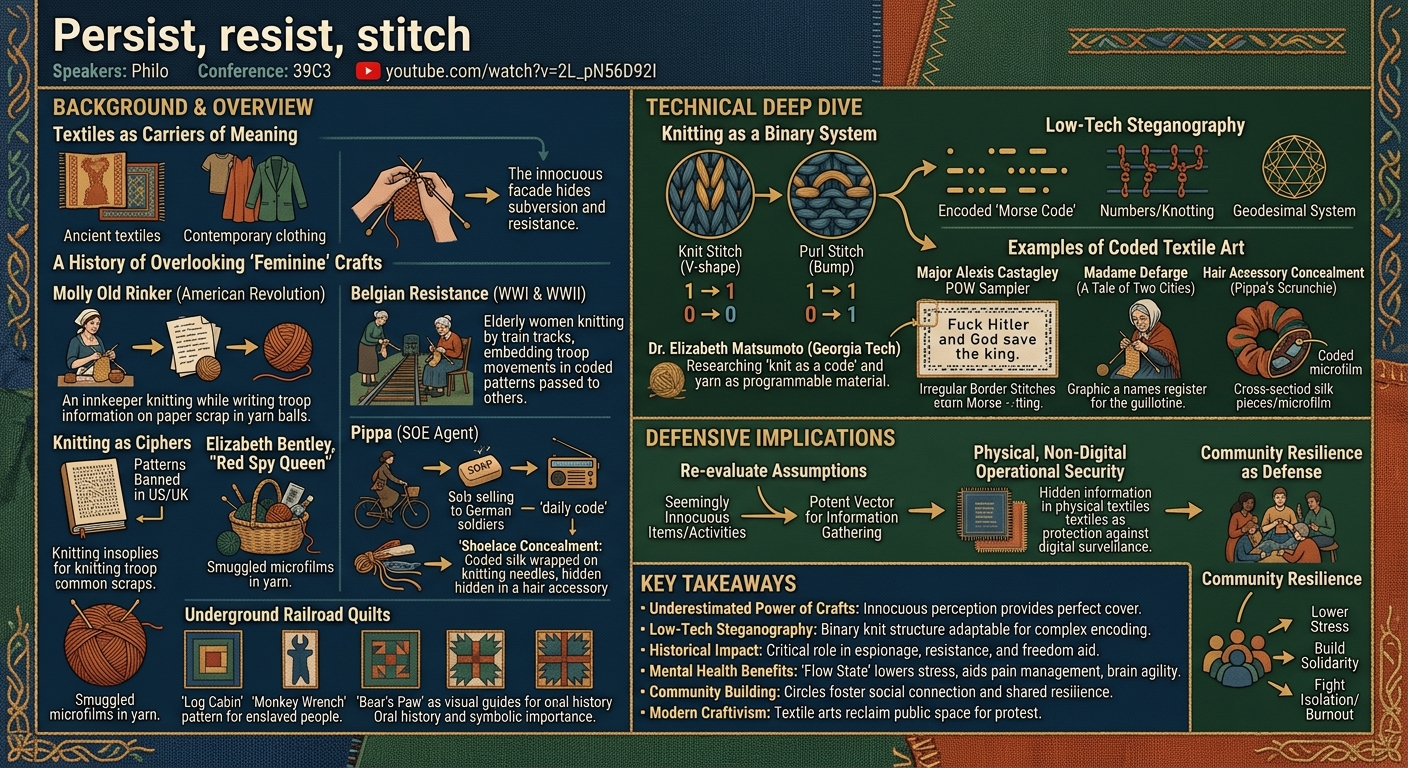
The talk begins by establishing the deep historical roots of textiles as carriers of meaning, from the ancient Bayeux Tapestry to the clothing we wear today. Philo highlights a pervasive societal tendency, rooted in patriarchal structures, to underestimate anything considered "feminine" or domestic. This underestimation, however, has inadvertently created a powerful opportunity for subversion and resistance. The image of a friendly, knitting grandmother, for instance, is rarely associated with serious information gathering, yet this innocuous facade has been exploited by countless individuals throughout history.
One of the earliest documented examples comes from the American War of Independence, where Molly Old Rinker, an innkeeper in Philadelphia, spied for George Washington. She used knitting as a cover, pretending to knit while actually writing down troop information on scraps of paper, which she then hid in balls of yarn and tossed off a cliff for collection. Similarly, during both World Wars, the Belgian resistance relied on elderly women who sat by train tracks, knitting while observing troop movements, then incorporating coded information into their knitted pieces—shawls or socks—which were then passed to others who could "read" the stitches. The ubiquity of knitting as a civilian war effort during these periods made it an ideal, unsuspicious cover.
The concept of knitting patterns themselves being perceived as ciphers was so strong that their printing was forbidden in the US and UK during both World Wars. Despite this, the British actively employed "knitting spies." A notable case is American agent Elizabeth Bentley, dubbed the "Red Spy Queen," who smuggled microfilms and classified documents, including B-29 bomber plans, in a basket filled with yarn and knitting supplies. Bentley famously quipped she should have been called "communist June Cleaver," underscoring how deeply the patriarchy's limited view of women could be turned against it.
Perhaps the most famous knitting spy was Phyllis Ada Lour Doyle, known as Pippa, a British Special Operations Executive (SOE) agent. Parachuted into Normandy in 1944, she operated undercover as a wireless operator in a spy network. Her mission involved cycling around, selling soap to German soldiers, and extracting intelligence about their bases and movements. She then knitted this information into a code, which she transmitted daily to London via radio. Pippa's ingenuity extended to her personal concealment methods; she wrapped coded silk pieces around knitting needles and hid them in a flat shoelace used to tie her hair, successfully evading searches by female soldiers.
Beyond wartime espionage, textile crafts have served marginalized communities for centuries. The controversial, yet deeply significant, stories of the American Underground Railroad quilts illustrate this. While hard historical evidence is scarce, oral histories suggest that quilts designed with coded messages were hung as signals to guide enslaved people to freedom. Philo argues that dismissing these stories due to a lack of written documentation ignores the realities of enslaved people, who were often forbidden from reading or writing, and discounts the validity of oral traditions in non-Western cultures. These quilts, whether factual or legendary, have become a powerful symbol of heritage and resistance for African-American communities today.
The speaker also touches upon the broader cultural significance of preserving textile traditions as an act of resistance against Western cultural dominance, encapsulating this sentiment with the quote from Stéphane Hessel: "To create is to resist, and to resist is to create."
Key Findings
▶ Watch: Belgian Resistance: Knitting ladies observed troop movements (4:00)
The core findings of this talk revolve around the multifaceted power and underestimated significance of textile crafts. Firstly, Philo establishes that these crafts are exceptionally potent tools for steganography and covert communication. Their seemingly innocuous nature, often dismissed due to societal biases against "feminine" activities, provides an unparalleled cover for hiding and transmitting sensitive information in plain sight. This makes them ideal for environments where traditional communication methods are monitored or dangerous.
Secondly, the talk highlights the profound role of textile arts in resistance and subversion against oppressive regimes and societal norms. From wartime espionage to the Underground Railroad and modern craftivism, these activities have enabled marginalized and disenfranchised groups to organize, protest, and persist. The act of creating, in this context, becomes an act of defiance.
Thirdly, Philo underscores the significant, empirically measured mental health benefits of crafting. Repetitive actions inherent in knitting or crocheting induce a relaxed "flow state," lowering heart rate, blood pressure, and cortisol levels. Crafting also aids in pain management by redirecting cognitive focus and keeps the brain agile, potentially slowing cognitive decline. This makes it a crucial practice for personal well-being and resilience, particularly during stressful or challenging periods.
Finally, the talk emphasizes the community-building aspect of crafting. Crafting circles provide social interaction without the pressure of constant eye contact or conversation, making them accessible even for introverts. This collective engagement fosters solidarity, shared skills, and mutual support, transforming individual acts of creation into powerful collective movements. The speaker argues that these "grandma hobbies" are not just quaint pastimes but historically proven, "extra badass" forms of resistance and self-care.
Technical Deep Dive
▶ Watch: Knitting as low-tech steganography and binary code (5:55)
The technical ingenuity inherent in textile crafts, particularly knitting, lies in its fundamental structure as a binary system. Philo explains that knitting primarily consists of two basic stitches: the knit stitch (V-shaped in the fabric) and the purl stitch (appearing as dashes or bumps). This binary nature makes it remarkably adaptable for encoding information, akin to digital programming languages. The speaker notes that "binary programming language and binary code" can be beautifully translated into knitted patterns.
One direct application discussed is the encoding of Morse code. In this system, one knit or purl stitch could represent a dot, and three stitches could represent a dash. Variations also exist for knotting yarn to signify Morse code or embed numbers. The geodesimal system, a method for representing geographical coordinates, is also mentioned as easily translatable into knitting. This entire approach constitutes a very low-tech form of steganography, leveraging common materials and skills to conceal messages where they are least expected.
The talk references academic research in this area, specifically mentioning Dr. Elizabeth Matsumoto at Georgia Tech University. Her work explores yarn as a programmable material and researches "knit as a code," drawing a direct connection between the logic of coding and the logic of knitting. This research suggests that learning to knit can even aid in learning to code, highlighting the underlying computational principles common to both.
Historical examples further illustrate these technical concepts. Madame Defarge in Charles Dickens' A Tale of Two Cities famously knits the names of nobles condemned to the guillotine, transforming her craft into a chilling ledger of resistance. More concretely, Phyllis Ada Lour Doyle, the British SOE agent, knitted intelligence into a code daily, which was then transmitted via radio. While the specific stitch-to-information mapping isn't detailed, the principle of embedding complex data into seemingly innocuous patterns is clear.
A particularly striking example of technical steganography is the cross-stitch sampler made by Major Alexis Castagley, a British prisoner of war during WWII. While appearing to be a simple, commemorative piece, a closer look reveals an irregular border. This border, Philo reveals, is encoded with Morse code that defiantly spells out, "Fuck Hitler and God save the king." This sampler was openly displayed in four different POW camps without its hidden message being discovered, demonstrating the effectiveness of the technique.
Beyond stitches, the physical properties of textiles themselves offer technical advantages for concealment. Pippa, the SOE agent, utilized the hollow space within a scrunchie (a voluminous hair tie) to hide coded silk pieces and microfilms. Philo points out that scrunchies, and textiles in general, offer numerous opportunities for concealing small items due to their structure and the common perception of them as harmless accessories. This highlights how the "technical deep dive" in this context extends beyond purely abstract coding to the practical, physical engineering of concealment within everyday objects.
Demo / Proof of Concept
▶ Watch: Madame Defarge: Literary example of knitting recording history (7:59)
The talk, "Persist, resist, stitch," did not feature a live, interactive technical demo or a traditional software/hardware proof of concept in the manner typically found at security conferences. Instead, Philo presented a compelling series of historical and theoretical examples that served as demonstrations of the core concepts.
For instance, the speaker visually presented an image of Major Alexis Castagley's cross-stitch sampler, pointing out the seemingly irregular border and then revealing its hidden Morse code message. This served as a powerful visual "proof of concept" for steganography within textile art, showing how a message could be overlooked for years despite being openly displayed. Similarly, images of complex knitting patterns were shown to illustrate how their appearance could easily be mistaken for a cipher, leading to their prohibition during wartime.
The narratives of Molly Old Rinker, the Belgian resistance knitters, Elizabeth Bentley, and Phyllis Ada Lour Doyle provided detailed, real-world "demonstrations" of how knitting and other crafts were used for intelligence gathering, smuggling, and covert communication. While not interactive, these historical accounts vividly illustrate the practical application and effectiveness of textile-based steganography and resistance. The discussion around knitting as a binary system and its potential for encoding Morse code or other programming languages also served as a theoretical "proof of concept" for its technical adaptability.
Defensive Implications
▶ Watch: "Knitting spies" and Elizabeth Bentley's microfilm smuggling (8:52)
While Philo's talk isn't about traditional cybersecurity vulnerabilities, its insights carry significant defensive implications in a broader sense, particularly concerning intelligence, counter-intelligence, and resilience in oppressive environments.
Firstly, the talk underscores the critical need for re-evaluating assumptions about "harmless" activities and objects. The historical success of textile crafts as a cover for espionage and resistance highlights that what appears innocuous can be a potent vector for information gathering or subversive action. Defenders, whether in national security, corporate intelligence, or personal privacy, should broaden their scope beyond obvious threats and consider the potential for low-tech steganography and covert communication embedded in everyday items and activities. This means not underestimating methods that might be dismissed as "feminine hobbies" or domestic pursuits.
Secondly, the historical narratives serve as a reminder of the enduring power of physical, non-digital methods of information concealment. In an age dominated by digital surveillance, understanding how information can be hidden in plain sight—whether in knitted patterns, sewn quilts, or even within hair ties—is crucial. For individuals seeking to protect their privacy or resist monitoring, these methods offer valuable lessons in maintaining operational security when digital channels are compromised or untrustworthy. It encourages a diversified approach to secure communication and data storage.
Thirdly, the talk implicitly advocates for fostering community and shared skills as a defensive strategy. The strength of resistance movements often lies in collective action and mutual support. Crafting circles, as highlighted by Philo, provide a low-stress environment for building these networks. For communities facing systemic challenges, promoting activities that enhance mental well-being and build social cohesion can be a vital form of defense against burnout, isolation, and psychological pressure. This resilience is a critical, often overlooked, aspect of any defensive posture.
Finally, the talk challenges a narrow, technology-centric view of security. By demonstrating the profound impact of textile arts on historical events and personal well-being, it suggests that "soft" skills and traditionally undervalued activities can possess immense strategic value. Defenders should cultivate a more holistic understanding of human agency and creativity in the face of adversity, recognizing that resistance and persistence can manifest in myriad, often surprising, forms. The ability of individuals to create, adapt, and connect through simple crafts can be a powerful counter to sophisticated surveillance and control mechanisms.
Key Takeaways
- Underestimated Power of Crafts: Textile crafts, often dismissed as "feminine hobbies," are historically proven, potent tools for steganography, espionage, and resistance due to their innocuous perception.
- Low-Tech Steganography: Knitting and other textile arts provide a binary system (knit/purl stitches) easily adaptable for encoding complex information like Morse code, making them effective for hiding messages in plain sight.
- Historical Impact: From American Revolutionary War spies and WWII resistance fighters to the Underground Railroad, crafts have played a crucial role in intelligence gathering, smuggling, and aiding marginalized communities.
- Mental Health and Resilience: Repetitive crafting actions induce a "flow state," reducing stress, lowering blood pressure, aiding pain management, and keeping the brain agile, making them vital for personal well-being and persistence.
- Community Building: Crafting circles foster social connection and solidarity, offering a low-pressure environment for individuals to gather, share skills, and build collective resilience.
- Modern Craftivism: The tradition continues today with "craftivism," where textile arts are used for public protest, political messaging, and social activism, reclaiming public space and challenging perceptions of "soft" forms of resistance.
About the Speaker(s)
Philo is an individual deeply passionate about the historical and contemporary significance of textile crafts, particularly their role in resistance and personal well-being. While their professional title and affiliation were not specified in the talk, they mentioned their everyday job involves "Nazi time research," suggesting a background in historical studies, which they balance with their interest in crafting as a source of calm and exploration. Philo is actively involved in crafting communities, referencing the "Hexon" and "Millieways," and is working towards greater accessibility in platforms like the Fediverse. Their presentation style is confident, engaging, and analytical, reflecting a deep personal connection to the subject matter.
All talks from 39th Chaos Communication Congress (39C3): Power Cycles