Current Drone Wars
Leonard
39th Chaos Communication Congress (39C3): Power Cycles · Day 2 · Saal Ground
Overview
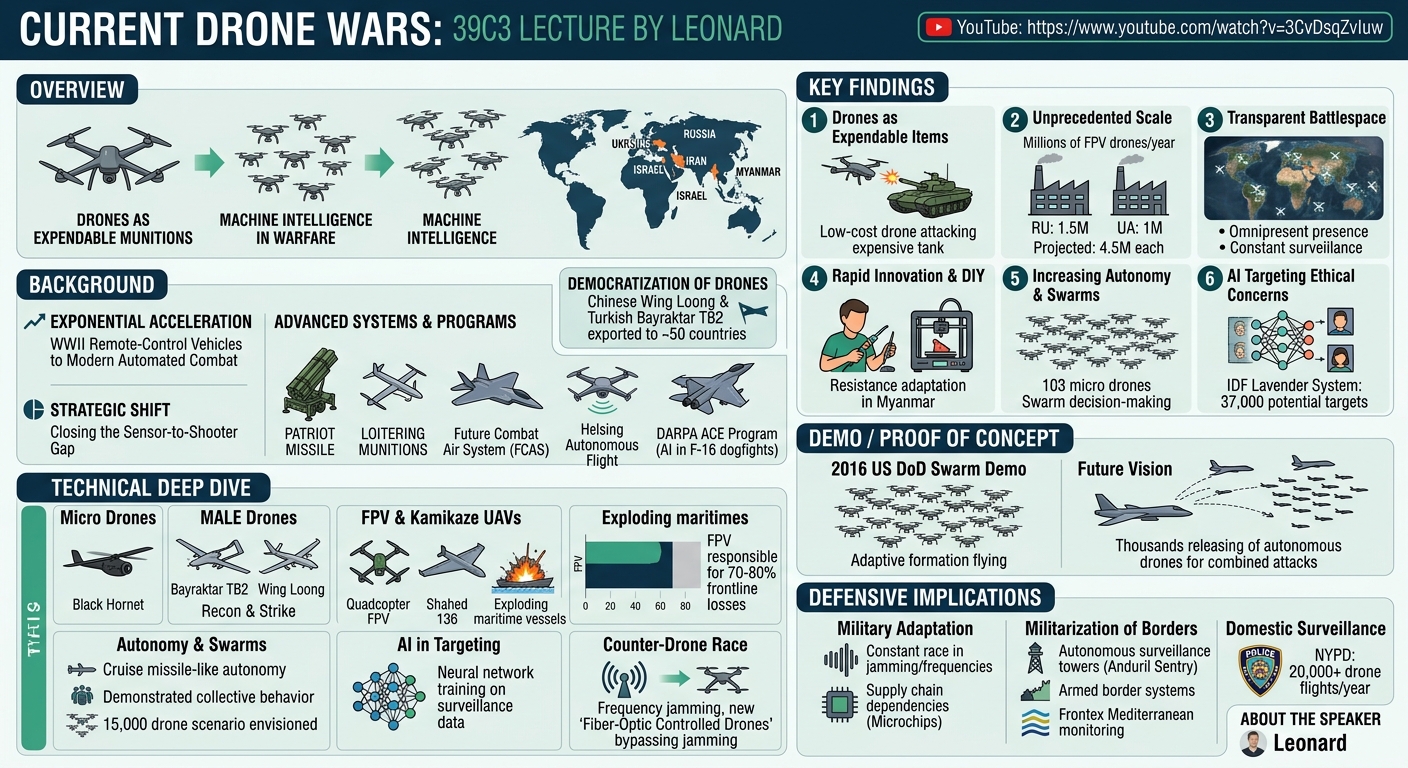
Leonard's thought-provoking talk, "Current Drone Wars," delivered at 39C3, plunged into the rapidly evolving landscape of modern warfare, where unmanned combat vehicles, or drones, are redefining conflict. The presentation meticulously detailed how these systems have transcended their traditional roles as expensive, specialized tools to become expendable, mass-produced munitions, fundamentally altering the dynamics of battlefields across the globe. Leonard underscored the profound shift towards applying machine intelligence to warfare, highlighting the strategic military objectives of achieving autonomous combat actions and seamless drone-soldier teaming.
Key moments
- 0:00 Introduction to current drone wars and their impact
- 1:35 Evolution of drones and advanced autonomous weapon systems
- 4:00 Rise of armed MALE drones like Bayraktar TB2
- 5:15 Ukrainian war: a turning point for drone warfare
- 6:40 FPV drones: low-cost, high-impact battlefield game-changers
- 9:45 Russia's Shahed drones and Ukraine's high-value counter-strikes
- 11:10 Ukrainian remote-controlled exploding vessels impact Russian fleet
Current Drone Wars
Speakers: Leonard
Conference: 39C3
YouTube: https://www.youtube.com/watch?v=3CvDsqZvIuw
Overview
Leonard's thought-provoking talk, "Current Drone Wars," delivered at 39C3, plunged into the rapidly evolving landscape of modern warfare, where unmanned combat vehicles, or drones, are redefining conflict. The presentation meticulously detailed how these systems have transcended their traditional roles as expensive, specialized tools to become expendable, mass-produced munitions, fundamentally altering the dynamics of battlefields across the globe. Leonard underscored the profound shift towards applying machine intelligence to warfare, highlighting the strategic military objectives of achieving autonomous combat actions and seamless drone-soldier teaming.
The talk provided a stark, analytical look at how drones are being deployed in contemporary conflicts, from the unprecedented scale of the Russian-Ukrainian War to the DIY ingenuity of resistance fighters in Myanmar and the sophisticated arsenals in the Israel-Iran conflict. Beyond the immediate battlefront, Leonard extended the discussion to the chilling implications of drone technology for border surveillance, domestic law enforcement, and the broader humanitarian crisis exacerbated by militarized borders. The presentation served as a critical examination of technological advancement meeting geopolitical realities, urging a deeper understanding of the ethical and societal ramifications of this "new normal" in warfare.
Background
▶ Watch: Introduction to current drone wars and their impact (0:00)
The concept of unmanned vehicles in warfare is far from new, with early forms emerging a century ago for reconnaissance in World War I. By the 1930s and World War II, rudimentary remote-control tanks and demolition vehicles marked the initial steps towards automated combat. However, the modern era has seen an exponential acceleration in drone capabilities, driven by a deliberate, long-lasting military strategy to integrate machine intelligence into warfare. This strategy aims to close the gap between sensor and shooter, transforming reconnaissance tools into direct combatants.
Early examples of advanced autonomous weapon systems include the Patriot surface-to-air missile system and loitering munitions like the Harpy or Harop, which have been programmed to surveil areas and attack enemies autonomously since the 1980s. Current military programs, particularly in the US, Europe, and China, prioritize the advancement of autonomous combat actions and the teaming of drones with soldiers. Projects such as the Future Combat Air System (FCAS), a massive undertaking by German, French, and Spanish armament companies, exemplify this ambition. Companies like Helsing proudly demonstrate autonomous flight capabilities for military jets, reacting to threats without human intervention. Similarly, DARPA's ACE program developed F-16 fighter prototypes after DeepMind's neural networks proved capable of defeating human pilots in virtual dogfights, aiming for "autonomous air dominance." Initially, advanced medium-altitude, long-endurance (MALE) drones were exclusive to the US and Israel, but their proliferation, fueled by Chinese exports of the Wing Loong and Turkish exports of the Bayraktar TB2, has expanded their use to almost 50 countries, marking a significant shift in global military capabilities.
Key Findings
▶ Watch: Rise of armed MALE drones like Bayraktar TB2 (4:00)
The talk revealed several critical shifts and findings in the landscape of modern drone warfare, underscoring its transformative impact on global conflicts:
- Drones as Expendable Munitions: The most significant finding is the redefinition of drones from expensive, superior systems to expendable items in a war of attrition. The Russian-Ukrainian War, in particular, serves as a testbed where drones are seen primarily as munition. This shift is driven by their cost-effectiveness: hundreds of dollar drones can destroy tactical equipment worth millions, leading to an "enormous" cost-benefit ratio.
- Unprecedented Scale of Production and Deployment: Both Russia and Ukraine claim to be ramping up production to unprecedented levels, with Russia claiming 1.5 million small expendable drones (mostly quadcopters) and Ukraine 1 million, with projections of 4.5 million each next year. This massive scale of production, approximately 12,000 FPV drones per day, indicates a future where drone swarms could become a common sight.
- Ubiquitous Presence and Transparent Battlespace: Drones are now "omnipresent" on the battlefield, creating a "transparent battle space" where every movement is observed. Soldiers report feeling like "thousands of snipers in the sky," highlighting the psychological impact and the constant threat posed by these devices, which can arrive at a scene "within minutes, ready to kill."
- Rapid Innovation and DIY Adaptation: The conflicts demonstrate rapid innovation, with prototypes produced and combat-tested within weeks. In regions like Myanmar, resistance groups, lacking foreign state backing, have resorted to DIY drone construction using commercial parts, 3D printers, and shared online/offline knowledge, successfully deploying low-cost multi-rotor drones against military targets.
- Increasing Autonomy and Swarm Capabilities: While many drones are still remotely controlled, there's a clear trend towards greater autonomy. Many are equipped with cruise missile-like autonomy, enabling them to crash into targets even if connection is lost. The talk also highlighted military demonstrations of micro drone swarms (e.g., 103 quadcopters by the US DoD) capable of collective decision-making and adaptive formation flying, with scenarios envisioning 15,000 autonomous drones in combined attacks.
- AI-Driven Targeting and Ethical Concerns: The disclosure of the IDF's Lavender system revealed the use of neural networks trained on mass surveillance data to identify potential targets, generating lists of 37,000 Palestinians for potential airstrikes within weeks. This raises significant ethical concerns about algorithmic warfare and the potential for indiscriminate targeting.
Technical Deep Dive
▶ Watch: Ukrainian war: a turning point for drone warfare (5:15)
The technical advancements discussed by Leonard span a wide spectrum of drone types, autonomy levels, and their integration into sophisticated combat and surveillance systems.
At the smaller end of the spectrum are micro drones like the Black Hornet, utilized by military and special operations forces in over 50 countries for reconnaissance. These highly portable units provide immediate situational awareness. Scaling up, medium-altitude, long-endurance (MALE) drones such as the Chinese Wing Loong and Turkish Bayraktar TB2 have become pivotal. Costing a relatively low $1-2 million, these drones were initially key advantages for forces like Ukraine, performing reconnaissance and strike missions. Their widespread export has democratized access to advanced aerial capabilities.
The Russian-Ukrainian War has particularly highlighted the rise of First-Person View (FPV) drones, mostly quadcopters, often equipped with rocket-propelled grenades. These low-cost consumer drones, financially and organizationally furnished by civil society, are remotely controlled into targets. While initially deployed by Ukrainian forces, Russia quickly adapted, leading to FPV drones being responsible for an estimated 70-80% of all human and material losses on the front lines. Ukraine has also developed and mass-produced larger, fixed-wing kamikaze UAVs with long ranges, attacking high-value targets and Russian oil depots deep behind front lines. Russia, in turn, heavily relies on Iranian-supplied Shahed 136 kamikaze drones, which are frequently used alongside missiles to attack Ukrainian cities and infrastructure. Beyond aerial platforms, Ukraine has innovated with remote-controlled exploding vessels, successfully reducing the Russian fleet and targeting oil tankers in the Black Sea.
The level of autonomy in these systems varies significantly. Many drones, especially kamikaze variants, are equipped with cruise missile-like autonomy, allowing them to navigate to and crash into their target even if communication links are lost due to jamming or range limitations. This "fire-and-forget" capability enhances their effectiveness and resilience. However, the cutting edge lies in swarm technology and AI integration. In 2016, the US Department of Defense demonstrated one of the world's largest micro drone swarms, comprising 103 small quadcopters (approximately 15 cm wide) dropped from aircraft. These drones performed complex tasks such as collective decision-making and adaptive formation flying, showcasing a rudimentary form of distributed intelligence. China soon demonstrated similar capabilities. Future scenarios, as outlined in the German Bundeswehr document "Künstliche Intelligenz für die Landstreitkräfte" (Artificial Intelligence for the Army), envision the deployment of 15,000 autonomous drones of different types and sizes from aircraft, forming swarms for combined reconnaissance and attack missions.
AI-driven targeting systems represent another critical technical development. The IDF's Lavender system, disclosed in April 2024, exemplifies this. It's a neural network trained on mass surveillance data to identify features of suspected Hamas or Palestinian Islamic Jihad members. The system then generates lists of potential targets and estimates their likelihood of being a member. When used to target lower ranks, it reportedly generated a list of 37,000 Palestinians within weeks, marking their homes as potential airstrike targets. This highlights the growing reliance on AI for target acquisition, raising profound ethical and accuracy questions.
Regarding counter-drone measures, the talk touched upon the constant "race" between jamming frequencies and military adaptation. The emergence of fiber optically controlled drones in the Russian-Ukrainian conflict is a novel development to circumvent radio jamming. These FPV drones pull 10-50 km of fiber optic cable, maintaining a secure, unjammable connection to the operator, although this introduces new logistical challenges. The global supply chain for these technologies, particularly for microchips (mostly produced in Taiwan), remains a critical dependency, prompting countries to try and build up domestic production capabilities to reduce vulnerabilities.
Demo / Proof of Concept
▶ Watch: Russia's Shahed drones and Ukraine's high-value counter-strikes (9:45)
While the talk did not feature a live demonstration by the speaker, Leonard presented numerous real-world military exercises and ongoing deployments that serve as compelling proofs of concept for the advanced drone capabilities discussed. These examples illustrate the practical application and future trajectory of drone warfare.
A significant proof of concept was the US Department of Defense's demonstration in 2016 of one of the world's largest micro drone swarms. This involved 103 small quadcopters, each about 15 cm in width, being dropped from three aircraft. These drones were not merely flying in formation but performed specific, coordinated tasks, including collective decision-making and adaptive formation flying. This demonstration showcased the foundational capabilities for future autonomous swarm operations, hinting at a future where individual drones act as a single, intelligent entity. China subsequently demonstrated similar capabilities, reinforcing the global race in this domain.
Further illustrating the future of these systems, Leonard referenced a scenario from the 2019 Bundeswehr document "Künstliche Intelligenz für die Landstreitkräfte" (Artificial Intelligence for the Army). This document describes a hypothetical, yet increasingly realistic, scenario where 15,000 autonomous drones of various types and sizes are released from aircraft. These drones would then form swarms to conduct diverse tasks, including reconnaissance and combined attacks. The sheer scale of this vision, coupled with the current production claims of 4.5 million FPV drones annually by both Russia and Ukraine, underscores that such a scenario is no longer distant science fiction but an imminent reality being actively prepared for by major military powers. These examples, though not live demonstrations by the speaker, powerfully serve as "proofs of concept" for the terrifying scale and sophistication of current and future drone wars.
Defensive Implications
▶ Watch: Ukrainian remote-controlled exploding vessels impact Russian fleet (11:10)
The proliferation and rapid advancement of drone technology present multifaceted defensive challenges for both military and civilian entities. For military forces, the primary implication is the necessity for constant adaptation and innovation. As seen in the Russian-Ukrainian conflict, the "constant race" between adversaries jamming frequencies and militaries adapting to others means that defense systems must be agile, capable of detecting and countering drones operating across diverse frequencies and modes. This includes developing robust anti-drone systems that can neutralize individual drones or entire swarms through electronic warfare, kinetic interception, or cyberattacks. The emergence of fiber optically controlled drones highlights the need for new defensive strategies beyond traditional radio jamming.
Furthermore, the scale of drone production (e.g., millions of FPV drones annually) demands equally scaled defensive capabilities. This includes not only counter-drone technologies but also a re-evaluation of battlefield tactics, as traditional armored vehicles are increasingly vulnerable to low-cost FPV attacks. Soldiers are forced to adapt, often dismounting and marching longer distances to avoid detection and targeting by omnipresent drones. Reducing supply chain dependencies, particularly for critical components like microchips (mostly produced in Taiwan), is a strategic imperative for all nations to ensure resilience in weapon production.
Beyond military battlefields, the defensive implications extend to civilian populations and fundamental human rights. The militarization of borders through drone technology poses a significant threat. Frontex, for instance, deploys MALE drones like Heron or Hermes 900 over the Mediterranean to monitor migration routes. More concerning are the autonomous surveillance towers and armed systems deployed at borders, such as the machine gun with thermal cameras and an alert system deployed at the Turkish-Syrian border in 2016, which shoots if warnings are not heeded. US Customs and Border Protection operates Predators and Anduril's Sentry autonomous surveillance towers, with thousands more from Anduril projected for deployment by 2026. While these systems may not directly shoot in some contexts, they contribute to a "deadly border" regime, forcing migrants into more perilous routes.
Domestically, the rise of companies like Skydio, a multi-billion dollar drone manufacturer, demonstrates the increasing deployment of surveillance drones by law enforcement and security agencies. The New York Police Department, for example, has launched over 20,000 drone flights in less than a year, monitoring people in cities. This raises significant concerns about privacy, civil liberties, and the potential for mass surveillance. The IDF's Lavender system, an AI-driven targeting system that generated lists of tens of thousands of potential targets based on mass surveillance data, exemplifies the ethical perils of algorithmic warfare and the potential for automated, indiscriminate targeting. Defenders, therefore, must not only consider technological countermeasures but also advocate for strong ethical guidelines, international regulations, and robust legal frameworks to govern the development and deployment of autonomous weapons and surveillance systems, fighting against the rise of authoritarian regimes and militarized border policies.
Key Takeaways
- Drones as Expendable Munitions: Modern conflicts, particularly the Russian-Ukrainian War, have redefined drones as cheap, mass-produced, and expendable munitions, rather than expensive, specialized assets, fundamentally altering battlefield dynamics.
- Unprecedented Scale and Rapid Innovation: Both state and non-state actors are engaging in a rapid arms race, with production claims reaching millions of FPV drones annually and prototypes developed and tested in combat within weeks, including DIY solutions.
- Increasing Autonomy and Swarm Capabilities: The trend is towards greater drone autonomy, from cruise missile-like "fire-and-forget" capabilities to sophisticated micro drone swarms capable of collective decision-making and adaptive formation flying, with scenarios envisioning deployments of 15,000 autonomous drones.
- High Cost-Benefit Ratio and Battlefield Transparency: Low-cost drones (hundreds of dollars) are proving effective at destroying high-value tactical equipment (millions of dollars), creating an "omnipresent" and "transparent battle space" that significantly impacts troop movement and psychological welfare.
- Militarization of Borders and Domestic Surveillance: Drone technology is increasingly deployed for border surveillance, with some systems becoming armed and autonomous, while domestic law enforcement agencies are rapidly adopting drones for widespread public monitoring.
- Ethical Concerns of AI-Driven Targeting: The integration of AI for target identification, as exemplified by the IDF's Lavender system, raises profound ethical questions about algorithmic warfare, potential for indiscriminate targeting, and the implications of mass surveillance data.
About the Speaker(s)
The speaker for "Current Drone Wars" was identified solely by their first name, Leonard, in the provided metadata and transcript. No additional biographical details, professional titles, or affiliations were mentioned during the presentation or in the accompanying information.
All talks from 39th Chaos Communication Congress (39C3): Power Cycles