Textiles 101: Fast Fiber Transform
octoprog
39th Chaos Communication Congress (39C3): Power Cycles · Day 2 · Saal Ground
Overview
In "Textiles 101: Fast Fiber Transform," octoprog, also known as Lionus, delivered a comprehensive and engaging primer on the vast world of textiles. Presented at the 39th Chaos Communication Congress (39C3), a conference renowned for its diverse technical and cultural talks, this presentation offered a deep dive into the fundamental components, processing methods, and significant societal impacts of the textile industry. While 39C3 often features cybersecurity and technology discussions, Lionus’s talk provided a unique and highly accessible educational journey through the science and craft of fabrics.
Key moments
- 0:00 Introduction and what defines a textile
- 2:00 Overview of natural and synthetic fiber types
- 2:57 Different sources of cellulosic (plant) fibers
- 4:09 The process of manufacturing cotton fiber
- 5:12 Processing bast fibers: retting, decortication, hackling
- 6:13 Explanation of mercerization and its effects
- 7:09 Key properties and characteristics of cellulosic fibers
- 8:08 Practical fabric identification: the burn test
Textiles 101: Fast Fiber Transform
Speakers: octoprog (Lionus)
Conference: 39C3
YouTube: https://www.youtube.com/watch?v=9CVJ5ijkC_M
Overview
In "Textiles 101: Fast Fiber Transform," octoprog, also known as Lionus, delivered a comprehensive and engaging primer on the vast world of textiles. Presented at the 39th Chaos Communication Congress (39C3), a conference renowned for its diverse technical and cultural talks, this presentation offered a deep dive into the fundamental components, processing methods, and significant societal impacts of the textile industry. While 39C3 often features cybersecurity and technology discussions, Lionus’s talk provided a unique and highly accessible educational journey through the science and craft of fabrics.
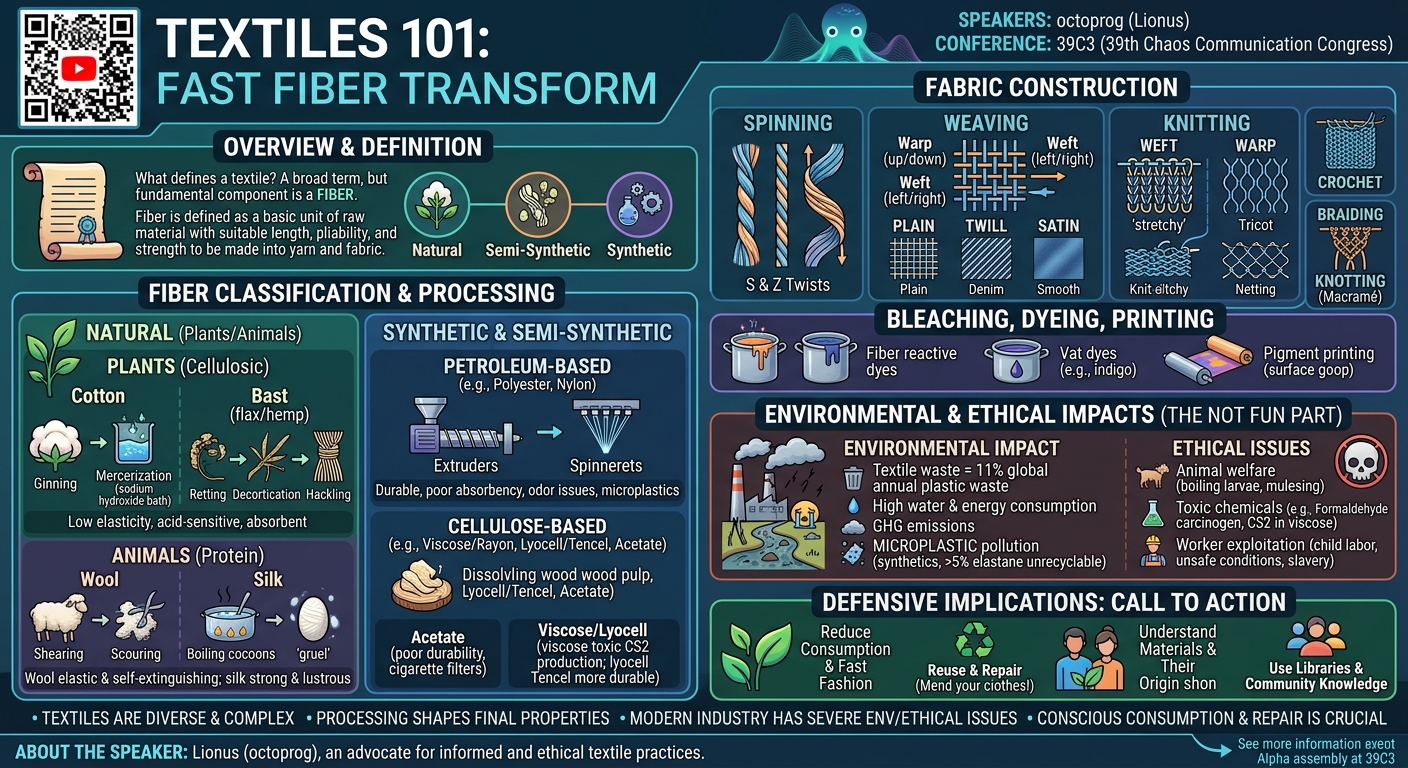
The talk systematically breaks down what constitutes a fiber and a textile, exploring the origins and characteristics of natural, semi-synthetic, and synthetic materials. Beyond the technical aspects of fiber production, spinning, weaving, and knitting, Lionus critically examined the profound environmental and ethical challenges embedded within the modern textile industry. This article will explore the intricate details of textile creation, the speaker's key insights into material properties, and the urgent call to action regarding sustainable and ethical consumption.
Background
▶ Watch: Introduction and what defines a textile (0:00)
The journey into textiles begins with a foundational question: "What even is a textile?" Lionus humorously acknowledged the difficulty in providing a concise definition, citing Merriam-Webster's broad "fiber, filament or yarn used making cloth" and other sources that include woven, nonwoven, knit, and even silicone/latex materials. Ultimately, a fiber is defined as a basic unit of raw material possessing suitable length, pliability, and strength for conversion into yarns and fabrics – essentially, anything thin, long, and bendy enough.
The presentation then categorized fibers into three main groups: natural, semi-synthetic, and synthetic. Natural fibers are predominantly derived from plants and animals, with a brief, historical mention of mineral fibers like asbestos, once used for non-flammable blankets. Semi-synthetic and synthetic fibers are primarily cellulose-based, protein-based, or petroleum-based, with other niche materials like glass fiber. This foundational classification sets the stage for understanding the diverse properties and processing requirements of the materials that form the backbone of our clothing and countless other products. The talk made it clear from the outset that this would not be about networking fiber optics, but rather the fibers we wear and use every day.
Key Findings
▶ Watch: Different sources of cellulosic (plant) fibers (2:57)
Lionus's talk illuminated several key findings regarding the nature and impact of textiles, moving beyond superficial appearances to reveal the underlying science and ethical considerations.
Firstly, the talk underscored the incredible diversity and specificity of fiber properties. For instance, cellulosic fibers like cotton and bast fibers (e.g., flax, hemp) exhibit little elasticity, are easily damaged by acids, but are highly absorbent and resistant to alkaline pH and high temperatures. Animal fibers, such as wool (keratin-based) and silk (protein-based), present a contrasting profile. Wool is highly elastic, self-extinguishing, and unique in its ability to generate heat when absorbing moisture, but is also prone to felting when agitated with heat and water due to its rough outer layer. Silk, known for its luster and strength, involves a more "gruel" processing method of boiling cocoons. Synthetic fibers, largely petroleum-based (e.g., polyester, nylon) or cellulose-based (e.g., viscose, lyocell), offer durability and appearance retention but struggle with absorbency and UV resistance, often developing odors due to bacterial growth. The speaker highlighted that even within synthetic cellulose, acetate is a poor performer in terms of durability and maintenance, while viscose (rayon) and lyocell (Tencel) are more robust, though their production processes carry significant environmental burdens.
Secondly, the presentation detailed the complex and varied processing techniques required to transform raw fibers into usable textiles. From the simple ginning of cotton to the multi-stage retting, decortication, and hackling of bast fibers, and the shearing, scouring, and carding of wool, each fiber demands specific mechanical and chemical treatments. Mercerization, a sodium hydroxide bath under tension, was identified as a key process for cellulosic fibers to enhance strength, luster, and dyeability. The talk also demystified spinning (twisting filaments into yarn, with S and Z twists), weaving (interlacing warp and weft threads into plain, twill, or satin patterns), and knitting (connecting loops into stretchy fabrics via knit and pearl stitches). These processes fundamentally dictate the final fabric's structure, drape, and utility.
Finally, and perhaps most critically, Lionus exposed the devastating environmental and ethical impacts of the modern textile industry. This was a stark "not fun part" of the talk, revealing that textile waste contributes 11% to global annual plastic waste. The industry is a massive consumer of water, a generator of greenhouse gas emissions, and a significant source of microplastic pollution from synthetic garments (especially those with over 5% elastane, which are typically unrecyclable). Ethically, the talk covered animal exploitation in silk (boiling larvae alive) and wool (mulesing, slaughter), the use of toxic substances like formaldehyde (a known carcinogen) and endocrine disruptors in finishes, and widespread worker exploitation, including child labor, literal slavery, and unsafe working conditions (e.g., carbon disulfide exposure in viscose production). These findings serve as a powerful indictment of fast fashion and a call for conscious consumption.
Technical Deep Dive
▶ Watch: Processing bast fibers: retting, decortication, hackling (5:12)
The technical exposition of "Textiles 101" was comprehensive, breaking down the journey from raw fiber to finished fabric with illustrative detail.
Fiber Classification and Processing:
Lionus began by distinguishing natural fibers from semi-synthetic and synthetic fibers.
- Natural Cellulosic Fibers (Plants):
- Seed Fibers: Cotton is the prime example, processed by plucking and then a cotton gin which cleans, combs, and sorts fibers by length.
- Bast Fibers: Found in the inner bark (phloem) of plants like flax or hemp. Processing involves retting (rotting away bark, often in water), decortication (breaking away rind), and hackling (aggressive combing to straighten and sort fibers).
- Other Plant Fibers: Leaf, stem, and fruit fibers like coir (coconut fiber) and agave fibers.
- Mercerization: A chemical treatment, typically for cotton and linen, involving a sodium hydroxide bath under tension. This process smooths hydrogen bonds, increasing strength, luster, and dyeability. Cellulosic fibers generally lack elasticity, are acid-sensitive, but absorbent and resistant to alkaline pH.
- Natural Protein Fibers (Animals):
- Wool: Derived from sheep and similar animals. Processing involves shearing, scouring (cleaning and removing fats), and carding (straightening fibers). Wool's unique Velcro-like outer scales cause felting when agitated with heat and water. It is hydrophobic externally but highly absorbent internally, giving off heat upon moisture absorption. Wool is self-extinguishing but weak when wet.
- Silk: Primarily from the domestic silk moth. Production involves boiling cocoons to unravel the continuous filament. The concept of Ahimsa silk (peace silk) allows larvae to fully develop, but consumers are urged to verify claims. Silk is known for its strength and luster.
- Synthetic and Semi-Synthetic Fibers:
- Petroleum-Based (e.g., Polyester, Nylon, Acrylic): These are extruded from a goo or liquid through spinnerets into various forms. They are durable, maintain appearance well, but are poor at absorbing moisture and resisting UV light. Their chemical similarity means many share properties, differing mainly in elasticity. They also tend to retain odors more than natural fibers.
- Cellulose-Based (e.g., Viscose/Rayon, Lyocell/Tencel, Acetate): Made from dissolved cellulose (often from bamboo, though the source doesn't change the final fiber's properties). They are generally silky, lustrous, and smooth.
- Acetate: One of the earliest synthetic fibers, chemically a cellulose acetate. It is noted for poor durability, high maintenance (melts with hot ironing, wrinkles easily, water stains), and is widely used in cigarette filters (up to 75% of production). Its solvent is easily reusable.
- Viscose/Lyocell: 100% cellulose, chemically identical at a molecular level but differing in polymer chain crystallization. Lyocell (Tencel) generally has a better crystalline structure, making it more durable. Viscose production is highly problematic due to the use of toxic carbon disulfide.
Yarn Formation and Fabric Construction:
- Spinning: The process of taking fibers or filaments and twisting them together to form yarn. Key terms include S-twist and Z-twist, referring to the direction of the slant of the twist. Measurement systems like tex and denier describe weight per unit length.
- Weaving: Interlacing two sets of threads at right angles.
- Warp threads: Run lengthwise (up-down).
- Weft threads: Run crosswise (left-right).
- Main Weave Patterns:
- Plain weave: Simple one-over, one-under pattern.
- Twill weave: Two to five threads over/under, creating diagonal lines (e.g., denim).
- Satin weave: One thread floats over many (five to seven) other threads before going under, creating a smooth, lustrous surface.
- Fabric Considerations: When buying fabric, understanding the fiber material, quality, fabric type (e.g., thin vs. thick), fabric count/weight, and grain (to avoid wonky pieces) are crucial.
- Knitting: Creating fabric from a single continuous yarn by forming interconnected loops.
- Weft knitting: What people typically do with needles; loops are connected to previous loops. Main stitches are knit and purl. Knitted fabrics are inherently stretchy due to their loop structure and unravel in "ladders."
- Warp knitting: A more industrial process, often used for tricot, netting, and rolls. While traditionally machine-done, humans can do it.
- Other Yarn Crafts:
- Crochet: Loops are connected to previous loops but not those below, making it less stretchy and more bumpy than knitting. No machine can replicate it due to the need to "find the hole."
- Braiding: Intertwining strands to create flat or three-dimensional pieces.
- Knotting (Macramé): Looping strands around each other to form decorative and functional items.
- Honorable Mentions: Sprang (a very stretchy, lace-like technique using only warp threads) and tablet weaving (creating intricate patterns, good for belts or lanyards).
- Bleaching, Dyeing, and Printing:
- Bleaching: Removing color. Different bleaches have different effects.
- Dyeing: Adding color via a chemical process, making it more permanent. Specific dyes like fiber reactive dyes for cellulose and vat dyes (e.g., indigo) are common.
- Printing: Applying dye in a structural manner. Pigment printing uses pigment inks that stick to the fabric surface, forming a goop that can be less durable against abrasion.
Demo / Proof of Concept
▶ Watch: Explanation of mercerization and its effects (6:13)
While "Textiles 101" was not a security talk featuring code exploits or system vulnerabilities, Lionus effectively incorporated practical demonstrations to illustrate key textile concepts, functioning as a "proof of concept" for the discussed properties.
Throughout the presentation, the speaker utilized readily available examples to concretize abstract ideas. For instance, a physical bracelet was used to demonstrate complex weave patterns, showing how an inverted appearance on both sides could be achieved by creatively manipulating the warp and weft threads. This highlighted the versatility and aesthetic potential of weaving techniques.
Another key demonstration involved a knitted fabric sample where a stitch was deliberately dropped. This visually represented how knitted fabrics "unravel in ladders" when a loop is released, directly illustrating the structural integrity (or lack thereof) of interconnected loops in knitting. This contrasted with crochet, which unravels stitch by stitch. The speaker also pointed to their own clothing, noting that their shirt was not knit fabric because it wasn't stretchy, while a t-shirt would likely show the tiny V-shaped stockinget stitch characteristic of knit fabrics.
These hands-on examples, combined with figures and images of fiber structures (like the rough outer layer of wool responsible for felting, or the smoother mercerized cotton), served to ground the technical explanations in tangible reality. They allowed the audience to visually grasp the consequences of different fiber types and construction methods on the final textile's behavior and appearance, acting as practical validations of the theoretical concepts presented.
Defensive Implications
▶ Watch: Practical fabric identification: the burn test (8:08)
Given that "Textiles 101" is a non-security talk presented at a security conference, the traditional "Defensive Implications" section requires reinterpretation. Instead of cybersecurity defenses, this section focuses on "Defenses Against Unsustainable and Unethical Practices" within the textile industry, and how consumers can "defend" themselves and the planet from its negative impacts.
Lionus delivered a powerful indictment of the modern textile industry, urging a shift in consumer behavior and industry practices. The "defensive implications" are primarily ethical and environmental calls to action:
- Reduce Consumption: The sheer volume of clothing produced and destroyed is unsustainable. Consumers should question the necessity of new purchases.
- Reuse and Repair: Instead of discarding, mend clothes. Lionus explicitly encouraged, "Please mend your clothes." This extends the lifespan of garments and reduces waste.
- Recycle with Awareness: While recycling is often promoted, the speaker revealed its limitations. For example, clothing with over 5% elastane (a common synthetic stretch fiber) is currently often unrecyclable. Donating clothes doesn't guarantee proper recycling; much ends up in landfills or burned.
- Understand Material Impact:
- Microplastics: Every wash of petroleum-based (e.g., polyester) clothing releases microplastics. Consumers should consider this when choosing materials and washing practices (e.g., using specialized detergents for synthetic activewear to mitigate smell, which is often bacterial growth on synthetic fibers).
- Water Usage & Emissions: The production of fibers like cotton and bamboo (for viscose) involves monocultures, significant water consumption, and greenhouse gas emissions.
- Toxic Chemicals: Be aware of finishes and flame retardants (like formaldehyde, a known carcinogen) used in clothing. The lack of transparency around "mystery chemicals" and endocrine disruptors poses health risks to both workers and consumers.
- Production Ethics: Understand the processes behind materials. Viscose production, for example, often uses highly toxic carbon disulfide, exposing workers to severe health risks due to inadequate PPE and exploitative conditions, including child labor and slavery.
- Ethical Sourcing:
- Animal Welfare: For animal fibers, consider the ethical implications. Silk production often involves boiling silkworms alive. The mulesing practice in the wool industry, where skin is cut from sheep to prevent flystrike, is a significant welfare concern. Furthermore, wool animals are often slaughtered when no longer profitable. Lionus, as a vegan, highlighted these issues and encouraged seeking verified Ahimsa silk or thrifted animal products if consuming them.
- Worker Rights: Recognize that many textile workers face exploitation, child labor, and unsafe conditions globally, despite corporate promises.
- Support Sustainable Alternatives & Practices: Explore plant-based fibers beyond cotton (though they might be harder to find or more expensive). Engage with textile crafts and learn to make things yourself, or appreciate the labor involved in handmade items.
- Seek Knowledge: Lionus strongly advocated for using local libraries, joining textile clubs, watching other talks, and practicing textile crafts to deepen understanding and make informed choices. Recommended readings like "Textiles" by Kov & Marquetti, "To Die For" by Lucy Siegle, and "How Toxic Fashion is Making Us Sick" by Rachel S. Miller were suggested.
In essence, the "defense" here is active, informed, and ethical consumerism, coupled with a deeper appreciation for the craft and the hidden costs of fast fashion.
Key Takeaways
- Textiles are Diverse and Complex: Fibers are categorized into natural (plant, animal), semi-synthetic (cellulose-based), and synthetic (petroleum-based), each with unique chemical structures, physical properties, and processing requirements.
- Processing Shapes Properties: From retting bast fibers to mercerizing cotton, and the distinct methods of spinning, weaving (plain, twill, satin), and knitting (weft, warp), each step fundamentally alters the final fabric's characteristics, such as elasticity, durability, and drape.
- Environmental Impact is Severe: The textile industry is a major contributor to global plastic waste (11%), greenhouse gas emissions, water pollution, and microplastic release (especially from synthetics with >5% elastane, which are often unrecyclable).
- Ethical Concerns are Widespread: Animal exploitation (boiling silkworms, mulesing sheep), toxic chemical usage (formaldehyde, carbon disulfide in viscose), and pervasive worker exploitation (child labor, unsafe conditions, slavery) are deeply embedded issues within the industry.
- Conscious Consumption is Crucial: Consumers are urged to reduce purchases, reuse and mend existing clothes, understand material origins and impacts, and support ethical and sustainable practices to mitigate the industry's negative footprint.
- Textile Crafts are Accessible and Rewarding: Engaging in activities like knitting, crocheting, braiding, or tablet weaving offers a deeper appreciation for textiles and encourages a more hands-on, sustainable approach to clothing and fabric.
About the Speaker(s)
The talk was delivered by octoprog, identified as Lionus. Lionus expressed a personal passion for textiles and textile crafts, describing themselves as a "jack of some trades and a master of none" in this broad field. Their enthusiasm for the subject was evident throughout the presentation, as was their dedication to sharing knowledge and fostering greater understanding of textile science and its societal implications. Lionus encouraged attendees to ask questions and engage in further discussions about textiles, indicating their availability at the A assembly (Alpha assembly, an alliteration) or via their handle "octoprog" across various platforms. They are clearly an advocate for informed and ethical practices within the textile world.
All talks from 39th Chaos Communication Congress (39C3): Power Cycles