When Vibe Scammers Met Vibe Hackers: Pwning PhaaS with Their Own Weapons
Chiao-Lin Yu (Steven Meow)
39th Chaos Communication Congress (39C3): Power Cycles · Day 2 · Saal Zero
Key moments
- 0:00 Introduction to AI Hacking and fighting scams
- 3:40 How AI agents perform automated pentesting
- 7:40 Summary of the multi-stage scam pattern
- 8:00 AI finds SQL injection vulnerabilities in source code
- 9:50 SQLMap fails, manual check reveals mobile-only access
When Vibe Scammers Met Vibe Hackers: Pwning PhaaS with Their Own Weapons
Speakers: Chiao-Lin Yu (Steven Meow), Vibe Hacker, Trend Micro
Conference: 39C3
YouTube: https://www.youtube.com/watch?v=Ye9LjLkGLsU
Overview
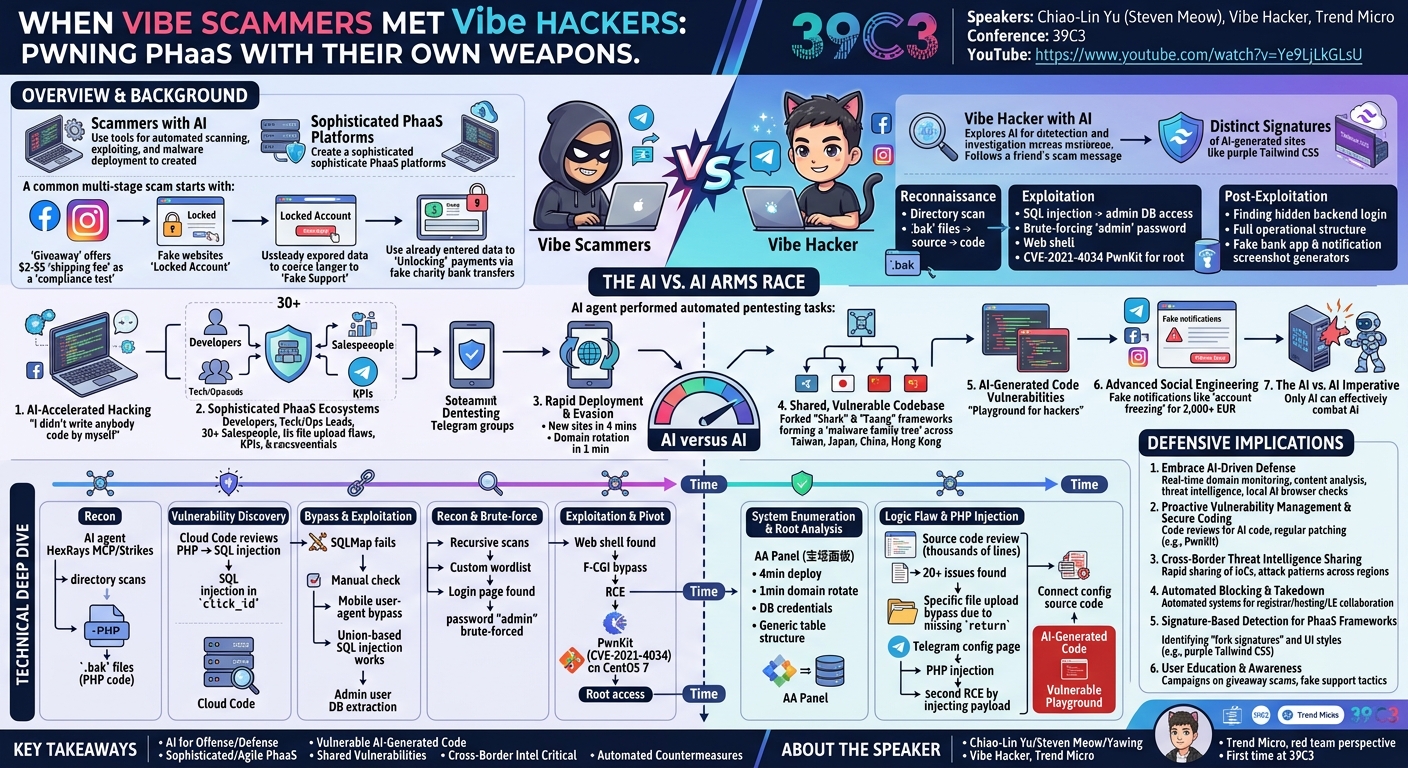
In an era increasingly dominated by artificial intelligence, the landscape of cybercrime is undergoing a profound transformation. This talk, delivered by Steven Yu (also known as Yoing or Steven Meow), a Vibe Hacker at Trend Micro in Taiwan, presents a compelling narrative of how AI is not only being leveraged by scammers to build sophisticated phishing-as-a-service (PhaaS) platforms but also how white-hat hackers can wield AI as a potent weapon to dismantle these operations. Yu’s presentation offers a unique red team perspective, detailing an investigation into a real-world scam campaign, from initial reconnaissance to full system compromise and intelligence gathering.
The core of the talk highlights an emerging "AI versus AI" arms race, where automated offensive capabilities are met with equally advanced defensive strategies. Yu demonstrates how large language models (LLMs) and specialized AI security tools can automate complex penetration testing tasks, allowing security researchers to efficiently identify vulnerabilities, exploit systems, and gather crucial intelligence on scammer infrastructure. This research not only exposes the inner workings of modern PhaaS operations but also underscores the critical need for AI-driven defense and cross-border intelligence sharing to effectively combat the rapidly evolving threat landscape.
Background
▶ Watch: Introduction to AI Hacking and fighting scams (0:00)
The proliferation of AI has created a dual-edged sword in cybersecurity. On one side, malicious actors are increasingly employing AI for automated scanning, exploitation, and malware deployment, as well as for generating convincing scam websites and messages. On the other side, white-hat hackers are exploring how AI can aid in detection and investigation. The genesis of this research began when a friend of Steven Yu received a scam message, providing a real-world target for Yu to test the latest AI pentesting and red teaming tools. The initial observation was that many AI-generated phishing websites exhibited a distinct signature, such as the use of Tailwind CSS with a characteristic purple color scheme, which served as a clear indicator of AI assistance.
The common scam pattern observed in this research involved a multi-stage attack. It typically started with scammers posting enticing "free giveaway" offers on social media platforms like Facebook, Instagram, and Threads, requiring victims to only pay a small "shipping fee" (typically $2-$5 USD). This initial payment, made on a fake website, served as a "compliance test" – a low-stakes transaction designed to identify victims who are more susceptible to further manipulation. If a victim paid, they were deemed "easy to scam." The next stage involved the fake website claiming the victim's seller account was "locked" due to a lack of "real-name identity verification," directing them to contact a fake customer support. This "support" team, armed with the personal data victims had already entered, would then coerce them into making larger payments to "unlock" their accounts, leading to a successful scam. The payment methods often involved online bank transfers to fake charity foundations, further obfuscating the money trail. Early reconnaissance attempts, such as using IP loggers, were considered but deemed risky due to operational security concerns.
Key Findings
▶ Watch: How AI agents perform automated pentesting (3:40)
The research yielded several critical insights into the operational methodologies of modern PhaaS providers and the effectiveness of AI in combating them:
- AI-Accelerated Hacking: AI agents, specifically LLMs like Cloud Code 4.5 and Gemini 2.5 Pro, coupled with security tools, can automate extensive portions of the penetration testing lifecycle, from reconnaissance and vulnerability discovery to exploitation and post-exploitation analysis. The speaker emphasized that he "didn't write anybody code by myself," highlighting the transformative potential of AI.
- Sophisticated PhaaS Ecosystems: Scam operations are highly organized, resembling legitimate businesses with distinct roles (developers, tech leads like "Dang," operation leads like "Kai," and over 30 salespeople). They operate with key performance indicators (KPIs) and utilize dedicated communication channels (Telegram groups) for coordination, victim data sharing, and even celebrating successful scams.
- Rapid Deployment and Evasion: PhaaS platforms demonstrate alarming agility. New phishing websites can be built in approximately four minutes (uploading source code, importing databases, setting up SSL), and domain names can be rotated in as little as one minute. This speed renders traditional manual domain blocking efforts largely ineffective, as new sites appear faster than they can be blacklisted.
- Shared, Vulnerable Codebase: A significant finding was that numerous phishing websites, even across different regions (Taiwan, Japan, China, Hong Kong) and with varying front ends, often share a common backend framework. This framework, originating from a 2016 version and forked into "Shark Platform" (China, 2020) and "Taang" (Taiwan), contains widespread vulnerabilities. A single bug or design flaw can thus affect hundreds of variations, creating a "malware family tree" of exploitable instances.
- AI-Generated Code Vulnerabilities: The code generated or customized by AI often contains a plethora of security flaws, including multiple SQL injections, file upload bypasses, hardcoded credentials, and logic vulnerabilities. This makes AI-built scam sites a "playground for hackers" due to the high volume of easily discoverable weaknesses.
- Advanced Social Engineering: Scammers employ clever social engineering tactics, such as providing fake bank application interfaces and iOS notification screenshot generators within their system. These tools create convincing visual evidence (e.g., "account freezing" notifications for over 2,000 EUR) to panic victims and reinforce the scam narrative.
- The "AI vs. AI" Imperative: The talk concludes that in the current threat landscape, only AI can effectively combat AI. As scammers increasingly automate their attacks with AI, defenders must embrace AI-driven solutions for real-time monitoring, threat intelligence, and automated response to stay ahead.
Technical Deep Dive
▶ Watch: Summary of the multi-stage scam pattern (7:40)
The technical investigation commenced with reconnaissance using AI agents like HexRays MCP and Strikes. The AI performed directory scans and quickly identified interesting artifacts, notably .bak files. These files, remnants of poor development practices, contained portions of the PHP source code. Uploading this code to Cloud Code for review, the AI swiftly pinpointed several SQL injection vulnerabilities, including one in a click_id parameter.
An initial attempt to exploit this with SQLMap failed, yielding a "parameter does not seem to be injectable" response. Manual inspection of the HTTP request via Burp Suite revealed a user-agent check requiring a mobile device. By simply modifying the user agent to simulate a mobile phone, the SQL injection became exploitable. However, boolean-based injection proved inefficient. Further AI-assisted scanning revealed another page vulnerable to union-based SQL injection. This allowed the extraction of database information, including an admin users database containing plaintext usernames and passwords. Curiously, one table was found to have 85 columns, a design choice later understood to accommodate multiple scam templates.
The next challenge was locating the login page. The AI performed recursive scans and intelligently generated a customized wordlist based on previously discovered file names (e.g., admin_backup.php would suggest admin_login.php, admin_panel.php). This led to the discovery of an unusual login page that only required a password. The AI successfully brute-forced this password, which was simply "admin."
Upon logging in, the team was surprised to find a web shell instead of an administrative panel. The speaker speculated this could be a developer backdoor, a maintenance utility, or an indication of a prior compromise. Regardless, this web shell proved invaluable for further internal enumeration. It allowed access to the filesystem and, crucially, led to the discovery of the actual hidden login page for the scammer's backend system, which was labeled as the "Ice Blade System" (冰刀系統) in Chinese.
Using the SQL injection-obtained credentials, the team logged into what was internally referred to as the "Tapang system." This revealed the full operational structure, including product management, order management (exposing victim names, phone numbers, addresses, and payment screenshots), and specialized tools. A notable discovery was an internal page generating fake bank app screenshots and iOS notifications to simulate "account freezing" for social engineering purposes.
The initial web shell, running on PHP 5, had many disabled functions, limiting direct command execution. The AI suggested using F-CGI to bypass these restrictions, which, once implemented, granted full Remote Code Execution (RCE). To escalate privileges from a low-privilege user, the AI identified the system as CentOS 7 with an outdated Linux kernel. This allowed the use of CVE-2021-4034 (PwnKit), a widely known privilege escalation vulnerability from 2021, to gain root access.
With root privileges, a deeper dive into the system revealed it was built using AA Panel (宝塔面板), a popular Chinese web server control panel. Analysis of AA Panel logs demonstrated the scammer's operational efficiency: creating a new phishing site took only four minutes, and rotating a domain name took just one minute. The database credentials (root, just_q) were found, leading to access to PHPMyAdmin, where various phishing templates (e.g., for Chinese apps) were observed. The 85-column table was then understood as a generic structure supporting these diverse templates, inheriting many unnecessary columns.
Downloading the entire source code package, the AI (Cloud Code) reviewed thousands of lines of PHP, identifying over 20 security issues, including more SQL injections, file upload bypasses, and hardcoded credentials. A particularly interesting file upload vulnerability was discovered: while the code checked file extensions, the logic flaw meant it didn't return or exit the function if the check failed, allowing malicious files to be uploaded regardless. This provided an alternative method for web shell deployment, even if the initial web shell was absent.
Finally, the AI uncovered references to Telegram: telegram_admin, telegram_config, and telegram_error_log. The telegram_admin page required credentials, but its password was found hardcoded in the backend source code. The telegram_config page allowed setting a Telegram chatbot token, group ID, and domain name. Despite some regular expression checks, these user-controlled parameters were vulnerable to PHP injection, enabling the team to craft a payload and achieve RCE once more. This "AI attacking AI-generated websites" scenario underscored the core theme of the talk.
Demo / Proof of Concept
▶ Watch: AI finds SQL injection vulnerabilities in source code (8:00)
The entire presentation serves as a detailed walkthrough and proof of concept for AI-assisted offensive operations against a live PhaaS infrastructure. While there wasn't a single, isolated "live demo" segment, Steven Yu meticulously described each step of the hack, illustrating how AI agents performed tasks that would traditionally require significant manual effort.
Key aspects demonstrated through the narrative include:
- Automated Reconnaissance: AI performing directory scans and identifying
.bakfiles containing sensitive source code. - AI-Powered Vulnerability Discovery: The AI's ability to review thousands of lines of PHP code to pinpoint SQL injection flaws, file upload vulnerabilities, and hardcoded credentials.
- Bypass Techniques: The AI's suggestion and execution of a user-agent bypass for SQLMap, and later, the F-CGI bypass for restricted PHP environments to achieve RCE.
- Intelligent Brute-Forcing: The AI successfully guessing the "admin" password for a backend login page after generating a customized wordlist.
- Privilege Escalation: The practical application of a known CVE, PwnKit (CVE-2021-4034), to achieve root access on the CentOS 7 system.
- Logic Flaw Exploitation: Demonstrating how a seemingly secure file upload mechanism could be bypassed due to a missing
returnstatement, allowing arbitrary file uploads. - PHP Injection: Crafting a payload to exploit user-controlled parameters in the Telegram configuration page, leading to another RCE by injecting PHP code into a configuration file.
Each of these steps, described with specific tools and techniques, collectively forms the proof of concept for how "vibe hackers" (AI-augmented white-hats) can effectively "pwn PhaaS" by leveraging AI's capabilities across the entire attack chain. The speaker's narrative effectively showcased the seamless integration of AI in automating and accelerating complex security tasks, turning a manual, time-consuming process into an efficient, AI-guided operation.
Defensive Implications
▶ Watch: SQLMap fails, manual check reveals mobile-only access (9:50)
The findings from this research carry significant implications for defenders striving to combat the burgeoning threat of AI-powered PhaaS. The rapid evolution and deployment capabilities of these platforms necessitate a paradigm shift in defensive strategies:
- Embrace AI-Driven Defense: The core message is that "only AI can beat AI." Defenders must invest in and integrate AI and machine learning into their security operations. This includes AI-powered real-time monitoring of newly registered domains, AI-driven content analysis for phishing detection, and AI-assisted threat intelligence platforms to predict and respond to evolving scam patterns. Local AI/LLMs in browsers could also check URLs and content proactively.
- Proactive Vulnerability Management and Secure Coding: The prevalence of vulnerabilities in PhaaS platforms, particularly in AI-generated or rapidly developed code, highlights the critical need for robust secure coding practices. Developers should rigorously review code, especially when AI tools are used, to prevent common flaws like SQL injection, file upload bypasses, and hardcoded credentials. Regular patching for known CVEs, such as CVE-2021-4034 (PwnKit), remains non-negotiable for system administrators.
- Cross-Border Threat Intelligence Sharing: The discovery of a shared codebase and "malware family tree" across various PhaaS forks operating in different countries (Taiwan, Japan, China, Hong Kong) underscores the global nature of this threat. Effective defense requires seamless and rapid sharing of threat intelligence, indicators of compromise (IoCs), and attack patterns across national and organizational boundaries. What one country learns about a specific PhaaS variant can provide invaluable insights for others.
- Automated Blocking and Takedown: The ability of scammers to rebuild websites in four minutes and rotate domains in one minute renders manual domain blacklisting largely ineffective. Defenders need automated systems for real-time identification, analysis, and rapid takedown requests. This requires collaboration between security researchers, domain registrars, hosting providers, and law enforcement.
- Signature-Based Detection for PhaaS Frameworks: While the speaker refrained from sharing specific evasion techniques, the concept of identifying "fork signatures" for PhaaS frameworks is crucial. Security vendors should develop and deploy mechanisms to detect the unique patterns, backend structures, and code characteristics that identify these shared phishing platforms, allowing for broader detection beyond individual domain names. The observation of AI-generated UI styles (e.g., purple Tailwind CSS) can serve as a useful hunting indicator.
- User Education and Awareness: Despite technical defenses, social engineering remains a powerful weapon for scammers. Continuous education campaigns for the public about common scam patterns, the dangers of "free giveaways," the tactics of fake customer support, and the signs of phishing websites are essential to reduce victim susceptibility.
Key Takeaways
- AI for Offense and Defense: AI tools significantly automate and accelerate offensive security tasks, from reconnaissance to exploitation, making "AI vs. AI" the new reality in cybersecurity.
- Sophisticated and Agile PhaaS: Phishing-as-a-Service (PhaaS) platforms are highly organized, with dedicated teams and the ability to deploy new scam sites in minutes and rotate domains in seconds, rendering manual blocking ineffective.
- Vulnerable AI-Generated Code: Code developed or customized with AI assistance often contains numerous security vulnerabilities, creating an exploitable "playground" for ethical hackers.
- Shared Vulnerabilities Across Forks: Many PhaaS operations, even across different regions, share a common, vulnerable codebase, meaning a single identified flaw can be exploited across numerous scam instances.
- Cross-Border Intelligence is Critical: Effective defense against globally distributed PhaaS networks requires rapid, cross-border sharing of threat intelligence and attack insights.
- Automated, AI-Driven Countermeasures: To combat the speed and scale of AI-powered scamming, defenders must embrace AI for real-time monitoring, automated detection, and proactive response mechanisms.
About the Speaker(s)
The talk was delivered by Chiao-Lin Yu, also known by his aliases Steven Meow or Yawing. He is identified as a Vibe Hacker at Trend Micro in Taiwan. Steven approaches cybersecurity from a red team perspective, focusing on offensive techniques to understand and combat scam operations and protect people. He expressed his excitement about presenting at 39C3, noting it was his first time at the conference.
All talks from 39th Chaos Communication Congress (39C3): Power Cycles