The Spectrum - Hackspace Beyond Hacking
sjaelv, MultisampledNight
39th Chaos Communication Congress (39C3): Power Cycles · Day 3 · Saal Fuse
Overview
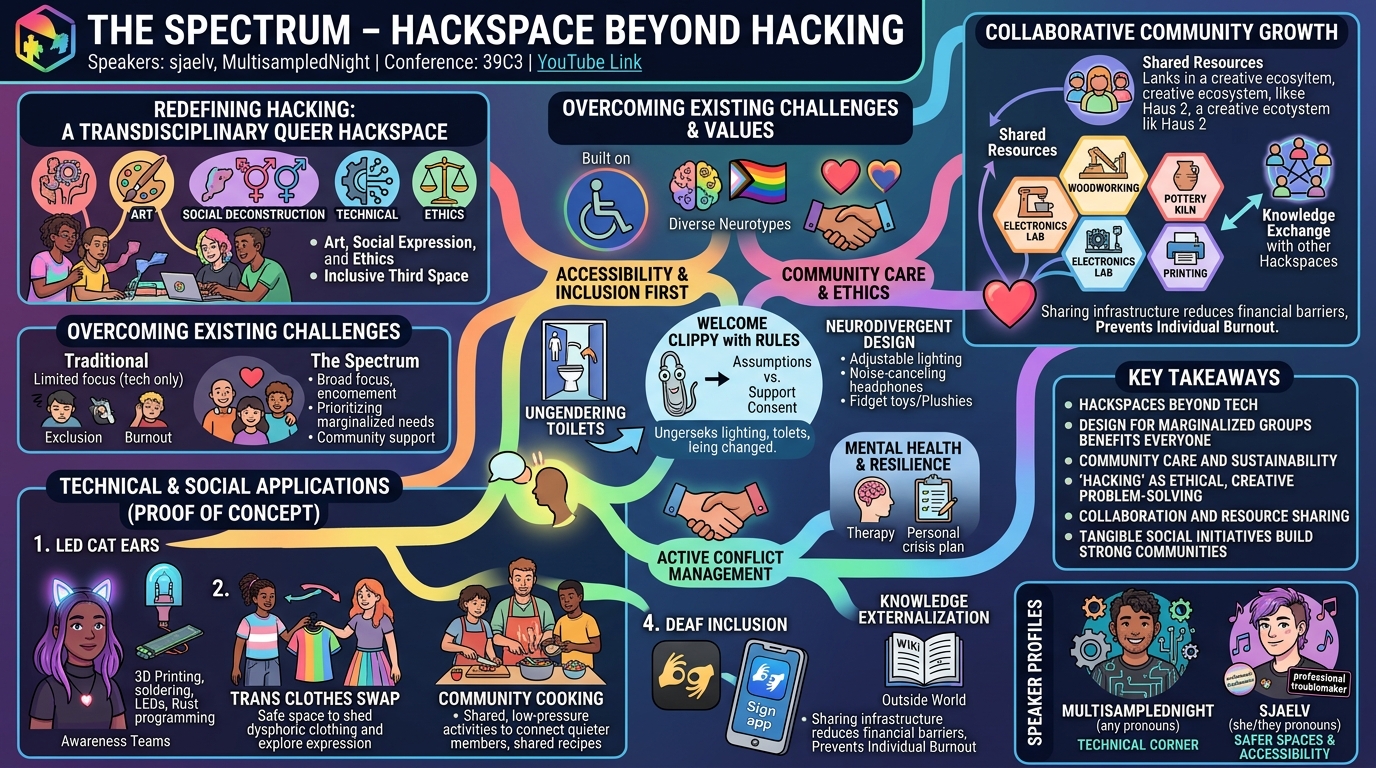
This talk introduces "The Spectrum," a groundbreaking transdisciplinary and queer hackspace that redefines the traditional concept of hacking. Presented by MultisampledNight, who brings a technical background, and sjaelv, from the music industry and creative fields with expertise in safer spaces and accessibility, the presentation outlines their vision for a community-centered space that extends far beyond purely technical pursuits. It champions the idea that hacking encompasses artistic expression, social deconstruction, and ethical inquiry, creating an environment where diverse interests and identities can flourish.
Key moments
- 0:00 Introduction to The Spectrum: a queer hex space
- 1:00 Why traditional hackspaces fail marginalized communities
- 3:30 Core values: accessibility, inclusion, community care first
- 4:10 First action: Ungendering toilets in the space
- 5:10 Community rules and neurodivergent-friendly features
- 8:00 Hacking beyond tech: art, social structures, innovation
The Spectrum - Hackspace Beyond Hacking
Speakers: sjaelv; MultisampledNight
Conference: 39C3
YouTube: https://www.youtube.com/watch?v=gcR7RK1iKBA
Overview
This talk introduces "The Spectrum," a groundbreaking transdisciplinary and queer hackspace that redefines the traditional concept of hacking. Presented by MultisampledNight, who brings a technical background, and sjaelv, from the music industry and creative fields with expertise in safer spaces and accessibility, the presentation outlines their vision for a community-centered space that extends far beyond purely technical pursuits. It champions the idea that hacking encompasses artistic expression, social deconstruction, and ethical inquiry, creating an environment where diverse interests and identities can flourish.
The core motivation behind The Spectrum is to address the unmet needs within existing hackspaces, which often prioritize technical endeavors and inadvertently exclude marginalized groups. The speakers argue for the critical importance of diverse "third spaces" in modern society – environments distinct from home and work where individuals can find connection, support, and a sense of belonging. By prioritizing accessibility, inclusion, and community care, The Spectrum aims to foster innovation and personal growth, demonstrating how a consciously designed social infrastructure can unlock new forms of collaboration and creativity.
Ultimately, this talk serves as both a manifesto and a practical guide for building more inclusive and impactful communities. It challenges the audience to reconsider who hackspaces are for, what "hacking" truly means, and how intentional design can create spaces that are not only technologically advanced but also socially transformative, offering a blueprint for fostering belonging and driving innovation in a way that respects and empowers all participants.
Background
▶ Watch: Introduction to The Spectrum: a queer hex space (0:00)
The genesis of The Spectrum stems from a critical observation: while numerous hackspaces exist, they often fall short in catering to a broad spectrum of needs, particularly for those outside the traditional technical mainstream. Many current hackspaces, as the speakers highlight, are exclusively focused on technical hacking, leaving a significant void for artistic and social expression. This narrow focus contributes to the underrepresentation of marginalized entities, who may not find these environments welcoming or relevant to their interests.
A key problem identified is the issue of governance: who controls these spaces, how are they managed, and how can they be shielded from burnout? Critically, the speakers point to survivorship bias, noting that "we don't see who we don't see" – meaning, those who don't feel comfortable or can't participate in existing spaces remain invisible, perpetuating a cycle of exclusion. This underscores the necessity for truly diverse "third spaces" that allow individuals to connect, find support, and realize that their unique experiences are not isolated but shared. Such spaces are vital for "nerds" too, as social connection actively benefits idea generation and problem-solving, even for technical bugs.
The Spectrum was thus conceived with a foundational commitment to accessibility, inclusion, and connection. Its operational basis is rooted in ethics and an awareness concept, alongside a robust community care concept. A primary goal is to accommodate marginalized people first, understanding that such an approach will ultimately benefit everyone. This involves actively centering queer, trans, disabled, and neurodivergent individuals who often lack priority or space elsewhere. Practical manifestations of this philosophy include the immediate ungendering of all bathrooms upon moving into their space, complete with explanatory signs detailing how gendered toilets reinforce stereotypes and cause harm to trans people. This initiative was met with widespread positive reception, demonstrating the tangible impact of inclusive design.
Further illustrating their commitment, The Spectrum implemented a "Welcome Clippy" on their door, outlining clear community rules. These rules emphasize not assuming gender, fostering mutual support, and adhering to consent in all interactions – ensuring a "yes" rather than a "maybe" or "no response at all." Recognizing that many members are neurodivergent (including ADHD and autism), the space is designed with adjustable lighting (from very bright to very dim), offers noise-canceling headphones, and explicitly eschews "weird societal expectations" regarding communication styles, eye contact, or social interaction. Fidget toys and plushies are also readily available, creating a sensory-friendly environment. The space also focuses on active conflict management and taking responsibility for mistakes, acknowledging that change involves learning and missteps.
Crucially, The Spectrum redefines hacking itself. It's presented as encompassing more than just technical endeavors; it includes art, questioning social expectations and structures (like gender), and deconstructing systems of authority and power to understand their mechanisms. This broader definition also comes with an ethical imperative: "just because everything can be hacked doesn't mean it should." The speakers use the example of hacking a hospital and leaking data, highlighting the severe, irresponsible harm that could result. Hacking, in their view, is also about creatively working around restrictions imposed by others or by limited resources, questioning conventional ingredients and finding alternative solutions. This expansive, ethical, and socially conscious view of hacking forms the bedrock of The Spectrum's philosophy.
Key Findings
▶ Watch: Core values: accessibility, inclusion, community care first (3:30)
The primary finding presented by The Spectrum is the successful establishment and operation of a transdisciplinary and queer-centered hackspace that fundamentally redefines the role and scope of such communities. This model demonstrates that integrating artistic, social, and ethical dimensions with technical pursuits not only fosters a more inclusive environment but also generates innovative solutions and stronger community bonds.
One of the most significant contributions is the tangible implementation of inclusive design principles. The immediate and successful ungendering of all toilets, accompanied by educational signage, served as an early and powerful proof of concept for their commitment to trans-inclusive spaces. This initiative, rather than causing issues, was reportedly well-received, highlighting the potential for positive change when marginalized needs are prioritized. Furthermore, the meticulous design of their physical space to accommodate neurodivergent individuals – with features like adjustable lighting, readily available noise-canceling headphones, a relaxed stance on social communication norms (e.g., eye contact), and access to fidget toys and plushies – showcases a practical framework for creating truly accessible environments.
The talk provides compelling examples of transdisciplinary collaboration and how the expanded definition of "hacking" leads to novel outcomes:
- LED Cat Ears for Awareness Teams: This project exemplifies the fusion of diverse skills. Combining 3D printing, LEDs, soldering, awareness principles, and Rust programming, the team developed highly visible cat ears designed to quickly identify awareness teams in dark, crowded settings like music festivals. This practical application directly addresses a safety need through creative technical integration.
- Trans Clothes Swap: Beyond a simple exchange, this event served as a vital social support mechanism. It provided a safe and vulnerable space for trans individuals to shed dysphoric clothing, explore new gender expressions, and receive peer support and advice during their transition journeys. This demonstrates how a seemingly mundane activity can be imbued with profound social significance.
- Community Cooking: This initiative proved effective in integrating quieter members into the community. By engaging in a shared, low-pressure activity like chopping vegetables, individuals could gradually acclimate to the space and connect with others without the immediate demand for conversation. The creation of a shared recipe repository further solidifies this as a collaborative, ongoing project.
- Deaf Inclusion Efforts: While still in early stages, the introduction of a sign language app within the space signifies a proactive step towards broader accessibility. This highlights a commitment to continuous improvement in making the space welcoming for individuals with diverse abilities.
- Mental Health and Suicide Prevention: Recognizing the critical need for support, The Spectrum is actively developing community resources, including a personal crisis emergency plan (currently in German, with English translation planned). This demonstrates a commitment to addressing the holistic well-being of its members.
- Externalizing Accessibility Knowledge: The vision to compile and share accessibility tools and resources (like tactile maps from Congress) from hackspaces into a publicly accessible wiki represents a significant contribution. It aims to bridge the gap between specialized hackspace knowledge and broader societal needs, promoting wider adoption of inclusive practices.
Finally, the talk highlights the importance of community-driven funding and growth through collaboration. Being part of larger creative ecosystems like Creativity Mention and Haus 2 in Munich provides shared infrastructure (e.g., basements for woodworking, electronics, pottery kilns), reduces financial barriers, and fosters an environment of mutual exchange and support. This model of shared resources and collaborative projects, such as assisting other organizations with their websites in exchange for using their kilns, underscores a sustainable and interconnected approach to hackspace development. The emphasis on shared responsibility and mindful, slow growth aims to prevent burnout and ensure the long-term health and inclusivity of the community.
Technical Deep Dive
▶ Watch: First action: Ungendering toilets in the space (4:10)
The "technical deep dive" within The Spectrum's philosophy transcends traditional hardware and software specifications, focusing instead on the social architecture and design principles that underpin their inclusive hackspace. While conventional technical elements are present, they are consistently framed within a broader context of community building and ethical engagement.
At its core, The Spectrum’s technical approach is the implementation of a human-centered design methodology for community spaces. This is evident in their foundational ethics and awareness concept, which acts as a "social protocol" guiding all interactions. This protocol includes explicit guidelines for consent-based interactions, where "a yes and not just a maybe or no response at all" is the standard. This proactive approach to social safety is a critical component of their operating model, designed to prevent conflict and ensure a respectful environment.
For neurodivergent inclusion, the space incorporates specific environmental and interactional design choices:
- Adjustable Lighting: The ability to control light levels from "very very bright to very very little" directly addresses sensory sensitivities common among neurodivergent individuals.
- Noise-Canceling Headphones: Available for use, these serve as a practical tool for managing auditory input and creating personal zones of calm within a shared space.
- Flexible Social Expectations: By explicitly stating that there are "no weird societal expectations of how to communicate, when to communicate or how much eye contact is okay or not okay," The Spectrum reduces social anxiety and allows individuals to interact in ways that are comfortable and authentic for them.
- Sensory Support Tools: The provision of fidget toys, blow highs, and "really big plushies" offers tactile and proprioceptive input, which can aid focus and self-regulation.
While the talk emphasizes social engineering, it does touch upon conventional technical applications through its project examples. The LED cat ears project (16:00) provides a concrete illustration of a technical stack applied to a social problem. This involved 3D printing for custom enclosures, LEDs for high visibility, soldering for electronic assembly, and likely microcontroller programming (possibly in Rust, as mentioned in the context of combined skills) to control the light patterns. This demonstrates how technical skills are leveraged to create practical tools for awareness teams in challenging environments.
In terms of organizational "tech," The Spectrum initially adopted a Kanban board for managing tasks during the space's initial buildup (24:00). While effective in the early stages, the speakers acknowledge its limitations for ongoing operations with fluctuating member availability and the need for constant onboarding of new individuals. This highlights an ongoing challenge in scaling agile methodologies to volunteer-driven, community-based structures. The idea of an internal wiki is also discussed as a potential tool for knowledge management and task delegation, though the specific platform is still under debate (34:00).
The physical infrastructure of The Spectrum is significantly enhanced by its integration into larger creative communities in Munich, specifically Creativity Mention and Haus 2. This collaborative model provides access to shared resources that would be difficult for a single hackspace to acquire:
- Shared Workshop Basements: These areas are planned for future community use, housing facilities for woodworking, electronics, printing, and pottery kilns (13:00-14:00). This decentralized access to specialized tools reduces the financial burden and maintenance overhead for The Spectrum.
- Networking and IT Infrastructure: While they admit to having their own network questions (e.g., unused fiber optics, 22:00), the concept of knowledge exchange with other hackspaces includes sharing best practices for setting up and maintaining IT infrastructure (e.g., hosting services, Kanban implementation, 25:00).
- Communication Platforms: The Spectrum actively uses a Matrix chat for general community interaction and a Signal channel for low-volume event announcements (36:00), demonstrating a conscious choice of communication tools to suit different needs.
The concept of "hacking" is deeply re-engineered here. It's not just about exploiting vulnerabilities in computer systems, but about deconstructing social systems of authority and power to understand their workings, and creatively working around restrictions whether they are technical, social, or resource-based (08:00-10:00). This intellectual framework is the most profound "technical deep dive" of the talk, presenting a meta-level approach to problem-solving that encompasses all aspects of existence.
Demo / Proof of Concept
▶ Watch: Community rules and neurodivergent-friendly features (5:10)
The talk itself serves as a comprehensive demonstration and proof of concept for The Spectrum's unique hackspace model, showcasing both its physical embodiment and the tangible outcomes of its inclusive philosophy. Rather than a traditional software or hardware demo, the presentation offers a vivid tour of their social and physical infrastructure, punctuated by concrete examples of projects and initiatives.
The speakers provide a visual tour of their physical space within Haus 2 in Munich (14:00). Photographs illustrate key features:
- A vibrant room adorned with a pride flag, symbolizing their core values of queer inclusivity.
- A diverse setup including a piano, bookshelves, a comfortable sofa (from which one photo was taken), and a dedicated desk for focused work.
- A collaborative working space at the front and a unique "calm corner" area above the flags, featuring mattresses and pillows. This space is explicitly designed for "extended calm sessions" – a direct manifestation of their commitment to neurodivergent-friendly and stress-reducing environments.
- The presence of cat ears is highlighted, humorously noted as the "canonical reason that The Spectrum is a cat and the spectrum meows," but also foreshadowing the technical project involving them.
Beyond the physical space, the most compelling demonstrations come from the project examples that illustrate the synergy between technical skills, artistic expression, and social awareness:
- Ungendered Toilet Signs: This was the very first "demo" of their philosophy. Upon moving in, they immediately installed signs explaining why toilets do not have a gender and how gendered toilets discriminate. This simple yet powerful act served as an immediate and successful proof of their commitment to inclusivity, demonstrating that such changes can be implemented without issue and with positive community reception (04:00).
- LED Cat Ears for Awareness Teams: This project is a clear technical proof of concept. The combination of 3D printing, LEDs, soldering, and Rust to create highly visible markers for awareness teams at large, dark events (like music festivals) demonstrates how diverse technical skills can be applied to solve real-world safety problems in a creative and impactful way (16:00).
- Trans Clothes Swap: This social event serves as a powerful demonstration of community care in action. It proved the concept that a supportive, safe space for trans individuals to explore gender expression and manage dysphoria through clothing exchange can be profoundly beneficial, fostering connection and mutual aid (16:00).
- Community Cooking Events: These events demonstrate an effective method for integrating new or quieter members into the community. By providing a low-pressure, collaborative activity, it shows how shared tasks can build community and create a sense of belonging without forcing uncomfortable social interactions. The resulting shared recipe repository (18:00) is a tangible outcome.
- Deaf Inclusion – Sign Language App: While a small step, making a sign language app available in the space demonstrates an ongoing commitment to accessibility for deaf individuals, proving that incremental efforts can pave the way for broader inclusion (18:00).
- Mental Health and Suicide Prevention Plan: The development of a personal crisis emergency plan and community resources for mental health (19:00) serves as a crucial demonstration of The Spectrum's dedication to holistic well-being, showing proactive steps to address critical community needs.
The entire presentation effectively functions as a large-scale demonstration of how a hackspace can extend its impact beyond technical innovation, proving that a model centered on ethical awareness, social inclusion, and transdisciplinary collaboration can create a vibrant, supportive, and highly effective community.
Defensive Implications
▶ Watch: Hacking beyond tech: art, social structures, innovation (8:00)
While typically associated with cybersecurity, the "Defensive Implications" within the context of The Spectrum's talk can be reframed as strategies for community resilience, protecting marginalized groups from social harms, and building sustainable, ethical environments. These implications are crucial for any organization aiming to foster a truly inclusive and safe space.
1. Defending Against Discrimination and Harassment: The Spectrum implements several proactive measures to create a safe space and prevent social harms.
- Proactive Policy Implementation: The immediate ungendering of toilets with clear explanatory signage (04:00) acts as a strong defensive stance against gender-based discrimination, setting an inclusive tone from the outset.
- Community Rules and Consent Culture: The "Welcome Clippy" outlining rules against assuming gender, promoting mutual support, and emphasizing consent ("a yes and not just a maybe or no response at all," 06:00) establishes a clear ethical framework, acting as a defensive barrier against unwanted interactions and fostering respect.
- Active Conflict Management: The commitment to "talking about problems before they kind of like spiral out of control" and taking responsibility for mistakes (06:00) is a defensive strategy to prevent interpersonal conflicts from escalating and damaging community cohesion.
2. Protecting Mental Health and Preventing Burnout: Recognizing the vulnerabilities within creative and activist communities, The Spectrum integrates specific defenses for well-being.
- Neurodivergent-Friendly Environment: The provision of adjustable lighting, noise-canceling headphones, and acceptance of diverse communication styles (06:00) defends against sensory overload and social anxiety, which can lead to burnout or withdrawal for neurodivergent individuals.
- Mental Health Resources: The development of a personal crisis emergency plan (19:00) and community-based mental health support systems provides crucial defensive tools for members facing mental health challenges, reducing isolation and offering pathways to assistance.
- Distributed Responsibility: The explicit warning against "no one single entity takes too much responsibility" (22:00) is a direct defensive strategy against burnout. By fostering shared ownership and task distribution, The Spectrum aims to prevent the exhaustion of key individuals, ensuring the long-term sustainability of the space.
3. Defending Against Exclusionary Norms and Survivorship Bias: The very existence and design of The Spectrum act as a defense against the subtle and overt biases present in many traditional hackspaces.
- Prioritizing Marginalized Needs: By centering queer, trans, disabled, and neurodivergent individuals (04:00), The Spectrum actively defends against the survivorship bias that hides those who feel unwelcome elsewhere. This proactive inclusion ensures a broader range of voices and needs are addressed.
- Redefining "Hacking" Ethically: The philosophical stance that "just because everything can be hacked doesn't mean it should" (08:00) is a critical ethical defense. This explicitly cautions against irresponsible or harmful applications of technical skills, such as leaking hospital data, and embeds a strong sense of social responsibility into the hacking ethos. This also defends against the notion that all technical prowess is inherently beneficial, emphasizing ethical considerations.
4. Preserving and Sharing Knowledge for Collective Defense:
- Accessibility Wiki: The initiative to compile and share accessibility tools and resources (e.g., tactile maps) from hackspaces with the "outside world" via a wiki (20:00) is a defensive strategy against knowledge siloing. By making this information widely available, they empower other communities to build more accessible spaces, thus collectively defending against exclusion.
- Knowledge Exchange and Collaboration: Actively seeking collaboration with other hackspaces for knowledge exchange on bylaws, infrastructure setup (e.g., Kanban, hosting services), and task distribution (24:00-25:00) builds a network of mutual support and shared best practices, which can defend against common organizational pitfalls.
In essence, The Spectrum's defensive implications are about building a resilient, ethical, and inclusive community by actively anticipating and mitigating social, psychological, and organizational vulnerabilities, thereby creating a truly safe and empowering environment for all its members.
Key Takeaways
- Hackspaces must evolve beyond purely technical focuses: The Spectrum demonstrates the critical need for hackspaces to embrace transdisciplinary approaches, integrating art, social expression, and ethical considerations to foster richer, more innovative communities.
- Intentional design for marginalized groups benefits everyone: By actively centering the needs of queer, trans, disabled, and neurodivergent individuals through specific accommodations (e.g., ungendered toilets, sensory-friendly environments, consent culture), spaces become inherently more accessible, inclusive, and welcoming for all participants.
- Community care and shared responsibility are vital for sustainability: Proactive conflict management, clear communication, and the distribution of tasks are essential strategies to prevent individual burnout and ensure the long-term health and functionality of volunteer-driven communities.
- "Hacking" can be redefined as ethical, creative problem-solving: The talk broadens the definition of hacking to include questioning social structures, deconstructing power dynamics, and innovatively working around restrictions, while simultaneously emphasizing the ethical imperative that not everything that can be hacked should be.
- Collaboration and resource sharing empower growth: Being part of larger creative ecosystems and engaging in knowledge exchange with other communities (e.g., sharing physical resources, technical know-how, and best practices) significantly enhances the capabilities and sustainability of an inclusive hackspace.
- Tangible social initiatives build strong communities: Projects like trans clothes swaps, community cooking, and mental health support plans are practical, impactful ways to integrate members, foster connection, and address the holistic well-being of the community, proving that social hacks are as valuable as technical ones.
About the Speaker(s)
The talk was delivered by two individuals, sjaelv and MultisampledNight, who bring complementary expertise to The Spectrum.
MultisampledNight (any pronouns) identifies as coming from a technical corner, indicating a background rooted in technology and its practical applications.
sjaelv (she/they pronouns) is more situated in the music industry and creative fields. She describes herself as a professional troublemaker working in the areas of safer spaces and accessibility, highlighting her dedication to fostering inclusive environments and challenging existing norms.
All talks from 39th Chaos Communication Congress (39C3): Power Cycles