Who runs the www? WSIS+20 and the future of Internet governance
Sophia Longwe
39th Chaos Communication Congress (39C3): Power Cycles · Day 4 · Saal Ground
Overview
Sophia Longwe, a Project Manager in the public policy team of Wikimedia Germany, delivered a compelling talk at 39C3, addressing the fundamental question of "Who runs the worldwide web?" Her presentation, titled "WSIS+20 and the future of Internet governance," delved into the complex, often opaque, world of global digital policy. Longwe's core premise, quoting Rebecca McKinnon, is that the internet is inherently political, and its evolution compatible with democratic values is not automatic but depends entirely on its structure, governance, and usage. Governments and corporations, she argues, are actively shaping the internet to fit their own agendas.
Key moments
- 0:00 Unpacking "Who runs the WWW?" and internet's political nature
- 2:40 Explaining WSIS: UN's first global digital technology process
- 3:20 Detailed history of the World Summit on Information Society
- 5:00 The 2005 Tunis agenda definition of internet governance
- 5:40 Core debate: multilateral vs. multistakeholder internet governance
- 6:00 Understanding the Internet Governance Forum as a discussion platform
Who runs the www? WSIS+20 and the future of Internet governance
Speakers: Sophia Longwe, Project Manager, Wikimedia Germany
Conference: 39C3
YouTube: https://www.youtube.com/watch?v=nLNh-vvofpo
Overview
Sophia Longwe, a Project Manager in the public policy team of Wikimedia Germany, delivered a compelling talk at 39C3, addressing the fundamental question of "Who runs the worldwide web?" Her presentation, titled "WSIS+20 and the future of Internet governance," delved into the complex, often opaque, world of global digital policy. Longwe's core premise, quoting Rebecca McKinnon, is that the internet is inherently political, and its evolution compatible with democratic values is not automatic but depends entirely on its structure, governance, and usage. Governments and corporations, she argues, are actively shaping the internet to fit their own agendas.
The talk provided a historical deep dive into the World Summit on the Information Society (WSIS) process, tracing its origins from 2003-2005 to its current WSIS+20 review and implications for 2025. Longwe meticulously unpacked the ongoing power struggles between different governance models—specifically the multilateral approach championed by intergovernmental bodies like the International Telecommunication Union (ITU) and the multistakeholder model favored by organizations like the Internet Corporation for Assigned Names and Numbers (ICANN) and the Internet Governance Forum (IGF). She highlighted the critical role of civil society and technical communities in navigating these complex landscapes.
This discussion is crucial because the decisions made within these governance frameworks directly impact the internet's openness, security, interoperability, and accessibility for billions worldwide. Longwe emphasized that digital divides persist, with approximately 26% of the global population still offline according to the ITU, exacerbated by layers of geography, gender, race, and other forms of marginalization. Understanding who holds the power in setting the internet's standards and norms is paramount for anyone invested in ensuring its future remains equitable, democratic, and truly global.
Background
▶ Watch: Unpacking "Who runs the WWW?" and internet's political nature (0:00)
The genesis of formal international discussions on internet governance can be traced back to the World Summit on the Information Society (WSIS), a United Nations-led initiative that unfolded in two phases: Geneva in 2003 and Tunis in 2005. Prior to this, in 1998, the International Telecommunication Union (ITU) had already begun to consider the "information society," and ICANN was founded, setting the stage for a fundamental ideological split. WSIS aimed to develop a vision for a "people-centered, inclusive, and development-oriented information society," recognizing the internet's growing global importance. The Geneva phase produced a declaration and an action plan, establishing "WSIS action lines" and a solidarity fund to help developing nations catch up technologically. Crucially, it also formed a working group tasked with defining Internet governance itself.
The Tunis phase in 2005 culminated in the Tunis Commitment and Agenda, which provided the widely accepted definition of Internet governance: "the development and application by governments, the private sector and civil society, in their respective roles, of shared principles, norms, rules, decision-making procedures and programmes that shape the evolution and use of the Internet." This definition enshrined the multistakeholder approach, a model where governments, the private sector, and civil society all participate. However, it immediately sparked a significant debate with the multilateral approach, predominantly advocated by the ITU, which favors intergovernmental decision-making with limited stakeholder involvement. This power struggle remains a central theme in internet governance to this day.
A decade later, the WSIS+10 review in 2015 prolonged the mandate of the Internet Governance Forum (IGF), a key outcome of WSIS. The IGF was established as a platform for discussing public policy issues related to internet governance, fostering dialogue among diverse stakeholders without making binding decisions. A pivotal moment in the ongoing evolution of internet governance occurred in 2013 with the Snowden revelations, which exposed widespread global surveillance. This event spurred the Brazilian government to host NetMundial, a global multistakeholder conference that emphasized the need for more inclusive internet governance. A decade later, NetMundial+10 in 2024 revisited these principles, developing the São Paulo multistakeholder guidelines to enhance inclusivity in governance bodies. Concurrently, 2024 also saw the emergence of the Global Digital Compact (GDC), a UN initiative aiming to avoid fragmentation and safeguard human rights in technology, further complicating the already intricate landscape of global digital policy.
Key Findings
▶ Watch: Detailed history of the World Summit on Information Society (3:20)
Sophia Longwe's talk illuminated several critical findings regarding the current state and future trajectory of internet governance:
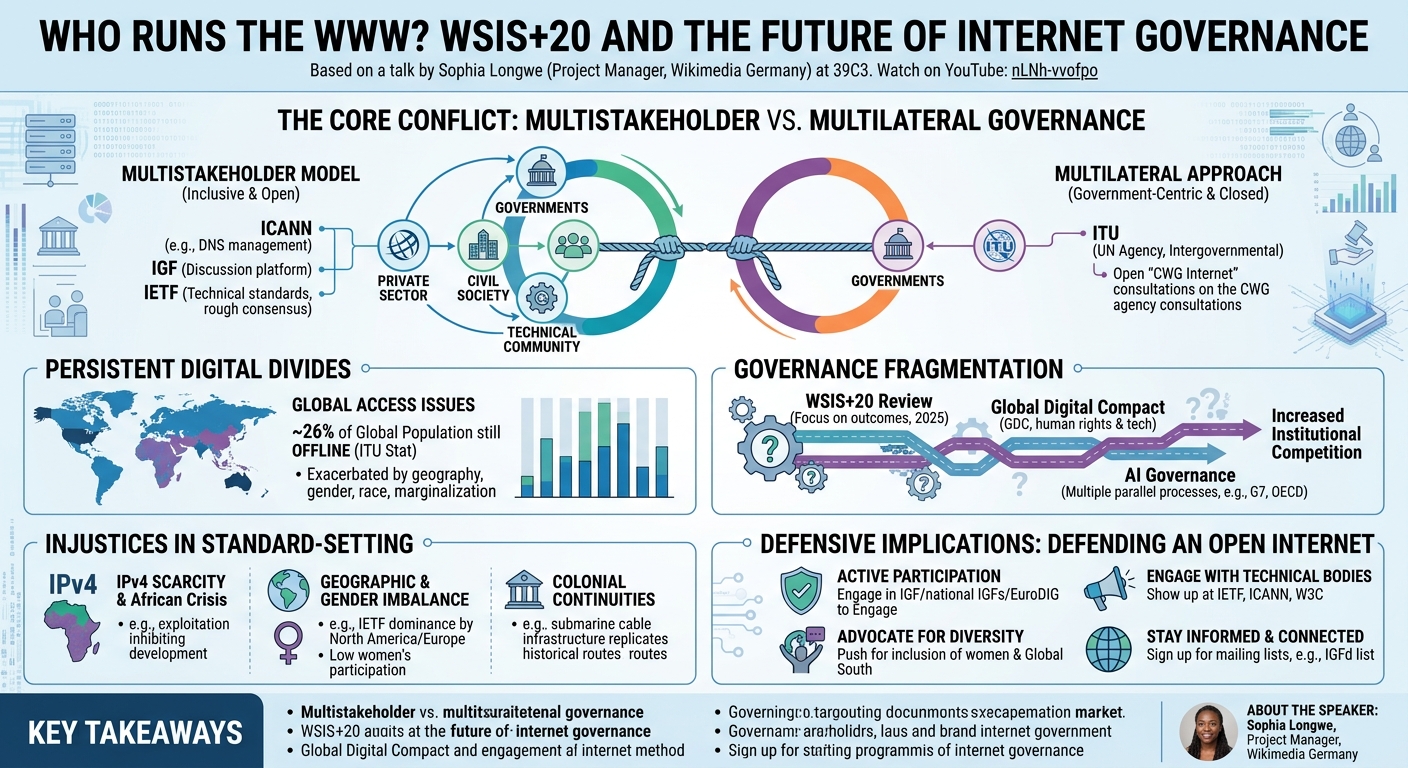
- Persistent Digital Divides: Despite decades of effort, significant portions of the world remain unconnected. Longwe cited ITU statistics indicating that approximately 26% of people are still offline. This divide is not merely about access but is compounded by geographical, gender, racial, and other forms of marginalization, preventing vast populations from participating in the digital world. This directly contradicts Kofi Annan's vision for an inclusive and participatory internet.
- Ongoing Multilateral vs. Multistakeholder Power Struggle: The fundamental debate between the multilateral approach (government-centric, often closed-door, favored by ITU and some UN blocs like the G77 + China) and the multistakeholder model (open, inclusive of governments, private sector, civil society, technical community, championed by ICANN and the IGF) continues to define internet governance. This struggle manifests in attempts to introduce separate tracks for governments within forums like the IGF, which Longwe argues would lead to fragmentation and backroom deals, undermining the spirit of open dialogue.
- Governance Fragmentation and Institutional Competition: The landscape of digital policy is increasingly fragmented. Longwe pointed to parallel processes such as the WSIS+20 review, the Global Digital Compact, and numerous initiatives around AI governance by bodies like the G7 and OECD. This proliferation of forums, often with overlapping mandates, creates "governance fragmentation." It makes it exceedingly difficult for civil society organizations and smaller nations (like Lesotho, not represented in the G7/G20/OECD) to track, participate in, and influence all relevant discussions, effectively serving as a distraction or barrier to entry.
- Injustices within Standard-Setting Bodies: The current structure of internet governance often replicates existing global power imbalances. Longwe highlighted several injustices:
- IPv4 Scarcity and Exploitation: The critical resource of IPv4 addresses is unevenly distributed and exploited, particularly in Africa. The case of an individual amassing over 10 million IPv4 addresses and leasing them out, hindering internet development on the continent and causing a governance crisis at AfriNIC (the Regional Internet Registry for Africa), exemplifies this.
- Geographic and Gender Imbalance in Technical Standards: The majority of Internet Engineering Task Force (IETF) documents originate from North America and Europe, indicating a lack of diverse perspectives in defining fundamental internet protocols. Furthermore, women's participation in most governance bodies, including ICANN, remains consistently low, reinforcing "exclusionary cultures" as documented by Dr. Karen CF's study on the IETF.
- Colonial Continuities: Longwe emphasized that internet infrastructure, particularly submarine cables (referencing Estam Wemoir's work), often replicates colonial routes and power imbalances, perpetuating historical inequalities in digital connectivity.
- The WSIS+20 Consensus Resolution as a Major Achievement: Despite the challenges, Longwe identified the consensus resolution at the WSIS+20 review as a "huge achievement." Member states of the United Nations, even those in conflict, agreed on a resolution concerning the internet, signifying a rare moment of global alignment on digital policy and a significant success for civil society advocacy. The recognition of national and regional IGF initiatives in this text is also a positive development.
Technical Deep Dive
▶ Watch: The 2005 Tunis agenda definition of internet governance (5:00)
The true power in shaping the internet, as Sophia Longwe explained, often resides not in high-level political declarations but in the technical organizations that define its underlying standards and norms. These bodies dictate how the internet functions, from addressing to protocols, and their governance structures are critical to its future.
One such organization is the International Telecommunication Union (ITU), a specialized agency of the United Nations. The ITU operates on a multilateral model, meaning its decision-making processes are primarily government-centric, with limited direct participation from other stakeholders. While this approach is often criticized for its exclusivity, Longwe highlighted a positive exception: the ITU Council Working Group on WSIS and the SDGs (CWG Internet). This working group is notable because its consultations are open to all stakeholders, allowing diverse voices to provide input on critical topics such as expanding internet connectivity, bridging the digital gender divide, and optimizing Internet Exchange Points (IXPs). Longwe herself, through the German Youth IGF, actively participates in these consultations, demonstrating a pathway for engagement even within a predominantly multilateral body.
The Internet Engineering Task Force (IETF) represents a different governance paradigm, embodying the "technical community." The IETF is responsible for developing and promoting internet standards, most famously HTTP, TCP/IP, and SMTP, which define how computers and networks communicate. Its operational philosophy is "rough consensus and running code," meaning that decisions are made through a meritocratic process based on technical expertise and practical implementation rather than formal voting. Longwe noted the unique consensus-checking mechanism, where working group chairs might gauge agreement by "humming." However, she also cautioned against the IETF's often "exclusionary cultures," referencing Dr. Karen CF's case study, "Loud Men Talking Loudly: Exclusionary Cultures of Internet Governance," which highlights challenges related to diversity and inclusion within this highly technical environment.
The Worldwide Web Consortium (W3C) is another crucial standard-setting body, known for developing HTML and other specifications that define the World Wide Web. Founded by Sir Tim Berners-Lee, the inventor of the web, the W3C operates on a multistakeholder model, bringing together industry, research, and civil society to create open standards. Berners-Lee's original vision for the web combined hypertext, TCP, and the Domain Name System (DNS), demonstrating the foundational importance of these technical underpinnings.
Central to the functioning of the DNS are ICANN (Internet Corporation for Assigned Names and Numbers) and IANA (Internet Assigned Numbers Authority). ICANN manages internet addresses, ensuring the uniqueness of every IP address globally and overseeing the Domain Name System. Each country is responsible for its own country code Top-Level Domain (ccTLD), such as .de for Germany. ICANN also facilitates the introduction of new generic Top-Level Domains (gTLDs); an applicant round is slated for next year, though the application fee alone stands at approximately $227,000. IANA, historically managed by John Postel, serves as the central registry for IP addresses and other protocol parameters. A significant shift occurred in 2016 with the IANA stewardship transition, moving oversight from the U.S. Department of Commerce to a global multistakeholder community, a move that the BBC famously questioned as "Has the US just given away the internet?"
Finally, Regional Internet Registries (RIRs) manage critical internet resources, primarily IP addresses, within their respective regions. Longwe highlighted the ongoing struggle between IPv4 and IPv6, noting the scarcity and increased value of IPv4 addresses. She presented a stark example of injustice within this system: a controversy in Africa where an individual amassed over 10 million IPv4 addresses and leased them out, hindering internet development on the continent and leading to a significant governance crisis within AfriNIC, the RIR for Africa. This demonstrates how technical resource allocation directly impacts digital equity and development.
Demo / Proof of Concept
▶ Watch: Core debate: multilateral vs. multistakeholder internet governance (5:40)
This technical article is based on a conference talk that primarily focused on policy, governance structures, and historical context rather than demonstrating a specific technical exploit, tool, or proof of concept. Sophia Longwe's presentation was an analytical deep dive into the political and organizational aspects of internet governance, aiming to inform and motivate engagement rather than showcase a working system or vulnerability.
Defensive Implications
▶ Watch: Understanding the Internet Governance Forum as a discussion platform (6:00)
The "defensive implications" arising from Sophia Longwe's talk are not about protecting systems from cyberattacks, but rather about defending the internet's open, inclusive, and democratic nature from forces that seek to centralize control, deepen digital divides, or undermine multistakeholder governance. For individuals, organizations, and governments committed to a free and equitable internet, several key actions are imperative:
- Active Participation in Multistakeholder Forums: The most crucial defense is engagement. Stakeholders, particularly from civil society, academia, and the technical community, must actively participate in forums like the Internet Governance Forum (IGF), its national (e.g., German IGF - IGFD) and regional (e.g., European Dialogue on Internet Governance - EuroDIG) initiatives. Longwe stressed that these are platforms for crucial dialogue and for shaping public policy issues. She specifically highlighted the ongoing "call for issues" for EuroDIG as an immediate opportunity.
- Engaging with Standard-Setting Bodies: While often perceived as highly technical, bodies like the IETF, W3C, ICANN, and even specific open working groups within the ITU (e.g., CWG Internet) are where the internet's fundamental rules are defined. Longwe encouraged individuals to get involved in policy development processes (PDPs) within ICANN or working groups within the IETF. This means "showing up and keeping showing up," even if the environment feels exclusionary, as she acknowledged the IETF can be. The RIPE community's presence and efforts to engage more at IGF meetings are a good example of bridging the technical and governance communities.
- Advocating for Diversity and Inclusion: Actively challenging the "exclusionary cultures" prevalent in many governance bodies is essential. This includes pushing for greater participation from women, individuals from the Global South, and those from marginalized communities. Longwe emphasized that diverse perspectives are critical for ensuring standards and policies serve the needs of all global users, not just a dominant few. Organizations like the Internet Society are doing "amazing work to also improve the diversity in all of those standardization bodies."
- Countering Multilateralism and Fragmentation: Defenders must push back against attempts to revert to purely multilateral, closed-door decision-making, which undermines the multistakeholder model. This also means advocating for greater coherence and linkage between parallel governance processes (like WSIS, GDC, and various AI governance initiatives) to reduce fragmentation and ensure civil society can effectively participate.
- Securing Financial Mechanisms for Open Governance: The financial instability of forums like the IGF, which relies on voluntary contributions (like the €1 million from the German government), is a significant vulnerability. Advocates must press for stable and sufficient funding to ensure these platforms remain free of charge and accessible globally.
- Leveraging Fellowships and Educational Opportunities: For those new to internet governance, numerous fellowships exist, such as the German government's fellowship for international digital policy, ICANN's NextGen fellowship (for 18-30 year olds), and various programs from the Internet Society (Early Career, Policymaker). These programs provide crucial pathways to gain knowledge, experience, and network within these complex spaces.
- Staying Informed and Connected: Given the rapid pace and fragmentation of digital policy, continuous learning is vital. Longwe recommended signing up for mailing lists of various working groups (IETF, W3C, ICANN) and newsletters. Her "biggest recommendation" was the IGFd community list, where the German government and other stakeholders share updates on events and policy processes, fostering engagement and mutual information.
By actively participating, advocating for inclusion, and staying informed, individuals can collectively defend the principles of an open, secure, and globally accessible internet against the political and structural challenges it faces.
Key Takeaways
- The Internet is Inherently Political: Every layer of the internet, from its infrastructure to its applications, is shaped by political decisions and power struggles, directly influencing its compatibility with democratic values.
- Multistakeholderism vs. Multilateralism is the Core Struggle: The ongoing debate between open, inclusive multistakeholder governance (involving governments, private sector, civil society, technical community) and closed, government-centric multilateral approaches remains central to the internet's future.
- Digital Divides and Governance Fragmentation Persist: Significant portions of the global population remain offline, and the proliferation of parallel governance processes (WSIS, GDC, AI governance) creates fragmentation, hindering effective participation, especially for civil society and smaller nations.
- Technical Standard-Setting Bodies Hold Real Power: Organizations like the ITU, IETF, W3C, ICANN, IANA, and RIRs define the internet's fundamental protocols and resource allocation, making their governance structures and inclusivity critically important.
- Injustices Replicate Colonial and Patriarchal Models: Current internet governance structures and resource distribution often perpetuate historical power imbalances, leading to issues like IPv4 scarcity in Africa and a lack of diversity in standard-setting bodies.
- Active Participation is Crucial for a Democratic Internet: Individuals, particularly from underrepresented groups and technical backgrounds, are strongly encouraged to engage in forums like the IGF, national/regional IGFs, and standard-setting bodies to advocate for an open, secure, and inclusive internet.
About the Speaker(s)
Sophia Longwe is a Project Manager in the public policy team of Wikimedia Germany. She is deeply passionate about international digital policy and has actively engaged in various forums related to internet governance. Her journey into this field included attending her first Internet Governance Forum in Ethiopia in 2022 and making her debut appearance at the Chaos Communication Congress (39C3) with this talk. Longwe identifies as a huge fan of Beyoncé, a detail she humorously shared at the outset of her presentation. Her work at Wikimedia Germany and her advocacy for an inclusive internet underscore her commitment to shaping digital policy for the public good.
All talks from 39th Chaos Communication Congress (39C3): Power Cycles