Essential Marketing for Cyber Founders
Gianna Whitver (CEO and Co-founder · Cyber Security Marketing Society)
BSides NYC 2025 (0x05) · Day 1 · Entrepreneur
Overview
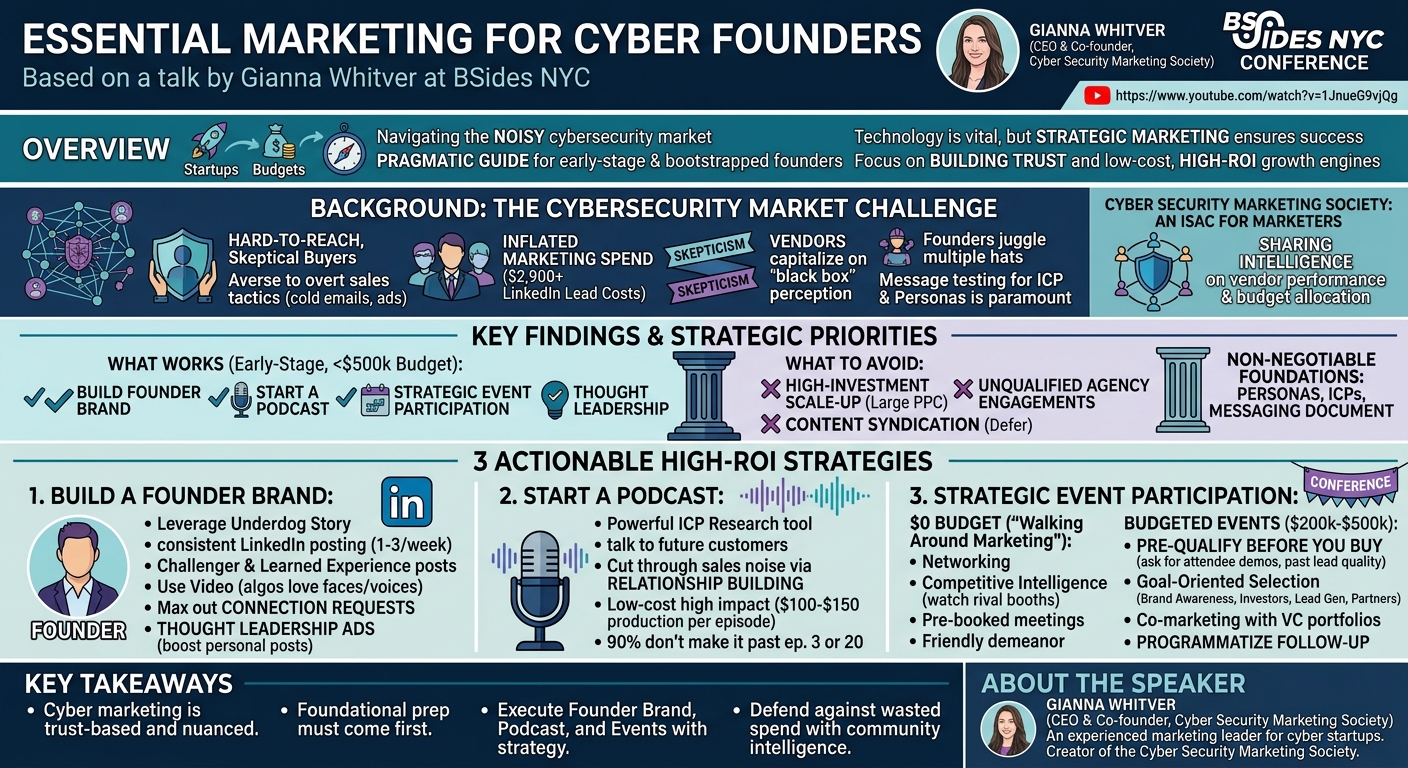
In a landscape often dominated by technical prowess and advanced threat intelligence, the role of effective marketing for cybersecurity startups can be paradoxically overlooked or misunderstood. Gianna Whitver, CEO and Co-founder of the Cyber Security Marketing Society, delivered a candid and highly practical talk at BSides NYC, titled "Essential Marketing for Cyber Founders." This presentation was not a theoretical exploration of marketing principles but a pragmatic guide aimed squarely at early-stage, bootstrapped, or seed-funded cyber founders grappling with limited budgets and the unique challenges of marketing in the security industry.
Key moments
- 0:00 Speaker introduction and cybersecurity marketing background
- 2:00 Why this talk focuses on marketing budget and ROI
- 2:40 Presentation goals: empowering founders with marketing decisions
- 3:40 Three actionable strategies: founder brand, podcast, events
- 4:40 Detailed agenda and available resources/templates
- 6:00 Key assumptions about the audience and their budget
Essential Marketing for Cyber Founders
Speakers: Gianna Whitver (CEO and Co-founder, Cyber Security Marketing Society)
Conference: BSides NYC
YouTube: https://www.youtube.com/watch?v=1JnueG9vjQg
Overview
In a landscape often dominated by technical prowess and advanced threat intelligence, the role of effective marketing for cybersecurity startups can be paradoxically overlooked or misunderstood. Gianna Whitver, CEO and Co-founder of the Cyber Security Marketing Society, delivered a candid and highly practical talk at BSides NYC, titled "Essential Marketing for Cyber Founders." This presentation was not a theoretical exploration of marketing principles but a pragmatic guide aimed squarely at early-stage, bootstrapped, or seed-funded cyber founders grappling with limited budgets and the unique challenges of marketing in the security industry.
Whitver, drawing from her extensive experience managing marketing budgets from zero to $2 million at various cybersecurity startups, emphasized the critical importance of strategic, high-ROI (Return on Investment) marketing. Her core message underscored that while cutting-edge technology is vital, it doesn't always guarantee success without a compelling go-to-market strategy. The talk provided founders with actionable strategies to navigate the noisy and often inflated world of cybersecurity marketing, focusing on building trust, understanding buyer problems, and making every dollar count.
The session distinguished itself by offering a founder-centric perspective, acknowledging that many early-stage entrepreneurs wear multiple hats, often including that of the marketer. Whitver's goal was to equip these founders with the context and tools necessary to make informed marketing decisions, whether they have a dedicated marketing team, are the sole marketer, or are considering their first hires. The presentation demystified common marketing pitfalls and offered clear, tactical advice on leveraging founder brand, podcasting, and events as potent, cost-effective growth engines in the highly skeptical cybersecurity market.
Background
▶ Watch: Speaker introduction and cybersecurity marketing background (0:00)
The cybersecurity industry presents a unique and often challenging environment for marketing. As Gianna Whitver highlighted, the traditional marketing playbooks that might succeed in other SaaS sectors often fall flat here. The primary reason is the nature of the cybersecurity buyer: they are typically hard to reach, incredibly skeptical, and averse to overt sales tactics like retargeting ads or incessant cold emails. This skepticism means that marketing efforts must be fundamentally trust-based, where strong brands and authentic communication play a disproportionately large role in a company's success.
This difficult-to-reach buyer profile, however, has inadvertently led to an industry-wide inflation of marketing spend. Vendors selling marketing services to cybersecurity companies often capitalize on the perceived "black box" around security buyers, leading to exorbitant costs for programs that frequently deliver low ROI. Whitver shared her personal observation that cybersecurity marketing has "the most inflated spend of any [industry] I've been in so far," with lead costs potentially reaching $2,900 for LinkedIn campaigns with questionable returns. Founders are often bombarded with advice from various sources—investors, friends, agencies, and SaaS tools—all claiming to have the silver bullet, yet many of these insights are generalized or outdated, failing to account for the unique nuances of the cyber market.
Recognizing this pervasive challenge, Whitver co-founded the Cyber Security Marketing Society. This organization functions as an ISAC (Information Sharing and Analysis Center) for marketers within the industry, providing a community for in-house marketers to share intelligence on vendor performance, budget allocation, and effective strategies. It was born out of Whitver's own frustration with inflated costs, such as a six-figure Gartner contract for an early-stage company, and the realization that collective intelligence could help marketers make better, more cost-effective decisions. The society aims to cut through the noise, offering education, mentorship, and networking to help companies market successfully in cybersecurity, emphasizing that there is "no silver bullet" and that effective strategies are highly context-dependent, often starting with "it depends."
Early-stage companies, in particular, face additional hurdles. They typically operate with limited budgets, often between $0 and $500K for marketing. They are not yet well-known entities like Wiz or CrowdStrike and are still in the crucial phase of message testing, trying to identify their ICP (Ideal Customer Profile)—whether it’s a security engineer, a CISO, or a developer—and understand their specific problems. This foundational work is paramount, as Whitver emphasized, before any significant marketing spend can be truly effective.
Key Findings
▶ Watch: Presentation goals: empowering founders with marketing decisions (2:40)
Gianna Whitver's presentation distilled several critical insights for cyber founders seeking to maximize their marketing impact with limited resources. Her core findings revolve around strategic prioritization, foundational preparation, and leveraging specific, high-ROI tactics tailored to the cybersecurity buyer.
Firstly, the talk underscored the nuanced nature of cybersecurity marketing. Unlike other industries, the tech doesn't always win; effective go-to-market strategies are paramount. This is due to the inherent skepticism and difficulty in reaching security buyers, who prioritize trust-based marketing and strong brands over aggressive outreach. This reality means founders must be wary of generic marketing playbooks and agencies that lack deep industry expertise, as they can quickly lead to wasted budgets.
Secondly, Whitver emphasized the absolute necessity of foundational marketing documents. Before launching any significant campaigns, companies must define their personas (detailed profiles of target buyers), ICPs (Ideal Customer Profiles, specifying company size, industry, and problems), and a clear messaging document. This involves understanding "who in what role at what type and size of company that has what problem is buying your product for what amount and why, and why not others." This iterative process of message testing and refinement, even with imperfect initial assumptions, is crucial for building a strong base from which all marketing programs can launch.
Thirdly, the presentation offered a clear distinction between what works and what to avoid for early-stage companies with limited budgets (typically $0-$500K).
- What Works: Events (both attending and strategic sponsoring), content marketing (especially thought leadership), and building a strong founder brand. These strategies are effective because they build trust, provide direct feedback loops, and can often be executed with minimal financial outlay.
- What to Avoid: High-investment scale-up tactics like large-scale PPC (Pay-Per-Click) campaigns or unqualified agency engagements without a clear understanding of the buyer and market fit. Whitver specifically warned against agencies that promise the world but lack cyber-specific experience, citing instances of $180,000 investments yielding poor results. Content syndication was also flagged as a tactic to defer until later stages.
Finally, the talk highlighted three actionable strategies that early-stage founders can implement to achieve significant ROI:
- Building a Founder Brand: Leveraging the compelling story of an underdog founder to attract customers, referrals, investors, and speaking opportunities.
- Starting a Podcast: Utilizing this medium for direct customer engagement, market research, and messaging refinement, while cutting through the noise due to low long-term retention rates of most podcasts.
- Strategic Event Participation: Maximizing the value of conferences and trade shows, from "walking around marketing" at zero cost to carefully pre-qualifying and programmatizing follow-up for sponsored events.
These findings collectively arm founders with a framework to make informed, budget-conscious decisions, steering them away from common pitfalls and towards strategies proven to resonate with the discerning cybersecurity buyer.
Technical Deep Dive (Strategic Deep Dive into Marketing Tactics)
▶ Watch: Three actionable strategies: founder brand, podcast, events (3:40)
While this talk doesn't delve into traditional cybersecurity "technical deep dives," it offers an equally rigorous strategic deep dive into marketing tactics, providing founders with granular, actionable steps to implement the key findings. Whitver meticulously detailed three core strategies: building a founder brand, starting a podcast, and strategic event participation.
Building a Founder Brand
The founder brand is presented as a high-ROI, often zero-cost strategy. Whitver emphasized that founders are the underdogs, and their personal story of building something new from scratch is inherently compelling to the market. A strong founder brand attracts customers, referrals, investors, and speaking opportunities.
The tactical execution involves consistent engagement on platforms like LinkedIn:
- Posting Frequency: Aim for one to three posts per week on LinkedIn.
- Content Pillars:
- Challenger Posts: Articulating how your solution is different or challenges the status quo.
- Learned Experiences: Sharing insights from your journey or industry observations.
- Personal Story: Connecting with the audience on a human level, showcasing passion and dedication.
- Post Types: Utilize photos, graphics, videos, and long-text posts. Video, in particular, is prioritized by the LinkedIn algorithm, and "people love faces and voices." Founders don't need a professional setup; even a smartphone video from an office or hotel room can be effective.
- AI Tools: For founders who struggle with writing, AI tools can help overcome the "writer's block" and refine thoughts into engaging text.
- Connection Requests: A hugely undervalued, free tactic. LinkedIn Premium users can send up to 100 connection requests per week; free users get 40-50. Consistently sending these requests expands a founder's network, builds credibility (e.g., "700 mutual connections"), and opens doors for relationships. This creates a "virtuous cycle" where being known facilitates more connections, and more connections increase visibility.
- Thought Leadership Ads: For those with a small budget ($800-$2,000/month), these are highly recommended. Instead of promoting the company, these ads boost a founder's personal posts. This strategy yields much higher engagement and better ROI than traditional LinkedIn ads because "people want to hear from you, the person, the founder, the face, and the voice of the company."
Starting a Podcast
Whitver provocatively stated, "You all in here should start a podcast. It's not oversaturated." She debunked the myth by citing statistics (from Pod News, albeit with a caveat about reputability) that 90% of podcasts don't make it past three episodes, and 90% of those that do, don't make it past episode 20. This indicates a massive graveyard of abandoned podcasts, leaving ample opportunity for consistent creators.
The strategic advantages of a podcast are manifold:
- Dual Purpose: It serves as both a marketing channel and a powerful ICP research tool. Founders can talk directly to current and future customers, conducting "research on air" to refine messaging and understand buyer problems.
- Relationship Building: It offers a unique way to cut through sales noise. Inviting a prospect or industry expert onto your show is flattering and provides a platform for genuine conversation, fostering relationships that cold outreach cannot. Whitver shared an example of inviting a senior security engineer complaining on LinkedIn to discuss the issue on her show.
- Cost-Effectiveness: Whitver's own podcast, producing 52 episodes a year for three and a half years, costs only $100-$150 per episode for production (editing). The time commitment is two to four hours a week for the hosts. This translates to an annual cost of $10,000-$14,000 for a consistent, high-impact marketing channel.
- Automation: With a year of setup, Whitver noted her process became highly automated, requiring hosts mainly to show up, plug in mics, and talk on platforms like Riverside.
- Basic Setup Costs: A quality microphone (e.g., Shure MV7 at $250), a mic arm ($50), and hosting services (Buzzsprout or Transistor, $10-$20/month) are the primary initial investments.
Strategic Event Participation
Events are a cornerstone of cybersecurity marketing, with virtually every founder attending at least one conference annually. Whitver is a strong advocate for events, viewing them as unparalleled opportunities for direct engagement and feedback.
For $0 Budget (Walking Around Marketing):
- Networking: Attend every side event and networking session.
- Competitive Intelligence: "Stand near your competition's booth" to observe their customers and engagement.
- Pre-Booked Meetings: Reach out to contacts beforehand, leveraging the event as a reason to meet in person ("Hey, I'll be at RSA, are you going?").
- Outgoing and Friendly: While optional, a friendly demeanor helps. Canned questions can assist those less naturally outgoing.
- Instant Feedback Loop: Events offer immediate, unfiltered feedback on your product, messaging, and sales approach.
Programmatizing Follow-Up: This is critical for both free and paid event participation.
- Immediate Connections: Connect with people on LinkedIn instantly, noting where and why you met them.
- Canned Messages: Prepare follow-up messages to personalize and send promptly, ensuring relationships are portable beyond the event.
- On-Site Meetings: If a prospect shows interest, book a follow-up meeting on the spot.
For Budgeted Events ($200K-$500K):
- Goal-Oriented Selection: Choose events based on specific goals: brand awareness for new companies, investor hunting (especially at early-stage booth areas at RSA or Black Hat), lead generation (e.g., a healthcare security conference if selling to healthcare), or strengthening channel/partner relationships.
- Pre-Qualification: Just like with agencies, event sales teams are often incentivized to sell booths without proper qualification. Founders must ask specific questions to ensure the event aligns with their ICP, persona, and budget ("location, location, low basis"). This includes asking for attendee demographics, past lead quality metrics, and specific opportunities to engage target buyers.
- Co-Marketing: Pool resources with other companies, especially those within the same venture portfolio or ecosystem, to sponsor parties or activities around larger events.
- Targeted Verticals & Partners: Focus on events by industry associations (e.g., oil and gas shows) or partner ecosystems (AWS, Microsoft Ignite). These often have pre-qualified audiences, making lead generation more efficient ("how do you integrate with X?" instead of "what do you do?").
- Budget Templates: Whitver offers her personal budget templates, allowing founders to strategically allocate funds across various marketing activities rather than over-investing in a single channel like conferences. The Cyber Security Marketing Society also provides ROI reports, like their ROI of RSA report, broken down by company stage, to help members make data-driven decisions.
This detailed breakdown provides founders with a comprehensive toolkit, moving beyond theoretical marketing concepts to practical, cost-effective implementation strategies.
Demo / Proof of Concept
▶ Watch: Detailed agenda and available resources/templates (4:40)
This technical article covers a conference talk on marketing strategy, not a software or hardware security vulnerability demonstration. Therefore, there was no traditional "demo" or "proof of concept" in the conventional sense of a live exploit or tool showcase.
However, Gianna Whitver's presentation served as its own proof of concept for the strategies she advocated. Her success in building the Cyber Security Marketing Society—a bootstrapped, profitable organization with over 4,000 in-house marketers from 1,600 security companies—directly demonstrates the efficacy of founder brand and community building. Her personal journey, evolving from 17,000 to 19,000 LinkedIn followers in five months through consistent posting and connection requests, validates the power of personal branding. Furthermore, the sustained success of her podcast, running for over three and a half years with 184 episodes, exemplifies the long-term value and relationship-building potential of this medium.
Whitver also provided tangible resources as "proof of concept" for her methodologies, including:
- Templates: She offered to share her standardized messaging, ICP, and persona documents, as well as her personal marketing budget templates, which she uses in her own roles.
- Industry Research: The Cyber Security Marketing Society regularly publishes reports, such as the "ROI of RSA," which analyzes the effectiveness of major events for companies at different stages, providing data-backed evidence for strategic decision-making.
- Community Intelligence: The very existence of the Society, acting as an intelligence-sharing program for marketers, serves as a testament to the value of collective insights in navigating vendor performance and program effectiveness.
These elements, while not a live technical demonstration, functioned as practical, real-world validations of the marketing strategies presented, offering founders concrete tools and evidence to apply the advice.
Defensive Implications
▶ Watch: Key assumptions about the audience and their budget (6:00)
In the context of a marketing talk, "defensive implications" shift from protecting systems against cyber threats to defending a startup's precious marketing budget and strategic direction against common pitfalls, inflated costs, and ineffective tactics. Gianna Whitver's presentation provided several crucial defensive strategies for cyber founders:
- Defending Against Wasted Spend: The most significant defensive implication is safeguarding limited budgets from programs with low ROI. Whitver explicitly warned against high-investment scale-up tactics like large-scale PPC or content syndication for early-stage companies, as well as unqualified agencies. Founders should be highly skeptical of vendors promising "silver bullets" or lacking deep, proven expertise in the nuanced cybersecurity market. The advice to "pre-qualify before you buy" applies not only to event sponsorships but to any marketing service.
- Building a Strong Foundation as a Shield: A robust defense against marketing missteps begins with foundational work. Investing time in defining personas, ICPs, and a clear messaging document acts as a strategic shield. Without this clarity, any marketing spend is akin to firing arrows in the dark. The continuous refinement of this foundation, based on feedback loops, ensures that subsequent investments are targeted and relevant.
- Leveraging Community Intelligence: The Cyber Security Marketing Society itself is a defensive mechanism. By joining such a community (or similar intelligence-sharing groups), founders and their marketing teams gain access to collective wisdom, vendor reviews, and ROI data. This intelligence helps "defend" against making costly mistakes by learning from others' experiences, identifying reputable partners, and understanding what truly works (or doesn't) in the industry. The society's ROI of RSA report, for instance, directly empowers companies to defend their event budgets by providing data-driven insights.
- Prioritizing Trust-Based Engagement: In an industry characterized by skeptical buyers, a key defensive strategy is to move away from aggressive, interruptive marketing towards trust-based engagement. Tactics like building a founder brand, hosting a podcast for genuine conversations, and engaging authentically at events are inherently defensive. They build credibility and relationships, making the company less susceptible to being dismissed as "just another vendor" and thus more resilient against the pervasive buyer skepticism.
- Empowering Internal Capabilities: Whitver's emphasis on founders taking an active role in marketing, even with limited time, and the importance of having easily editable websites (e.g., using Canva for brand materials, drag-and-drop website builders) are defensive measures. They reduce reliance on expensive external agencies for basic tasks and empower internal teams to be agile and responsive, thereby protecting the budget from unnecessary agency fees and delays.
In essence, the defensive implications of Whitver's talk are about adopting a proactive, informed, and community-supported approach to marketing. It's about making deliberate choices to protect limited resources, build genuine connections, and ensure that every marketing effort contributes meaningfully to the company's growth rather than becoming another casualty of the industry's inflated and noisy marketing landscape.
Key Takeaways
- Cybersecurity marketing is uniquely challenging: Buyers are highly skeptical and difficult to reach, necessitating trust-based marketing and strong brands. Generic playbooks and unqualified agencies often lead to wasted budgets in this nuanced industry.
- Foundational marketing is non-negotiable: Before any significant spend, early-stage companies must define their personas, ICPs, and messaging document. This foundational work, even if imperfect initially, is critical for effective and targeted marketing.
- Prioritize high-ROI, low-cost strategies: For limited budgets ($0-$500K), focus on building a founder brand, starting a podcast, and strategic event participation. Avoid high-investment, scale-up tactics like large-scale PPC or content syndication until market fit is proven.
- Leverage your founder story and LinkedIn: Build a personal founder brand through consistent LinkedIn posting (1-3 times/week) with challenger, learned experience, and personal story content. Max out connection requests and consider thought leadership ads for cost-effective personal promotion.
- Podcasting offers unique advantages: It's not oversaturated and serves as a powerful tool for direct customer engagement, market research, and messaging refinement, cutting through noise and building relationships with future customers for a relatively low cost ($100-$150/episode for production).
- Maximize event participation: For zero budget, engage in "walking around marketing" by networking, observing competitors, and pre-booking meetings. For budgeted events, pre-qualify thoroughly, align sponsorship with specific goals (awareness, lead gen, investors), and meticulously programmatize follow-up to convert connections into actionable leads.
About the Speaker(s)
Gianna Whitver is the CEO and Co-founder of the Cyber Security Marketing Society, an ISAC for marketers in the cybersecurity industry. Her extensive experience includes over a decade in marketing roles at cybersecurity startups, primarily at the Series A stage and lower, where she managed budgets ranging from zero to $2 million without additional headcount. Whitver has a background in threat intelligence, anti-malware, and general technology.
She is also an AWS, CrowdStrike, and NVIDIA Cyber Accelerator mentor in marketing, an advisor to early-stage startups, and the organizer of industry conferences such as Cyber Marketing Con and Cyber CEO Summit. Additionally, Whitver co-hosts a podcast on the Cyberwire Network, where she actively invites founders to share their stories. Her passion lies in the "messy" and "crazy" environment of early-stage companies, and she is deeply committed to ensuring marketing budgets deliver strong ROI, a principle that underpins her work and advice.
Reviews
Dr. Zero (Offensive Security Researcher) — SOLID
Competent, practitioner-grade talk aimed squarely at a real gap — cyber founders who are technically sharp but marketing-illiterate. Whitver knows her lane and delivers usable tactical advice, but nothing here will surprise anyone who's spent time in B2B SaaS marketing, and the conference context (BSides NYC) makes it a somewhat awkward fit.
Heather Calloway (CISO) — PASS
A competent, practical marketing talk for cyber founders that has no meaningful intersection with security governance, defender operations, or institutional risk. This is a vendor-adjacent business session — useful to its audience, entirely outside my lane.