They Don't Want to Talk to Sales—So Let the Community Sell for You
Mariana Padilla (Community Evangelist · Harmonic)
BSides NYC 2025 (0x05) · Day 1 · Entrepreneur
Overview
In an insightful talk at BSides NYC, Mariana Padilla, Community Evangelist at Harmonic and former CEO of Hackerverse, challenged traditional sales and marketing paradigms in the cybersecurity industry. Her presentation, "They Don't Want to Talk to Sales—So Let the Community Sell for You," argued compellingly for a community-first approach to customer acquisition and retention. Padilla highlighted the growing skepticism among cybersecurity professionals towards conventional sales tactics, emphasizing that modern buyers are increasingly turning to peer recommendations and authentic community engagement long before ever contacting a sales representative.
Key moments
- 0:00 Speaker introduction and community's role in success
- 1:15 The buyer's journey now starts in community
- 2:40 Buyers are 57-70% through journey before sales
- 3:30 Community lowers acquisition costs, speeds deals, builds loyalty
- 4:40 Give first, sell later: a core philosophy
- 6:15 Hackerverse's World Hacker Games CTF example
- 7:00 Cybersecurity audience: 'irreverent nerds' who love challenges
They Don't Want to Talk to Sales—So Let the Community Sell for You
Speakers: Mariana Padilla, Community Evangelist, Harmonic
Conference: BSides NYC
YouTube: https://www.youtube.com/watch?v=acGfp2vCGIs
Overview
In an insightful talk at BSides NYC, Mariana Padilla, Community Evangelist at Harmonic and former CEO of Hackerverse, challenged traditional sales and marketing paradigms in the cybersecurity industry. Her presentation, "They Don't Want to Talk to Sales—So Let the Community Sell for You," argued compellingly for a community-first approach to customer acquisition and retention. Padilla highlighted the growing skepticism among cybersecurity professionals towards conventional sales tactics, emphasizing that modern buyers are increasingly turning to peer recommendations and authentic community engagement long before ever contacting a sales representative.
The talk provided a practical framework for building and leveraging genuine communities to drive business growth, reduce customer acquisition costs, and foster long-term loyalty. Padilla’s message resonates deeply within the cybersecurity landscape, where trust and credibility are paramount. By understanding the unique culture of "irreverent nerds" that defines the industry, companies can create engaging, value-driven spaces that empower users and naturally lead to advocacy and sales, rather than relying on outdated, high-pressure methods that alienate potential customers. This approach is not merely a marketing tactic but a fundamental shift in how businesses should interact with their audience, ensuring alignment with the evolving buyer's journey and the inherent desire for authentic connection.
Background
▶ Watch: Speaker introduction and community's role in success (0:00)
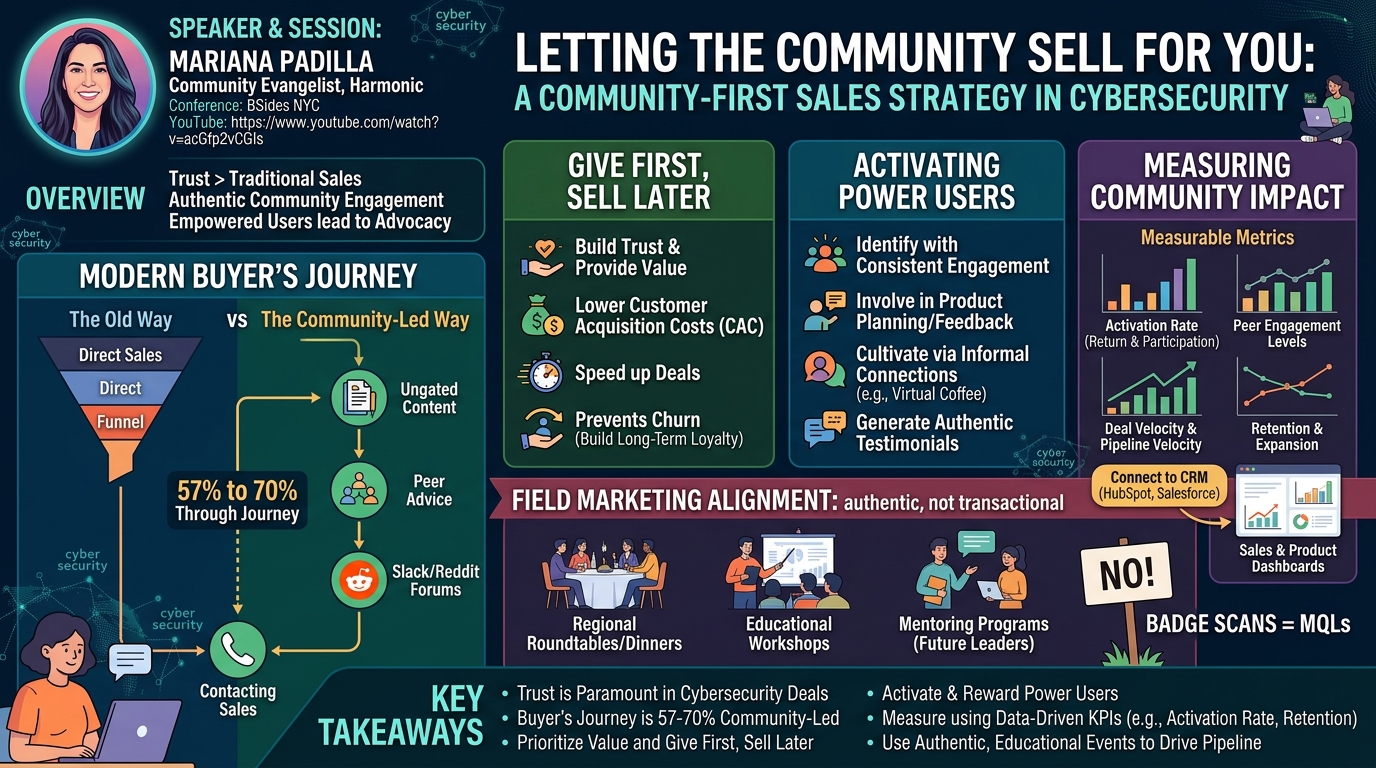
The landscape of B2B sales, particularly in cybersecurity, has undergone a dramatic transformation. Padilla opened by referencing the Gartner map, illustrating the complex and protracted nature of the modern buyer's journey. Gone are the days when a customer's first significant interaction with a product or service was through a sales representative. Today, buyers are already 57% to 70% of the way through their journey before they ever contact a sales team. This shift is driven by a pervasive distrust of traditional sales processes, which Padilla colorfully described as the "existential dread of clicking on the talk to sales button," leading to endless email lists, unwanted calls, and irrelevant pitches.
Instead, the initial phases of product discovery and validation now predominantly occur within community forums. Cybersecurity professionals are actively seeking information and recommendations in Slack channels, Reddit, Discord, and even informal gatherings at the "pub." They ask peers, "Hey, do you have any experience using X, Y, and Z products?" This peer-to-peer validation is considered far more credible and authentic than vendor-produced marketing materials or direct sales outreach. Padilla drew from her experience as CEO of Hackerverse, where her company built a "try before you buy" platform for cybersecurity using AI to create cyber ranges for sales. During this time, hundreds of hours of customer discovery calls confirmed that people actively avoid the traditional sales funnel. This background underscores the urgent need for companies to adapt their strategies, recognizing that the sales process effectively begins in the community, long before a salesperson enters the picture.
Key Findings
▶ Watch: Buyers are 57-70% through journey before sales (2:40)
Mariana Padilla’s core thesis is encapsulated in the motto "give first, sell later." This philosophy posits that in an era of heightened skepticism, particularly within the cybersecurity community, building trust and providing genuine value without immediate transactional expectations is the most effective path to sustainable growth. The talk highlighted several key findings that challenge conventional marketing and sales wisdom:
Firstly, the buyer's journey is fundamentally community-driven. Prospects are consuming ungated content, engaging in discussions, and seeking peer advice long before they identify themselves to a vendor. This means that if a company's sales strategy only begins when a lead contacts them, they are already significantly behind. The implication is that businesses must proactively engage with communities, creating spaces where potential customers can learn, share, and solve problems without the pressure of a sales pitch.
Secondly, the cybersecurity community, which Padilla aptly describes as "irreverent nerds," thrives on engagement, challenges, and authentic connections, not boring marketing. Successful strategies must tap into this culture by providing entertainment and educational value. By doing so, companies can significantly lower customer acquisition costs, speed up deals, and build profound customer loyalty from the outset. This proactive nurturing prevents churn—a common issue many founders mistakenly "build into their model"—by fostering deeper relationships and a sense of belonging.
Thirdly, identifying and activating power users is crucial. These are the individuals who consistently engage with content, participate in discussions, and demonstrate genuine enthusiasm for a product or concept. Padilla advocated for actively cultivating relationships with these users through informal interactions like virtual coffees, and involving them in processes such as product planning and feedback. This creates a sense of "ownership" among power users, transforming them into authentic advocates who will "blast your praises on LinkedIn" without being asked. This concept ties into the "thousand true fans" theory (or "100 true fans" spin-off), suggesting that a small number of deeply engaged, loyal fans can be more impactful than a vast, loosely connected audience. These early adopters provide invaluable product validation, ensuring that what a company builds genuinely addresses market needs.
Finally, while community engagement might seem intangible, Padilla stressed the importance of metrics. Key performance indicators (KPIs) such as activation rate (how often people return and participate), peer engagement, deal velocity, retention, and expansion can and should be measured. By tying community activities to the sales pipeline in platforms like HubSpot, businesses can quantify the impact of their community efforts, ensuring that these initiatives are not just "shooting the shit" but are strategically aligned with overarching business goals.
Technical Deep Dive
▶ Watch: Community lowers acquisition costs, speeds deals, builds loyalty (3:30)
While this talk is not "technical" in the traditional sense of code or infrastructure, it offers a deep dive into the mechanisms and strategies for building and leveraging community in a technically-minded industry. The "technical" aspect here refers to the systematic and structured approach to community building that underpins successful engagement.
The foundation of Padilla's strategy is the creation of authentic, non-sales-oriented spaces. This can manifest in various forms:
- Structured Engagement Platforms: Companies can host office hours or webinars where experts answer questions without pushing products. Utilizing platforms like Discord or Slack for community channels allows for real-time interaction, AMAs (Ask Me Anything) with product teams or security leaders, and peer-to-peer support. While Discord presents some security challenges, its free tier makes it accessible for scrappy startups. The key is to foster an environment where users feel comfortable asking "stupid questions" without fear of being sold to.
- Experiential Learning and Gamification: Hackerverse, Padilla’s previous company, exemplified this with the World Hacker Games. These were CTF (Capture The Flag) competitions where participants could "drop in vendor products" and actually use them in a practical, challenge-based environment. This approach aligns perfectly with the "irreverent nerds" culture of cybersecurity professionals who love challenges and hands-on learning. Winners were even rewarded with certifications through partnerships, adding tangible value beyond mere product exposure. This is a powerful form of "technical" engagement, allowing users to interact with tools in a sandbox environment, gaining real experience and building trust.
- Leveraging Power Users for Product Feedback: A critical "technical" integration involves connecting community insights directly with product development. Padilla emphasized creating strong relationships between community evangelists, product teams, and sales teams. Power users, identified through consistent engagement on platforms like LinkedIn or community channels, are invited to be early users of new technology or participate in product feedback sessions. This iterative process ensures that new features or products are aligned with actual user needs, preventing the "worst-case scenario" of building something "no one's going to freaking use." The feedback gathered can also be used for authentic testimonials, screenshotting praises to be used on websites, which resonate more deeply than corporate case studies.
- Metrics and Attribution: To avoid community efforts being perceived as unmeasurable "feelings," Padilla detailed a robust approach to metrics. While not code-level, this is a "technical" implementation of marketing analytics. Key metrics tracked include:
- Activation Rate: How often members return and participate.
- Peer Engagement: Levels of interaction within the community.
- Deal Velocity: How community involvement speeds up sales cycles.
- Retention and Expansion: The impact on customer loyalty and growth.
Harmonic, for instance, integrates its community pipeline directly into HubSpot, allowing them to measure the impact of community events on the overall sales pipeline. This requires careful attribution modeling to understand where deals originate and how community touchpoints contribute, reinforcing shared goals and dashboards across marketing, sales, and product teams.
- Field Marketing Alignment: Padilla, also the Director of Field Marketing at Harmonic, detailed how community principles guide event strategy. She strongly stated, "A badge scan does not equal an MQL (Marketing Qualified Lead)." Instead, events should be designed to foster genuine connections, not just collect contacts. This means turning community discussions into regional roundtables, dinners, and educational events that drive pipeline through authentic engagement. Mentoring programs for aspiring CISOs, for example, build deep emotional connections that may not yield immediate sales but cultivate future loyal customers. This strategic alignment ensures that field marketing activities feel "authentic, not transactional," with champions inviting peers and the room already trusting the brand before sales even enters the conversation.
In essence, the "technical deep dive" here is about the engineering of trust and advocacy within a discerning professional community, using structured engagement, data-driven insights, and a deep understanding of human psychology.
Demo / Proof of Concept
▶ Watch: Hackerverse's World Hacker Games CTF example (6:15)
While Mariana Padilla's talk did not feature a live software demonstration in the traditional sense, she provided a compelling example of a "proof of concept" from her previous venture, Hackerverse. This practical application demonstrated how a community-first approach could directly integrate product experience into engaging activities.
At Hackerverse, the team developed and executed the World Hacker Games. These were not just theoretical discussions or passive webinars; they were interactive CTF (Capture The Flag) competitions. The innovative aspect, serving as a de facto "demo," was that these CTFs "dropped in vendor products" into the challenges. This allowed participants to actively use and interact with various cybersecurity tools and platforms in a live, problem-solving environment. Instead of a sales representative demonstrating features, users were able to experience the products firsthand, understanding their capabilities and limitations in a practical context.
The World Hacker Games fostered a vibrant Discord community where participants could engage, ask questions, and collaborate while tackling the CTFs. This created an authentic space for product discovery and peer-led learning. Furthermore, Hackerverse established a partnership with a certification company, offering winners a code for a professional certification. This provided a tangible reward, appealing to the "nerd factor" of the cybersecurity community and incentivizing deep engagement.
This approach served as a powerful "try before you buy" mechanism, allowing potential customers to gain hands-on experience and form their own opinions about products in a low-pressure, high-engagement setting. It bypassed the "existential dread of clicking on the talk to sales button" by embedding product experience within a fun, challenging, and community-driven event. This proof of concept validated Padilla's core message: by providing genuine value and authentic experiences, companies can build trust and advocacy that naturally leads to sales, far more effectively than traditional sales demonstrations.
Defensive Implications
▶ Watch: Cybersecurity audience: 'irreverent nerds' who love challenges (7:00)
For cybersecurity professionals—the "defenders" this article aims to inform—Mariana Padilla's insights, while focused on sales and marketing, carry significant implications for how they interact with vendors, evaluate products, and leverage their own professional networks.
Firstly, understanding the evolving buyer's journey empowers defenders to make more informed purchasing decisions. Knowing that vendors are increasingly seeking to engage through community channels means defenders can actively participate in these spaces (Slack, Discord, Reddit, industry events) to gather authentic, peer-driven intelligence on products. Rather than relying solely on vendor-provided information, they can seek out unfiltered experiences and recommendations from fellow practitioners, which Padilla emphasizes are "so much more" valuable than traditional case studies or white papers. This peer validation can significantly reduce the risk of acquiring solutions that don't meet real-world needs or integrate well with existing infrastructure.
Secondly, the talk highlights the power of community-led product validation. Defenders can leverage these communities to influence product development. By actively engaging with vendors who embrace this model—providing feedback, participating in early access programs, or contributing to discussions—defenders can help shape tools to better address their specific pain points and operational requirements. This symbiotic relationship ensures that products entering the market are more aligned with the actual challenges faced by security teams, rather than being built in a vacuum.
Thirdly, Padilla's emphasis on "give first, sell later" encourages defenders to be discerning about vendor engagement. If a vendor is genuinely investing in educational content, sponsoring community events, or fostering open forums without immediate sales pressure, it signals a commitment to the community that can translate to better support and partnership down the line. Conversely, vendors who cling to aggressive, transactional sales tactics are likely to be less aligned with the community's values and needs. Defenders should seek out those who respect their time and intelligence, offering value before expecting a commitment.
Finally, for defenders who are also security leaders or aspiring CISOs, the concept of "field marketing" aligned with community presents an opportunity for mentorship and career development. Padilla specifically mentioned initiatives like mentoring the "next generation of security leaders" as a community-building effort. Engaging with such programs allows defenders to expand their networks, gain valuable insights, and potentially influence future technology decisions from an earlier stage in their careers, all within a trusted, non-transactional environment. In essence, Padilla's framework provides defenders with a roadmap for navigating the vendor landscape more effectively, empowering them to demand authenticity, influence product direction, and ultimately make better strategic choices for their organizations.
Key Takeaways
- Trust is Paramount: In cybersecurity, trust drives every deal, and authentic community engagement is where that trust begins, replacing skepticism towards traditional sales.
- The Buyer's Journey is Community-Led: Modern buyers are 57-70% through their decision process, relying on peer recommendations in forums like Slack, Reddit, and Discord, before contacting sales.
- Give First, Sell Later: Companies must create engaging, valuable, and non-transactional spaces for "irreverent nerds" to learn and interact, lowering acquisition costs and building loyalty.
- Activate Power Users: Identify and empower deeply engaged individuals by involving them in product planning, seeking their feedback, and fostering a sense of "psychological ownership" through low-cost rewards like challenge coins.
- Measure Impact: Community efforts are measurable through KPIs like activation rate, peer engagement, deal velocity, retention, and expansion, requiring alignment and shared dashboards with sales and product teams.
- Authentic Events Drive Pipeline: Field marketing should transform community connections into real-world, educational, and non-transactional events that build long-term relationships and trust, rather than just collecting badge scans.
About the Speaker(s)
Mariana Padilla is a Community Evangelist at Harmonic, an AI security company. In this role, she focuses on building and nurturing authentic communities to drive engagement and advocacy. Prior to her current position, Mariana was the CEO of Hackerverse, a venture she described as a "try before you buy" platform for cybersecurity, leveraging AI to create cyber ranges for sales purposes. Her experience as a founder, navigating the challenges of a startup (which she humorously referred to as "founder recovery mode rewiring my brain from three and a half years of trauma"), deeply informs her perspective on the critical role of community in business success. She is a strong proponent of "giving first" and fostering genuine connections, emphasizing that she has "been there in the trenches" with her audience. Padilla is also responsible for field marketing at Harmonic, overseeing events with a strong regional and community-focused approach. She can be found on LinkedIn at "linkedin.com/in/heretoshakeitup."
Reviews
Dr. Zero (Offensive Security Researcher) — HARD PASS
A vendor employee giving a sales pitch about why sales pitches don't work — the irony is apparently lost on everyone involved. This is a marketing talk dressed in community-building language, delivered at a security conference where it has no business being.
Heather Calloway (CISO) — PASS
A vendor marketing talk dressed as practitioner insight. Nothing here touches security governance, risk, or defender operations — it's a go-to-market strategy session delivered at a security conference.