Contribute to Learn: Building DFIR Expertise Through Open Source
Christopher Eng
BSides NYC 2025 (0x05) · Day 1 · Tech - Blue
Overview
Christopher Eng's talk, "Contribute to Learn: Building DFIR Expertise Through Open Source," delivered at BSides NYC, presents a compelling argument for leveraging open-source contributions as a primary pathway for professional development in Digital Forensics and Incident Response (DFIR). Eng, a recent DFIR graduate with 15 years of IT experience, shares his personal journey and insights into how actively engaging with open-source projects can address common challenges faced by aspiring and seasoned DFIR professionals alike: acquiring practical skills, expanding professional networks, and making tangible contributions to the field. The talk is particularly relevant for students and recent graduates, though its principles apply broadly to anyone seeking to deepen their expertise and impact in cybersecurity.
Key moments
- 0:00 Speaker's background, DFIR transition, and talk's audience
- 2:00 Post-graduation challenges: learning, networking, field contribution
- 4:00 Open source as a programmer's path to DFIR contribution
- 4:40 Examples of key open source tools in DFIR
- 5:30 Low contributor numbers in DFIR open source projects
- 6:00 Transparency: understanding artifact parsing in open source
- 6:25 Agility and global collaboration in open source DFIR
Contribute to Learn: Building DFIR Expertise Through Open Source
Speakers: Christopher Eng
Conference: BSides NYC
YouTube: https://www.youtube.com/watch?v=fb7PzHq5x7A
Overview
Christopher Eng's talk, "Contribute to Learn: Building DFIR Expertise Through Open Source," delivered at BSides NYC, presents a compelling argument for leveraging open-source contributions as a primary pathway for professional development in Digital Forensics and Incident Response (DFIR). Eng, a recent DFIR graduate with 15 years of IT experience, shares his personal journey and insights into how actively engaging with open-source projects can address common challenges faced by aspiring and seasoned DFIR professionals alike: acquiring practical skills, expanding professional networks, and making tangible contributions to the field. The talk is particularly relevant for students and recent graduates, though its principles apply broadly to anyone seeking to deepen their expertise and impact in cybersecurity.
The core premise of Eng's presentation is that contributing to open-source DFIR tools offers a unique blend of benefits that traditional learning methods often lack. Beyond academic coursework, certifications, and even Capture The Flag (CTF) events, open-source engagement provides unparalleled transparency into how forensic artifacts are processed, fosters rapid adaptation to evolving digital landscapes, and facilitates global collaboration among experts. This talk serves as a practical guide, detailing various avenues for contribution—from documentation to code development—and illustrating these points with the speaker's own successful endeavors in enhancing popular DFIR tools like Cape, Velociraptor, and Alap.
Background
▶ Watch: Speaker's background, DFIR transition, and talk's audience (0:00)
The landscape of professional development in DFIR often presents a paradox: a vast array of learning resources exists, yet many practitioners struggle to bridge the gap between theoretical knowledge and practical application, networking, and meaningful contribution. Christopher Eng, having transitioned into DFIR after a significant career in IT and graduating in 2023, articulated these pain points clearly. He noted that while traditional methods like books, courses, CTFs, and certifications are valuable, they often have limitations. CTFs, for instance, are infrequent and time-consuming, especially for those with existing full-time commitments. Networking, crucial for career advancement, can be challenging without established connections, often relying on blog posts or social media engagement. The fundamental question Eng sought to answer was: "How can I specifically, individually start contributing towards the field of digital forensics?"
This quest led him to open-source projects, a domain he was already familiar with as a programmer. Eng observed that while many DFIR professionals utilize open-source tools, a surprisingly small percentage actively contribute to them. He cited Alap, a mobile forensics parsing tool, as having only around 60 contributors, and Velociraptor, a popular incident response tool, with approximately 115. This highlights a significant opportunity for engagement. The speaker contrasted open-source tools with their proprietary counterparts, emphasizing that closed-source solutions, while powerful, often obscure the underlying mechanisms of artifact extraction and analysis. This lack of transparency can be a hindrance for students wanting to understand the "how" and "why" behind forensic findings, and potentially problematic in legal contexts where the methodology must be defensible. Furthermore, the rapid evolution of software and operating systems means that new artifacts and changes to existing ones are constant. Proprietary tools often have slower update cycles, tied to quarterly releases or development priorities, leaving practitioners waiting for crucial support. Open-source projects, by their nature, allow for more agile and immediate community-driven updates.
Key Findings
▶ Watch: Open source as a programmer's path to DFIR contribution (4:00)
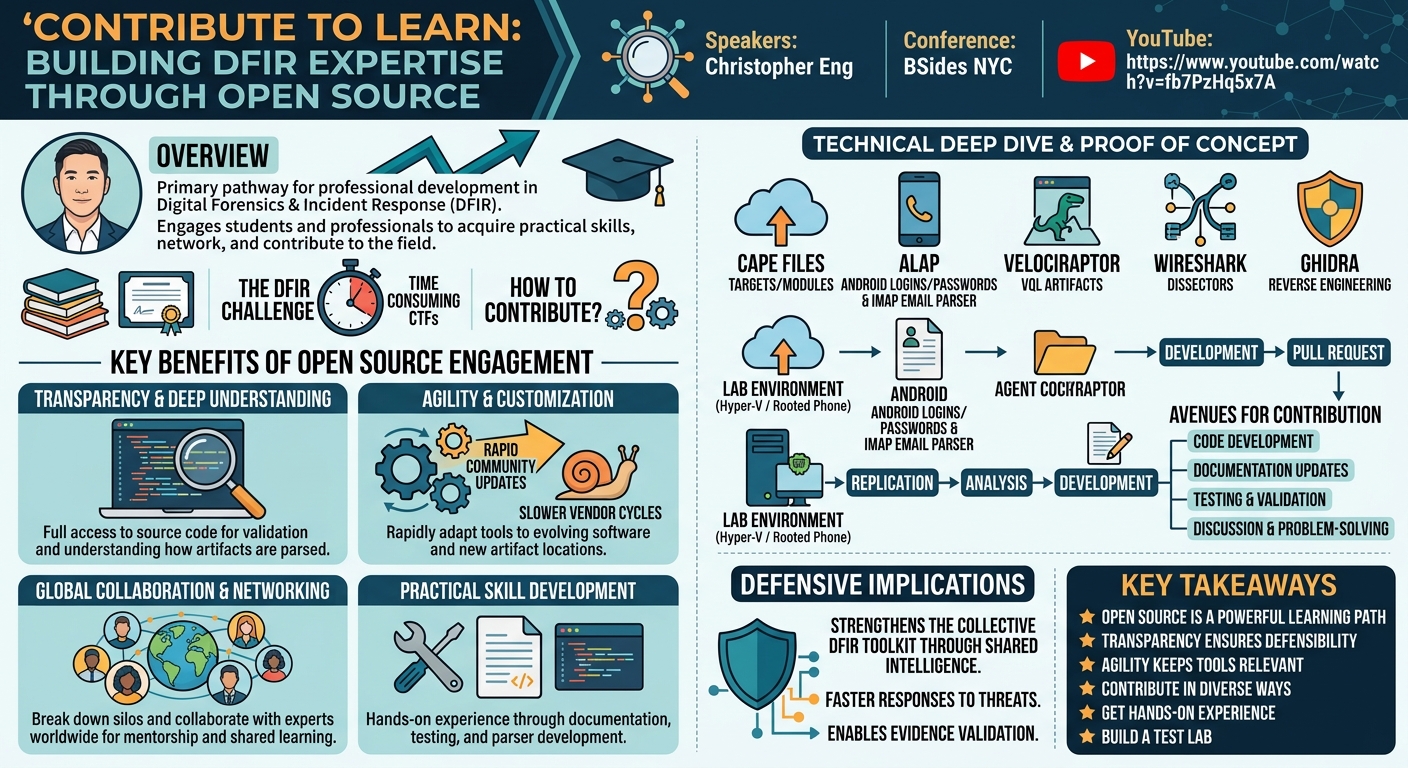
The central finding of Eng's talk is that active contribution to open-source DFIR projects is an exceptionally effective, yet often underutilized, strategy for accelerating professional growth, fostering deep technical understanding, and building a robust professional network. This approach transcends passive learning, transforming individuals from mere tool users into active developers and innovators within the DFIR community. Eng identified several critical benefits inherent to this model:
- Transparency and Deep Understanding: Unlike closed-source tools that operate as black boxes, open-source projects provide full access to their source code. This transparency is paramount for DFIR professionals who need to understand precisely how artifacts are parsed, where data is extracted from, and what interpretations are being made. This capability is not just for academic curiosity; it's essential for validating findings, explaining methodologies in legal proceedings, and developing a nuanced understanding of digital evidence. By delving into the code, contributors gain an unparalleled insight into the intricacies of various operating systems, applications, and file formats.
- Agility and Customization: The digital threat landscape and the applications used daily are in constant flux. New versions of software often introduce changes to artifact locations or formats, rendering existing parsers ineffective. Open-source projects empower contributors to rapidly adapt to these changes. Instead of waiting for a vendor's update cycle (which could be quarterly or longer), an individual who identifies a change can research it, develop a fix or a new parser, and contribute it to the community. This ability to quickly customize and update tools directly benefits the entire DFIR community, ensuring tools remain relevant and effective.
- Global Collaboration and Networking: Open-source projects naturally foster a collaborative environment, connecting individuals from diverse backgrounds and geographical locations. Eng highlighted that this breaks down the "small silos" often found within individual companies. Working alongside project maintainers and other contributors, often across different time zones, provides invaluable opportunities for mentorship, sharing ideas, and learning best practices. This direct engagement builds a strong professional network based on shared technical endeavors, which can be far more impactful than traditional networking events.
- Practical Skill Development: The act of contributing—whether through documentation, testing, or code—forces individuals to engage with tools and artifacts at a deeper level. Writing documentation requires a thorough understanding of a tool's functionality. Testing new versions of software for artifact changes demands investigative skills. Developing a parser necessitates research into artifact structures and programming proficiency. These activities provide hands-on experience that directly translates into enhanced DFIR capabilities. Eng's journey, from researching Windows Notepad artifacts to developing IMAP email parsers for Alap, exemplifies this practical skill acquisition.
In essence, Eng's talk posits that contributing to open-source DFIR projects is not merely an altruistic act but a self-serving one that yields significant returns in personal and professional development, solidifying one's expertise and standing within the DFIR community.
Technical Deep Dive
▶ Watch: Examples of key open source tools in DFIR (4:40)
The technical core of contributing to open-source DFIR projects lies in understanding the various avenues of engagement and the specific tools involved. Christopher Eng elaborated on how these contributions manifest, citing concrete examples and the underlying technical rationale.
At the most fundamental level, open-source tools provide transparency through their readily available source code. For instance, when analyzing a specific artifact, a DFIR professional can examine the code of tools like Alap (for mobile forensics) or a Cape target/module (for Windows/application forensics) to understand the exact registry keys, file paths, or database queries used to extract that data. This is crucial for validating forensic findings and explaining methodologies, especially in legal contexts where the provenance and interpretation of evidence must be unimpeachable. Eng noted that this is a stark contrast to proprietary tools, where the "black box" nature can make such validation difficult.
The concept of agility in open-source DFIR is particularly vital given the rapid evolution of software. Eng used the example of new versions of applications like ChatGPT desktop client or mobile operating system updates. These often alter the structure or location of artifacts. In an open-source ecosystem, if a Cape parser for ChatGPT breaks due to an update, a community member can investigate the changes, identify the new artifact structure, and propose a fix or an updated parser. This involves:
- Replication: Setting up a lab environment with the new software version.
- Analysis: Manually examining the system for changes in file formats, registry entries, or database schemas related to the artifact.
- Development: Writing or modifying a parser (often in Python for tools like Alap or Velociraptor, or specific configuration files for Cape) to correctly extract the updated artifact data.
- Contribution: Submitting a pull request with the proposed changes to the project's repository.
Eng specifically mentioned several prominent open-source DFIR tools that are ripe for contribution:
- Cape Files: This repository, associated with the Cape sandbox, provides targets and modules for analyzing various Windows artifacts and application behaviors. Contributions here involve creating or updating scripts (often in Python) that define how to extract specific information from a system or application.
- Alap (Android Logins and Passwords, etc.): Developed by Alexis Brignoni, Alap is a suite of tools for parsing mobile forensic artifacts. Contributing to Alap involves understanding Android database structures (e.g., SQLite), file systems, and application data to write Python parsers that extract meaningful information. Eng's personal contribution involved developing an IMAP email artifact parser for Alap, which required in-depth research into how IMAP email data is stored on Android devices.
- Velociraptor: A powerful, open-source endpoint visibility and incident response tool. Contributions to Velociraptor typically involve developing new artifacts using its VQL (Velociraptor Query Language). These artifacts define how to collect specific data from endpoints (e.g., registry keys, file contents, process information) in a structured and efficient manner. Eng contributed several artifacts to this platform.
- Wireshark: The ubiquitous network protocol analyzer. Contributions can range from dissectors for new protocols to bug fixes and documentation.
- Ghidra: The NSA-developed reverse engineering framework. Contributions here often involve developing new processors, loaders, or analyzers for various binary formats.
The actual mechanics of contribution often follow standard open-source workflows:
- Forking the Repository: Creating a personal copy of the project.
- Branching: Creating a new branch for the specific feature or fix.
- Making Changes: Implementing the documentation update, bug fix, or new feature.
- Testing: Thoroughly validating the changes in a controlled environment.
- Submitting a Pull Request: Proposing the changes to the main project, which then undergoes review by maintainers.
Eng underscored that even seemingly minor contributions, such as improving documentation, are technically significant. Well-written documentation, for example, for Cape Files plugins, must accurately describe the artifact being parsed, its significance, the data it extracts, and any nuances in its interpretation. This requires a deep understanding of the artifact itself, making it a technical exercise in its own right. Similarly, participating in discussions on GitHub issues involves technical problem-solving and collaboration to diagnose bugs or clarify features.
The speaker's advice on setting up a lab environment (e.g., Hyper-V for Windows hosts, a rooted older Pixel phone for mobile forensics) is crucial for practical, technical contributions. This allows contributors to generate their own test data, replicate issues, and validate their parsers against known ground truth, a methodology critical for ensuring the accuracy and reliability of forensic tools.
Demo / Proof of Concept
▶ Watch: Transparency: understanding artifact parsing in open source (6:00)
While Christopher Eng did not perform a live, step-by-step technical demonstration during his talk, his entire presentation served as a compelling proof of concept through the detailed recounting of his personal journey and contributions to various open-source DFIR projects. This narrative effectively illustrates how the principles he advocated for—learning by contributing—translate into tangible results and skill acquisition.
Eng's journey began with independent research into Windows Notepad artifacts. This initial foray into artifact analysis led him to publish his findings and a related tool on GitHub. This project, he noted, initiated collaborations with other researchers globally, serving as a "light bulb moment" where he realized the immense learning and networking potential of open-source engagement. This early success validated his hypothesis that direct contribution could bridge his knowledge gaps and connect him with the broader DFIR community.
Following this, Eng actively engaged with Cape, a popular automated malware analysis system. He contributed new targets and modules, which involve writing specific configuration files or Python scripts that instruct Cape on how to analyze certain file types or extract particular artifacts from a system under analysis. This experience deepened his understanding of automated dynamic analysis and artifact collection within a sandbox environment.
His contributions extended to Velociraptor, a powerful open-source endpoint visibility and incident response tool. Eng submitted several artifacts to Velociraptor's artifact exchange. Velociraptor artifacts are essentially queries written in VQL (Velociraptor Query Language) that define how to collect specific forensic data from endpoints (e.g., running processes, network connections, file system metadata, registry keys). Developing these artifacts requires a strong grasp of both operating system internals and the VQL syntax, showcasing his growing technical proficiency in endpoint forensics.
Perhaps the most illustrative example of his contributions, and a direct result of a Belkasoft CTF challenge, involved Alap. During the CTF, Eng encountered a scenario with IMAP email artifacts on a mobile phone image. He discovered that Alap, at the time, lacked the capability to parse these specific artifacts. Recognizing this gap, he undertook the necessary research to understand the storage mechanisms for IMAP email data on Android devices. This involved reverse-engineering the application's data structures, likely examining SQLite databases or proprietary files, to pinpoint where the relevant email headers, bodies, and attachments were stored. He then developed a new parser for Alap to extract this information, submitting it as a contribution. This project perfectly encapsulated the "Contribute to Learn" ethos: a real-world problem (unparsed CTF artifact) led to in-depth technical research, development of a new tool feature, and a valuable contribution back to the community.
Eng also provided practical advice on setting up a home lab to facilitate these contributions, which acts as a foundational "proof of concept" for any aspiring contributor. He described using Hyper-V for Windows desktop hosts to simulate environments and a rooted older Pixel phone for mobile forensics. Crucially, he emphasized the importance of meticulously documenting the steps taken to create the data set. For instance, when testing an IMAP parser, one should record details like "I sent this email at this time, with this content." This meticulous record-keeping is vital for validating that the developed parsers correctly identify and extract the intended artifacts, ensuring the integrity and accuracy of the forensic analysis.
Through these varied examples, Christopher Eng demonstrated that active participation in open-source projects is not just a theoretical ideal but a practical, effective, and enriching path for building significant DFIR expertise and making lasting contributions.
Defensive Implications
▶ Watch: Agility and global collaboration in open source DFIR (6:25)
While Christopher Eng's talk primarily focuses on individual learning and contribution, the implications for DFIR defenders are significant and far-reaching. The collective effort of open-source contributions directly strengthens the defensive posture of organizations by enhancing the tools and knowledge available to their security teams.
Firstly, the agility inherent in open-source development directly benefits defenders facing rapidly evolving threats. When new malware techniques emerge, or popular applications update their data storage mechanisms, open-source tools can be updated much faster than their proprietary counterparts. If a new version of a chat application stores critical forensic artifacts differently, a community member can quickly develop and contribute an updated parser to a tool like Cape or Alap. This means defenders gain access to improved capabilities to analyze these new artifacts almost immediately, rather than waiting for vendor release cycles that might span months. This rapid adaptation is crucial for maintaining effective incident response capabilities in a dynamic threat landscape.
Secondly, the transparency of open-source tools empowers defenders to better understand and validate their findings. In a defensive context, especially during critical incident response operations or when preparing for legal proceedings, the ability to explain how a particular piece of evidence was acquired and interpreted is paramount. By inspecting the source code of tools like Velociraptor or Alap, defenders can confidently articulate the methodology, ensuring the integrity and admissibility of their forensic reports. This deep understanding also allows defenders to customize tools for specific, unique environments or threat scenarios, tailoring data collection and analysis to their organization's precise needs.
Thirdly, the collaborative nature of open-source projects fosters a collective intelligence that benefits all defenders. When a contributor identifies a new artifact, develops a parser, or documents a specific forensic technique, that knowledge becomes publicly available. This shared intelligence minimizes redundant effort across organizations and accelerates the overall advancement of DFIR capabilities. Defenders can leverage the collective expertise of hundreds or thousands of contributors globally, rather than relying solely on internal teams or specific vendor roadmaps. This is especially true for niche artifacts or less common operating systems where commercial support might be lacking.
Finally, the call to action for improved documentation directly impacts defensive effectiveness. Tools, no matter how powerful, are only as good as their usability and the understanding of their output. Well-documented Cape Files plugins, for example, provide clear explanations of what an artifact means, how it's collected, and its forensic significance. This clarity helps less experienced analysts correctly interpret findings, reduces errors, and standardizes investigative processes across a team. It also lowers the barrier to entry for new DFIR professionals joining an organization, allowing them to quickly become productive members of the defensive team. Christopher Eng's emphasis on areas like the Cape Files documentation that have been seeking updates since 2021 highlights a critical area where defenders can directly contribute to improving the collective defensive toolkit.
In essence, contributing to open-source DFIR is a proactive defensive strategy. It not only cultivates individual expertise but also strengthens the entire community's ability to detect, analyze, and respond to cyber threats more effectively and efficiently.
Key Takeaways
- Open-Source as a Learning and Networking Powerhouse: Contributing to open-source DFIR projects is an exceptionally effective, often overlooked, method for acquiring practical skills, deepening technical understanding, and building a robust professional network beyond traditional learning paths.
- Transparency is Key for DFIR: Open-source tools provide unparalleled transparency into the source code, allowing forensic professionals to understand precisely how artifacts are parsed and validated. This is crucial for defensibility and in-depth learning, contrasting sharply with the "black box" nature of closed-source solutions.
- Agility in a Dynamic Landscape: Open-source contributions enable rapid adaptation to changes in software, operating systems, and threat landscapes. Individuals can quickly develop and submit updates for new artifacts, ensuring tools remain current and effective without waiting for slow vendor release cycles.
- Diverse Avenues for Contribution: Contribution isn't just about writing code. It encompasses improving documentation (e.g., for Cape Files plugins), participating in discussions on issues and pull requests, and performing testing and validation of new features or artifact parsers.
- Practical Application through Personal Projects: Engaging with specific tools like Cape (targets/modules), Velociraptor (artifacts), and Alap (new parsers, e.g., for IMAP email) provides invaluable hands-on experience and addresses real-world forensic challenges.
- Build a Home Lab for Practical Testing: Setting up a dedicated lab environment (e.g., Hyper-V for Windows, a rooted Pixel phone for mobile forensics) is essential for generating test data, replicating scenarios, and validating artifact parsers and tool functionality. Always meticulously document data creation steps.
About the Speaker(s)
Christopher Eng brings a unique blend of experience to the field of Digital Forensics and Incident Response. With approximately 15 years in IT, his background spans system administration, development, and programming. This foundational technical expertise provided him with a strong understanding of how systems operate, which is invaluable in forensic investigations. Notably, he previously served as the CIO over at Gutman Community College. Following this extensive IT career, Christopher pursued formal education in digital forensic science, graduating in 2023. This academic pursuit solidified his interest in DFIR, leading him to explore innovative ways to deepen his expertise and contribute to the community, particularly through open-source projects. His talk reflects his journey of transitioning into DFIR and his passionate advocacy for practical, community-driven learning.
Reviews
Dr. Zero (Offensive Security Researcher) — SOLID
Earnest, well-structured career advice from someone who genuinely did the work — but it's a BSides mentorship talk, not a research drop, and it should be judged as such. Eng's core argument is sound and his examples are concrete enough to be actionable, but the ceiling on this content is 'useful blog post for DFIR newcomers.'
Heather Calloway (CISO) — WEAK
Eng's talk is a sincere, well-structured career development pitch aimed at students and recent DFIR graduates. It does not reach the governance, institutional, or operational levels where security programs are actually built or broken.