Why Being A Great Technologist May Not Make You A Great CEO (And How To Bridge The Gap)
Jason Kaplan
BSides NYC 2025 (0x05) · Day 1 · Entrepreneur
Overview
Jason Kaplan's talk at BSides NYC, "Why Being A Great Technologist May Not Make You A Great CEO (And How To Bridge The Gap)," delves into the profound differences between excelling as a technologist and succeeding as a Chief Executive Officer. Kaplan, a seasoned CEO and co-founder, argues that while technical brilliance is often the genesis of groundbreaking companies, the skills, mindset, and daily responsibilities required to lead a business are fundamentally distinct from those of an engineer or innovator. He uses compelling sports analogies, contrasting Wayne Gretzky, an unparalleled hockey player who struggled as a coach and general manager, with Mike Krzyzewski (Coach K), a mediocre athlete who became one of college basketball's greatest coaches, to illustrate that mastery in one domain does not automatically translate to success in another.
Key moments
- 0:00 Introduction: Why great technologists may not be great CEOs
- 2:00 Speaker's journey and common challenges for technologist CEOs
- 4:00 Core difference: Innovating vs. solving customer problems today
- 6:00 Reality of CEO time: Revenue, people, and 'boring stuff'
Why Being A Great Technologist May Not Make You A Great CEO (And How To Bridge The Gap)
Speakers: Jason Kaplan
Conference: BSides NYC
YouTube: https://www.youtube.com/watch?v=eXHqYuHjEfQ
Overview
Jason Kaplan's talk at BSides NYC, "Why Being A Great Technologist May Not Make You A Great CEO (And How To Bridge The Gap)," delves into the profound differences between excelling as a technologist and succeeding as a Chief Executive Officer. Kaplan, a seasoned CEO and co-founder, argues that while technical brilliance is often the genesis of groundbreaking companies, the skills, mindset, and daily responsibilities required to lead a business are fundamentally distinct from those of an engineer or innovator. He uses compelling sports analogies, contrasting Wayne Gretzky, an unparalleled hockey player who struggled as a coach and general manager, with Mike Krzyzewski (Coach K), a mediocre athlete who became one of college basketball's greatest coaches, to illustrate that mastery in one domain does not automatically translate to success in another.
The core of Kaplan's presentation lies in demystifying the CEO role for technologists who aspire to lead. He aims not to discourage, but to inform and prepare, emphasizing that the journey from building innovative solutions to managing a profitable enterprise demands a shift in focus from "what's cool to build" to "what problems will customers pay to solve today." This talk is crucial for anyone in the technology sector, particularly security professionals, contemplating the entrepreneurial path, as it outlines the practical realities, challenges, and necessary skill development for a successful transition into executive leadership.
Background
▶ Watch: Introduction: Why great technologists may not be great CEOs (0:00)
The genesis of many successful technology companies lies in the brilliant minds of engineers and researchers who identify a problem and develop an innovative solution. However, Kaplan highlights a common paradox: while a technologist might possess the vision and skill to invent a groundbreaking product, those very qualities do not inherently equip them to lead a business. He observes that it's rare for a sales or marketing-oriented entrepreneur to attempt to build complex technology from scratch, acknowledging their lack of technical expertise. Conversely, technologists frequently believe they can seamlessly step into the CEO role, often encountering significant challenges along the way, a scenario frequently observed by venture capitalists and industry veterans.
The fundamental problem, as Kaplan articulates, stems from the disparate objectives and daily realities of the two roles. A technologist's primary motivation often revolves around solving hard problems, building cool things, and fostering innovation. Their satisfaction comes from the elegance of a solution or the complexity of a system mastered. The CEO, however, operates from a vastly different perspective. Their paramount concern is the customer's pain and whether the company is building something that will solve that pain today, for which people are willing to pay. The innovation factor, while valuable, becomes secondary to market demand and implementability. Many technically brilliant solutions fail because they are too difficult to integrate, use, or simply don't address a pressing, monetizable customer need. This divergence in focus—from technical achievement to market viability—forms the critical backdrop for understanding why the transition from technologist to CEO is often fraught with difficulty.
Key Findings
▶ Watch: Speaker's journey and common challenges for technologist CEOs (2:00)
Kaplan's presentation distills the essential differences and critical skills required for technologists aspiring to the CEO role into several key findings, primarily centered around the CEO's perspective, time allocation, and necessary competencies.
Firstly, the CEO's outlook is fundamentally different. While technologists are driven by building innovative and challenging solutions, a CEO's job is about creating something people will pay for today. The innovation itself is "sort of irrelevant" if it doesn't solve a current, monetizable customer pain point and isn't easily implementable. This customer-centric, market-driven perspective is paramount.
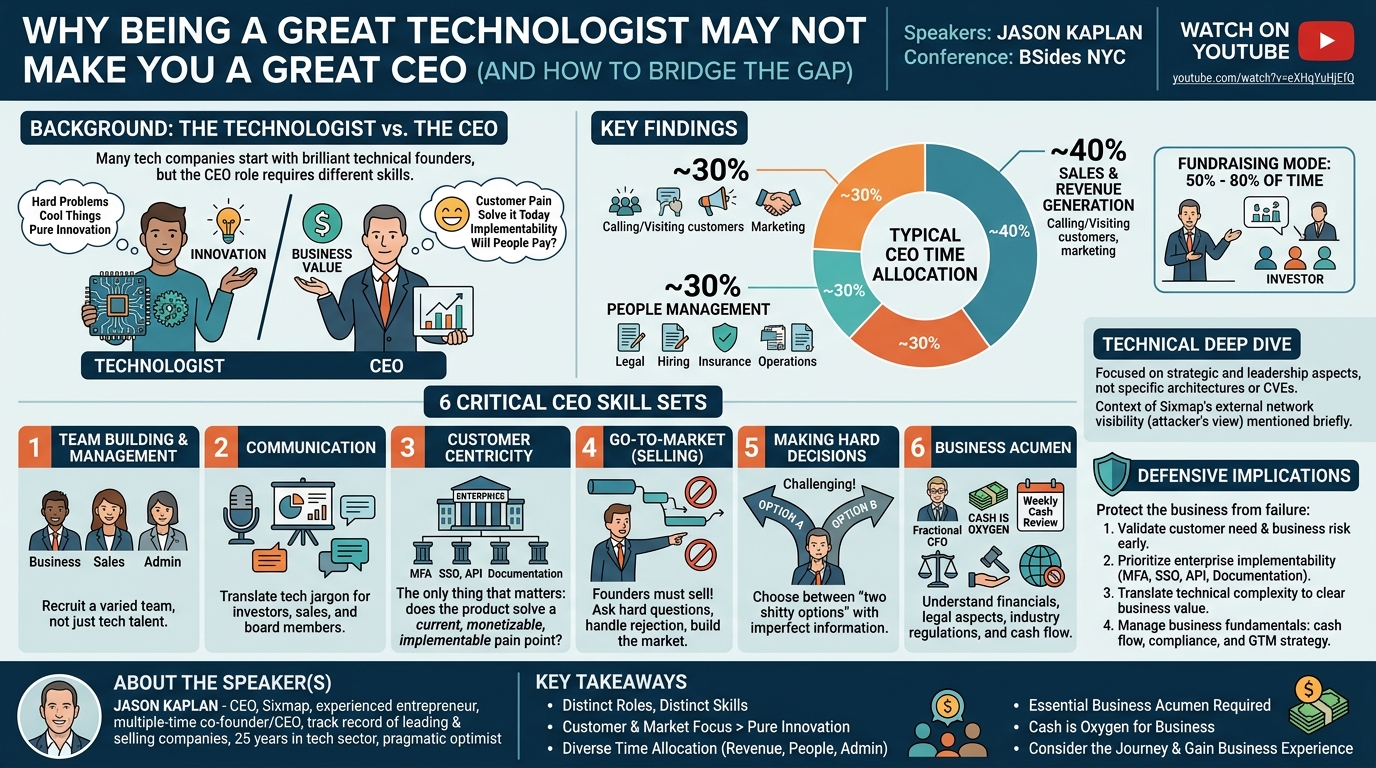
Secondly, a CEO's time allocation is strikingly diverse and often far removed from technical tasks. Kaplan estimates his own time breakdown as:
- ~40% on sales and revenue generation: This includes calling and visiting customers, traveling, marketing efforts, preparing presentations, and general selling activities.
- ~30% on people management: This encompasses the arduous processes of hiring and firing, policy setting, team communication, and resolving interpersonal complexities. Recruiting the right talent, especially convincing key leaders like a CFO or head of product to join, consumes substantial time.
- ~30% on administrative, legal, and financial tasks: This "boring stuff" includes ensuring legal documents are correct, managing insurance, setting up office spaces, and other foundational operational elements.
Crucially, Kaplan emphasizes that during fundraising periods, which are often unavoidable for early-stage companies, a CEO will spend 50% to 80% of their time pitching to investors, enduring numerous rejections, and refining their narrative. This relentless pursuit of capital is a non-negotiable aspect of the role, demanding strong communication and resilience.
Kaplan then outlines six critical skill sets necessary for an aspiring CEO:
- Team Building and Management: Beyond just technical recruitment, this involves assembling a diverse team with varied expertise, including business, sales, and administrative roles. He cites the example of Akamai's founders, brilliant MIT technologists, who recognized they weren't the right people to build the company and actively recruited experienced business leaders like Paul Sagan and George Conrades to be CEO, with one of the technical founders, Tom Leighton, only taking the helm over a decade later after significant operational experience. This highlights the importance of humility and strategic delegation.
- Communication: Technologists must learn to articulate their vision and product's value proposition to non-technical audiences, including investors, sales teams, customers, and board members, without relying on jargon. Board members, for instance, are primarily interested in the problem being solved, market size, and revenue potential, not the "bits and bytes" of the technology. The ability to simplify complex ideas for a layperson is indispensable.
- Customer Centricity: This is perhaps the most vital finding: the only thing that matters is whether the product solves a problem customers are willing to pay for today, and if it is implementable. Kaplan illustrates this with Sixmap's early challenges: despite powerful capabilities, the product initially lacked enterprise-essential features like MFA (Multi-Factor Authentication), SSO (Single Sign-On), a robust API (Application Programming Interface), and comprehensive documentation. Without these foundational elements, even a pain-solving solution becomes unsellable to large organizations that require seamless integration into their existing tech stacks.
- Go-to-Market (Selling): Selling is distinct from building. Kaplan firmly states that founders, especially in the early stages (often responsible for the first $1 million to $3 million in sales), must be prepared to sell. This involves actively asking hard questions, listening to "nos," handling rejection, and understanding the broader market fit. He dismisses the notion of merely "building relationships" as a substitute for selling, asserting that if a CEO doesn't sell, they shouldn't be the CEO.
- Making Hard Decisions: Leadership often involves choosing between "two shitty options," as a former Cisco CEO famously put it. When decisions escalate to the CEO, they are typically complex, high-stakes, and lack clear "good" choices. These decisions can impact employees' jobs, alter the company's strategic direction (e.g., shifting from "blue cars" to "yellow cars" based on market feedback), and must often be made with imperfect information. Technologists, accustomed to data-driven models, must adapt to this ambiguity and trust their judgment.
- Business Acumen: Ultimately, "it's all about the business." A CEO must understand financial statements, explain business models to investors, defend valuations, comprehend legal aspects like indemnification clauses in contracts, navigate industry regulations for compliance, and manage cash flow meticulously. Kaplan describes starting every week by reviewing cash on hand and spend with his fractional CFO, emphasizing that cash is oxygen to a business. The technology, while important, is a means to an end—a successful, sustainable business.
In summary, Kaplan's key findings highlight that while technologists bring invaluable innovation, the CEO role demands a comprehensive suite of business, leadership, and interpersonal skills, a radical shift in time allocation, and an unwavering focus on market demand and financial viability above all else.
Technical Deep Dive
▶ Watch: Core difference: Innovating vs. solving customer problems today (4:00)
This talk by Jason Kaplan, "Why Being A Great Technologist May Not Make You A Great CEO," focuses primarily on the strategic, operational, and leadership aspects of running a business, rather than delving into specific technical architectures, code, or protocols. The presentation's objective is to articulate the distinct skill sets required for executive leadership compared to technical innovation.
While the speaker's current company, Sixmap, operates in the cybersecurity domain, providing external visibility to enterprise networks to give an attacker's view of vulnerabilities and exploitable points, the talk itself does not offer a technical deep dive into Sixmap's technology or any other specific security solution. Kaplan briefly mentions Sixmap's capability and its differentiation in a crowded market but quickly pivots to his personal journey and the broader themes of business leadership. The technical specifics of how Sixmap achieves its "attacker's view" or identifies vulnerabilities are not discussed, nor are any particular tools, CVEs, or technical methodologies. The "technical" aspect of the talk is limited to acknowledging the foundational importance of a strong technical product, but only within the context of its market viability and implementability.
Demo / Proof of Concept
▶ Watch: Reality of CEO time: Revenue, people, and 'boring stuff' (6:00)
As a strategic and leadership-focused presentation, "Why Being A Great Technologist May Not Make You A Great CEO" did not include a live demonstration or proof of concept of any particular technology. The talk's objective was to impart wisdom on the transition from a technical role to a CEO position, rather than to showcase a product or a specific security exploit. The speaker, Jason Kaplan, used his company, Sixmap, as a contextual example for his experience in the cybersecurity industry, but did not present any features or capabilities of Sixmap's platform during the session.
Defensive Implications
While Jason Kaplan's talk isn't about defending against cyber threats in the traditional sense, its insights carry significant defensive implications for technologists, particularly those in the cybersecurity space, who aspire to found or lead companies. These "defenses" are aimed at protecting a business from failure, ensuring its viability, and securing its market position.
Firstly, for cybersecurity founders, understanding customer centricity is a critical defensive strategy. Many security products are built with technical elegance but fail to gain traction because they don't address a clear, monetizable pain point that customers are willing to pay for today. A strong defensive posture for a security startup involves rigorously validating customer need and market demand before deep investment in technical development. This means identifying not just a vulnerability, but a business risk that enterprises are actively seeking to mitigate and for which they have budget.
Secondly, the emphasis on implementability directly impacts a security product's defensibility. Kaplan highlighted Sixmap's initial challenge of lacking enterprise-grade features like MFA, SSO, a robust API, and comprehensive documentation. For any security solution targeting the enterprise market, these are not optional "nice-to-haves" but fundamental requirements. Without seamless integration capabilities and adherence to enterprise security standards, even the most innovative solution becomes a liability rather than an asset for a potential customer. Building these features in from the start, or prioritizing them early, defends against market rejection and ensures the product can actually be adopted and used by its target audience. This also implicitly means understanding the customer's existing security stack and operational workflows to ensure compatibility and ease of deployment.
Thirdly, effective communication is a defensive shield against misunderstanding and missed opportunities. Cybersecurity solutions, by their nature, are often technically complex. The ability to translate this complexity into clear, concise business value for non-technical stakeholders—CEOs, CFOs, board members, and even sales teams—is crucial. If a security founder cannot articulate why their solution matters in terms of risk reduction, cost savings, or compliance benefits, they risk losing investment, customer trust, and internal alignment. This defensive communication ensures that the value proposition of the security product is understood and appreciated across the organization, securing its internal and external support.
Finally, managing the business fundamentals—cash flow, legal compliance, and go-to-market strategy—is the ultimate defense against startup mortality. A technically superior security product will fail if the company runs out of cash, faces legal challenges due to non-compliance (e.g., with GDPR, HIPAA, or industry-specific regulations), or cannot effectively sell its solution. Cybersecurity leaders must "defend" their company's existence by meticulously managing financials, understanding the legal landscape, and building a robust sales engine. Kaplan's point about the founder being the first salesperson is particularly relevant; a security founder must be prepared to articulate and sell the value of their solution directly, defending its position in a crowded market and ensuring early revenue.
In essence, for a technologist in cybersecurity, the "defensive implications" of Kaplan's talk are about building a resilient, market-aware, and financially sound business around their technical innovation. It's about defending the business of security, not just the technology of security.
Key Takeaways
- Distinct Roles, Distinct Skills: Being a great technologist and a great CEO require fundamentally different skill sets, mindsets, and daily focuses. Technical brilliance in innovation does not automatically translate to effective business leadership.
- Customer and Market Focus Over Pure Innovation: CEOs prioritize solving problems that customers are willing to pay for today, ensuring the solution is implementable and fits into existing workflows, rather than solely pursuing the most innovative or technically challenging endeavors.
- Diverse Time Allocation: A CEO's time is dominated by non-technical activities, including sales and revenue generation (~40%), people management (~30%), and administrative/legal/financial tasks (~30%). During fundraising, 50-80% of time is spent pitching for capital.
- Essential Business Acumen: Critical skills for a CEO include adept team building, clear communication with diverse audiences, unwavering customer centricity, a strong go-to-market strategy that embraces selling, the ability to make hard decisions with incomplete information, and robust financial and legal literacy.
- Cash is Oxygen: Meticulous cash flow management, understanding financial statements, and navigating legal and regulatory landscapes are paramount for business survival, often overshadowing the technical aspects of the product.
- Consider the Journey: Aspiring technologist-CEOs should seriously consider gaining broader business experience or working with experienced business leaders before taking the CEO helm, potentially circling back to the role later in their careers.
About the Speaker(s)
Jason Kaplan is a highly experienced and successful entrepreneur and executive in the technology sector, currently serving as the CEO of Sixmap, a cybersecurity company focused on providing external visibility into enterprise networks to identify vulnerabilities from an attacker's perspective. His career journey began in sales as an inside sales representative, giving him a foundational understanding of market dynamics and customer needs.
Over the past 25 years, Kaplan has accumulated extensive experience, holding roles as a co-founder and CEO multiple times. He has a track record of successfully leading companies, including taking over from technology founders as CEO, and has successfully sold a business. Notably, Kaplan was the first sales leader at Akamai in 1999, where he was responsible for hiring the initial ten sales professionals, contributing to the early growth of a company founded by brilliant MIT technologists. This experience provided him with firsthand insight into how highly technical founders can strategically bring in business leadership to scale a venture. He describes himself as a "pragmatic optimist," indicating a grounded yet hopeful approach to business challenges, and emphasizes transparency in his leadership style. This is his second CEO role within a cybersecurity company, highlighting his deep commitment to the industry.
Reviews
Dr. Zero (Offensive Security Researcher) — WEAK
A competent LinkedIn article dressed up as a conference talk, delivered by someone with real startup experience who nonetheless packages 'CEOs do sales and technologists don't' into 45 minutes of sports analogies and numbered lists. Nothing here would surprise anyone who's read a single HBR piece on founder-to-CEO transitions, and none of it belongs at a security conference in a technical slot.
Heather Calloway (CISO) — WEAK
Kaplan delivers competent career advice for technologist-founders, but this is a business school talk dressed in BSides clothing. It offers no governance angle, no defender value, and no institutional analysis — just entrepreneurship 101 with a cybersecurity accent.