Student Engagement Doesn't Have to Suck
Dr Muhsinah Morris
DEF CON 32 Creator Stage · Day 1 · Creator Stage
Overview
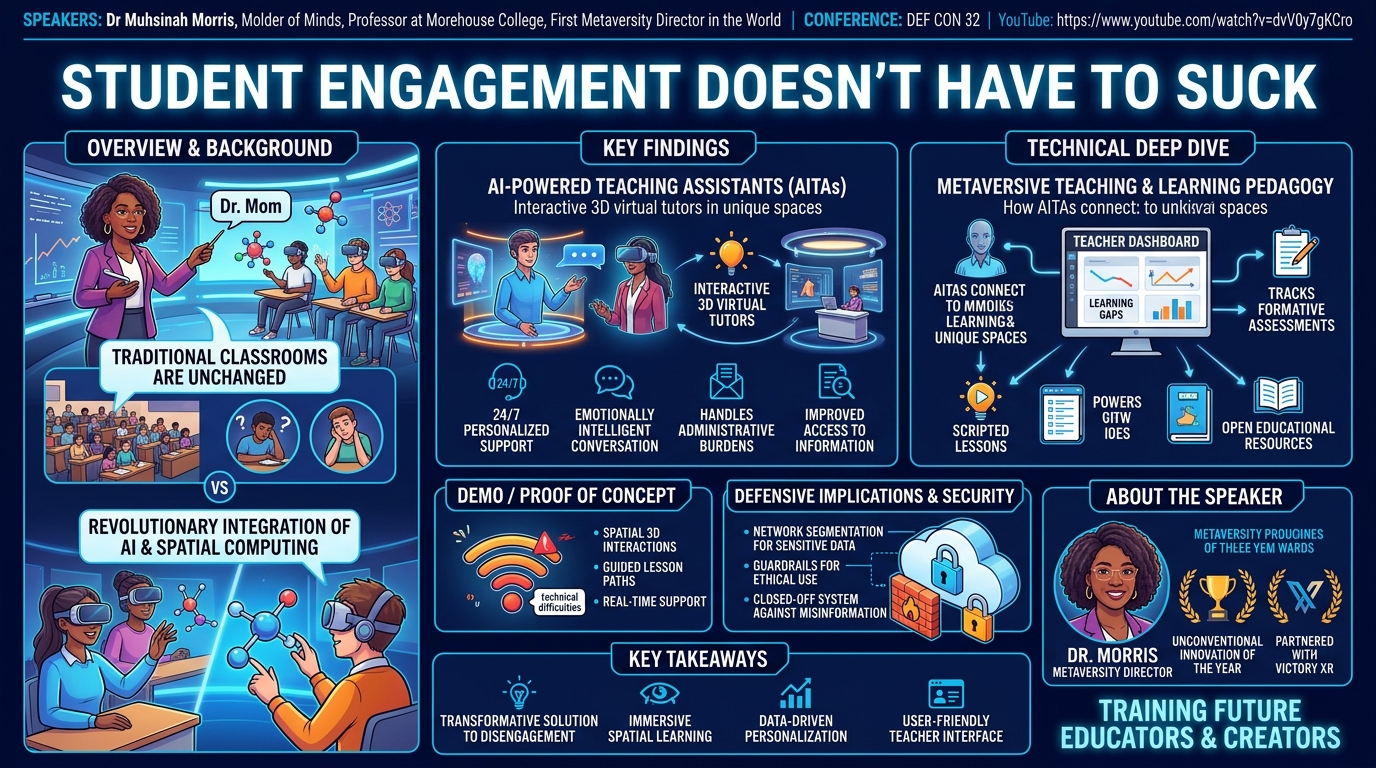
In an era where educational methodologies often struggle to keep pace with rapid technological advancements, Dr. Muhsinah Morris, affectionately known as "Dr. Mom" by her students at Morehouse College, presented a compelling vision for the future of learning at DEF CON 32. Her talk, "Student Engagement Doesn't Have to Suck," tackled the pervasive issue of student disengagement in traditional academic settings, proposing a revolutionary integration of artificial intelligence and spatial computing. Dr. Morris unveiled her pioneering work in developing AI-powered teaching assistants (AITAs) within metaversive teaching and learning environments, a pedagogical approach she coined and implemented at Morehouse College's Metaversity.
Key moments
- 0:00 Introduction: Making chemistry accessible for all
- 2:00 Why AI Teaching Assistants are essential for educators
- 3:30 Defining 'Metaversive Teaching and Learning' pedagogy
- 4:15 Addressing common educator concerns about AI in classrooms
- 6:15 Developing an emotionally intelligent conversational AI TA model
- 7:00 AI as the new 24/7 Homework Helpline
- 8:00 AI TA's backend for tracking learning losses and support
Student Engagement Doesn't Have to Suck
Speakers: Dr Muhsinah Morris, Molder of Minds, Professor at Morehouse College, First Metaversity Director in the World
Conference: DEF CON 32
YouTube: https://www.youtube.com/watch?v=dvV0y7gKCro
Overview
In an era where educational methodologies often struggle to keep pace with rapid technological advancements, Dr. Muhsinah Morris, affectionately known as "Dr. Mom" by her students at Morehouse College, presented a compelling vision for the future of learning at DEF CON 32. Her talk, "Student Engagement Doesn't Have to Suck," tackled the pervasive issue of student disengagement in traditional academic settings, proposing a revolutionary integration of artificial intelligence and spatial computing. Dr. Morris unveiled her pioneering work in developing AI-powered teaching assistants (AITAs) within metaversive teaching and learning environments, a pedagogical approach she coined and implemented at Morehouse College's Metaversity.
The core of Dr. Morris's presentation centered on how these innovative technologies can transform the educational landscape, making learning more accessible, personalized, and interactive. Far from seeking to replace human educators, her initiative aims to augment their capabilities, alleviate administrative burdens, and provide students with 24/7 access to tailored support. This talk is particularly significant for its interdisciplinary appeal, bridging the worlds of education, technology, and even cybersecurity by addressing the implications of deploying advanced AI systems in sensitive academic environments. It challenges conventional thinking about classroom design and instructional delivery, advocating for an evolution that embraces the "connected student" and prepares them for the demands of the Fourth Industrial Revolution.
Background
▶ Watch: Introduction: Making chemistry accessible for all (0:00)
The landscape of modern education, as Dr. Morris starkly highlighted, remains largely unchanged from past decades, failing to evolve with the students it serves. Classrooms, she noted, "still look like whatever it looked like when you were in school." This stagnation creates a significant disconnect, particularly for the generation of "connected students" who were "born into this technology" of constant scrolling and instant information access. While adept at using digital tools, many lack a foundational understanding of their ethical implications or historical evolution, often leading to misuse or a superficial engagement with information.
Dr. Morris, a biomolecular chemistry PhD, shared her personal struggle as a student where she often had to "go teach myself" due to inaccessible teaching methods. This experience fueled her passion to become a professor dedicated to making complex subjects like chemistry more understandable and engaging. The challenges faced by educators today are immense: large class sizes, often hundreds of students in a single lecture hall, with minimal or no teaching assistants. This leaves professors with insufficient time to address individual student questions, identify learning gaps, or provide personalized support, leading to widespread student disengagement and academic struggles.
Historically, AI in education was limited to basic chatbots, offering rudimentary assistance without true personalization or spatial interaction. However, with the advent of advanced 3D and spatial computing technologies, coupled with more sophisticated AI, the potential for educational transformation has dramatically increased. Despite this potential, significant resistance persists within the educational community. Concerns range from the fear of AI replacing human teachers and the perceived lack of personalization to anxieties about increased opportunities for student cheating. Dr. Morris directly confronted these fears, positing that human intelligence is the creator of artificial intelligence, and that these tools, when properly designed and integrated, are meant to enhance, not erase, human educators. Her work at Morehouse College's Metaversity, where she coined the term metaversive teaching and learning, represents a direct response to these challenges, seeking to establish a rigorous pedagogical approach for leveraging virtual reality and AI-powered assistance effectively.
Key Findings
▶ Watch: Defining 'Metaversive Teaching and Learning' pedagogy (3:30)
Dr. Morris's work and presentation underscore several key findings regarding the transformative potential of AI in education. Foremost is the premise that student engagement doesn't have to suck when leveraging modern technological paradigms. She posits that by moving beyond traditional, static classroom models, educators can tap into the inherent digital fluency of today's students.
The primary contribution is the development and implementation of spatial 3D AI-powered teaching assistants (AITAs) within virtual environments, a concept she pioneered as the first Metaversity director globally. These AITAs are designed to be more than just chatbots; they are immersive, interactive entities capable of operating within unique 3D learning spaces. This spatial dimension is crucial for enhancing engagement, particularly in subjects like chemistry where visualizing complex molecular structures is paramount.
A significant finding is the ability of these advanced AITAs to enhance efficiency and reduce administrative burden for educators. By providing 24/7 access to information and support, AITAs free up professors from repetitive tasks, allowing them to focus on deeper pedagogical engagement and mentorship. This addresses the long-standing issue of professors being overwhelmed by hundreds of student questions with limited support staff.
Furthermore, the system is designed to personalize learning and student support. Unlike generic tutoring, the AITA backend incorporates formative assessments and tracks student transcripts, allowing teachers to identify precise "learning losses" and "gaps in understanding." This data-driven approach enables the AITA to guide students through scripted lessons and curated open educational resources that Dr. Morris has cultivated over years, ensuring a tailored learning path.
Finally, Dr. Morris emphasizes that this approach facilitates improved access to information and enhanced classroom interaction. By creating a Metaversity at Morehouse College, she demonstrated a viable pedagogical approach to making virtual reality the classroom, effectively preparing students for the demands of the Fourth Industrial Revolution and the evolving future of work. The platform, developed with educational partners like Victory XR, is built with a user-friendly teacher dashboard that mirrors social media interfaces, ensuring accessibility for educators without requiring them to "code" or "pick up another craft."
Technical Deep Dive
▶ Watch: Addressing common educator concerns about AI in classrooms (4:15)
The core of Dr. Morris's innovation lies in the architectural and functional design of her AI-powered teaching assistants (AITAs). These are not merely text-based chatbots but represent a significant leap forward, leveraging 3D and spatial computing to create immersive, interactive learning experiences. The AITAs are situated within "unique environments," implying virtual reality or augmented reality platforms where students can interact with educational content and the AI itself in a more natural and engaging manner. This spatial dimension is critical for subjects that benefit from visualization, such as chemistry, where students can "see molecules like me," as Dr. Morris envisioned.
The AITA system is characterized by its emotionally intelligent conversational model. While the specific algorithms or natural language processing (NLP) frameworks were not detailed, the emphasis on "emotionally intelligent" suggests a sophisticated AI capable of understanding context, tone, and potentially even student frustration, adapting its responses to foster a more empathetic and effective learning dialogue. This moves beyond simple question-and-answer interactions to a more nuanced tutoring experience.
Crucially, the backend of the AITA interface provides robust tools for educators. It integrates formative assessments, allowing the system to continuously evaluate student comprehension and identify specific areas of "learning loss" or "gaps in understanding." This data is not just for the AI; teachers gain access to the transcript of all student interactions with the AITA. This transparency and data collection are vital for professors to monitor student progress, understand common misconceptions, and tailor their in-person teaching more effectively.
The learning content delivered by the AITA is highly structured and curated. Students are guided through "scripted lessons" created by Dr. Morris, ensuring pedagogical alignment and accuracy. Furthermore, the system directs students to "open educational resources" that Dr. Morris has "put together and cultivated over years of my craft." This implies a carefully vetted and accessible library of materials, ensuring that the AI provides high-quality, reliable information rather than pulling from an undifferentiated internet. The system is described as "closed off," meaning it prioritizes these pre-approved resources and lessons before potentially accessing broader information, ensuring a controlled and educationally sound learning environment.
The user interface for educators, referred to as the teacher dashboard, is designed for simplicity and accessibility. Dr. Morris explicitly stated it is "as user friendly as any social media platform," addressing the common apprehension among teachers about adopting complex new technologies. This design philosophy aims to lower the barrier to entry, allowing educators to manage student interactions, review analytics, and integrate the AITA into their curriculum without requiring specialized coding skills or extensive technical training. This emphasis on ease of use is fundamental to widespread adoption and success of such educational technology.
Demo / Proof of Concept
▶ Watch: AI as the new 24/7 Homework Helpline (7:00)
Dr. Morris intended to provide a live demonstration of her emotionally intelligent conversational AITA model during the talk, expressing her eagerness for the audience to "see it in order to understand it." Unfortunately, due to an unexpected loss of Wi-Fi connectivity mid-presentation—attributed humorously to a colleague walking away with the shared connection—the live demo could not proceed as planned.
Despite the technical setback, Dr. Morris's description provided a clear picture of what the demonstration would have showcased. The AITA is designed to be a spatial 3D entity, implying an immersive experience where students would interact with a virtual character in a simulated environment. The "emotionally intelligent conversational" aspect suggests a natural language interface where students could ask questions, receive explanations, and engage in dialogue with the AI, much like they would with a human tutor. The demo would have illustrated how this AITA could guide students through scripted lessons and leverage open educational resources, offering personalized support and identifying learning gaps in real-time. While the audience didn't get to witness the live interaction, the conceptual framework and the detailed explanation of the AITA's capabilities served as a comprehensive proof of concept for its design and intended functionality.
Defensive Implications
▶ Watch: AI TA's backend for tracking learning losses and support (8:00)
While Dr. Morris's talk primarily focuses on educational innovation, the deployment of advanced AI systems in academic environments inherently carries significant defensive implications, particularly concerning data security, privacy, and academic integrity. The very nature of AI-powered teaching assistants (AITAs), which collect student interaction data and conduct formative assessments, necessitates robust security measures.
One critical aspect highlighted by Dr. Morris is the need for appropriate network infrastructure and IT support. She acknowledged the challenges, revealing that she often serves as her own IT support, relying on her network design engineer husband as a "cheat code." Crucially, she noted that institutions, especially "medical schools, graduate schools that have information that they keep in databases," require "a separate network for connecting for this." This points directly to the principle of network segmentation, isolating sensitive educational AI traffic and student data from broader institutional networks to prevent unauthorized access or data breaches. The mention of "firewalls" further reinforces the need for perimeter security to control ingress and egress of data.
The system's design, which is "closed off to go into my lessons first and all of the resources that I put up there," serves as a defensive mechanism against misinformation and uncontrolled information access. By directing students to curated, vetted open educational resources and scripted lessons, the system mitigates the risk of students encountering inaccurate or inappropriate information from the vast, unregulated internet. This controlled environment also implicitly addresses concerns about academic integrity, as the AI is designed to guide learning through approved content, rather than facilitating unmonitored information retrieval that could be used for cheating. However, the transcript data collected by the AITA also provides a valuable audit trail for educators to monitor student engagement and identify potential patterns of misuse, if necessary.
Furthermore, Dr. Morris's acknowledgment of the "connected student" generation who "don't ethically know how to use it" (referring to technology) underscores the need for built-in guardrails within the AI system itself. While not explicitly detailed, these guardrails would ideally prevent misuse, promote ethical technology habits, and ensure that the AI is used as a learning aid rather than a shortcut for bypassing learning. The partnership with T-Mobile for hotspots also highlights an understanding of the need for secure, reliable connectivity, which is foundational to the secure operation of any cloud-based educational technology. Ultimately, the successful and secure implementation of metaversive teaching and learning requires a proactive and robust cybersecurity posture from educational institutions to protect student data, maintain academic integrity, and ensure the reliability of the learning environment.
Key Takeaways
- AI-powered teaching assistants (AITAs) offer a transformative solution to student disengagement and the administrative burden on educators, providing personalized, 24/7 learning support.
- Metaversive teaching and learning, a pedagogical approach pioneered by Dr. Morris, leverages spatial 3D AI and virtual reality environments to create immersive and highly interactive educational experiences.
- The AITA system incorporates formative assessments and tracks student transcripts on the backend, enabling educators to precisely identify learning gaps and tailor support, moving beyond generic tutoring.
- The teacher dashboard is designed for extreme user-friendliness, akin to social media platforms, to ensure accessibility and adoption by educators without requiring coding or advanced technical skills.
- Robust network security measures, including separate networks and firewalls, are essential for deploying these EdTech solutions, particularly to protect sensitive student data and maintain academic integrity within institutions.
- The "closed off" nature of the AITA system, directing students to curated scripted lessons and open educational resources, acts as a safeguard against misinformation and promotes a controlled, pedagogically sound learning environment.
About the Speaker(s)
Dr. Muhsinah Morris is a visionary educator, widely known as "Dr. Mom" and "Molder of Minds" by her students at Morehouse College in Atlanta, Georgia. With a PhD in biomolecular chemistry, Dr. Morris became a professor with a mission to make chemistry more accessible and engaging for a broader audience, driven by her own experiences of needing to self-teach complex subjects. She is the pioneering founder and first Metaversity Director in the world, where she coined and implemented the pedagogical approach of metaversive teaching and learning. Her work focuses on developing and deploying spatial 3D AI-powered teaching assistants (AITAs) to revolutionize student engagement and support. Dr. Morris works in conjunction with multiple partners in tech and EdTech, including Victory XR, and has been recognized for her innovative contributions, winning T-Mobile's unconventional innovation of the year award. She is dedicated to training a thousand educators and a thousand student creators to leverage these advanced educational technologies.