Reflections on a Decade in Bug Bounties
Nikhil Shrivastava, Charlie Waterhouse
DEF CON 32 Creator Stage · Day 1 · Creator Stage
Overview
This DEF CON 32 talk, "Reflections on a Decade in Bug Bounties," offers a unique dual perspective on the evolving world of vulnerability research and disclosure. Presented by Nikhil Shrivastava, a distinguished bug bounty hunter and Synack Red Team Legend, and Charlie Waterhouse, a veteran triager from Synack's vulnerability operations team, the session delves into the intricate dynamics, challenges, and rewards of a career in bug bounties. The speakers aim to illuminate the path to success for aspiring and current bounty hunters, providing insights from both the offensive (researcher) and defensive (triage) sides of the ecosystem.
Key moments
- 0:00 Introduction: 10 years in bug bounties, triager vs. researcher.
- 0:40 Nick's credentials as a top hacker and full-time bounty hunter.
- 1:40 Charlie's journey from customer service to triaging 40,000 reports.
- 3:20 Bug bounties in 2013: Only Google and PayPal.
- 40:00 Core advice: Don't give up; embrace new opportunities.
Reflections on a Decade in Bug Bounties
Speakers: Nikhil Shrivastava; Charlie Waterhouse
Conference: DEF CON 32
YouTube: https://www.youtube.com/watch?v=h86p7pcZmL8
Overview
This DEF CON 32 talk, "Reflections on a Decade in Bug Bounties," offers a unique dual perspective on the evolving world of vulnerability research and disclosure. Presented by Nikhil Shrivastava, a distinguished bug bounty hunter and Synack Red Team Legend, and Charlie Waterhouse, a veteran triager from Synack's vulnerability operations team, the session delves into the intricate dynamics, challenges, and rewards of a career in bug bounties. The speakers aim to illuminate the path to success for aspiring and current bounty hunters, providing insights from both the offensive (researcher) and defensive (triage) sides of the ecosystem.
The talk is particularly relevant for anyone involved in application security, penetration testing, or vulnerability management, as it dissects the common frustrations encountered during the triage process and offers strategies for effective communication and reporting. By sharing their collective decade-plus of experience, Shrivastava and Waterhouse provide a comprehensive look at what it takes to thrive in this demanding field, emphasizing the journey, the importance of persistence, and the potential for bug bounty hunting to become a sustainable, full-time career.
The session underscores the critical importance of understanding the perspectives of both the submitter and the recipient of vulnerability reports. For researchers, it offers guidance on optimizing their submissions for better outcomes, while for organizations, it provides a glimpse into the mindset of top-tier hackers and the operational realities of managing a large-scale bug bounty program. This dialogue between the "enemy" (researcher) and the "bad guy" (triager), as Charlie humorously puts it, is designed to foster a more collaborative and efficient vulnerability disclosure environment for the benefit of the entire security community.
Background
▶ Watch: Introduction: 10 years in bug bounties, triager vs. researcher. (0:00)
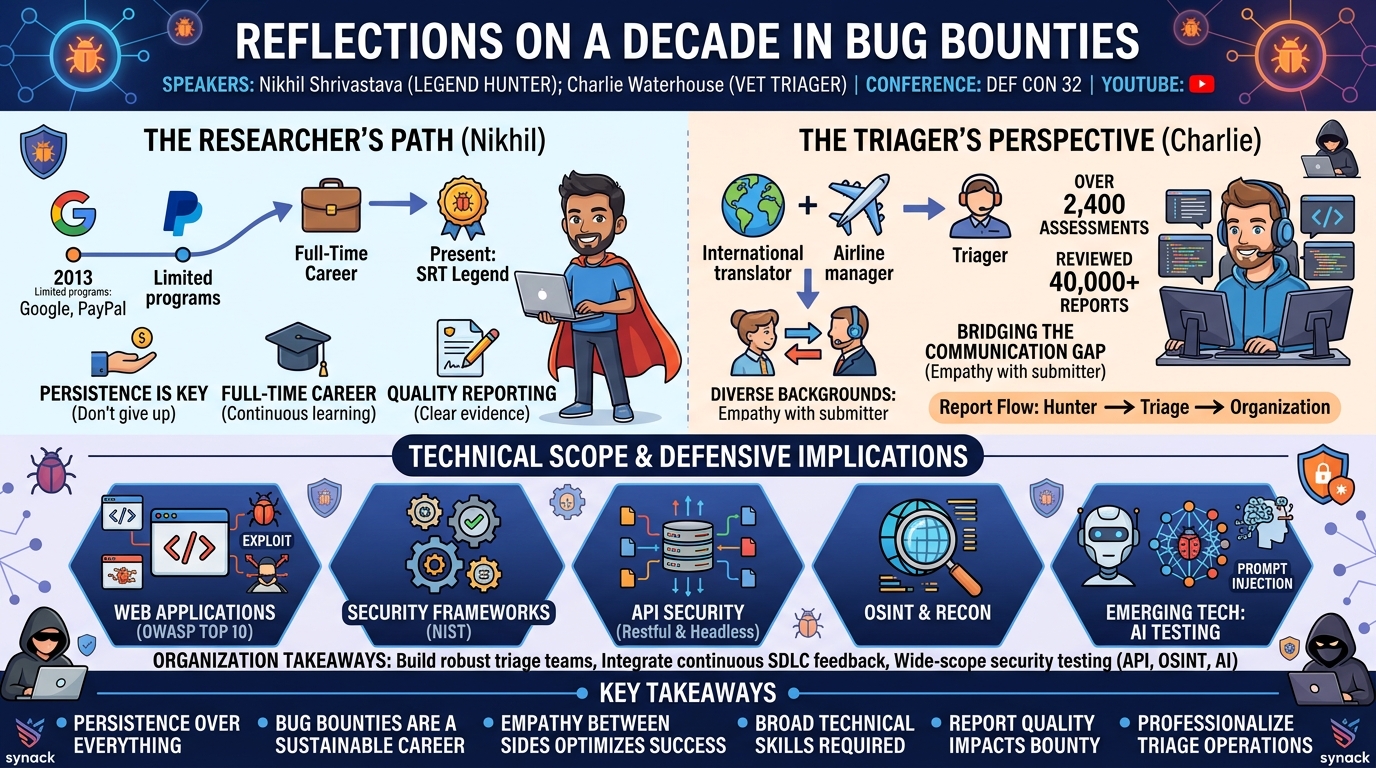
The landscape of bug bounties has undergone a significant transformation over the past decade, evolving from a nascent concept to a cornerstone of modern cybersecurity. As Nikhil Shrivastava recounts, when he began his journey in 2013, the concept of bug bounties was far less pervasive and visible than it is today. At that time, only a handful of tech giants like Google and PayPal were actively running public bug bounty programs, making it challenging for individuals outside a select circle to even discover or participate in such initiatives. This limited exposure meant that the idea of bug bounty hunting as a viable career path was largely unheard of, requiring pioneering individuals like Shrivastava to forge their own way through an uncharted territory.
Charlie Waterhouse's entry into the security field also highlights the diverse backgrounds from which security professionals emerge. With over two decades of experience in customer service, including roles as an international translator and airline manager, Charlie's path was anything but traditional. His lifelong passion for technology, evident from his early days building Napster servers and earning an MCSE "from amusement," eventually led him back to dedicated study and a pivotal opportunity to join Synack's vulnerability operations team as a triager. This unconventional journey underscores a common theme in cybersecurity: talent often comes from unexpected places, driven by curiosity and a deep-seated interest in technology.
The convergence of these two distinct journeys – Nikhil's as a self-taught, persistent hacker navigating the early days of bug bounties, and Charlie's as an experienced professional transitioning into the critical role of vulnerability triage – forms the essential backdrop of their discussion. Their combined experience offers a panoramic view of the bug bounty ecosystem, highlighting the initial struggles of establishing a career in a nascent field, the continuous learning required, and the often-frustrating interface between vulnerability researchers and the organizations receiving their reports. This historical context sets the stage for understanding the evolution of best practices and the enduring challenges that persist in the bug bounty space.
Key Findings
▶ Watch: Nick's credentials as a top hacker and full-time bounty hunter. (0:40)
The core findings presented in this talk revolve around the essential elements for sustained success in bug bounty hunting and the critical need for empathy and understanding between researchers and triagers. One of the most prominent insights from Nikhil Shrivastava's decade of experience is the unwavering importance of persistence. He succinctly summarizes this with the adage, "don't give up anytime and when one opportunity closes the another opens up." This philosophy is not just about technical skill but about the mental fortitude required to navigate frequent rejections, false positives, and the often-lengthy disclosure process. For Shrivastava, bug bounty hunting is more than a hobby; it's a full-time career, demanding continuous effort, learning, and adaptability, akin to a "daytime job as well and night time too." His journey from a time when bug bounties were obscure to becoming a Synack Red Team Legend exemplifies this dedication.
From Charlie Waterhouse's perspective as a triager, a key finding is the sheer volume and diversity of vulnerability reports that pass through a platform like Synack. Having overseen over 2,400 different assessments and reviewed approximately 40,000 individual reports, Charlie possesses an unparalleled understanding of common vulnerability patterns, effective reporting methodologies, and the nuances that differentiate a high-quality submission from a less impactful one. His experience underscores that while technical prowess is crucial, the quality of communication and evidence in a report significantly impacts its triage and eventual bounty. The frustration often felt by researchers regarding triage is a direct outcome of this high-volume environment, where clarity and precision are paramount.
Collectively, the speakers highlight that success in bug bounties is not solely about discovering novel exploits but also about mastering the art of reporting, understanding program scopes, and continuously refining one's methodology. The dual perspective reveals that while researchers strive for impact and bounty, triagers are tasked with validating, contextualizing, and communicating these findings to development teams, often under pressure. Therefore, a crucial finding is that bridging the communication gap and fostering mutual understanding between these two roles is fundamental to enhancing the overall efficiency and satisfaction within the bug bounty community. This symbiotic relationship, when optimized, leads to better security outcomes for organizations and more rewarding experiences for researchers.
Technical Deep Dive
▶ Watch: Charlie's journey from customer service to triaging 40,000 reports. (1:40)
While the talk emphasizes the journey, mindset, and operational aspects of bug bounties rather than specific zero-day exploits or novel attack techniques, Charlie Waterhouse's insights into his role as a triager provide a high-level overview of the broad technical domains covered in vulnerability assessments. His experience heading developments on products related to various security standards and technologies offers a glimpse into the diverse technical expertise required in modern bug bounty programs.
Charlie explicitly mentions his involvement with products built around OWASP (Open Web Application Security Project) guidelines, Nist (National Institute of Standards and Technology) frameworks, Oint (Open-Source Intelligence), API (Application Programming Interface) testing, headless API interactions, and "most recently some AI testing." Although the talk does not delve into the specifics of how these are exploited or what particular vulnerabilities were found, the mere mention of these areas signifies the comprehensive technical scope that bug bounty hunters and triagers must contend with.
- OWASP and Nist: These foundational frameworks suggest a strong emphasis on common web application vulnerabilities (e.g., SQL Injection, Cross-Site Scripting, Broken Authentication) and adherence to established security best practices. Triagers like Charlie must evaluate reports against these widely accepted standards to determine severity and impact.
- API and Headless API Testing: The inclusion of API and headless API testing highlights the shift towards modern application architectures. This implies a focus on vulnerabilities specific to API endpoints, such as improper authorization, rate limiting bypasses, data exposure, and insecure direct object references (IDORs). Researchers targeting these areas need proficiency in understanding API documentation, crafting specific requests, and manipulating parameters to uncover flaws that might not be apparent through traditional web interface testing.
- Oint (Open-Source Intelligence): The mention of Oint suggests that reconnaissance and information gathering techniques play a crucial role. This could involve identifying exposed credentials, misconfigured public resources, leaked sensitive information, or discovering subdomains that expand the attack surface. Effective Oint can often lead to initial access or provide context for more complex attacks.
- AI Testing: The "most recently some AI testing" is perhaps the most forward-looking aspect mentioned. While details are scarce, this points to the emerging field of securing artificial intelligence and machine learning systems. Potential vulnerabilities in this domain could include adversarial attacks on models, data poisoning, prompt injection in large language models (LLMs), model inversion attacks, or privacy issues related to training data. This indicates that the bug bounty landscape is continuously expanding to incorporate cutting-edge technologies, requiring researchers to adapt and acquire new specialized skills.
In summary, while the talk avoids granular technical details of exploits, Charlie's enumeration of these technical domains underscores the broad and ever-expanding skill set demanded of both successful bug bounty hunters and the triagers who evaluate their findings. It emphasizes that a truly effective bug bounty program must encompass a wide array of testing methodologies and an understanding of diverse technology stacks and security paradigms.
Demo / Proof of Concept
▶ Watch: Bug bounties in 2013: Only Google and PayPal. (3:20)
This particular talk, "Reflections on a Decade in Bug Bounties," focuses primarily on the overarching experiences, career paths, and philosophical insights gained over years in the bug bounty ecosystem. As such, it did not include any live demonstrations of specific exploits or technical proof-of-concept code. The speakers chose to dedicate their time to a high-level discussion of strategy, communication, and the evolution of the field from both a researcher's and a triager's perspective.
Defensive Implications
▶ Watch: Core advice: Don't give up; embrace new opportunities. (40:00)
The insights shared by Nikhil Shrivastava and Charlie Waterhouse carry significant defensive implications for organizations running bug bounty programs or seeking to improve their overall security posture. The dual perspective offers a unique lens through which to evaluate current practices and identify areas for enhancement.
Firstly, Charlie Waterhouse's experience of triaging approximately 40,000 individual reports across 2,400 different assessments highlights the immense volume and diversity of vulnerabilities that organizations face. For defenders, this underscores the necessity of having a robust and well-defined vulnerability operations team capable of efficiently processing, validating, and prioritizing a constant stream of reports. The quality of a triager, as exemplified by Charlie's background and expertise across OWASP, Nist, API, and AI testing, directly impacts the effectiveness of the program. Organizations should invest in training their triage teams not only in technical validation but also in clear communication, as frustration with triage is a common pain point for researchers. A well-structured triage process, clear guidelines, and prompt feedback can significantly improve researcher engagement and the overall quality of submissions.
Secondly, Nikhil Shrivastava's perspective as a top-tier bug bounty hunter, and his emphasis on persistence and making it a full-time career, reveals the mindset of highly motivated attackers. Defenders should recognize that dedicated researchers are continuously honing their skills, exploring new attack vectors, and are often more persistent than internal teams. This necessitates that organizations view bug bounty programs not merely as compliance checkboxes but as an integral, ongoing component of their security development lifecycle (SDLC). Embracing this continuous feedback loop means being prepared for sophisticated attacks and leveraging the collective intelligence of the hacking community. Organizations should also strive to make their bug bounty programs attractive to top talent by offering competitive bounties, clear scope definitions, and transparent communication, thereby incentivizing researchers to focus their efforts on their assets.
Furthermore, Charlie's mention of developing products around OWASP, Nist, Oint, API, headless API, and AI testing provides a roadmap for organizations on where to focus their defensive efforts. This indicates that modern attack surfaces are complex and multifaceted, extending beyond traditional web applications to include intricate API infrastructures, open-source intelligence exposure, and emerging AI/ML systems. Defenders must ensure their security testing strategies are equally comprehensive, covering these diverse domains. This includes:
- API Security: Implementing strong authentication, authorization, rate limiting, and input validation for all APIs, especially headless ones.
- OSINT Monitoring: Actively monitoring public sources for leaked credentials, sensitive information, or misconfigurations related to their assets.
- AI/ML Security: Beginning to understand and implement defenses against adversarial machine learning attacks, data poisoning, and privacy breaches in AI systems.
In essence, the talk serves as a call to action for organizations to professionalize their vulnerability management processes, embrace the expertise of external researchers, and broaden their defensive scope to match the evolving threat landscape identified by expert hackers and triagers.
Key Takeaways
- Persistence is Paramount: Successful bug bounty hunting requires unwavering dedication and the ability to learn from failures and rejections, viewing each closed opportunity as a precursor to a new one.
- Bug Bounty as a Full-Time Career: With strategic effort and continuous learning, bug bounty hunting can be a viable and rewarding full-time profession, demanding consistent work ethic and skill development.
- Understand Both Sides: Optimal bug bounty experiences stem from researchers understanding the triage process and organizations appreciating the hunter's perspective, fostering better communication and report quality.
- Comprehensive Technical Scope: Modern bug bounty programs demand expertise across a wide array of technical domains, including OWASP top 10, Nist guidelines, OSINT, diverse API architectures (including headless), and emerging areas like AI security.
- Quality Reporting is Crucial: For researchers, clear, concise, and well-evidenced vulnerability reports significantly increase the likelihood of acceptance and higher bounties, easing the triager's validation process.
- Invest in Triage Operations: Organizations must professionalize their vulnerability operations teams, providing them with the necessary tools, training, and clear processes to efficiently handle the high volume and complexity of incoming bug bounty reports.
About the Speaker(s)
Nikhil Shrivastava is a highly accomplished bug bounty hunter with a decade of experience in the field. Recognized as a Synack Red Team Legend, he is among the top hackers on the Synack platform. Beyond his prolific bug-hunting career, Nikhil is also the founder of B-sides Ahmedabad, which he describes as the biggest security conference in India. He also serves as an advisor to an ASM (Attack Surface Management) product, demonstrating his commitment to broader cybersecurity initiatives. Nikhil started his bug bounty journey in 2013, at a time when awareness and opportunities in the sector were significantly limited, with only Google and PayPal running visible programs. His career exemplifies how dedication and continuous learning can transform bug bounty hunting into a successful full-time profession.
Charlie Waterhouse brings a unique and diverse background to the cybersecurity domain, particularly in his role as a triager within Synack's vulnerability operations team. Prior to his work in security, Charlie spent over two decades in customer service, including extensive experience as an international translator and manager for an airline. His passion for technology dates back to his early days, where he built Napster servers and earned an MCSE "from amusement." Transitioning into security, Charlie has played a pivotal role in Synack, having contributed to over 2,400 different assessments and reviewed an estimated 40,000 individual vulnerability reports. He has also spearheaded developments on products centered around key security standards and technologies, including OWASP, Nist, Oint, API, headless API, and most recently, AI testing, showcasing his broad technical expertise and commitment to advancing security testing methodologies.