Top War Stories from a TryHard Bug Bounty Hunter
Justin Rhynorater Gardner
DEF CON 32 Creator Stage · Day 1 · Creator Stage
Overview
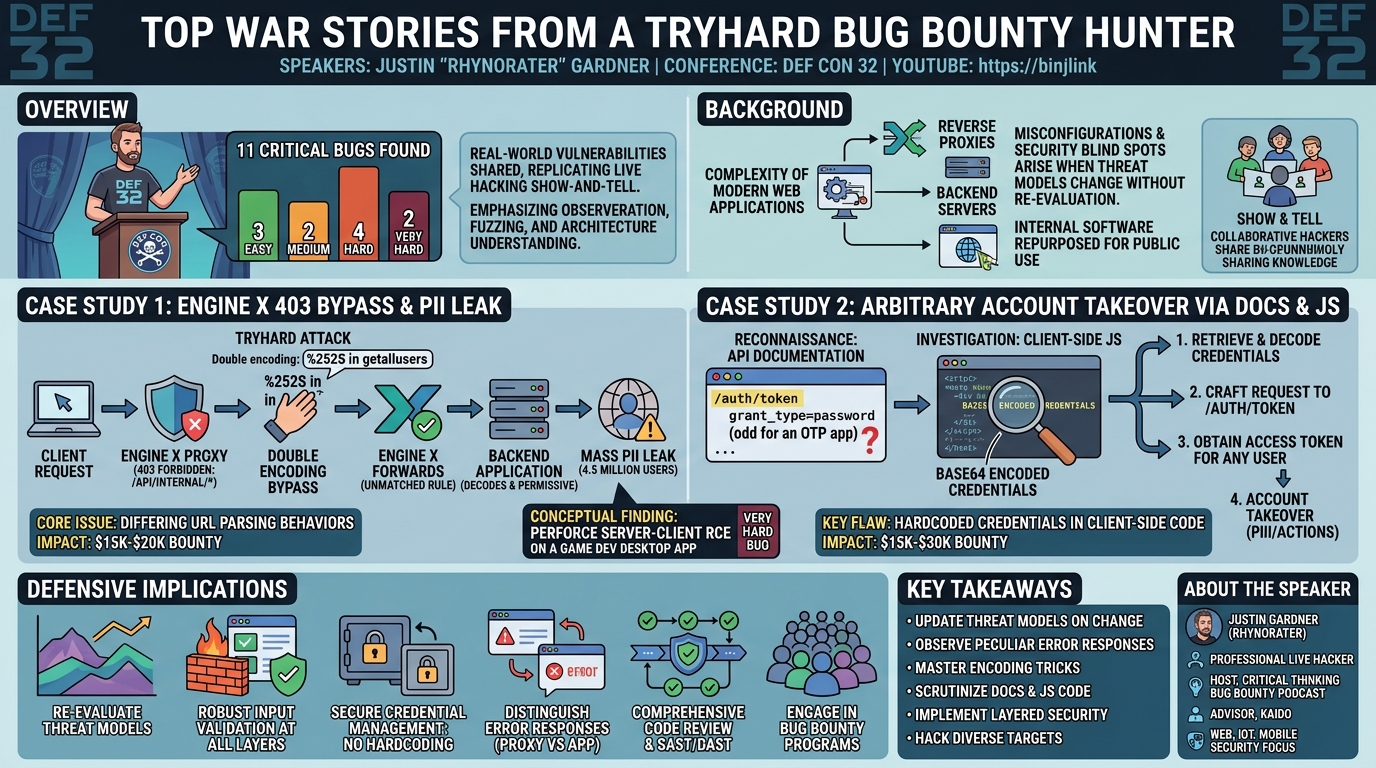
Justin Gardner, known in the cybersecurity community as Rhynorater, took the stage at DEF CON 32 to share a treasure trove of real-world critical vulnerabilities he discovered during his extensive career as a full-time bug bounty hunter. His talk, "Top War Stories from a TryHard Bug Bounty Hunter," was structured to replicate the "show and tell" portion of live hacking events, where hackers gather to present and compare notes on their latest findings. Gardner compiled 11 critical bugs discovered over the past two to three years, categorizing them by difficulty: three easy, two medium, four hard, and two very hard.
Top War Stories from a TryHard Bug Bounty Hunter
Speakers: Justin Rhynorater Gardner
Conference: DEF CON 32
YouTube: https://www.youtube.com/watch?v=TqKb7h8VFcA
Overview
Justin Gardner, known in the cybersecurity community as Rhynorater, took the stage at DEF CON 32 to share a treasure trove of real-world critical vulnerabilities he discovered during his extensive career as a full-time bug bounty hunter. His talk, "Top War Stories from a TryHard Bug Bounty Hunter," was structured to replicate the "show and tell" portion of live hacking events, where hackers gather to present and compare notes on their latest findings. Gardner compiled 11 critical bugs discovered over the past two to three years, categorizing them by difficulty: three easy, two medium, four hard, and two very hard.
This presentation offers invaluable insights into the mindset and methodologies of a successful bug bounty hunter, showcasing how diverse vulnerabilities, from misconfigured reverse proxies to hardcoded credentials, can lead to severe impacts like mass Personal Identifiable Information (PII) leaks and arbitrary account takeovers. The talk serves as a practical guide for both aspiring hackers seeking to understand real-world exploits and defenders looking to fortify their systems against advanced techniques. Gardner's approach emphasizes diligent observation, creative fuzzing, and a deep understanding of application architecture to uncover flaws often overlooked by conventional testing.
Background
The landscape of modern web applications is complex, often involving multiple layers of technology, from reverse proxies to backend application servers, and sometimes integrating software originally designed for internal use into public-facing services. This complexity frequently introduces misconfigurations and security blind spots, particularly when the initial threat model of an application changes without a corresponding security re-evaluation. Many organizations, in an effort to accelerate development or leverage existing tools, adapt internal applications for external users, inadvertently exposing functionalities or implicit trusts that become critical vulnerabilities in a public context.
Gardner's talk explicitly highlights this phenomenon. He describes a scenario where an application, initially built with implicit trust among internal users, was repurposed for public access. This shift fundamentally alters the security posture, as assumptions about user behavior and access privileges no longer hold true. Similarly, the rapid development cycles and reliance on various frameworks and libraries can lead to critical information, such as API endpoints or hardcoded credentials, being inadvertently exposed in client-side code or documentation. Bug bounty hunters like Gardner specialize in identifying these discrepancies and exploiting them. The "show and tell" format underscores the collaborative and knowledge-sharing nature of the bug bounty community, where understanding diverse attack vectors and bypass techniques is paramount.
Key Findings
Gardner presented a series of critical vulnerabilities, emphasizing that even seemingly minor misconfigurations or overlooked details can have catastrophic consequences. While he outlined a roadmap of 11 bugs, he provided detailed technical insights into two primary critical findings, with a third mentioned conceptually.
- Engine X 403 Bypass leading to PII Leak: This vulnerability exploited a common misconfiguration in Engine X reverse proxy setups. By leveraging double URL encoding, Gardner bypassed a proxy-level block on an internal API endpoint, gaining access to 4.5 million users' Personal Identifiable Information (PII). This critical finding resulted in a bounty of $15,000 to $20,000. The core issue stemmed from differing URL parsing behaviors between the reverse proxy and the backend application server.
- Arbitrary Account Takeover via Exposed API Documentation and Hardcoded Credentials: In an application designed for One-Time Password (OTP) login, Gardner discovered an API endpoint documented for password-based authentication. Further investigation revealed Base64 encoded authorization credentials hardcoded within the application's JavaScript files. Exploiting this allowed for arbitrary account takeover. This critical vulnerability commanded a bounty ranging from $15,000 to $30,000.
- Perforce Server to Client Remote Code Execution (RCE): Gardner also briefly introduced a "very hard" vulnerability involving a Perforce server to client RCE on a desktop application used for game development. While specific technical details of its exploitation were not elaborated upon in the provided transcript, its inclusion highlights the breadth of targets and complexity of bugs a seasoned bug bounty hunter tackles, even outside their primary comfort zones like web applications.
These findings collectively underscore the importance of thorough security assessments, particularly when application architectures or threat models change, and the critical need for robust input validation and secure credential management across all layers of an application stack.
Technical Deep Dive
Gardner's talk provided concrete technical breakdowns of how specific vulnerabilities were identified and exploited, offering a practical look at the methodologies employed by top-tier bug bounty hunters.
Engine X 403 Bypass to PII Leak
The first detailed vulnerability centered on an Engine X reverse proxy misconfiguration that allowed for a bypass of access controls, leading to a massive PII leak. The target was a semi-private program where an application originally designed for internal organizational use had been adapted for public access. This change in context immediately raised a red flag for Gardner, as internal applications often operate under an implicit trust model among users, which is entirely inappropriate for a public-facing service.
Gardner began by searching for internal-use API endpoints that might have been overlooked during the transition to public access. He identified specific paths, such as an obfuscated version of /API/internal/getallusers, which, when requested, returned an Engine X 403 Forbidden error. Crucially, this was not an application-level 403, but rather a response directly from the reverse proxy. This distinction was a key indicator: an Engine X 403 suggested that the proxy itself was blocking the request, likely based on a configured deny rule for that specific path.
To confirm this hypothesis, Gardner conducted a simple fuzzing test. He attempted to access /API/internal/getallusers (receiving a 403) and then /API/internal/getallusersZ. The latter returned a 404 Not Found error, indicating that the path /API/internal/ itself was not blocked by Engine X, but rather the specific endpoint getallusers. This confirmed that the block was applied to the exact string getallusers at the proxy level.
The breakthrough came through experimentation with path normalization and URL encoding tricks. Gardner systematically tried various encoding techniques and path traversal attempts. He discovered that double URL encoding of the character 'S' in getallusers would bypass the Engine X block. For example, if the original path was /API/internal/getallusers, modifying it to something like /API/internal/getalluser%252S would be the key.
Here's how this typically works:
- Client Request: The attacker sends a request with the double URL encoded character (e.g.,
%252S). - Engine X Processing: The Engine X reverse proxy receives the request. It performs its URL parsing and normalization routines. In this specific misconfiguration, Engine X either did not fully decode the double-encoded character or its blocking rule was only configured to match the single-encoded or raw form of the path. Thus,
%252Sdid not match the block rule forgetallusers. - Backend Processing: Engine X, not recognizing the path as blocked, forwards the request to the backend application server. The backend server, having different (and often more permissive) URL parsing logic, would then fully decode
%252Sback into 'S'. - Exploitation: The backend application then interprets the request as
/API/internal/getallusersand, due to the original implicit trust model, proceeds to dump sensitive data.
The impact of this bypass was severe: access to 4.5 million users' PII. This highlights a critical vulnerability in relying solely on a reverse proxy for access control without robust, redundant validation at the application layer, and the dangers of mismatched URL normalization behaviors between different components in a web stack.
Arbitrary Account Takeover via Docs
The second detailed finding involved an arbitrary account takeover in an application primarily designed for One-Time Password (OTP) based login. Gardner's initial reconnaissance involved thoroughly reviewing the application's API documentation. He noticed a significant discrepancy: despite the application's OTP-only login mechanism, the API documentation explicitly listed an endpoint, /auth/token, that required traditional username/password credentials. The documented request body specified grant_type=password, username=user, and password=userpassword, with an Authorization header also required.
This immediately struck Gardner as odd. An OTP-only application should not have a functional password-based authentication endpoint, especially one documented for public consumption. His next step was to investigate how this endpoint might be used, even if not by the primary user interface. He hypothesized that if such an endpoint existed, the necessary credentials for its use might be hardcoded or inadvertently exposed elsewhere.
Gardner focused his attention on the application's JavaScript (JS) files. Client-side JS often contains logic, API calls, and sometimes even sensitive data that developers assume won't be easily discovered or exploited. By searching through these JS files, he found Base64 encoded authorization credentials that were being used by a part of the UI. These credentials were not random but a specific string, suggesting they were intended for some internal or privileged API access.
The exploitation path was straightforward:
- Retrieve Credentials: Gardner extracted the Base64 encoded credentials from the JS files.
- Decode and Format: He decoded the credentials and formatted them correctly for the Authorization header as specified in the
/auth/tokenendpoint's documentation. - Craft Request: He then crafted an API request to the
/auth/tokenendpoint, including the obtained authorization header and the documentedgrant_type=password, along with a targetusername(which could be any user in the system). - Obtain Access Token: Upon sending the request, the API returned a valid access token for the specified user.
- Account Takeover: With this access token, Gardner could then impersonate any user, effectively achieving arbitrary account takeover.
This vulnerability underscores several critical security flaws: the danger of hardcoding credentials (even Base64 encoded ones, which are trivial to decode) in client-side code, the importance of consistent authentication mechanisms across an entire application, and the need for rigorous review of API documentation to ensure it doesn't expose unintended functionalities or conflicting authentication schemes.
Perforce Server to Client RCE (Conceptual)
Gardner also mentioned a "very hard" bug involving a Perforce server to client Remote Code Execution (RCE). The target was a desktop application used for game development. While he did not delve into the specific technical exploit details, he highlighted the challenge of attacking desktop applications, a domain outside his usual focus on web and IoT. He emphasized shifting from local privilege escalation to seeking remote attack vectors when confronting such targets. This bug serves as a testament to the diverse and complex nature of vulnerabilities encountered in bug bounty hunting, requiring adaptability and a willingness to explore unfamiliar attack surfaces.
Demo / Proof of Concept
As the talk was structured as a "show and tell" of past critical vulnerabilities, Justin Gardner did not perform live demonstrations or proof-of-concept exploits during the presentation. Instead, he walked the audience through the methodologies, observations, and technical steps he took to discover and exploit each bug. His detailed explanations of the request/response flows, the specific encoding tricks, and the logical leaps made during his investigation effectively served as a narrative walkthrough of his successful proofs of concept in real-world scenarios. The core of the talk was sharing these "war stories" to convey the practical application of bug hunting techniques.
Defensive Implications
The vulnerabilities highlighted by Justin Gardner offer crucial lessons for developers, security engineers, and organizations aiming to bolster their defenses against sophisticated attackers.
- Re-evaluate Threat Models with Application Context Changes: The most fundamental takeaway is the critical need to re-evaluate the threat model whenever an application's context changes, especially when internal tools are repurposed for public use. Assumptions of implicit trust, common in internal networks, become severe security risks in public environments. Every endpoint, every data flow, and every access control mechanism must be re-assessed under the new, more hostile threat model.
- Robust Reverse Proxy and Application-Level Input Validation: The Engine X 403 bypass underscores the dangers of relying solely on a reverse proxy for critical access control. Defenders must ensure that:
- Path normalization is consistent across all layers of the application stack (reverse proxy, web server, application server). Mismatched parsing can lead to bypasses.
- Backend applications always perform their own strict input validation and authorization checks, even if a reverse proxy is in front. The application should never trust that upstream components have already filtered malicious or unauthorized requests.
- Specific encoding bypasses like double URL encoding (
%252S) should be explicitly tested for and mitigated.
- Secure API Design and Credential Management: The arbitrary account takeover bug highlights severe flaws in API design and credential handling:
- Avoid hardcoding credentials: Never embed sensitive information, such as API keys, authentication tokens, or any form of credentials (even Base64 encoded ones), directly into client-side code (e.g., JavaScript files). Use secure credential management systems, environment variables, or server-side secrets management.
- Consistent Authentication Mechanisms: Ensure that an application's authentication scheme is consistent and well-defined. If an application is designed for OTP login, there should not be active, exploitable password-based authentication endpoints. Remove or disable any legacy or unused authentication methods.
- Thorough API Documentation Review: Regularly audit and review API documentation to ensure it accurately reflects the intended functionality and security posture of the application. Exposed or contradictory documentation can guide attackers to vulnerabilities.
- Distinguish Proxy vs. Application Errors: As Gardner noted, identifying an Engine X 403 versus an application-level 403 was a critical clue. Defenders should ensure their error responses clearly distinguish between different layers of the infrastructure. This can help identify where a block is occurring and prevent attackers from inferring architectural details. Consistent and generic error messages can help minimize information leakage.
- Comprehensive Source Code Review and Static/Dynamic Analysis: The discovery of hardcoded credentials in JS files emphasizes the need for comprehensive source code review, including client-side assets. Tools for Static Application Security Testing (SAST) and Dynamic Application Security Testing (DAST) should be integrated into the CI/CD pipeline to automatically flag potential issues like exposed credentials, misconfigurations, and API inconsistencies.
- Continuous Security Testing and Bug Bounty Programs: Engaging with professional bug bounty hunters or conducting regular penetration tests can uncover these subtle, yet critical, vulnerabilities that automated tools might miss. The "tryhard" approach demonstrated by Gardner is precisely what organizations need to leverage to find flaws before malicious actors do.
By implementing these defensive strategies, organizations can significantly reduce their attack surface and protect sensitive user data and application integrity.
Key Takeaways
- Threat Model Evolution: Always reassess and update your application's threat model when its intended use or audience changes, especially when moving from internal-only to public-facing.
- Observe Peculiar Error Responses: An Engine X 403 (or similar proxy-level error) can be a strong indicator of a bypass opportunity, signaling a discrepancy between proxy and backend processing.
- Master URL Encoding and Normalization Tricks: Familiarity with URL encoding, double URL encoding, and path reversal techniques is crucial for both finding and defending against access control bypasses.
- Scrutinize API Documentation and Client-Side Code: Inconsistencies in API documentation, such as password endpoints in an OTP-only app, and hardcoded credentials in JavaScript files, are common sources of critical vulnerabilities.
- Implement Layered Security: Never rely on a single layer (e.g., a reverse proxy) for authorization. Implement robust and consistent validation and authorization checks at every layer of the application stack.
- Don't Be Afraid to Hack Diverse Targets: Expanding beyond typical web applications to include IoT, mobile, and desktop applications can reveal unique and high-impact vulnerabilities.
About the Speaker(s)
Justin Gardner, widely known by his hacker alias Rhynorater, is a prominent figure in the bug bounty community. He is a professional live hacking event participant and a full-time bug bounty hunter, dedicating his efforts to discovering critical vulnerabilities across various platforms. Gardner primarily focuses on web applications and IoT devices, occasionally venturing into mobile application security, often collaborating with fellow hacker Joel Margolis. He is also the host of the "Critical Thinking Bug Bounty" podcast, where he shares insights and experiences from the world of bug hunting with Joel as co-host, and serves as an advisor for Kaido. His presentation at DEF CON 32 showcased his deep expertise and practical approach to uncovering high-impact security flaws.