Tough Adversary Don’t Blame Sun Tzu
Gregory Carpenter, DrPH
DEF CON 32 Creator Stage · Day 1 · Creator Stage
Overview
In "Tough Adversary Don’t Blame Sun Tzu," Dr. Gregory Carpenter, a former NSA analyst, presents a compelling and deeply researched examination of the foundational philosophies and historical influences shaping Chinese and Russian national strategic goals, particularly in the realm of psychological and information warfare. The talk challenges the common Western over-reliance on Sun Tzu's Art of War as the sole lens through which to understand Chinese strategy, revealing a much richer and more complex academic curriculum taught at their military universities. Carpenter argues that to truly comprehend the actions of these nations, one must delve into their broader historical narratives and a wider array of strategic texts that inform their approach to manipulating information, influencing perceptions, and ultimately, controlling reality.
Key moments
- 0:00 Introduction to Russian & Chinese military strategy study
- 0:54 Common strategy: controlling language and meaning of words
- 2:00 Chinese strategy: Beyond Sun Tzu, the seven military classics
- 3:22 Discovery of Sun Bin's work and its historical impact
- 4:22 Influential Chinese historical periods shaping modern strategy
- 6:00 Russian information warfare: history of state-controlled media
Tough Adversary Don’t Blame Sun Tzu
Speakers: Gregory Carpenter; DrPH
Conference: DEF CON 32
YouTube: https://www.youtube.com/watch?v=A-J3jGofYN8
Overview
In "Tough Adversary Don’t Blame Sun Tzu," Dr. Gregory Carpenter, a former NSA analyst, presents a compelling and deeply researched examination of the foundational philosophies and historical influences shaping Chinese and Russian national strategic goals, particularly in the realm of psychological and information warfare. The talk challenges the common Western over-reliance on Sun Tzu's Art of War as the sole lens through which to understand Chinese strategy, revealing a much richer and more complex academic curriculum taught at their military universities. Carpenter argues that to truly comprehend the actions of these nations, one must delve into their broader historical narratives and a wider array of strategic texts that inform their approach to manipulating information, influencing perceptions, and ultimately, controlling reality.
This presentation is crucial for anyone involved in cybersecurity, geopolitics, or national defense, as it uncovers the deep cultural and historical roots of modern information operations. By moving beyond superficial analyses, Carpenter provides a framework for understanding how adversaries like China and Russia construct their narratives, influence public opinion, and engage in strategic competition. The talk underscores that these strategies are not merely tactical maneuvers but are deeply embedded in centuries of philosophical thought and national experiences, making them formidable and persistent challenges for Western democracies.
Background
▶ Watch: Introduction to Russian & Chinese military strategy study (0:00)
The premise of Dr. Carpenter’s talk is that Western understanding of Chinese and Russian strategic thinking, particularly in information warfare, is often superficial, leading to misinterpretations and ineffective countermeasures. He explicitly states a "no Sun Tzu zone" to emphasize the need to look beyond the ubiquitous Art of War and explore the broader curriculum and historical experiences that truly shape these nations' approaches. The core problem, as identified by Carpenter, is a failure to appreciate the deep historical, philosophical, and cultural context that informs their national strategic goals and their methods for achieving them.
For China, Carpenter highlights two critical historical periods that fundamentally influenced its worldview and strategic doctrine. The first is the Warring States Period (approximately 500 BC to 200 BC), a tumultuous era when various parts of China fought for autonomy and control before eventual consolidation. During this time, the Art of War was not merely a military text but became integral to the emperor's philosophy for controlling and managing the population as a unified China. This period instilled a profound understanding of internal cohesion, the manipulation of power dynamics, and the importance of a unified national narrative. The second, and arguably more impactful, period is the Century of Humiliation (1839-1949). Marked by events such as the Opium Wars, the Boxer Rebellion, and numerous disadvantageous treaties forced upon China by Western powers, this era fostered a deep-seated resentment and a perception of the West as manipulative of China's national sovereignty and goals. This historical trauma profoundly shaped China's determination to regain its standing, protect its interests, and exert influence on the global stage, often through subtle, long-term strategies rooted in information control.
Similarly, for Russia, Carpenter points to a deep-rooted history in controlling the information environment. He references the Slavophile-Westernizer fight of the 1800s, a philosophical debate within Russia about its identity and direction, which eventually contributed to the idea of state-controlled media. The newspaper Pravda, meaning "Truth," emerged from this historical context, symbolizing the state's role in defining and disseminating "truth" to its populace and beyond. This historical trajectory established a precedent for centralized control over narratives, a practice that continues to this day.
Common to both Chinese and Russian (and, as Carpenter notes, American) psychological and information warfare strategies is the fundamental concept of controlling the language, which extends to controlling the meaning of words, and by extension, the meaning of reality. This focus on epistemology (the theory of knowledge, especially with regard to its methods, validity, and scope, and the distinction between justified belief and opinion) and ontology (the branch of metaphysics dealing with the nature of being) forms the bedrock of their influence operations. Carpenter credits science fiction author Philip K. Dick with best articulating this concept, suggesting that the ability to shape what people believe to be true, and even the very nature of truth itself, is the ultimate strategic advantage. This philosophical depth distinguishes their approach from purely tactical cyber operations, highlighting a holistic strategy aimed at shaping the cognitive domain.
Key Findings
▶ Watch: Chinese strategy: Beyond Sun Tzu, the seven military classics (2:00)
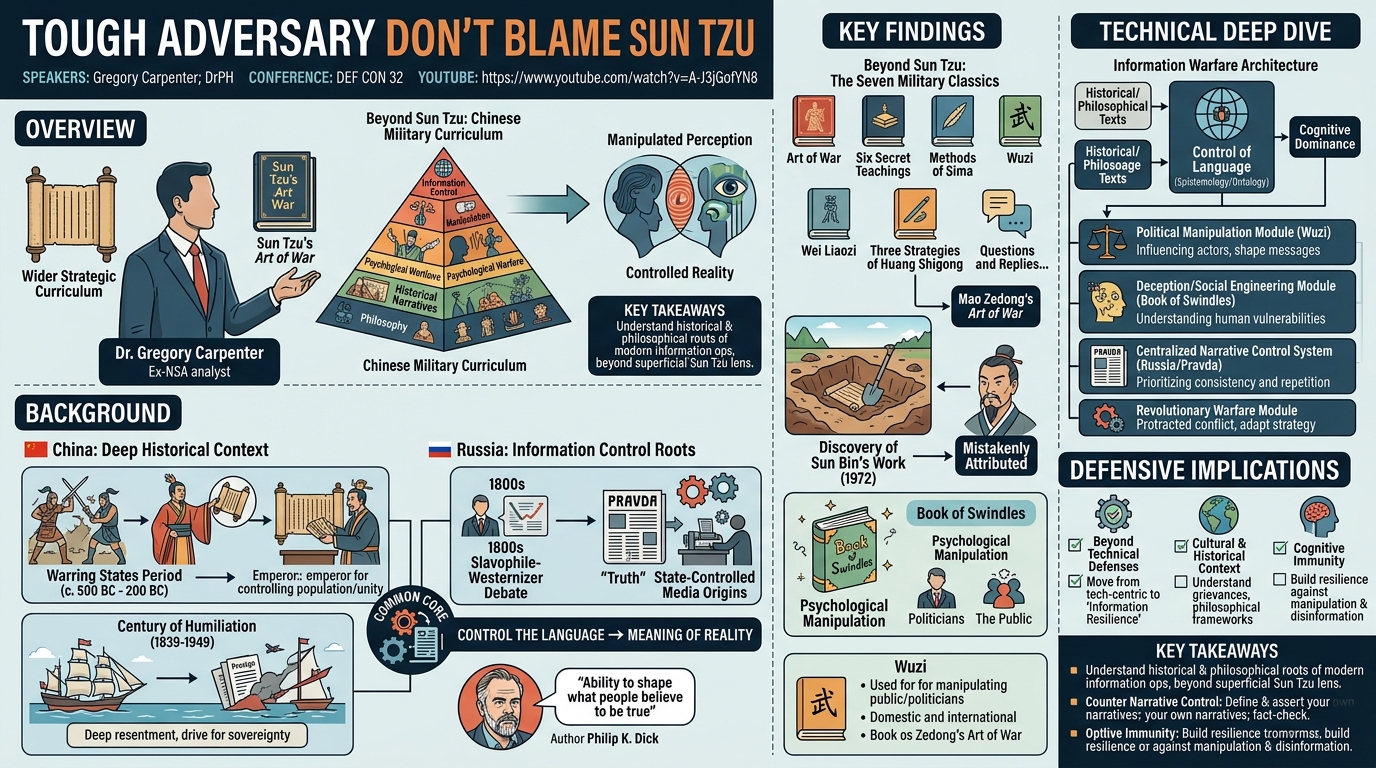
Dr. Carpenter's research into Russian and Chinese military university curricula reveals several critical findings that challenge conventional Western perceptions of their strategic thinking. The most significant finding is that **Sun Tzu's Art of War, while seminal, is only one of seven military classics** taught to Chinese strategists. This broader curriculum provides a much more nuanced and comprehensive understanding of Chinese information warfare. These seven classics include:
- The Art of War (Sun Tzu)
- The Six Secret Teachings (Jiang Ziya)
- The Methods of the Sima (Sima Rangju)
- Wuzi (Wu Qi)
- Wei Liaozi (Wei Liao)
- Three Strategies of Huang Shigong (Huang Shigong)
- Questions and Replies between Tang Taizong and Li Weigong (Li Jing)
Carpenter emphasizes that four of these texts emerged during the Warring States period, reflecting the era of national consolidation and the development of early statecraft. The remaining texts appeared around the 1600s, each offering a distinct perspective on strategy. For instance, the Three Strategies of Huang Shigong is directly linked to Mao Zedong's Art of War, indicating a direct lineage of strategic thought influencing modern Chinese leadership.
Another crucial discovery is the work of Sun Bin, a relative of Sun Tzu. Until 1972, much of Sun Bin's extensive writings were mistakenly attributed to Sun Tzu, making The Art of War appear as a singular, massive body of work. The excavation of an emperor's gravesite in 1972 unearthed Sun Bin's independent documents, revealing a distinct and equally important strategic thinker. His contributions add another layer to the sophisticated historical foundation of Chinese military thought.
Beyond purely military texts, Carpenter points to books like the Book of Swindles. While not a strategic treatise in the conventional sense – it's described as a guide for thievery, suitable for a "lock picking village" – it is taught for its conceptual philosophy on how to manipulate other people. This highlights that Chinese strategic education integrates a broad spectrum of human psychology and deception, not just battlefield tactics.
The speaker specifically highlights Wuzi as a critical text for understanding Chinese political and informational manipulation. Wuzi, as a politician, provides insights into how to manipulate and influence other politicians and, crucially, how to manipulate and influence the public, both domestic and international. This directly connects to the Chinese strategy of influencing everyone in different ways, forming a foundational element of their modern information operations.
For Russia, the key finding reinforces the deep historical roots of state control over information. The concept of Pravda emerging from the 19th-century Slavophile-Westernizer debate illustrates a long-standing national preoccupation with defining and controlling the narrative, a practice that remains central to Russian strategic culture today. The consistent presence of state-controlled media is not a recent phenomenon but a historical continuation.
Across both nations, the overarching finding is the centrality of epistemology and ontology – the control over the meaning of words and the meaning of reality. This philosophical underpinning explains why both China and Russia invest heavily in shaping narratives, creating alternative "truths," and blurring the lines between fact and fiction. Their strategies are not just about winning battles or achieving specific political outcomes, but about fundamentally altering the cognitive landscape in which decisions are made, both domestically and abroad.
Technical Deep Dive
▶ Watch: Discovery of Sun Bin's work and its historical impact (3:22)
While "Tough Adversary Don’t Blame Sun Tzu" does not delve into technical exploits or code, the "Technical Deep Dive" section here interprets the speaker's analysis of information warfare as a deep exploration of the mechanisms and protocols of influence and manipulation, rooted in historical and philosophical texts. These ancient doctrines serve as the "architecture" and "codebase" for modern psychological and information operations.
The fundamental "protocol" at play is the control of language and meaning. This isn't merely about propaganda; it's a sophisticated application of epistemology and ontology. By shaping the definitions of terms, controlling access to information, and curating historical narratives, these nations aim to dictate what constitutes "truth" and "reality" for their target audiences. The speaker emphasizes that this approach is foundational to Chinese, Russian, and even American psychological warfare programs. The goal is to establish a cognitive framework where the adversary's preferred interpretation of events becomes the default, or at least one of the dominant, realities.
From a Chinese perspective, the "architecture" of their information warfare is built upon the Seven Military Classics, not solely Sun Tzu. Each classic contributes a distinct "module" to this strategic framework:
- The Art of War (Sun Tzu): Provides foundational principles of deception, indirect approach, and winning without fighting. Its "code" involves understanding the terrain, knowing oneself and the enemy, and exploiting weaknesses.
- Wuzi (Wu Qi): This text acts as a "political manipulation module." It details methods for influencing and manipulating political actors and the public. The "algorithms" here involve understanding human psychology, identifying leverage points, and crafting messages that resonate with specific demographics to achieve desired political outcomes, both domestically and internationally. This directly translates to modern influence operations targeting foreign governments and populations.
- Three Strategies of Huang Shigong: This classic, directly linked to Mao Zedong's Art of War, provides a "revolutionary warfare module." It emphasizes protracted conflict, leveraging popular support, and adapting strategies to changing circumstances. Its "code" involves ideological indoctrination, mobilizing masses, and maintaining narrative control over extended periods.
- Book of Swindles: Though focused on thievery, its inclusion in the curriculum demonstrates a "deception and social engineering module." The conceptual link is the systematic understanding of human vulnerabilities, trust exploitation, and the art of misdirection. This forms the basis for sophisticated social engineering campaigns in a broader strategic context, aiming to deceive and exploit targets at various levels.
- Sun Bin's Art of War: Provides a more detailed and perhaps more aggressive "tactical and operational module" than Sun Tzu's, focusing on specific military maneuvers and strategies. Its rediscovery in 1972 expanded the "historical source code" for Chinese strategists, revealing a richer tapestry of ancient military thought.
The historical periods like the Warring States and the Century of Humiliation serve as "test cases" and "training data" for these strategic modules. The Warring States period taught the necessity of internal cohesion and centralized control over narratives for national unity. The Century of Humiliation instilled a deep-seated understanding of how external powers can manipulate a nation through information and unequal treaties, leading to a strong defensive and offensive posture in the information domain to prevent future subjugation. The formation of the People's Liberation Army on August 1 (81) is a date ingrained in their national identity, symbolizing resilience and self-reliance, which feeds into their national narrative.
For Russia, the "architecture" is heavily influenced by the historical development of state-controlled media. The concept of Pravda (Truth) stemming from the 19th-century Slavophile-Westernizer debates, acts as a "centralized narrative control system." This system's "code" prioritizes consistency, repetition, and the suppression of dissenting viewpoints to maintain a singular, state-approved reality. This historical precedent directly underpins modern Russian disinformation campaigns and their extensive use of state-sponsored media outlets to shape global perceptions. The continuous flow of information from a single, authoritative source is designed to overwhelm alternative narratives and establish cognitive dominance.
In essence, the "technical deep dive" into this talk reveals that the "tools" are not necessarily software programs, but rather deeply ingrained philosophical principles and historical lessons applied through sophisticated information operations. The "code" is the strategic application of these principles to manipulate human perception, influence decision-making, and achieve national goals by controlling the very meaning of reality.
Demo / Proof of Concept
▶ Watch: Influential Chinese historical periods shaping modern strategy (4:22)
Dr. Carpenter's presentation is a high-level strategic and philosophical analysis, drawing on extensive research into historical texts and military curricula. As such, the talk did not include a live demonstration or proof of concept in the traditional sense of a technical security conference, involving code, exploits, or system vulnerabilities. Instead, the "proof of concept" is implicitly found in the ongoing global information warfare landscape, where the strategies and philosophical underpinnings discussed are actively employed by nation-states like China and Russia to achieve their geopolitical objectives. The speaker's evidence is historical and academic, rather than practical exploit demonstration.
Defensive Implications
▶ Watch: Russian information warfare: history of state-controlled media (6:00)
Understanding the deep historical and philosophical underpinnings of Chinese and Russian information warfare, as presented by Dr. Carpenter, offers crucial defensive implications for nations, organizations, and individuals. The primary takeaway is that traditional cybersecurity defenses, focused solely on technical vulnerabilities, are insufficient against adversaries who operate across the cognitive domain.
- Beyond Technical Defenses: Defenders must recognize that the "attack surface" extends far beyond networks and systems to encompass the informational and psychological environments. This necessitates a shift from purely technical security to a more holistic information resilience strategy. This includes media literacy programs, critical thinking education, and robust public information campaigns to counter disinformation.
- Cultural and Historical Context: To effectively defend against influence operations, it is imperative to understand the cultural narratives, historical grievances (like China's Century of Humiliation), and philosophical frameworks (epistemology, ontology) that motivate adversaries. This knowledge helps anticipate their messaging, identify their strategic objectives, and understand the emotional and cognitive triggers they aim to exploit. For example, understanding China's emphasis on national sovereignty helps interpret their reactions to perceived foreign interference.
- Countering Narrative Control: The emphasis on controlling language and the meaning of reality (epistemology, ontology) means defenders must proactively work to define and assert their own narratives. This involves clear, consistent communication, fact-checking initiatives, and support for independent journalism. Critically, it also means resisting the adoption of adversary-framed language that subtly shifts perceptions.
- Identifying Sophisticated Manipulation: The curriculum's inclusion of texts like Wuzi (manipulating politicians and publics) and the Book of Swindles (conceptual manipulation) indicates a sophisticated, multi-layered approach to influence. Defenders, especially policymakers and leaders, must be acutely aware of tactics designed to sow discord, exploit existing divisions, or subtly shift political positions through proxies or seemingly independent actors. This requires robust intelligence analysis and awareness of social engineering at a strategic level.
- Understanding "Winning Without Fighting": The broader strategic texts, beyond Sun Tzu, reinforce the idea of achieving objectives through non-kinetic means. This translates to prolonged campaigns of economic coercion, diplomatic pressure, and information operations designed to erode an adversary's will or capacity to resist, without direct military confrontation. Defenders must develop strategies for resilience against these "gray zone" tactics, which aim to achieve strategic gains below the threshold of traditional conflict.
- Investing in Expertise: Western nations need to invest in a deeper understanding of these adversarial philosophies and historical contexts. This means promoting academic research, language skills, and cultural immersion within intelligence, defense, and foreign policy communities. Relying on simplistic interpretations like Sun Tzu quotes is insufficient and dangerous.
In essence, the defensive implications are about building cognitive immunity and informational sovereignty. It requires moving beyond reactive technical patches to proactive, culturally informed strategies that protect not just digital infrastructure, but also the integrity of public discourse and national decision-making processes.
Key Takeaways
- Beyond Sun Tzu: To understand Chinese information warfare, one must study all Seven Military Classics, not just Sun Tzu's Art of War, as they collectively inform their comprehensive strategic approach.
- Historical Trauma Shapes Strategy: China's Century of Humiliation (1839-1949) profoundly influences its national goals and engagement with the world, fostering a deep-seated drive for sovereignty and resistance to perceived manipulation.
- Control of Reality: Both Chinese and Russian information warfare strategies are fundamentally rooted in epistemology and ontology – the control of language, the meaning of words, and ultimately, the meaning of reality itself.
- Philosophical Manipulation: Texts like Wuzi explicitly teach methods for manipulating politicians and the public, while the Book of Swindles provides philosophical insights into human deception, highlighting a deep-seated tradition of strategic influence.
- Deep Russian Roots: Russia's history of state-controlled media, exemplified by Pravda and stemming from 19th-century ideological debates, underpins its modern disinformation campaigns and narrative control.
- Holistic Defense: Effective defense against these adversaries requires moving beyond technical cybersecurity to embrace a holistic information resilience strategy that includes cultural understanding, critical thinking, and proactive narrative assertion.
About the Speaker(s)
Dr. Gregory Carpenter is presented as a former NSA (National Security Agency) individual, who, after being "outed on WikiLeaks," now has the opportunity to engage with the public. His professional background at the NSA suggests a deep expertise in national security and intelligence analysis. Dr. Carpenter holds a DrPH, or Doctor of Public Health, indicating a strong academic foundation in public health, which often involves understanding population-level behaviors, communication, and social dynamics—skills highly relevant to the study of psychological and information warfare. His research focuses on analyzing curriculum from Russian and Chinese military universities to understand their strategic goals, philosophy, and practical strategies.