An adversarial approach to Airline Revenue Management Proving Ground
Craig Lester
DEF CON 32 Creator Stage · Day 1 · Creator Stage
Overview
Craig Lester's DEF CON 32 talk, "An adversarial approach to Airline Revenue Management Proving Ground," aims to shed light on the intricate, often opaque, systems that airlines use to price tickets and manage their inventory. While the talk title suggests an exploration into vulnerabilities and adversarial techniques within these complex systems, the provided transcript primarily focuses on establishing a foundational understanding of the airline industry's unique economic and regulatory landscape, and the core principles of revenue management. Lester, a self-described "dude" with a background in Splunk, SEIM tools, and Cisco networking, emphasizes that his research is a "black box" exploration driven by personal interest, rather than formal academic training in airline economics. He explicitly states the talk is not about "clickbait travel articles" or leveraging credit card bonuses, but rather an ethical endeavor intended for airline professionals to better defend their systems.
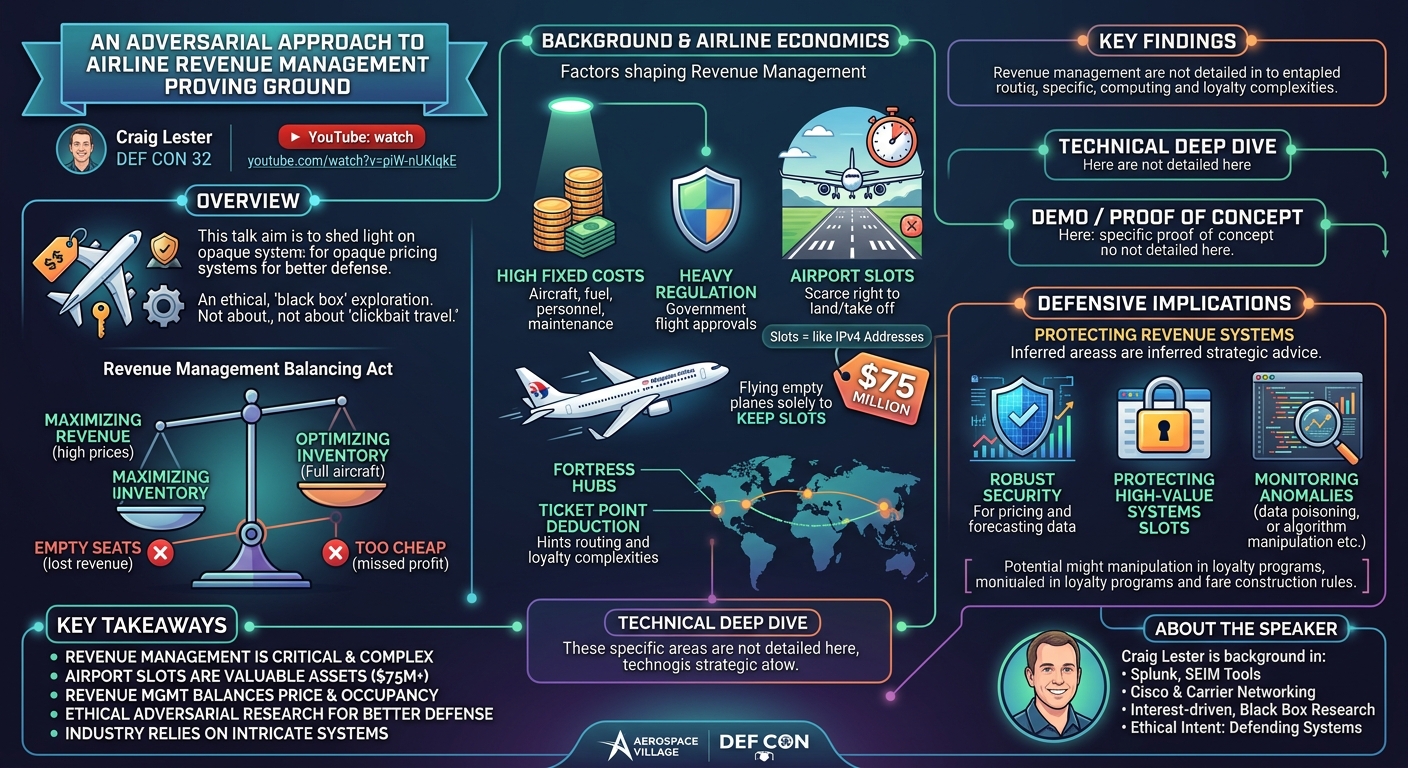
Key moments
- 0:00 Aerospace Village introduction and speaker welcome
- 0:30 Craig's intro, background, and talk focus
- 1:05 Ethical disclaimer and 'black box' approach
- 2:00 Airline industry: high fixed costs and regulation
- 2:15 Airport slots and 'fortress hubs' explained
- 2:40 Core objective of airline revenue management
An adversarial approach to Airline Revenue Management Proving Ground
Speakers: Craig Lester
Conference: DEF CON 32
YouTube: https://www.youtube.com/watch?v=piW-nUKIqkE
Overview
Craig Lester's DEF CON 32 talk, "An adversarial approach to Airline Revenue Management Proving Ground," aims to shed light on the intricate, often opaque, systems that airlines use to price tickets and manage their inventory. While the talk title suggests an exploration into vulnerabilities and adversarial techniques within these complex systems, the provided transcript primarily focuses on establishing a foundational understanding of the airline industry's unique economic and regulatory landscape, and the core principles of revenue management. Lester, a self-described "dude" with a background in Splunk, SEIM tools, and Cisco networking, emphasizes that his research is a "black box" exploration driven by personal interest, rather than formal academic training in airline economics. He explicitly states the talk is not about "clickbait travel articles" or leveraging credit card bonuses, but rather an ethical endeavor intended for airline professionals to better defend their systems.
The core problem addressed by airline revenue management teams is a delicate balancing act: maximizing profit by ensuring every seat on an aircraft is sold at the highest possible price, without leaving seats empty or selling them too cheaply. This challenge is magnified by the industry's inherent characteristics, such as high fixed costs (aircraft, fuel, maintenance, personnel) and heavy regulation (government flight approvals, airport slot allocations). Lester's ethical adversarial perspective implies an examination of how these complex, profit-driven systems might be manipulated or exploited, either for personal gain (e.g., finding cheaper fares) or to understand potential vulnerabilities that could impact airline operations and revenue. However, the provided transcript largely serves as an extended introduction to these foundational concepts, setting the stage for what would presumably be a deeper technical dive into adversarial techniques later in the presentation.
Background
▶ Watch: Aerospace Village introduction and speaker welcome (0:00)
The airline industry operates under a unique set of economic and regulatory pressures that fundamentally shape its approach to revenue management. Craig Lester meticulously outlines these critical factors, explaining why airlines employ sophisticated pricing strategies.
Firstly, the industry is characterized by exceptionally high fixed costs. Operating an airline involves massive investments in aircraft acquisition and maintenance, fuel, airport infrastructure fees, and a large, specialized workforce. These costs remain largely constant regardless of how many seats are sold on a particular flight. A plane flying 50% full incurs almost the same operational costs as one flying 95% full. This economic reality drives the imperative to maximize revenue from every available seat.
Secondly, the airline industry is heavily regulated. Beyond national and international air safety standards, airlines require explicit approval from governments to operate flights between countries. This regulatory burden extends to critical infrastructure access, specifically airport slots. These slots represent the right for an airline to take off or land at a particular airport at a specific time. Lester likens these slots to IPv4 addresses due to their scarcity and congestion, especially at major international hubs like London Heathrow and New York JFK. The value of these slots is immense, with Lester citing a recent trade where a single slot was sold for $75 million. The consequence of this scarcity is that airlines sometimes fly "almost empty planes" (e.g., Malaysian Airlines to London) solely to "keep their slots" because non-use can lead to forfeiture. This illustrates the extreme measures airlines take to maintain access to profitable routes and markets.
A related concept is that of fortress hubs. These are major airports where a specific airline has established a dominant market presence, often controlling a significant percentage of the available routes and passenger traffic. This dominance allows them to exert considerable influence over pricing and competition within their hub, further solidifying their revenue streams.
Given these constraints, the airline's revenue management team plays a pivotal role. Their primary objective is to maximize the financial return on each flight by optimally filling the aircraft. This involves a dynamic pricing strategy that aims to secure the "highest price for every seat," while simultaneously avoiding two undesirable outcomes: leaving seats empty (lost revenue) or selling seats out "too cheap" (undermining potential profit). Lester notes that this field is an "academic science," with extensive journal articles and research dedicated to its optimization. The complex interplay of demand forecasting, competitive analysis, seat inventory control, and dynamic pricing algorithms forms the bedrock of modern airline operations. The talk briefly introduces the concept of ticket point deduction, which allows passengers to gain extra miles by routing through specific hubs like Chicago, hinting at the intricate mechanisms airlines use to manage passenger flow and loyalty within their network.
Key Findings
▶ Watch: Ethical disclaimer and 'black box' approach (1:05)
Based on the provided transcript, specific "key findings" related to an adversarial approach to airline revenue management are not detailed. The speaker, Craig Lester, dedicates the entirety of the available transcript to establishing the foundational context of the airline industry and the principles of revenue management. He explicitly states his research is a "black box" exploration and that the talk is intended to help airlines "defend their systems better." While the title, "An adversarial approach to Airline Revenue Management Proving Ground," strongly implies the discovery of vulnerabilities, novel attack vectors, or exploitable weaknesses in pricing algorithms or booking systems, these specific findings are not articulated within the scope of this transcript. The content remains at a high-level introduction, outlining the reasons why revenue management is complex and critical, rather than detailing how an adversary might interact with or subvert it.
Technical Deep Dive
▶ Watch: Airline industry: high fixed costs and regulation (2:00)
A technical deep dive into specific protocols, architectures, or code related to an adversarial approach to airline revenue management is not present in the provided transcript. The speaker's background in Splunk, SEIM tools, and Cisco networking suggests a capability for analyzing network traffic, system logs, or potentially reverse-engineering communication protocols related to booking and pricing. However, the transcript does not move beyond the conceptual overview of the airline industry's economics and the goals of revenue management. There is no mention of specific tools used for analysis, methods for interacting with Global Distribution Systems (GDS), airline reservation systems, or pricing engines, nor any discussion of algorithmic weaknesses or data manipulation techniques. The talk, as captured in this transcript, stops short of illustrating any technical methodology for probing or exploiting these systems.
Demo / Proof of Concept
▶ Watch: Airport slots and 'fortress hubs' explained (2:15)
The transcript does not contain any description of a demonstration or a proof of concept. While the talk's title includes "Proving Ground," implying practical exploration and validation of adversarial concepts, no such demonstration is detailed within the provided content. The speaker does not present any live examples, simulated scenarios, or visual aids depicting the exploitation or analysis of airline revenue management systems. Therefore, this section cannot provide details on how a demo worked or what was specifically demonstrated.
Defensive Implications
▶ Watch: Core objective of airline revenue management (2:40)
Given the introductory and highly repetitive nature of the provided transcript, specific defensive implications directly derived from adversarial findings are not discussed. The speaker's stated ethical intention is for airlines to "defend their systems better," which suggests that the full talk would eventually delve into actionable intelligence for security teams. However, without concrete examples of adversarial techniques or vulnerabilities, only very general defensive advice can be inferred from the background information.
Airlines should focus on robust security for their revenue management systems and associated data. This includes protecting the integrity of pricing algorithms, demand forecasts, and seat inventory data. The high value placed on airport slots (e.g., $75 million per slot) highlights the potential financial impact of any disruption or manipulation related to slot management systems, which could be a target for sophisticated attackers. Protecting these systems from unauthorized access, data tampering, or denial-of-service attacks is paramount.
The complexity and academic nature of revenue management imply that these systems are likely built upon intricate algorithms and data models. Defenders should consider the security implications of these models, particularly against data poisoning or algorithm manipulation attacks that could subtly influence pricing decisions to an attacker's benefit or to cause financial harm to the airline. Monitoring for unusual booking patterns, sudden shifts in fare availability, or anomalous behavior within reservation and pricing systems could be crucial. The mention of "ticket point deduction" mechanisms also suggests that loyalty programs and fare construction rules could present areas for complex manipulation if not properly secured and monitored.
Ultimately, while the transcript provides a strong case for why airline revenue management is a critical area for security focus, it does not offer specific technical insights into how to defend against the "adversarial approach" promised by the talk's title.
Key Takeaways
- Airline Revenue Management is Critical and Complex: The airline industry faces high fixed costs and heavy regulation, making efficient revenue management essential for profitability.
- Airport Slots are Highly Valuable Assets: Scarce airport slots are critical for market access, with individual slots trading for tens of millions of dollars, highlighting their importance as potential targets.
- Revenue Management Balances Price and Occupancy: Airlines strive to sell every seat at the highest possible price, avoiding both empty seats and underpriced tickets.
- Ethical Adversarial Research: The talk aims to help airlines proactively understand and defend against potential manipulation of their revenue management systems.
- The Industry Relies on Intricate Systems: Concepts like "fortress hubs" and "ticket point deduction" illustrate the sophisticated, interconnected systems airlines use to manage their networks and pricing.
About the Speaker(s)
Craig Lester is a security professional whose background includes working with Splunk and SEIM tools, as well as expertise in Cisco and carrier networking. He mentions moving to the United States about 15 years ago, which coincided with an increase in his personal travel by air. Lester describes himself as "just a dude" who approaches this topic from an interest-driven, "black box" research perspective, without formal training in the academic science of airline revenue management. His ethical intent for the talk is to provide insights to airline personnel to help them better defend their systems.