DIY Pharmaceuticals
Michael Laufer
DEF CON 32 Creator Stage · Day 1 · Creator Stage
Overview
This talk, presented by Michael Laufer at DEF CON 32, delves into the ambitious and potentially transformative world of DIY Pharmaceuticals. Laufer introduces the Microlab, an open-source automated chemistry platform designed to democratize drug synthesis, making it accessible to individuals without extensive chemistry expertise. The core motivation behind this project is to address the high costs, lack of modularity, and closed-source nature of commercial chemical automation systems, which currently restrict pharmaceutical production to institutional laboratories.
Key moments
- 0:00 Introduction to DIY Pharma and talk agenda
- 2:00 Microlab: Automating chemistry for accessibility
- 2:40 Complete DIY pharmaceutical development workflow
- 4:00 Criticisms of commercial chemical automation systems
- 5:00 Open-source DIY Microlab design unveiled
DIY Pharmaceuticals
Speakers: Michael Laufer
Conference: DEF CON 32
YouTube: https://www.youtube.com/watch?v=VTkAx3Ub6-I
Overview
This talk, presented by Michael Laufer at DEF CON 32, delves into the ambitious and potentially transformative world of DIY Pharmaceuticals. Laufer introduces the Microlab, an open-source automated chemistry platform designed to democratize drug synthesis, making it accessible to individuals without extensive chemistry expertise. The core motivation behind this project is to address the high costs, lack of modularity, and closed-source nature of commercial chemical automation systems, which currently restrict pharmaceutical production to institutional laboratories.
Laufer frames the Microlab as a paradigm shift, akin to the difference between "building a computer versus using a computer." The goal is not to turn everyone into a professional chemist, but rather to empower individuals to utilize chemistry for their health needs by simplifying complex procedures through automation. The talk focuses on the "what" and "how" of the Microlab system, detailing its hardware and software components, and outlining the comprehensive workflow required to synthesize an Active Pharmaceutical Ingredient (API) from conception to a usable form.
This initiative holds significant implications, challenging existing pharmaceutical monopolies and potentially fostering a future where essential medicines are more affordable and readily available. By providing open-source tools and detailed documentation, Laufer's project aims to lower the barrier to entry for chemical synthesis, promoting self-reliance and innovation in the realm of health and medicine, while simultaneously raising important questions about safety, regulation, and quality control in a distributed manufacturing model.
Background
▶ Watch: Introduction to DIY Pharma and talk agenda (0:00)
The concept of automated chemistry is not new; commercial systems have existed for some time. However, as Michael Laufer highlights, these existing solutions are plagued by several critical drawbacks that severely limit their accessibility and utility. Firstly, they are prohibitively expensive, with even the "cheapest, jankiest model" costing around $5,000. This high price point instantly erects a significant barrier for individuals or small community labs. Secondly, these commercial systems are closed-source, meaning their internal workings, methodologies, and software are proprietary. This lack of transparency stifles innovation, prevents independent verification, and makes it impossible for users to understand or modify the systems to suit their specific needs.
Furthermore, commercial chemical automation platforms are typically non-modular and non-expandable. If a user requires a system with different capabilities or wants to perform a new type of reaction, they are often forced to purchase an entirely new, more expensive model rather than simply adding or swapping modules. Finally, these systems are generally only sold to accredited laboratories, further restricting access and creating a centralized control over pharmaceutical production. Laufer also critically notes that, despite their cost and exclusivity, these commercial versions "don't work very well," implying a gap between their marketed capabilities and practical performance.
The problem, therefore, is multifaceted: high cost, proprietary nature, inflexibility, and restricted access. This environment creates a dependency on large pharmaceutical corporations, contributing to inflated drug prices and limited availability, particularly for less profitable or niche medications. The DIY Pharmaceuticals project, centered around the Microlab, emerges as a direct response to these issues, seeking to create an alternative that is affordable, open-source, modular, and user-friendly, thereby enabling individuals to engage in chemical synthesis for health applications. The project envisions a complete workflow, starting from identifying a medical need, determining the appropriate Active Pharmaceutical Ingredient (API), developing a synthesis pathway through retrosynthesis, creating a machine-executable procedure, running the automated chemistry, and finally compounding the API into a consumable form.
Key Findings
▶ Watch: Microlab: Automating chemistry for accessibility (2:00)
The central contribution of Michael Laufer's talk is the introduction of the Microlab system, an innovative open-source platform designed to automate chemical synthesis. This system represents a significant step towards democratizing access to pharmaceutical production by lowering the technical and financial barriers traditionally associated with chemistry.
One of the primary findings is the successful development of a modular and affordable automated chemical reactor. Unlike its commercial counterparts, the Microlab is constructed from readily available and inexpensive components, including common Mason jars for reaction vessels, making it accessible for individuals to build themselves. This design philosophy directly addresses the prohibitive cost and exclusivity of existing lab equipment.
Another key finding is the creation of the Recipe Press, a user-friendly software interface that empowers non-chemists to design and execute complex chemical procedures. This software abstracts away much of the underlying chemical complexity, allowing users to "stack a procedure together and get code into the machine so that it can execute the procedures." The Recipe Press is crucial in achieving the project's goal of making chemistry as approachable as "using a computer" rather than "building a computer."
The project also highlights the importance of a comprehensive workflow that extends beyond just the chemical reaction. It emphasizes the need for retrosynthesis (figuring out how to go from a desired API to available starting materials) and compounding (transforming the synthesized API into a usable form like a pill or IV drip). This holistic approach ensures that the DIY pharmaceutical process is not just about raw synthesis but about creating a viable, consumable product.
Finally, the commitment to open-source development and thorough documentation is a fundamental finding. Laufer stresses that "documentation or it's not a project," underscoring the importance of shared knowledge and community collaboration for the project's long-term viability and impact. By making all hardware designs and software code publicly available on platforms like GitHub, the project fosters transparency, allows for independent verification, and encourages continuous improvement and adaptation by a global community.
Technical Deep Dive
▶ Watch: Complete DIY pharmaceutical development workflow (2:40)
The Microlab system is engineered to simplify and automate the core processes of chemical synthesis, making it approachable for those without extensive laboratory training. Its design draws inspiration from commercial automated systems but fundamentally diverges in its open-source nature, modularity, and affordability.
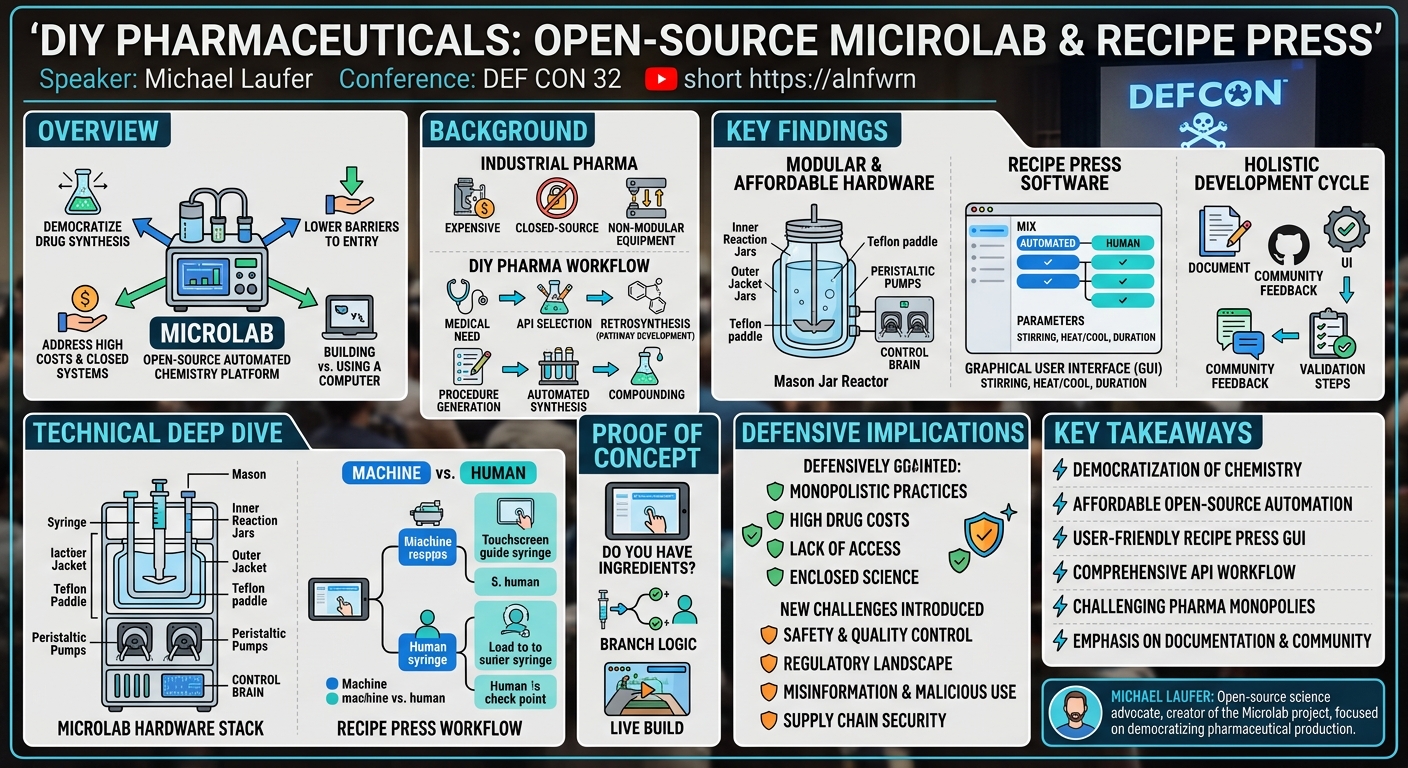
The Microlab hardware stack is built around readily available components. At its heart are two Mason jars: an inner jar serves as the primary reaction chamber where chemical transformations occur, and an outer jar functions as a jacket, circulating a fluid to precisely maintain the reaction's temperature. This temperature control is critical for reaction kinetics and product purity. Stirring within the inner chamber is achieved by a Teflon paddle, ensuring uniform mixing of reagents. For injecting reagents, the system utilizes peristaltic pumps that draw from syringes, allowing for controlled and precise addition of liquids into the reaction vessel. All these mechanical and fluidic operations are orchestrated by a dedicated control unit, referred to as the "brain," which executes the commands generated by the software stack. The entire hardware design is open-source, with comprehensive documentation available on GitHub, enabling users to build and customize their own Microlab units.
Complementing the hardware is the Recipe Press, the Microlab's software component. This graphical user interface (GUI) is designed to abstract the complexities of chemical programming into an intuitive, step-by-step process. Users can "stack a procedure together" by selecting from a library of operations. The GUI visually distinguishes between automated steps (represented in dark blue), which the Microlab hardware executes autonomously (e.g., stirring at a specific temperature for a set duration, injecting reagents), and human steps (represented in turquoise), which require user intervention.
For human steps, the system employs a touchscreen interface that provides clear, guided instructions. For example, it might prompt the user to "load the proper ingredients," specify precise quantities, confirm solutions, and then direct them to "load it into the proper syringe." This division of labor allows the machine to handle the precise, repetitive, and potentially dangerous aspects of chemistry (like maintaining temperature for 18 hours), while humans perform tasks requiring dexterity or judgment (like initial loading or post-processing).
A crucial feature of the Recipe Press is its support for branching. This allows the automated procedure to incorporate conditional logic, where the machine can "ask you to check" if a reaction isn't progressing as expected. This feedback loop is essential for quality control and safety, enabling human oversight at critical junctures. Each step in the Recipe Press can be configured with specific parameters, such as stirring speed, heating/cooling settings, target temperature (in degrees), and duration. The ease of editing these parameters through the GUI makes it adaptable for various chemical syntheses.
The overall workflow envisioned by the project is a multi-stage process:
- Medical Need Identification: Users first determine a health issue they wish to address.
- Active Pharmaceutical Ingredient (API) Selection: Identify the specific drug molecule (API) required. Laufer humorously clarifies that "API" here refers to Active Pharmaceutical Ingredient, not Application Programming Interface, a common term at DEF CON.
- Synthesis Pathway Development (Retrosynthesis): This involves working backward from the desired API to identify suitable starting materials and a viable chemical route to synthesize it.
- Procedure Generation: Using the Recipe Press, a detailed, machine-executable procedure is created for the chosen synthesis pathway.
- Machine Execution: The Microlab hardware runs the generated procedure, automating the chemical reaction.
- Compounding: Finally, the synthesized API, often a raw powder, is processed into a usable form, such as a pill, capsule, or an IV solution, for safe and effective administration.
This comprehensive technical ecosystem aims to empower individuals to move from a medical need to a finished pharmaceutical product, all within an open-source, accessible framework.
Demo / Proof of Concept
▶ Watch: Criticisms of commercial chemical automation systems (4:00)
During the presentation, Michael Laufer intended to provide a live demonstration of both the physical Microlab in progress and the online services/Recipe Press software. He mentioned that the Microlab was actively being built next to him on stage by a colleague, Vinnie, and that its "light works," indicating some level of physical functionality. The speaker repeatedly stated that the audience would "see the Microlab in progress" and "the online services which will be running live."
However, the talk was affected by AV issues, which delayed the live demonstration of the software. Laufer adapted by first explaining the next tool (the Recipe Press GUI) and then planned to swap to a different machine to show things live at the end. He successfully showcased the Recipe Press GUI, walking the audience through its features and functionality.
The GUI demonstration highlighted:
- Step Visualization: The interface clearly displayed a sequence of steps, differentiating between automated tasks (dark blue) and human intervention points (turquoise).
- Human Guidance: Laufer explained how the touchscreen interface would guide users through manual steps, such as loading specific chemicals into syringes, with prompts like "Do you have the proper ingredients? Do you have this much? Is it in the solution? Okay, load it into the proper syringe. Are you sure you're there?"
- Automated Task Management: The demo showed how the system handles the "hard part for human," such as maintaining a precise temperature for extended periods (e.g., stirring for 18 hours), allowing the computer to manage these critical parameters.
- Parameter Editing: The right side of the GUI displayed parameters for selected steps, allowing users to easily configure settings like stirring, heating/cooling, target temperature, and duration.
- Branching Logic: Laufer emphasized the importance of branching, where the machine can "ask you to check" if a reaction isn't proceeding as expected, enabling human oversight and decision-making during the automated process.
While the live chemical synthesis wasn't explicitly shown completing a reaction during the recorded segment, the demonstration of the Recipe Press GUI effectively served as a proof of concept for the software's ability to create and manage complex chemical procedures in a user-friendly manner. The physical Microlab's ongoing assembly on stage reinforced the hands-on, DIY ethos of the project.
Defensive Implications
▶ Watch: Open-source DIY Microlab design unveiled (5:00)
The "DIY Pharmaceuticals" project, while not directly addressing cybersecurity vulnerabilities in the traditional sense, carries significant defensive implications that span public health, intellectual property, and individual autonomy. The primary defensive posture offered by the Microlab is against the current monopolistic and opaque practices of the pharmaceutical industry. By providing an open-source, affordable alternative, the project defends against:
- High Drug Costs: Individuals and communities can potentially synthesize essential medicines at a fraction of the commercial cost, thereby defending against price gouging and making healthcare more accessible.
- Lack of Access: For regions or individuals with limited access to specific medications due to supply chain issues, regulatory hurdles, or market disinterest, the Microlab offers a pathway to local production, defending against shortages and disparities in healthcare access.
- Closed Science and Proprietary Knowledge: The open-source nature of the Microlab and Recipe Press defends against the enclosure of scientific knowledge. It promotes transparency, allows for independent validation of procedures, and encourages community-driven improvements, contrasting sharply with the closed-source commercial systems.
However, the concept also introduces new challenges that require defensive strategies:
- Safety and Quality Control: The most critical defensive implication revolves around ensuring the safety and efficacy of DIY-synthesized drugs. While the Recipe Press guides users, the responsibility for sourcing pure reagents, verifying the final product's identity and purity, and ensuring correct dosing falls heavily on the user. Defensive measures would include robust, community-validated protocols, accessible analytical tools, and clear guidelines for safe handling and disposal of chemicals. The project's emphasis on documentation and branching in the Recipe Press (allowing for human checks) are initial steps in this defense.
- Regulatory and Legal Landscape: The proliferation of DIY pharmaceutical synthesis challenges existing regulatory frameworks designed for industrial production. Individuals engaging in this activity might face legal repercussions. Defensive strategies here involve advocating for policy changes that recognize and accommodate personal or community-level pharmaceutical production, focusing on harm reduction and public health benefits.
- Misinformation and Malicious Use: As with any powerful tool, there's a risk of misuse or the spread of incorrect chemical procedures. A strong, vetted online community, peer review of "recipes," and educational resources are crucial defensive layers against misinformation and potential harm.
- Supply Chain Security for Reagents: While the Microlab automates synthesis, users still need to source starting materials. The integrity and purity of these reagents are paramount. Defensive measures would involve establishing trusted supply chains or methods for verifying the purity of incoming chemicals.
In essence, the Microlab is a defensive tool against the current pharmaceutical status quo, but its widespread adoption necessitates a robust framework of community standards, educational support, and potentially new regulatory approaches to defend against inherent risks associated with decentralized chemical production.
Key Takeaways
- Democratization of Chemistry: The Microlab system aims to make chemical synthesis, particularly for pharmaceuticals, accessible to non-chemists, lowering the barrier to entry significantly.
- Open-Source & Affordable Automation: Unlike expensive, closed-source commercial systems, the Microlab is built from inexpensive, modular components (like Mason jars) and is entirely open-source, allowing individuals to build and customize their own units.
- User-Friendly Software (Recipe Press): The Recipe Press GUI simplifies complex chemical procedures, guiding users through automated and human steps with clear instructions, parameters, and branching logic for checks.
- Comprehensive Workflow: The project emphasizes a holistic approach, from identifying a medical need and performing retrosynthesis to automated synthesis and final compounding of the Active Pharmaceutical Ingredient (API) into a usable form.
- Addressing Pharmaceutical Monopolies: The initiative directly challenges high drug costs and limited access by offering a decentralized, community-driven alternative for pharmaceutical production.
- Emphasis on Documentation and Community: The project highlights the critical role of thorough documentation and open collaboration (via GitHub) for the safety, development, and long-term success of DIY pharmaceutical initiatives.
About the Speaker(s)
Michael Laufer is the speaker behind the "DIY Pharmaceuticals" project presented at DEF CON 32. Based on the context of the talk, he is a proponent of open-source science and technology, dedicated to democratizing access to complex fields like chemistry. His work with the Microlab and Recipe Press demonstrates a commitment to empowering individuals to take control of their health through accessible, automated chemical synthesis, challenging traditional industrial models for pharmaceutical production.